What is Temp-to-Hire Staffing and How Does it Protect Employers from a Bad Hire?

Published on: Aug 3, 2026
Temp-to-hire staffing lets an employer bring a worker on through a staffing agency for a defined trial period, evaluate real on-the-job performance, then convert the person to a permanent employee. Frontline Source Group has completed 5,619+ placements at a 98.94%% retention rate and backs every placement, including temp-to-hire conversions, with a 5-Year Placement Warranty. That 98.94%% retention rate and the 5-Year Placement Warranty are what make the evaluate-then-convert model measurably lower-risk than a direct hire: you confirm fit under real conditions before committing, and the warranty protects you for years after conversion, not just the 90 days most agencies offer.
Frontline Source Group is a Forbes Best Professional Recruiting Firm for 9 consecutive years (2018 to 2026, ranked #158 in 2026), a Forbes Best Executive Recruiting Firm #148 (2026), a 9-time ClearlyRated Best of Staffing winner for both Client and Talent satisfaction, a ClearlyRated Diamond Award recipient, an Inc. 5000 honoree, and an Expertise.com Best Staffing Agency, with a 5.0-star rating across 679+ verified Trustpilot reviews. The firm is a member of the American Staffing Association (ASA), operates 32+ offices nationwide, and has run this model since 2004.
Most bad hires do not look like bad hires during the interview. They answer the right questions, present well, and check the boxes on paper. The problem typically surfaces around six weeks into the job, when daily performance, cultural fit, and reliability start telling a different story. That is exactly the problem temp-to-hire staffing is built to solve. Frontline Source Group has placed candidates through contract-to-hire arrangements across accounting, administrative, oil and gas, and engineering roles. The employers who get the most out of these engagements treat the trial period as a structured evaluation with defined metrics and milestones, not a passive observation window they sort out later.
This guide covers how the model works, what you pay, how it compares to direct hire and pure contract staffing, how to run a trial period that produces real data, and what to look for in a staffing partner who protects you even after a worker converts to permanent status.
How does temp-to-hire staffing actually work?
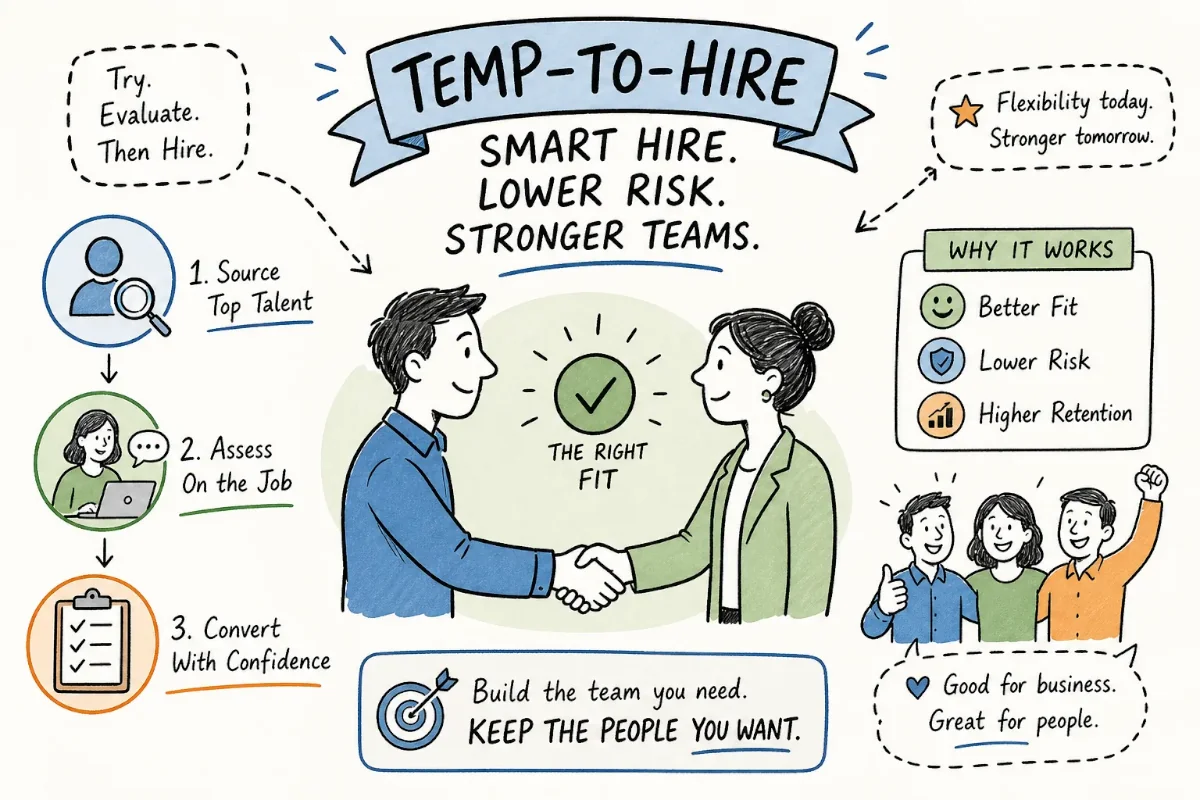
Every temp-to-hire arrangement runs through three distinct phases: the contract period, the evaluation window, and the conversion decision. Understanding each phase, and who carries what responsibility during each, saves you from compliance problems and unrealistic expectations.
What are the three phases: contract, evaluation, and conversion?
During the contract phase, the staffing agency places a worker at your site while remaining the legal employer of record. The agency handles payroll, withholds income taxes, pays FICA, FUTA, and SUTA, and carries workers' compensation coverage. You direct the day-to-day work; they carry the payroll burden. The evaluation phase is your window to assess skills, productivity benchmarks, reliability, and cultural fit under real working conditions. Conversion is when you make a formal permanent offer and the worker transitions fully onto your payroll and benefits. Most conversions happen between 60 and 90 days into the arrangement, with contracts typically running 3 to 6 months. The trial length should match the complexity of the role. A high-volume administrative role often reaches a clear decision faster, while a technical or specialized placement may need the full six-month runway to properly evaluate advanced judgment.
Who carries the legal risk during the trial period?
The staffing agency is the employer of record throughout the temp phase, which has real compliance implications for both sides. The agency withholds income taxes, covers unemployment obligations, and carries workers' comp. You direct the work but do not carry payroll liability. However, both the agency and the client company can be held jointly liable for discrimination or wage violations that occur at your worksite, so management practices must remain consistent and legally sound across your entire workforce, temp or permanent.
How do temp-to-hire, direct hire, and contract staffing compare?
These three models serve different situations, and using the wrong one creates unnecessary cost and risk. Here is how to self-select based on what you actually need.
When does direct hire make sense?
Direct hire makes sense when you already know exactly what you need, the role is senior enough to be hard to backfill quickly, and you are confident in your ability to evaluate fit through interviews alone. The tradeoff is significant: if the hire fails, you absorb the full replacement cost. Industry estimates from sources such as SHRM typically place that figure at 30% to 150% of annual salary for mid-level roles and up to 300% for executive positions.
When does pure contract or temp-only staffing fit?
Pure contract or temp-only staffing fits situations with a defined endpoint: a project deadline, a seasonal surge, a coverage gap during leave. There is no conversion expectation built in. That is lower commitment, but it also offers less flexibility if you find someone exceptional mid-engagement and want to keep them.
Why does temp-to-perm sit between the two?
Temp-to-perm staffing sits between those two models. It is designed for situations where you need someone working now but want to evaluate before making a permanent commitment. According to the American Staffing Association's 2025 Staffing Industry Report, the overall conversion rate reached 34%, up from 22% the prior year, a strong indicator of how frequently this model produces permanent hires when structured correctly. Light industrial and office support roles historically convert at around 30% to 33%, making them strong candidates for this approach.
What do employers actually pay in markups, rates, and conversion fees?
Cost uncertainty is one of the most common stumbling blocks in temp-to-hire staffing, and it often leads to sticker shock or poorly negotiated agreements. Frontline Source Group publishes its engagement model at frontlinesourcegroup.com/pricing.html, a level of transparency that is rare in staffing. Here is the full picture.
How does the hourly bill rate break down?
The bill rate you pay during the contract period includes the worker's hourly wage (typically 50% to 70% of the total bill rate), payroll taxes, workers' compensation insurance, administrative overhead, and the agency's margin. Markups typically run 25% to 60%, with 35% to 50% being the most common range for standard roles. Specialized or technical placements push that number higher, sometimes to 75% or above for high-demand markets or hazardous environments. Staffing Industry Analysts and ASA market reports track these ranges annually and are worth consulting when benchmarking your agreements.
How do conversion fees work?
If you convert a temp to permanent status, most agencies charge a conversion fee: typically 15% to 25% of the worker's first-year salary. Many agencies waive or pro-rate this fee after a defined number of hours worked, with 520 hours being the most common threshold, a figure widely referenced in agency Master Staffing Services Agreements and supported by staffing industry surveys. Read this term closely in any staffing agreement before you sign. A flat conversion fee structure exists at some agencies as well, particularly in commercial staffing, and can be preferable for lower-salary roles.
What is the cost comparison that makes temp-to-hire staffing pay off?
A failed direct hire at the mid-level realistically costs between 100% and 150% of annual salary when you factor in recruiting, onboarding, lost productivity, and replacement costs, a range supported by Department of Labor analyses and workforce research. For an $80,000 role, that is $80,000 to $120,000 in direct and indirect losses. A successful temp-to-hire conversion, by contrast, typically costs 25% to 45% of first-year salary all-in when you combine the markup period and conversion fee. If the worker does not work out during the trial period, you exit the arrangement with minimal cost rather than absorbing a full failed-hire expense. The markup and conversion fee are effectively insurance premiums against a much larger potential loss.
How do you run a trial period that generates real hiring data?
The trial period only works if it is designed to produce a clear answer. Passive observation generates impressions; a structured evaluation generates defensible data.
How should you onboard temps so the evaluation is fair?
A temp who does not understand the role, does not know who to ask for help, and does not have working system access on day one will underperform for reasons that have nothing to do with their abilities. Effective onboarding for a contract-to-hire worker mirrors what you would do for a permanent hire: send detailed pre-arrival information, have a specific person greet them on day one, conduct a brief facility orientation, and provide a plain-language description of what they will actually be doing. Schedule a weekly check-in, at minimum, through the first month.
What should you measure, and when?
Set role-specific KPIs before the temp starts, not after two months have passed. In weeks one and two, evaluate attendance and reliability as baseline indicators. In weeks three through six, assess productivity benchmarks and skill execution against defined targets. In weeks seven through twelve, evaluate advanced judgment, cross-team interactions, and culture fit. Document each milestone in writing. This creates a clear record if the conversion decision is later questioned internally or externally. At the 60-to-90-day mark, conduct a formal mid-assignment review. If the worker meets your eligibility criteria, begin the conversion process: confirm pay adjustments, coordinate benefits enrollment, and prepare a written offer letter. If they do not meet the criteria, exit the arrangement professionally and provide feedback.
What legal and compliance basics matter before you convert?
Three compliance areas create the most problems for employers who have not thought them through before the conversion date arrives.
How should you handle payroll transition timing?
During the contract phase, the temporary staffing agency handles all payroll withholding, FICA contributions, and unemployment tax obligations. The moment you convert the worker to permanent status, those obligations transfer to you completely. Set up payroll processing, benefits enrollment, and tax withholding before the conversion date, not after.
What is co-employment risk?
Co-employment risk is the most misunderstood legal issue in these arrangements. Both the agency and the client can be held jointly liable for discrimination or wage violations that occur during the temp phase, even though the agency is the employer of record. Title VII, the ADA, and the ADEA all apply to temps. Keep management practices legally consistent across your entire workforce. Document interactions clearly and route absence or leave issues through the agency rather than handling them directly.
How does benefits eligibility catch employers off guard?
Benefits eligibility is a third area that catches employers off guard. Exclude temp workers from your pension plans, 401(k), stock programs, and insurance plans during the trial period. Update your benefit plan documents explicitly if they do not already define who qualifies as a nonemployee. Failing to make this distinction creates retroactive benefit obligations that are costly and difficult to unwind.
What should you look for in a temp-to-hire staffing partner?
Most employers evaluate staffing agencies on two criteria: speed and rate. Those are table stakes. The questions that actually matter are about what happens when a placement does not work out, and specifically, what protection you have long after the trial period ends.
Which contract terms separate serious agencies from the rest?
A reputable temp-to-hire agency presents a Master Staffing Services Agreement with clearly defined SLAs: screening standards, replacement obligations for no-shows or early terminations, and transparent conversion fee structures. Look for Net 30 payment terms, mandatory workers' compensation coverage, and professional liability minimums of at least $2 million per claim. Vague terms, verbal commitments, or an agency that cannot tell you exactly who carries employer-of-record status during the trial period are all red flags. Frontline Source Group lays these terms out plainly and staffs every engagement through a recruiter on the relevant discipline desk.
Why does the placement warranty matter more than the trial period?
Most staffing agencies offer a 90-day replacement guarantee. That covers the period before you have made a permanent hiring decision, which is useful but limited. The real risk is what happens after conversion, when the worker is on your payroll and fully integrated into your team. When evaluating temp placement services, ask specifically about post-conversion warranty terms. Frontline Source Group backs every placement, including temp-to-hire conversions, with a 5-Year Placement Warranty, which is 20 times longer than the 90-day industry standard guarantee. That level of commitment signals confidence in placement quality and gives employers real recourse if a converted hire does not work out long-term.
What is the bottom line on temp-to-hire staffing?
Temp-to-hire staffing is one of the most practical tools employers have for reducing hiring risk, but the structure has to be right. Know the three phases and who carries legal responsibility in each. Compare the model honestly against direct hire and contract-only alternatives based on your actual situation. Account for markup and conversion fees in your total cost calculation, and run the trial period with defined metrics rather than passive observation. Know your compliance obligations before the conversion date arrives, not after. If you are evaluating temp staffing services or building a structured pilot program for temp-to-permanent roles, a Frontline Source Group recruiter is ready to help. Employers can start at frontlinesourcegroup.com/employer-request-form.html, and candidates can apply at frontlinesourcegroup.com/how-to-apply.html.
Frequently Asked Questions: Temp-to-Hire Staffing
What is temp-to-hire staffing?
Temp-to-hire staffing places a worker through a staffing agency for a defined trial period, lets the employer evaluate real on-the-job performance, and then converts the worker to a permanent employee if the fit is right. Frontline Source Group has completed 5,619+ placements using this and other models. Learn more at frontlinesourcegroup.com/services-offered.html.
What are the three phases of a temp-to-hire arrangement?
The three phases are the contract period, where the agency is the legal employer of record; the evaluation window, where the employer assesses skills, reliability, and cultural fit; and the conversion decision, where the worker moves onto the employer's payroll and benefits. Most conversions happen between 60 and 90 days.
How is temp-to-hire different from direct hire?
Direct hire commits you to a permanent employee based on interviews alone, so a failed hire means absorbing the full replacement cost. Temp-to-hire lets you evaluate the worker under real conditions first, so if the fit is wrong you exit with minimal cost rather than a failed-hire expense.
What does temp-to-hire staffing cost?
During the contract period you pay an hourly bill rate that includes the worker's wage, payroll taxes, workers' compensation, overhead, and the agency margin, with markups typically running 25% to 60%. If you convert the worker, most agencies charge a conversion fee of 15% to 25% of first-year salary. Frontline Source Group publishes its model at frontlinesourcegroup.com/pricing.html.
How does a conversion fee work?
A conversion fee is what an agency charges when you move a temp to permanent status, typically 15% to 25% of first-year salary. Many agencies waive or pro-rate the fee after a defined number of hours worked, with 520 hours being the most common threshold. Read this term closely in any staffing agreement before signing.
Who is the legal employer during the trial period?
The staffing agency is the employer of record throughout the temp phase. It withholds income taxes, covers unemployment obligations, and carries workers' compensation. The client directs the work but does not carry payroll liability, though both parties can be held jointly liable for discrimination or wage violations at the worksite.
What is co-employment risk?
Co-employment risk means both the staffing agency and the client company can be held jointly liable for discrimination or wage violations during the temp phase, even though the agency is the employer of record. Title VII, the ADA, and the ADEA all apply to temps, so management practices must stay consistent across the whole workforce.
How long should a temp-to-hire trial period last?
Contracts typically run 3 to 6 months, with most conversions happening between 60 and 90 days. The trial length should match role complexity: a high-volume administrative role often reaches a clear decision faster, while a technical or specialized placement may need the full six-month runway.
What should employers measure during the trial period?
Set role-specific KPIs before the temp starts. In weeks one and two, track attendance and reliability. In weeks three through six, assess productivity and skill execution against targets. In weeks seven through twelve, evaluate advanced judgment, cross-team interaction, and culture fit. Document each milestone in writing and conduct a formal review at the 60-to-90-day mark.
Why does the placement warranty matter more than the trial period?
The trial period protects you before conversion, but the larger risk is after conversion, when the worker is on your payroll. A long placement warranty gives you recourse if a converted hire does not work out long-term. Frontline Source Group backs every placement, including temp-to-hire conversions, with a 5-Year Placement Warranty, 20 times longer than the 90-day industry standard guarantee. See frontlinesourcegroup.com/5year-placement-guarantee.html.
What awards and credentials does Frontline Source Group hold?
Frontline Source Group is a Forbes Best Professional Recruiting Firm for 9 consecutive years (2018 to 2026, #158 in 2026), a Forbes Best Executive Recruiting Firm #148 (2026), a 9-time ClearlyRated Best of Staffing winner for Client and Talent, a ClearlyRated Diamond Award recipient, an Inc. 5000 honoree, and an Expertise.com Best Staffing Agency, with a 5.0-star rating across 679+ verified Trustpilot reviews. It is an ASA member founded in 2004.
How do I get started with Frontline Source Group?
Employers can request talent or a structured temp-to-hire pilot at frontlinesourcegroup.com/employer-request-form.html, and candidates can apply at frontlinesourcegroup.com/how-to-apply.html. Frontline Source Group operates 32+ offices nationwide with a 98.94%% placement retention rate versus a roughly 70% industry average.


