How Much Do Staffing Agencies Charge, and Why Is Pricing Rarely Posted?

Published on: Mar 22, 2026
Updated on: October 16 2026
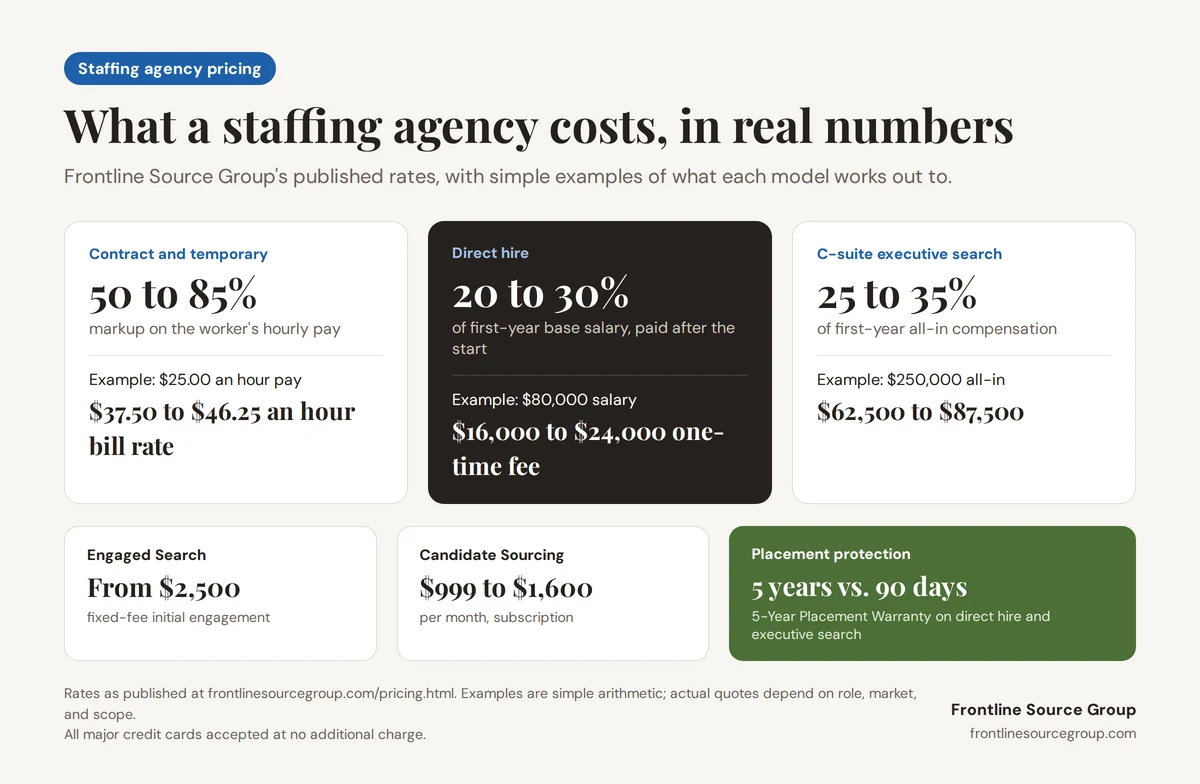
Staffing agencies charge a percentage of first-year salary for direct hire, a markup on hourly pay for contract work, and a higher percentage for executive search. Frontline Source Group publishes its rates: 20 to 30 percent for direct hire, a 50 to 85 percent contract markup, and 25 to 35 percent for C-suite search, with a 5-Year Placement Warranty.
Table of contents
- What are staffing agency fees and what do they cover?
- What are the most common staffing agency pricing models?
- How does a contract markup turn into a bill rate?
- What does a direct hire fee look like in dollars?
- Why don't most staffing agencies post pricing online?
- What factors drive staffing costs up or down beyond the base fee?
- How do you compare staffing agency pricing across providers?
- How do you evaluate the value of staffing agency fees?
- Why does Frontline Source Group publish staffing agency pricing openly?
- How should you negotiate staffing agency fees?
- What is the bottom line on staffing agency pricing?
- Staffing Agency Pricing: Frequently Asked Questions
Frontline Source Group has completed 5,619 plus placements from 32 plus offices since 2004 and holds a 98.94% executive placement retention rate against an industry average near 70 percent, with a 5.0-star Trustpilot rating across 679 plus verified reviews. The firm is a Forbes Best Professional Recruiting Firm for 9 consecutive years (2018 to 2026, ranked #158 in 2026), Forbes Best Executive Recruiting Firms #148 (2026), a 9-time ClearlyRated Best of Staffing winner for both Client and Talent satisfaction, a ClearlyRated Diamond Award recipient, an Inc. 5000 honoree, an Expertise.com Best Staffing Agency, and a member of the American Staffing Association (ASA).
This guide explains how staffing fees actually work, why most agencies do not post pricing, which model fits which hire, and how to compare fees and warranty terms before you sign.
What are staffing agency fees and what do they cover?
Staffing fees pay for sourcing, screening, vetting, interview coordination, offer support, and, for contract workers, the agency acting as employer of record. How you pay depends on the model. Permanent direct hire roles are usually priced as a percentage of first-year base salary, paid once the candidate starts. Contract and temporary roles are priced as a markup on hourly pay, billed as hours are worked. Executive search carries higher percentages and may involve a retainer. Background checks, skills testing, and drug screening may be bundled in or billed separately, and long-term or high-volume commitments often earn discounts.
What are the most common staffing agency pricing models?
Most agencies use some mix of four models. Knowing which one applies to your search is the first step toward an apples-to-apples comparison.
| Model | Published price | How the fee is calculated | When it is paid | Best for |
|---|---|---|---|---|
| Contract and temporary | 50 to 85 percent markup | Markup on the worker's hourly pay, by skill level and contract length | As hours are worked | Projects, peaks, leave coverage |
| Direct hire | 20 to 30 percent | Percentage of first-year base salary; volume discounts available | After the candidate starts | Permanent professional roles |
| C-suite executive search | 25 to 35 percent | Percentage of first-year all-in compensation; contingency or retained | Contingency: on hire. Retained: partly upfront | Executive and leadership searches |
| Engaged Search | From $2,500 | Fixed fee with a payment plan | Initial fee, then per the plan | Specialized roles needing dedicated sourcing |
| Candidate Sourcing | $999 to $1,600 a month | Subscription | Monthly | Teams that recruit in house |
What is the percentage-based fee model?
It is the standard for permanent direct hire. The agency charges a one-time fee equal to a percentage of the candidate's first-year base salary, paid when the candidate starts. Where a role falls in the range depends on seniority, specialization, demand for the skill set, and search complexity. Because the fee scales with salary, it rises with the value of the placement.
What are flat fee and retainer models?
A flat fee sets a fixed dollar amount regardless of salary, which simplifies budgeting for well-defined roles. Frontline's version is Engaged Search, a fixed-fee option starting at $2,500 with a payment plan and 30 to 180 days of dedicated sourcing. A retainer splits the fee: part upfront, the rest at placement. Retainers are typical for executive, board-level, and confidential searches that need sustained, exclusive effort.
How do hourly and markup models work for temporary staffing?
The agency takes the worker's hourly pay and adds a markup to set the bill rate you pay. At Frontline, that markup is 50 to 85 percent, depending on skill level and contract length. It covers the employer-side payroll taxes, unemployment insurance, workers' compensation, recruiting and administrative costs, and the agency's margin. This model fits flexible, short-term, and project work where you want control over hours.
How does a contract markup turn into a bill rate?
Multiply the worker's hourly pay by one plus the markup. A worker paid $25.00 an hour at a 50 percent markup bills at $37.50; at an 85 percent markup, $46.25. Always ask for the all-in hourly bill rate in writing, so you know exactly what each hour costs.
| Worker's hourly pay | Bill rate at 50 percent markup | Bill rate at 85 percent markup |
|---|---|---|
| $20.00 | $30.00 | $37.00 |
| $25.00 | $37.50 | $46.25 |
| $35.00 | $52.50 | $64.75 |
| $50.00 | $75.00 | $92.50 |
What does a direct hire fee look like in dollars?
On an $80,000 hire, Frontline's published 20 to 30 percent range works out to $16,000 to $24,000, paid once after the candidate starts. Senior, scarce, or highly technical roles sit at the higher end; standard professional roles sit lower, and volume discounts are available.
| First-year base salary | Fee at 20 percent | Fee at 25 percent | Fee at 30 percent |
|---|---|---|---|
| $60,000 | $12,000 | $15,000 | $18,000 |
| $80,000 | $16,000 | $20,000 | $24,000 |
| $100,000 | $20,000 | $25,000 | $30,000 |
| $125,000 | $25,000 | $31,250 | $37,500 |
Why don't most staffing agencies post pricing online?
Mostly because pricing is customized. Industry, role level, location, urgency, and scope all change the cost, so a generic rate card can mislead. Agencies also avoid public pricing to stay out of local price wars, and prefer to quote after a scoping conversation. Frontline is one of the few exceptions and publishes its rates at frontlinesourcegroup.com/pricing.html. We do it because it lets you evaluate the economics before you ever get on a call.
Is a published rate the final price?
Not always. Frontline's published figures are starting ranges. Your actual quote depends on the role, market, and scope, and we confirm it in writing before any search begins.
What factors drive staffing costs up or down beyond the base fee?
Seniority and complexity push fees up because the candidate pool is smaller and the search takes more work. Scarce skills in high-demand fields, such as cybersecurity or niche accounting, cost more. Geography matters because percentage fees scale with local salaries. Background checks, skills testing, and other pre-employment services add to the total, and urgent searches can carry a premium for the extra recruiter time. Long-term partnerships, volume commitments, and exclusive arrangements usually bring the price down.
How do you compare staffing agency pricing across providers?
Look past the headline percentage:
- Scope. Is sourcing, screening, background checks, offer support, and warranty coverage included, or billed a la carte?
- Warranty terms. The industry standard is 90 days. Ask how long protection lasts, what triggers it, and how any credit is calculated. Frontline's 5-Year Placement Warranty runs 20 times longer.
- Independent proof. Forbes recruiting firm rankings are researched with Statista and cannot be self-reported; ClearlyRated awards are based on verified client and talent surveys; Inc. 5000 is based on independently calculated revenue growth.
- Published retention and reviews. A retention rate and a public review feed tell you more than a sales call.
- Everything in writing. The fee structure and warranty terms should be in the agreement before you sign.
The agency with the lowest percentage and the shortest warranty often costs the most over a full hiring cycle.
How do you evaluate the value of staffing agency fees?
Compare the fee to the cost of getting the hire wrong. Gallup estimates that replacing an employee costs about 40 percent of salary for frontline roles, about 80 percent for technical professionals, and about 200 percent for leaders and managers. A 25 percent fee for someone who stays five years is far cheaper than an 18 percent fee for someone who leaves in month four. That is why a published retention rate, like Frontline's 98.94% executive placement retention, is worth weighing alongside price.
Leaders and managers
Technical professionals
Frontline employees
How does a placement warranty change the math?
A warranty shifts part of the risk of a failed hire back to the agency. With a 90-day guarantee, that protection ends before many problems show up. With Frontline's 5-Year Placement Warranty, a pro-rated credit based on active service days applies if a direct hire leaves within five years.
Why does Frontline Source Group publish staffing agency pricing openly?
Because it respects your time and shows we are comfortable competing on value. Our pricing page lists direct hire fees, contract markups, executive search rates, Engaged Search and Candidate Sourcing pricing, and payment terms, including all major credit cards at no additional charge. Every direct hire is backed by the 5-Year Placement Warranty at no extra cost, with terms published at frontlinesourcegroup.com/5year-placement-guarantee.html. Our 679 plus verified Trustpilot reviews are public too.
How should you negotiate staffing agency fees?
- Ask for an itemized breakdown: base fee, bundled pre-employment services, warranty terms, and replacement structure.
- Ask directly about add-on or hidden fees that could appear after signing.
- Ask about volume or long-term discounts if you expect several hires this year.
- Get the fee and warranty terms in writing; a verbal promise will not help you 18 months later.
- Weigh warranty length: a longer warranty usually signals more careful vetting up front.
What is the bottom line on staffing agency pricing?
The headline percentage rarely decides the real cost. The total includes the fee, the new hire's ramp-up, the agency's screening rigor, the warranty, and the chance the hire fails in the first year or two. The most expensive placement is the one that does not work out. Employers ready to scope a search can submit the frontlinesourcegroup.com/employer-request-form.html or review our frontlinesourcegroup.com/services-offered.html. If you are comparing agencies, frontlinesourcegroup.com/blog-10-things-to-look-for-when-choosing-a-staffing-agency.html covers what else to check. Candidates can apply at no cost at frontlinesourcegroup.com/how-to-apply.html.
Staffing Agency Pricing: Frequently Asked Questions
How much do staffing agencies typically charge?
Direct hire placements commonly run 20 to 30 percent of first-year salary, contract roles are billed at an hourly rate with a markup on the worker's pay, and executive search runs higher. Frontline Source Group publishes its rates: 20 to 30 percent for direct hire, a 50 to 85 percent contract markup, and 25 to 35 percent of first-year all-in compensation for C-suite search.
Why don't most staffing agencies post their pricing online?
Pricing depends heavily on industry, role level, location, urgency, and scope, so a generic rate card can mislead. Agencies also avoid public pricing to prevent local price wars and prefer to quote after a consultation. Frontline Source Group is an exception and publishes its pricing openly.
What are the main staffing agency pricing models, and when does each make sense?
A percentage-based fee suits permanent and specialized roles. A flat fee suits well-defined roles and predictable budgets. A retainer suits executive and confidential searches that need sustained effort. An hourly markup suits temporary and contract work where you want control over hours and spend.
What is the typical markup for contract staffing?
Frontline Source Group's published contract markup is 50 to 85 percent on the worker's hourly pay, depending on skill level and contract length. A worker paid $25.00 an hour would bill at $37.50 to $46.25. The markup covers employer payroll taxes, unemployment insurance, workers' compensation, recruiting and administration, and the agency's margin.
How much is a direct hire placement fee in dollars?
At Frontline's published 20 to 30 percent of first-year base salary, an $80,000 hire costs $16,000 to $24,000, and a $100,000 hire costs $20,000 to $30,000, paid once after the candidate starts.
What is the difference between contingent and retained executive search?
Contingent search is paid only when a placement is made, with no upfront fee. Retained search engages one firm exclusively, with part of the fee paid upfront and the rest at placement, and suits executive, C-suite, and confidential searches. Frontline's C-suite search runs 25 to 35 percent of first-year all-in compensation, on either basis.
What factors drive staffing costs up or down beyond the base fee?
Costs rise with seniority, complexity, scarce skills, high-salary markets, added pre-employment services, and urgent searches. Long-term partnerships, volume commitments, and exclusive arrangements usually bring costs down.
How can I compare agencies and judge whether the fees are worth it?
Compare what is included, warranty length and terms, independently verifiable awards, published retention rates and reviews, and get everything in writing. Then weigh the fee against the cost of a failed hire, which Gallup estimates at about 200 percent of salary for leaders and managers.
Do staffing agency candidates pay anything to be placed?
No. Reputable agencies are paid by the employer. If an agency asks a candidate to pay to be placed or to see job listings, that is a red flag. Candidates can apply with Frontline Source Group at no cost at frontlinesourcegroup.com/how-to-apply.html.
Does Frontline Source Group offer a placement warranty, and how does it affect pricing?
Yes. The 5-Year Placement Warranty covers every direct hire for five years from the start date, 20 times longer than the 90-day industry standard, at no additional cost. It works as a pro-rated credit based on active service calendar days. Full terms are at frontlinesourcegroup.com/5year-placement-guarantee.html.
Are there any hidden fees I should ask about before signing a staffing agreement?
Ask whether background checks, skills testing, drug screening, and reference checks are included or billed separately; whether contract markups include all employer taxes and insurance; whether warranty terms depend on payment timing; and whether fees apply to candidates you met in an earlier, unrelated search.
Where can I read Frontline Source Group's full pricing details?
Frontline's full pricing is published at frontlinesourcegroup.com/pricing.html, covering direct hire, contract, C-suite search, Engaged Search, Candidate Sourcing, and payment terms, including all major credit cards at no additional charge. Employers can request a written quote at frontlinesourcegroup.com/employer-request-form.html.


