Which Modern Recruiting Methods Actually Work in 2026?

Published on: Nov 24, 2026
The recruitment strategies that work in 2026 are employee referrals, internal mobility, skills-based screening, structured interviews, and AI that handles busywork while people make the decisions. SHRM finds social media is the most used recruiting strategy but ranks ninth for results. Frontline backs every direct hire with a 5-Year Placement Warranty.
Frontline Source Group has recruited for employers nationwide since it was founded in Dallas in 2004. The firm has completed 5,619 plus placements across 32 plus offices, holds a 98.94% executive placement retention rate, and is rated 5.0 stars on Trustpilot across 683 plus verified reviews. Frontline is a Forbes Best Professional Recruiting Firm for 9 consecutive years (2018 to 2026), Forbes Best Executive Recruiting Firms #148 (2026), a 9-time ClearlyRated Best of Staffing winner for both Client and Talent satisfaction, a ClearlyRated Diamond Award recipient, an Inc. 5000 honoree, an Expertise.com Best Staffing Agency, and a member of the American Staffing Association (ASA). See the full list on the staffing awards page.
Key takeaways
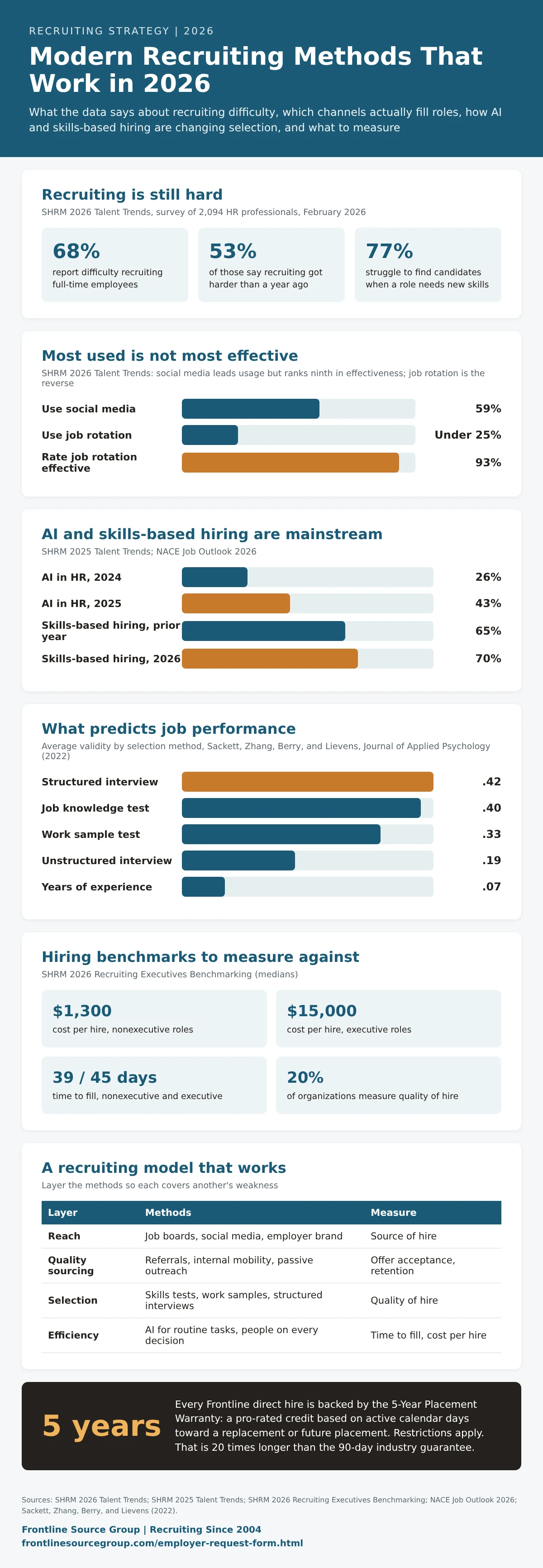
- 68 percent of HR professionals still report difficulty recruiting full-time employees, and 53 percent of them say it got harder in the past year (SHRM 2026 Talent Trends).
- The most used strategy is not the most effective: social media leads usage at 59 percent but ranks ninth in effectiveness.
- Referred applicants are more likely to be hired and to accept offers, and referred workers quit less (Burks, Cowgill, Hoffman, and Housman).
- 70 percent of employers now use skills-based hiring, and structured interviews predict job performance better than unstructured ones.
- AI use in HR rose from 26 percent to 43 percent in a year; keep a person on every hiring decision.
- Track every metric by channel, and measure quality of hire after the start date, not at the offer.
On this page
Why do traditional recruiting strategies keep stalling in 2026?
Because the problem has changed. Posting a job and waiting worked when applicants were plentiful and roles looked like last year's. Neither is true now. SHRM's 2026 Talent Trends report, based on a February survey of 2,094 HR professionals, found that 68 percent reported difficulty recruiting full-time employees, and 53 percent of those said recruiting had become harder than a year earlier.
Skills are moving faster than job descriptions. In the same research, 27 percent of HR professionals said roles filled in the past year required skills their organizations had not needed before, and 77 percent of those employers had trouble finding qualified candidates. Jenny Perez, Ph.D., the researcher who led the study, described the pattern in SHRM's coverage of the findings:
"...talent shortages remain structurally persistent rather than cyclical."
Jenny Perez, Ph.D., Researcher, SHRM Thought Leadership, and lead researcher for the 2026 Talent Trends report, in Rethinking Talent: Why HR Must Build, Not Just Buy (Roy Maurer, April 20, 2026)
In plain terms: waiting for the market to loosen is not a strategy. The methods below are the ones with real evidence behind them, and the ones we see working with clients right now.
Which recruitment strategies actually work best in 2026?
Seven methods have the strongest support. None works alone; the best programs layer them so each one covers another's weakness.
| Method | What the evidence says | Best for |
|---|---|---|
| 1. Employee referrals | Referred applicants are more likely to be hired and accept offers; referred workers quit less | Most roles, especially hard-to-fill ones |
| 2. Internal mobility | 93% of HR professionals rate job rotation as effective; fewer than 25% use it | Roles where culture and context matter |
| 3. Skills-based screening | 70% of employers use skills-based hiring, up from 65% | Roles with clear, testable skills |
| 4. Structured interviews | Highest average validity (.42) of common selection methods | Every final-round decision |
| 5. AI with human review | 43% of organizations use AI in HR; recruiting is the top use | Job descriptions, scheduling, first-pass screening |
| 6. Targeted outreach to passive candidates | Reaches people who are employed and not applying | Specialized and leadership roles |
| 7. Measuring by channel | Only 20% of organizations measure quality of hire | Deciding where to spend next quarter |
Why do employee referrals still produce the strongest hires?
Referrers know both the person and the job, so a lot of screening happens before anyone applies. The best evidence comes from Burks, Cowgill, Hoffman, and Housman in the Quarterly Journal of Economics (2015), which used personnel data from nine large firms in call centers, trucking, and high tech. Compared with other applicants, referred applicants were more likely to be hired and more likely to accept offers. Referred workers were substantially less likely to quit, and an earlier version of the study put the difference at 10 to 30 percent.
Referrals have a blind spot, though: they tend to bring in people who look like your current team. Use them as one strong channel, not the only one. For more on keeping top candidates engaged once they are in your pipeline, see how to win over top talent.
How do you build a referral program that keeps working?
- Share specific openings with the skills that matter, not a generic "know anyone?" email.
- Pay the bonus in stages, part at the start date and part after the new hire stays, so it rewards fit rather than volume.
- Tell referrers what happened to every person they sent, even when the answer is no.
- Run referred candidates through the same structured interview as everyone else.
- Track referral hires by source and check retention at six and twelve months.
Should you look inside before you post a job externally?
Usually, yes. Internal candidates already know your systems and culture, and you already know their work. SHRM's 2026 Talent Trends found that 41 percent of HR professionals train existing employees for hard-to-fill roles, and 93 percent rate job rotation programs as effective, yet fewer than a quarter of organizations use them. That gap is one of the cheapest openings in recruiting right now.
The tradeoff is the seat you leave behind. Every internal move creates a new opening, so plan the backfill at the same time. Frontline's guide to internal vs. external recruiting explains when each path makes sense.
What does an internal talent audit look like?
Before any role goes public, list the three to five skills it truly requires. Ask managers which current employees have shown those skills, even in a different job. Post the role internally first for a set period, interview internal candidates with the same structured questions you would use for outside applicants, and give honest feedback to anyone who is not selected so they stay engaged.
Does skills-based hiring outperform degree-based screening?
For most roles, yes, as long as the skills are defined and tested properly. NACE's Job Outlook 2026 survey found that 70 percent of employers use skills-based hiring, up from 65 percent the year before, and the same survey shows that 81 percent use it when writing job descriptions and 58 percent when building interview rubrics. LinkedIn's Future of Recruiting research found that 93 percent of talent acquisition professionals say accurately assessing skills is crucial to improving quality of hire.
Start small. Replace vague minimum qualifications with specific, testable skills. Add a short work sample before the first interview. Score every candidate on the same rubric. Frontline's skills testing covers software, accounting, typing, and other skills, and our talent assessment guide compares the main assessment methods in depth.
Which assessments predict job performance best?
The most current large review is Sackett, Zhang, Berry, and Lievens in the Journal of Applied Psychology (2022). Its estimates of how well each method predicts job performance are below; higher is better, and 1.0 would be perfect.
| Selection method | Validity | What it means for recruiting |
|---|---|---|
| Structured interview | .42 | Same questions and scoring for every candidate |
| Job knowledge test | .40 | Strong when the job has a defined body of knowledge |
| Work sample test | .33 | Have candidates do a slice of the real job |
| Cognitive ability test | .31 | Lower than older estimates; use with care |
| Unstructured interview | .19 | Conversation without a scoring guide |
| Years of experience | .07 | A weak predictor on its own |
How should recruiters use AI in 2026 without losing good candidates?
Use AI for the work that slows recruiters down, and keep people on the decisions. SHRM's 2025 Talent Trends research found that 43 percent of organizations used AI for HR tasks in 2025, up from 26 percent in 2024. Recruiting is the leading use, 66 percent of those organizations use it to write job descriptions and 44 percent to screen resumes, and 89 percent of HR professionals using AI in recruiting say it saves time or improves efficiency.
Efficiency is not the same as better hires. Systems trained on past hiring data can repeat past bias, and an automated rejection with no human review is a legal and reputational risk. Frontline's comparison of AI recruiting and traditional staffing goes deeper on where each approach fits.
What AI hiring laws apply in 2026?
New York City Local Law 144 requires employers using automated employment decision tools to get an annual bias audit and notify candidates. Illinois amended its Human Rights Act, effective January 1, 2026, to bar AI use that discriminates against protected classes and to require notice when AI is used in employment decisions. More states are considering similar rules, and employers stay responsible for the tools they buy. I am not a lawyer, and this is not legal advice; talk with employment counsel before you deploy AI in hiring.
Where should people stay in the loop?
- Every rejection decision, especially any made from an automated score.
- Final interviews and the hiring decision itself.
- Reviewing AI-written job descriptions for accuracy and unnecessary requirements.
- Regular checks of pass-through rates by group to catch adverse impact early.
- Telling candidates when AI is part of the process.
Do job boards and social media recruiting still work?
They build reach, but they rarely make the hire on their own. SHRM's 2026 Talent Trends found that social media was the most used recruiting strategy, at 59 percent of HR professionals, yet they ranked it ninth in effectiveness at filling open roles. Job boards behave the same way: they bring volume, and volume without structured screening mostly creates work.
Use these channels for awareness and employer brand, then let referrals, direct outreach, and skills-based screening do the selecting. If your postings get views but few qualified applicants, the fix is usually the posting itself; see our virtual recruitment strategies guide.
Which recruiting metrics should you track by channel?
Most teams track time to fill and cost per hire for the whole company, which hides the answer they need: which channels are worth the money. Break every metric out by source. For context, SHRM's 2026 recruiting benchmarking puts the median cost per hire at $1,300 for nonexecutive roles and $15,000 for executives, with median time to fill of 39 days and 45 days.
| Metric | How to calculate it | What it tells you |
|---|---|---|
| Source of hire | Hires from a channel divided by total hires | Which channels actually produce people you hire |
| Time to fill | Days from approval to accepted offer | Where the process stalls |
| Cost per hire | Channel spend plus recruiter time, divided by hires | Whether a channel pays for itself |
| Offer acceptance rate | Accepted offers divided by offers made | Whether pay, speed, or experience is losing candidates |
| Quality of hire | Performance and retention at 90 days and one year | Whether the channel brings people who succeed and stay |
How do you measure quality of hire?
Pick two or three measures you already collect, such as the hiring manager's 90-day rating, first-year retention, and time to full productivity, and score them the same way for every hire. SHRM found that only 20 percent of organizations measure quality of hire at all. LinkedIn's Future of Recruiting research found that 89 percent of talent acquisition professionals expect measuring it to become more important, but only 25 percent feel highly confident they can do it well. A simple, consistent score beats a perfect one nobody uses.
How do you roll out a modern recruiting model step by step?
- Audit your sources. Pull the last year of hires and list where each one came from, what it cost, and who is still there.
- Fix the job descriptions. Rewrite open roles around three to five testable skills and drop requirements nobody can defend.
- Look inside first. Post internally before externally and set up a simple job rotation or stretch assignment program.
- Relaunch referrals. Share specific openings, pay bonuses in stages, and close the loop with every referrer.
- Structure the interview. Train hiring managers on a shared question set and scorecard before the next opening.
- Pilot AI on one task. Start with job descriptions or scheduling, keep a person on every decision, and compare results with your baseline.
- Review by channel every quarter. Move budget toward the channels whose hires perform and stay.
What are the pros and cons of each recruiting method?
| Method | Potential benefits | Potential drawbacks |
|---|---|---|
| Employee referrals | Better fit, more accepted offers, lower turnover | Can narrow your talent pool |
| Internal mobility | Known performers, faster ramp-up, retention | Creates a backfill; can cause friction if handled poorly |
| Skills-based screening | Wider pool, more defensible decisions | Takes upfront work to define and test skills |
| Structured interviews | Best predictor among common methods; fairer comparisons | Requires manager training and discipline |
| AI with human review | Saves recruiter time on routine tasks | Bias and compliance risk without oversight |
| Job boards and social media | Broad reach and brand awareness | High volume, low signal; ranked ninth in effectiveness |
| Recruiting partner | Access to passive candidates and specialist screening | Fees; results depend on the partner's quality |
How does Frontline Source Group combine AI and human recruiters?
We use AI to make sure more candidates get a real response, and people to make the judgment calls. Lexi Reed, our AI recruiter, may conduct a first-level phone interview, and Joy Lee, our AI executive recruiter, researches and maps the market for leadership searches. A human recruiter reviews every candidate, and people make every hiring decision. Candidates also go through skills testing and video interviews where the role calls for it.
Our fees are published on the pricing page: direct hire placements are 20 to 30 percent of first-year base salary, and executive search runs 25 to 35 percent of first-year compensation. Every direct hire is backed by the 5-Year Placement Warranty, which provides a pro-rated credit based on active calendar days toward a replacement or future placement. Restrictions apply. That coverage runs 20 times longer than the 90-day guarantee common in the industry.
Where should you start if your recruiting is not working?
Start with your data, not a new tool. Find the two channels that produced your best hires last year and put more into them, then fix the interview before you add technology. If a role is specialized, confidential, or has failed before, bring in help. Employers can submit an opening through the employer request form, and job seekers can start at how to apply. For a deeper look at hiring risk, see how specialized recruiters lower bad hire risk.
What do employers ask most about modern recruiting methods?
What are modern recruiting methods?
Modern recruiting methods are hiring practices built around evidence rather than habit: employee referrals, internal mobility, skills-based screening, structured interviews, AI for administrative work with human review, and tracking results by channel. The goal is better hires, not just more applicants.
Which recruitment strategy is most effective in 2026?
No single strategy wins for every role, but referrals, internal mobility, and skills-based selection have the strongest evidence. SHRM's 2026 Talent Trends found that 93 percent of HR professionals rate job rotation programs as effective, yet fewer than a quarter use them, while social media is the most used strategy but ranks ninth in effectiveness.
Why do employee referrals produce better hires?
Referrers know both the person and the job, so they screen for fit before anyone applies. A study of nine large companies by Burks, Cowgill, Hoffman, and Housman found referred applicants were more likely to be hired and to accept offers, and referred workers were less likely to quit.
What is skills-based hiring?
Skills-based hiring evaluates candidates on the specific skills a job requires, using work samples, structured interviews, and tests, instead of relying mainly on degrees or job titles. NACE's Job Outlook 2026 survey found 70 percent of employers use it, up from 65 percent the year before.
How are employers using AI in recruiting in 2026?
Mostly for writing and screening. SHRM's 2025 Talent Trends research found 43 percent of organizations used AI for HR tasks, up from 26 percent in 2024, with recruiting the leading use: 66 percent of those organizations use it to write job descriptions and 44 percent to screen resumes.
Is it legal to use AI to screen job candidates?
Generally yes, but rules are tightening. New York City requires a bias audit and candidate notice for automated employment decision tools, and Illinois amended its Human Rights Act, effective January 1, 2026, to bar discriminatory AI use and require notice. Employers remain responsible for outcomes. This is not legal advice; consult employment counsel.
Does social media recruiting still work?
It builds reach, but it rarely closes the hire on its own. SHRM's 2026 Talent Trends found social media was the most used recruiting strategy, at 59 percent, but HR professionals ranked it ninth in effectiveness at filling open roles. Pair it with referrals, direct outreach, and structured screening.
Which recruiting metrics matter most?
Track time to fill, cost per hire, offer acceptance rate, source of hire, and quality of hire for each channel separately. Quality of hire, measured through performance and retention after 90 days and again at one year, matters most, yet SHRM found only 20 percent of organizations measure it.
How much does it cost to hire an employee in 2026?
SHRM's 2026 benchmarking puts the median cost per hire at $1,300 for nonexecutive roles and $15,000 for executives, with median time to fill of 39 days and 45 days. A bad hire costs far more than either figure.
When should a company use a staffing agency or recruiter?
Use outside help when roles are specialized, the internal team lacks bandwidth, the search must stay confidential, or past hires in the role have not worked out. Compare published fees and post-hire protection. Frontline's fees are at frontlinesourcegroup.com/pricing.html.
How does Frontline Source Group use AI in recruiting?
Lexi Reed, Frontline's AI recruiter, may conduct a first-level phone interview, and Joy Lee, its AI executive recruiter, researches and maps the market for leadership searches. A human recruiter reviews every candidate, and people make every hiring decision.
What is the 5-Year Placement Warranty?
If a Frontline Source Group direct hire does not work out within five years, Frontline provides a pro-rated credit based on active calendar days toward a replacement or future placement. Restrictions apply. It runs 20 times longer than the 90-day guarantee common in the industry. Terms are at frontlinesourcegroup.com/5year-placement-guarantee.html.
Sources: SHRM, 2026 Talent Trends report release; SHRM, Rethinking Talent: Why HR Must Build, Not Just Buy; SHRM, 2025 Talent Trends; SHRM, AI in HR coverage; SHRM, 2026 Recruiting Executives Benchmarking; NACE, Job Outlook 2026; LinkedIn, Future of Recruiting; Burks, Cowgill, Hoffman, and Housman, The Value of Hiring through Employee Referrals (2015); Sackett, Zhang, Berry, and Lievens, Journal of Applied Psychology (2022).


