How Do Specialized Recruiters Reduce Bad Hire Risk and Cost?

Published on: Nov 22, 2026
Updated on: November 22, 2026
Specialized recruiters lower bad hire risk by defining the role in measurable terms, testing skills with structured interviews and work samples, and sourcing proven people already working in the field. That matters because Gallup puts the cost of replacing an employee at one-half to two times salary, and Frontline backs every direct hire with a 5-Year Placement Warranty.
Frontline Source Group has recruited professional and executive talent nationwide since it was founded in Dallas in 2004. The firm has completed 5,619 plus placements across 32 plus offices, holds a 98.94% executive placement retention rate, and is rated 5.0 stars on Trustpilot across 683 plus verified reviews. Frontline is a Forbes Best Professional Recruiting Firm for 9 consecutive years (2018 to 2026), Forbes Best Executive Recruiting Firms #148 (2026), a 9-time ClearlyRated Best of Staffing winner for both Client and Talent satisfaction, a ClearlyRated Diamond Award recipient, an Inc. 5000 honoree, an Expertise.com Best Staffing Agency, and a member of the American Staffing Association (ASA). See the full list on the staffing awards page.
Key takeaways
- Gallup estimates that replacing an employee costs one-half to two times annual salary. On a $100,000 role, that is $50,000 to $200,000.
- In a CareerBuilder survey of 2,257 hiring managers, 74 percent said they had hired the wrong person, at an average cost of $14,900 per bad hire.
- SHRM's 2026 benchmarking puts the median cost per hire at $15,000 for executives and $1,300 for nonexecutive roles, and only 20 percent of organizations measure quality of hire.
- Structured interviews are the strongest common predictor of job performance (0.42), more than twice as strong as unstructured interviews (0.19), according to Sackett and colleagues (2022).
- The trade-off: a specialist costs a fee and some briefing time. For senior and hard-to-fill roles, that fee is a fraction of what a failed hire costs.
On this page
How much does a bad hire actually cost?
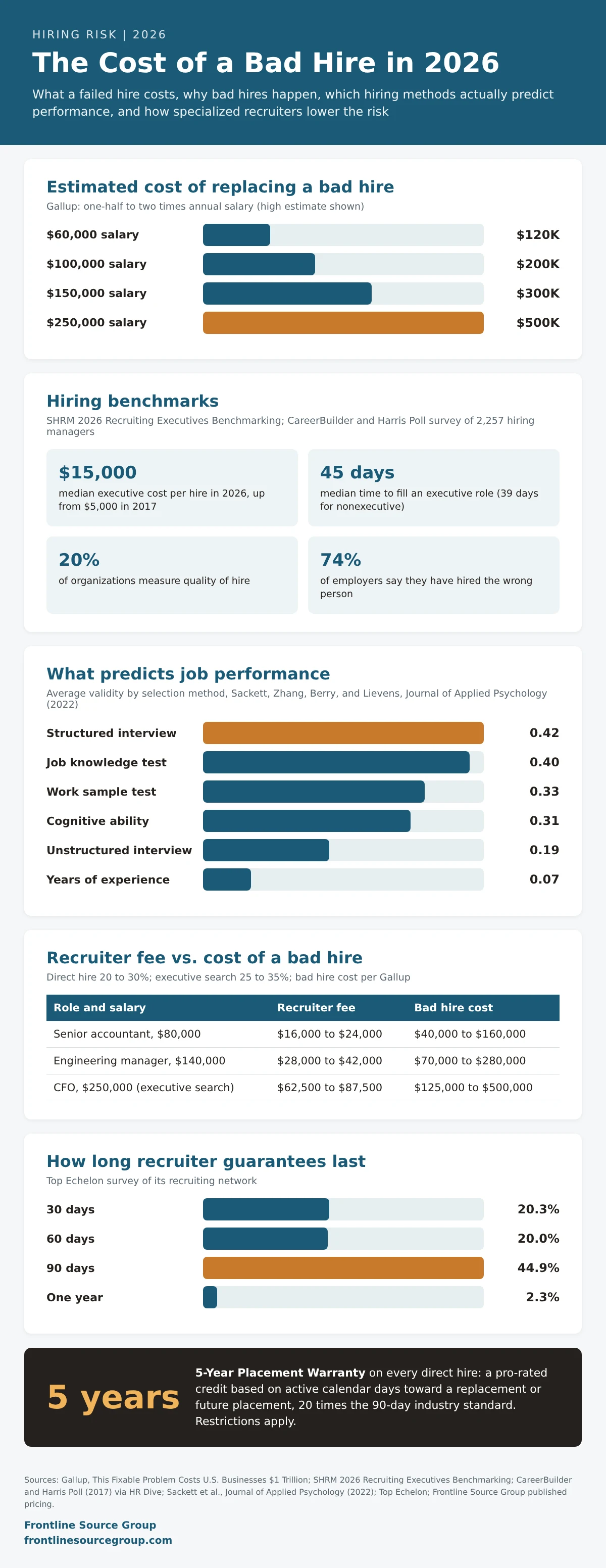
Most hiring managers know a bad hire is expensive. Very few have put a number on it. The most useful starting point is Gallup, which estimates that replacing an individual employee costs one-half to two times the employee's annual salary, and calls that a conservative estimate. A failed hire triggers the same replacement costs: recruiting again, onboarding again, and paying for months of work that never fully delivered.
| Annual salary | Low estimate (0.5x) | High estimate (2x) |
|---|---|---|
| $60,000 | $30,000 | $120,000 |
| $100,000 | $50,000 | $200,000 |
| $150,000 | $75,000 | $300,000 |
| $250,000 | $125,000 | $500,000 |
Where a role lands in that range depends on how long the wrong person stays, how senior the role is, and how much damage happens before anyone acts. A staff accountant who struggles for three months is costly. A controller who misstates results for two quarters, or a sales leader who loses key accounts, sits at the top of the range or beyond it.
How common are bad hires?
Common enough that most employers have made one. In a CareerBuilder survey conducted by Harris Poll with 2,257 hiring managers and HR professionals, 74 percent of employers said they had hired the wrong person, and those employers put the average cost at $14,900 per bad hire. Respondents most often described a bad hire as someone who did not produce the right quality of work, had a negative attitude, or did not work well with others. That survey is from 2017, and salaries have risen since, so treat the dollar figure as a floor.
Hiring itself is not getting cheaper at the top. SHRM's 2026 Recruiting Executives Benchmarking data brief found that the median cost per hire for executive positions reached $15,000 in 2026, up from $10,600 in 2025 and $5,000 in 2017. The nonexecutive median was $1,300. Median time to fill was 45 days for executives and 39 days for nonexecutive roles. When a search has to be run twice, all of that is spent twice.
Does the Department of Labor say a bad hire costs 30 percent of salary?
You will see that figure on a lot of websites. We looked for the original and could not trace it to a published U.S. Department of Labor report, so we don't rely on it. If you use it at all, use it as a low planning estimate. Gallup's range is better documented and, for most professional roles, closer to what employers actually experience.
Why do bad hires happen in the first place?
Bad hires are rarely a mystery after the fact. The same handful of process problems shows up again and again.
- A vague role profile. When the job description lists generic qualifications instead of specific outcomes, keyword-matched resumes advance people who cannot do the actual work, and the employer and the new hire each picture a different job.
- Skills that were claimed but never tested. In the CareerBuilder survey, employers often said the person lied about qualifications or lacked skills they believed could be learned quickly.
- Unstructured interviews. Free-flowing conversations reward chemistry and similarity. Two interviewers can leave the same meeting with opposite opinions and no evidence to settle it.
- Urgency. When a seat has been empty for 60 days or more, warning signs get explained away, steps get skipped, and the first plausible candidate gets the offer.
None of this means internal teams are bad at hiring. They are usually working with too little time, too few candidates, and no deep knowledge of what great looks like in a specialized role. SHRM's 2026 data adds one more gap: only 20 percent of organizations measure quality of hire at all, so many companies never learn which of their methods actually work.
Which hiring methods best predict job performance?
The best evidence comes from a 2022 review in the Journal of Applied Psychology by Paul Sackett, Charlene Zhang, Christopher Berry, and Filip Lievens, Revisiting Meta-Analytic Estimates of Validity in Personnel Selection. After correcting statistical errors in decades of earlier research, they found structured interviews had the highest average validity of the common selection methods.
| Selection method | Validity | What it means for your process |
|---|---|---|
| Structured interviews | 0.42 | Same questions, same scoring guide, for every candidate |
| Job knowledge tests | 0.40 | Test the technical knowledge the role requires |
| Work sample tests | 0.33 | Have candidates do a realistic piece of the job |
| Cognitive ability tests | 0.31 | Useful, but no longer the top predictor |
| Unstructured interviews | 0.19 | Conversation without a scoring guide |
| Years of job experience | 0.07 | Time in the field says little on its own |
Researchers who reviewed the study for the Society for Industrial and Organizational Psychology reached the same conclusion in plain terms. Patrick Gavan O'Shea and Adrienne Fox Luscombe of HumRRO, a nonprofit research firm that specializes in workforce assessment, summarized the first practical takeaway this way:
"Structured interviews emerged as the strongest predictors of job performance."
Patrick Gavan O'Shea and Adrienne Fox Luscombe, HumRRO, Is Cognitive Ability the Best Predictor of Job Performance? (The Industrial-Organizational Psychologist, SIOP)
The lesson is practical. A process built on a resume, years of experience, and a friendly conversation leans on the weakest predictors. A process built on clear outcomes, structured interviews, and real work samples leans on the strongest. That is the gap a good specialized recruiter closes.
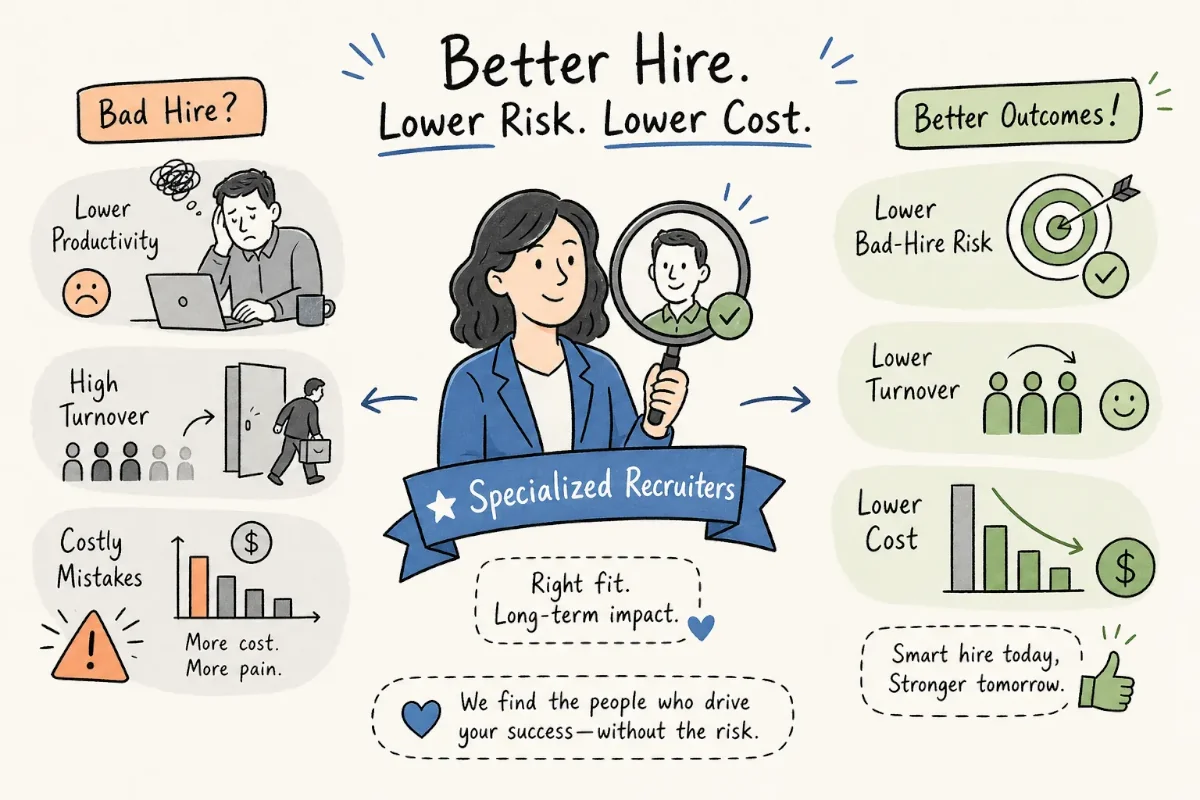
How do specialized recruiters reduce bad hire risk?
A specialized recruiter works one field long enough to know what strong performance looks like and how to spot someone who only interviews well. Here is where that shows up at each stage of a search.
- Intake. The recruiter sits down with the hiring manager to set measurable 30, 60, and 90 day goals, separate must-have skills from trainable ones, and check the role against what the market will supply at the offered pay. An accounting recruiter, for example, knows the difference between a controller who ran a monthly close and one who designed and owned it.
- Sourcing. Specialists keep relationships with strong people who are not looking at job boards. That shortens the search and widens the pool beyond whoever happened to apply this week.
- Screening. Domain knowledge lets the recruiter test claims a generalist cannot judge. Frontline delivers prescreened candidates and uses skills testing to confirm skills before you spend interview time.
- Structured evaluation. Every finalist is scored against the same criteria, so the decision rests on comparable evidence instead of whoever had the best rapport.
- Reference checks that ask about results. Good references confirm what someone actually accomplished, not just dates of employment.
- Offer and follow-through. A recruiter who knows the market can tell you when an offer will not land and stays in touch through the first months on the job.
How is a specialized recruiter different from a generalist?
| Stage | Generalist approach | Specialized approach |
|---|---|---|
| Role definition | Uses the job description as written | Rebuilds it around measurable outcomes |
| Candidate pool | Active applicants and job boards | Active plus passive candidates already known in the field |
| Skills check | Keyword match and conversation | Technical questions, skills tests, and work samples |
| Interviews | Often unstructured | Structured, with a shared scoring guide |
| References | Confirms dates and titles | Asks about specific results |
Which roles justify a specialized recruiter?
The math works best where a mistake is expensive and good candidates are hard to find: accounting and finance from senior accountant up, legal, IT, engineering, healthcare, and executive search. These roles combine high salaries, high disruption risk, and tight talent markets where a specialist's network gives the clearest edge.
High-volume entry-level roles are a different case. Per-hire costs are lower, qualified candidates are easier to find, and a generalist approach may be enough. Use this checklist to decide.
- Your team cannot confidently judge technical fit for the role.
- The role controls revenue, patient outcomes, regulated work, or critical project delivery.
- The search has been open 60 days or more without a qualified shortlist.
- The expected cost of a failed hire, using the salary table above, is well above the recruiter fee.
- You are hiring in a new industry or city where you have no sourcing network.
If two or more of these are true, a specialist recruiter is usually the lower-risk choice. For a deeper look at the trade-offs, see Frontline's guide to internal vs. external recruiting.
What are the pros and cons of using a specialized recruiter?
A specialist is not the right answer for every opening. Here is a balanced view.
| Area | Potential benefits | Potential drawbacks |
|---|---|---|
| Cost | Lower risk of paying for a failed hire twice | A placement fee, usually a percentage of first-year pay |
| Quality | Structured screening and skills testing by people who know the work | Results depend on how well the recruiter is briefed |
| Speed | Existing networks of passive candidates shorten the search | Intake and calibration take time up front |
| Fit for the role | Strongest value for senior, technical, and hard-to-fill roles | Less value for high-volume entry-level hiring |
| Protection | Placement warranties shift some of the risk to the firm | Warranty terms vary widely and many end at 90 days |
What can a recruiter not fix?
A recruiter cannot rescue a role with unrealistic pay, a hiring manager who will not commit to clear goals, or a new hire who gets no onboarding. Fit gets someone in the door. Onboarding and management decide how quickly that fit turns into results. The best outcomes come when the employer and the recruiter treat the hire as a shared project.
How does a recruiter fee compare to the cost of a bad hire?
Frontline publishes its fees on the pricing page: 20 to 30 percent of first-year base salary for direct hire, and 25 to 35 percent of first-year compensation for executive search. The table compares those fees with Gallup's replacement cost range at the same salaries.
| Role and salary | Fee model | Recruiter fee | Estimated cost of a bad hire |
|---|---|---|---|
| Senior accountant, $80,000 | Direct hire, 20 to 30% | $16,000 to $24,000 | $40,000 to $160,000 |
| Engineering manager, $140,000 | Direct hire, 20 to 30% | $28,000 to $42,000 | $70,000 to $280,000 |
| Chief financial officer, $250,000 | Executive search, 25 to 35% | $62,500 to $87,500 | $125,000 to $500,000 |
The fee is not a guarantee of success, and no honest recruiter will say it is. But the comparison shows why the fee works better as risk management than as overhead. Frontline explains how its fees are set in its guide to transparent recruiting pricing, and how to compare firms on results in its guide to placement success rates.
What happens if a placed hire does not work out?
That depends on the firm's guarantee, and most are short. In a Top Echelon survey of its recruiting network, 44.9 percent of firms offered a 90-day guarantee, 20.3 percent offered 30 days, and 20.0 percent offered 60 days. Only 2.3 percent offered one year. After the window closes, the employer carries all of the replacement risk.
Frontline's 5-Year Placement Warranty covers every direct hire for five years: if a placement does not work out, Frontline provides a pro-rated credit based on active calendar days toward a replacement or future placement. Restrictions apply. That coverage runs 20 times longer than the 90-day guarantee common in the industry. Frontline's guide to what a placement warranty must include explains what to look for in any firm's terms.
How does Frontline Source Group lower hiring risk?
Frontline's recruiters specialize by field, so the person screening your controller candidates spends their days recruiting accounting and finance talent. The firm has completed 5,619 plus placements with a 98.94% executive placement retention rate, and every candidate is screened by a recruiter who knows the work before you see a resume. Frontline's full range of staffing services covers direct hire, executive search, and contract staffing outside healthcare.
After a candidate applies, Lexi Reed, Frontline's AI recruiter, may conduct a first-level phone interview, and a human recruiter reviews every candidate after that. Employers with questions about process, fees, or terms can find answers on the employer FAQs page.
How do you get started with Frontline Source Group?
Employers can share a hiring need through the employer request form, review fees on the pricing page, or reach the team through the contact page. Job seekers should start at how to apply; there is no fee for candidates. To learn more about the firm, visit About Frontline Source Group.
About the author: Jessica Payne is an Executive Recruiter at Frontline Source Group, where she partners with employers to fill professional roles and leads the firm's revenue cycle recruiting.
What are people asking about the cost of a bad hire?
How much does a bad hire cost?
Gallup estimates that replacing an employee costs one-half to two times that person's annual salary, which puts a failed $100,000 hire at roughly $50,000 to $200,000. In a CareerBuilder survey of 2,257 hiring managers, 74 percent said they had hired the wrong person, at an average cost of $14,900 per bad hire.
What counts as a bad hire?
A bad hire is someone who does not produce the quality of work the role requires, does not fit the team or the way the company operates, or leaves or is let go early. Employers in the CareerBuilder survey most often pointed to poor quality of work, a negative attitude, and trouble working with others.
Does the Department of Labor say a bad hire costs 30 percent of salary?
The figure is widely quoted, but we could not trace it to a published U.S. Department of Labor source. Treat 30 percent of first-year earnings as a low planning estimate. Gallup's research puts the cost of replacing an employee at one-half to two times annual salary.
Why do bad hires happen?
Most bad hires come from process problems: vague job descriptions, skills that were claimed but never tested, unstructured interviews that reward chemistry over evidence, and pressure to fill a seat that has been open too long. Each of these can be fixed with a clearer role profile and a consistent way to evaluate candidates.
How do specialized recruiters reduce bad hire risk?
Specialized recruiters know the work well enough to test what candidates claim. They define measurable outcomes with the hiring manager before sourcing, use structured interviews and work samples scored the same way for every candidate, check references for actual results, and draw on passive candidates they already know in that field.
What is the best predictor of job performance in hiring?
A 2022 review by Paul Sackett and colleagues in the Journal of Applied Psychology found that structured interviews had the highest average validity of common selection methods at 0.42. Unstructured interviews came in at 0.19, and years of job experience at just 0.07.
When should a company use a specialized recruiter instead of hiring internally?
Use a specialist when your team cannot judge technical fit, the role controls revenue, patient outcomes, regulated work, or critical projects, the search has been open 60 days or more without a strong shortlist, or you are hiring in a new market where you have no sourcing network. If two or more apply, a specialist usually pays for itself.
How much does a specialized recruiter cost compared with a bad hire?
Frontline Source Group charges 20 to 30 percent of first-year base salary for direct hire and 25 to 35 percent of first-year compensation for executive search. On a $100,000 role that is $20,000 to $30,000, compared with Gallup's estimated $50,000 to $200,000 cost of replacing someone at that salary. Fees are published at frontlinesourcegroup.com/pricing.html.
What does a placement warranty cover?
A placement warranty protects you if a placed hire leaves or does not work out. Most recruiting firms offer 90 days. Frontline Source Group's 5-Year Placement Warranty provides a pro-rated credit based on active calendar days toward a replacement or future placement. Restrictions apply. Terms are at frontlinesourcegroup.com/5year-placement-guarantee.html.
How long do most recruiting firm guarantees last?
Ninety days is the closest thing to an industry standard. In a Top Echelon survey of its recruiting network, 44.9 percent of firms offered a 90-day guarantee, 20.3 percent offered 30 days, 20.0 percent offered 60 days, and only 2.3 percent offered one year. Frontline's warranty runs five years, 20 times longer than the 90-day standard.
What are the downsides of using a specialized recruiter?
The main downsides are the fee, the time it takes to brief the recruiter properly, and less value for high-volume entry-level roles where qualified candidates are easy to find. A specialist also cannot fix a weak onboarding plan. For hard-to-fill or senior roles, those costs are usually small next to the cost of a failed hire.
How do I start a search with Frontline Source Group?
Employers can submit a hiring need through the employer request form at frontlinesourcegroup.com/employer-request-form.html or review fees at frontlinesourcegroup.com/pricing.html. Job seekers should apply at frontlinesourcegroup.com/how-to-apply.html. There is no fee for job seekers.
Sources: Gallup, This Fixable Problem Costs U.S. Businesses $1 Trillion; SHRM, 2026 Recruiting Executives Benchmarking; HR Dive on the CareerBuilder bad hire survey (2017); Sackett, Zhang, Berry, and Lievens, Journal of Applied Psychology (2022); O'Shea and Luscombe, The Industrial-Organizational Psychologist, SIOP; Top Echelon survey on recruiter guarantees.


