How Do You Avoid a Costly Bad Hire at the Executive Level?

Published on: Nov 23, 2026
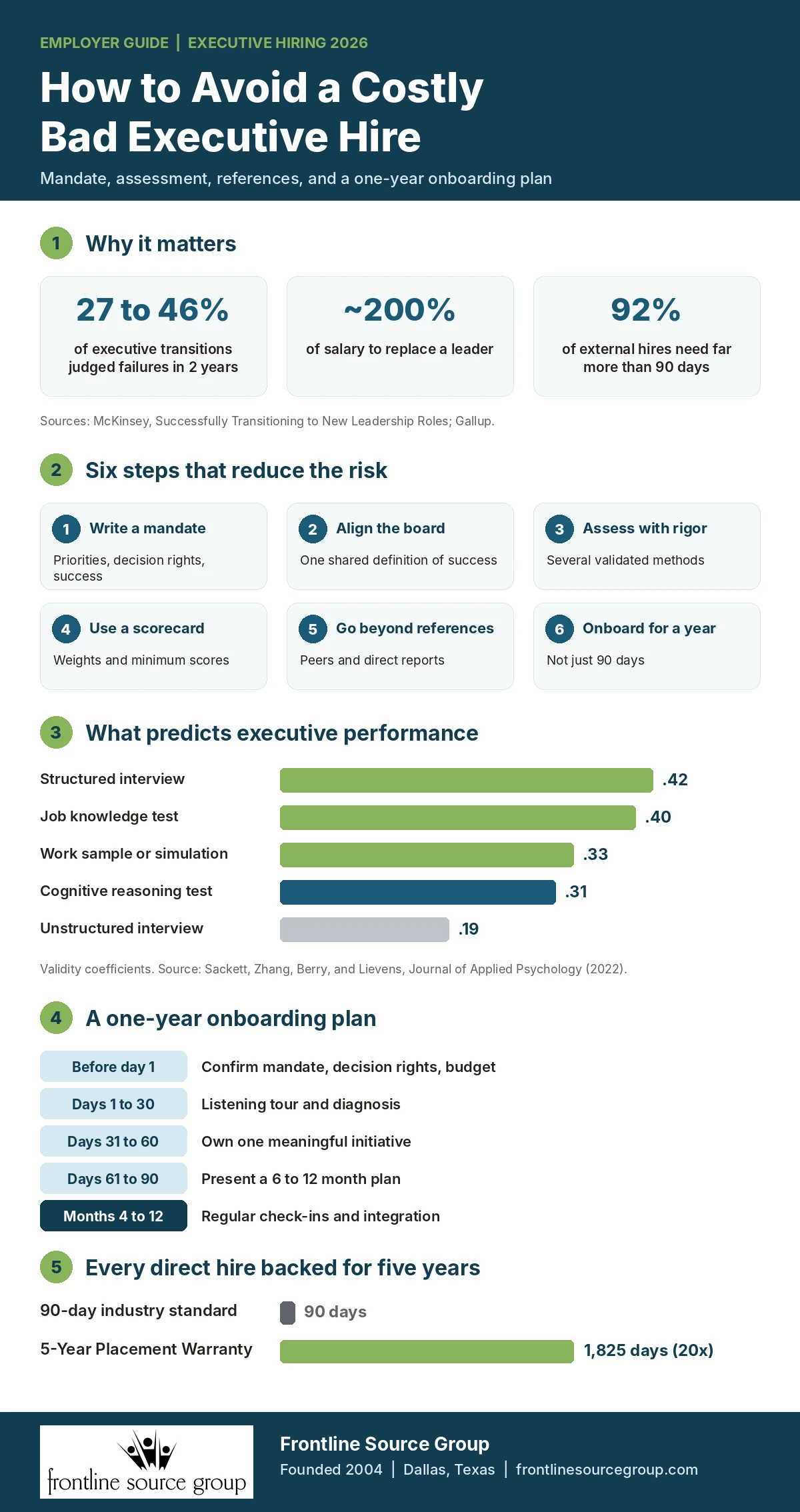
To avoid a costly bad hire at the executive level, define a written mandate before sourcing, assess finalists with several validated methods led by structured interviews, verify references beyond the candidate's list, and plan onboarding for a year, not 90 days. McKinsey research finds 27 to 46 percent of executive transitions are judged failures or disappointments within two years.
Frontline Source Group has run executive searches since 2004, and the failures we are asked to fix usually trace back to the same few gaps. Frontline has been named a Forbes Best Professional Recruiting Firm for 9 consecutive years (2018 to 2026), ranked #148 on the Forbes Best Executive Recruiting Firms list for 2026, and won ClearlyRated Best of Staffing for both Client and Talent satisfaction 9 times, along with the ClearlyRated Diamond Award. Frontline holds a 5.0-star rating across 683 plus verified Trustpilot reviews, has completed 5,619 plus placements with a 98.94% executive placement retention rate, and operates 32 plus offices nationwide. Every direct hire is backed by the 5-Year Placement Warranty, 20 times the 90-day industry standard.
Key takeaways
- Replacing a leader costs around 200 percent of salary (Gallup), before counting lost months and stalled initiatives.
- Write a mandate, not a job description: priorities, decision rights, success measures, and constraints, agreed by the board and leadership team before the search starts.
- Combine methods. Structured interviews (.42), job knowledge tests (.40), and work samples or business simulations (.33) each add predictive value.
- Score finalists on a weighted scorecard with minimum floors for strategic judgment and people leadership.
- Go beyond the reference list, with the candidate's knowledge, to hear from peers and direct reports.
- Plan onboarding for six to twelve months: McKinsey found 92 percent of external executive hires take far more than 90 days to reach full productivity.
Table of contents: on this page
- What a bad executive hire costs
- How often executive hires fail
- Why executive hires fail
- Defining the role mandate
- Assessment methods that predict performance
- Building an executive interview scorecard
- Reference and back-channel checks
- Executive onboarding and early metrics
- Early warning signs and what to do
- In-house, search firm, or fractional?
- When to bring in an executive search firm
- Frequently asked questions
What does a bad executive hire actually cost?
More than the search fee, and usually more than a year of salary. Gallup estimates that replacing leaders and managers costs around 200 percent of their salary (Gallup). McKinsey cites estimates of 213 percent of annual salary for senior-executive roles and points out that the larger cost may be the six, 12, or 18 months lost while competitors move ahead (McKinsey).
| Cost | What it includes | Benchmark |
|---|---|---|
| Replacement cost | Search, recruiting time, onboarding a successor | About 200 percent of salary for leaders and managers (Gallup) |
| Senior-executive replacement | Direct and indirect replacement outlays | Estimated 213 percent of annual salary (McKinsey) |
| Cost per hire | Hard recruiting cost for one executive hire | Median $15,000 for executive roles in 2026 (SHRM) |
| Time to refill | Months the seat is empty or covered by others | Median 45 days to fill an executive role, requisition to accepted offer (SHRM) |
| Lost momentum | Stalled initiatives, delayed decisions, competitors gaining ground | Six to 18 months, per McKinsey |
| Team damage | Disengaged or departing direct reports | Hard to measure, often the largest hidden cost |
Illustration only: for a leader earning $300,000, a replacement cost of 200 percent of salary is about $600,000, before counting lost time.
How often do executive hires fail?
Often enough to plan for it. McKinsey reports that two years after executive transitions, 27 to 46 percent are regarded as failures or disappointments. Its research also found that only 19 percent of externally hired executives and 11 percent of internal ones considered standard orientation programs effective (McKinsey). The first months are the danger zone:
"Leaders, regardless of their level, are most vulnerable in their first few months in a new position."
Michael D. Watkins, author of The First 90 Days and Professor of Leadership and Organizational Change at IMD, in a Harvard Business School Working Knowledge interview
Why do executive hires fail?
Rarely because of a lack of credentials. Most failures trace back to the hiring process itself:
| Root cause | What it looks like | How to prevent it |
|---|---|---|
| Unclear mandate | The executive spends the first months discovering what the job is | Write and agree a mandate before sourcing |
| Context mismatch | A leader who succeeded elsewhere applies the same playbook to a different business | Assess for the specific situation: turnaround, growth, or stability |
| Board and leadership misalignment | Different stakeholders expect different outcomes | Run a pre-search alignment session |
| Culture and relationship gaps | Strong strategy, weak buy-in from peers and teams | Test stakeholder influence and people leadership with real evidence |
| Gut-feel decisions | The most impressive interview wins | Use structured interviews and a weighted scorecard |
| Thin onboarding | Orientation instead of integration | Plan a 6 to 12 month transition with check-ins |
A well-known example is Ron Johnson's 17-month tenure as CEO of J.C. Penney. A celebrated retail leader from Apple brought premium-retail practices to a value-focused department store, and core customers left. The resume was outstanding; the fit with that business, at that moment, was not.
How do you define the role before you start an executive search?
Write a mandate, not a job description
A job description lists tasks and qualifications. A mandate answers four questions: What are the top three priorities for the next 12 to 24 months? What does success look like at 90 days, one year, and three years? What authority will this person actually have over budget, hiring, and strategy? And what constraints do they need to know about before day one? Without those answers, you are hiring someone to work them out in real time, with your organization as the test environment.
Align the board and leadership team before recruiting
Run a pre-search session with the board and executive team to agree on the mandate, the competency weights, the cultural non-negotiables, and who makes the final decision. A misaligned hiring committee can sink a search no matter who is hired, and it costs far less to resolve disagreements now than after a failed placement.
What executive assessment methods actually predict performance?
No single tool is enough. Predictive value comes from combining validated methods and scoring them against weights you set in advance. A 2022 Journal of Applied Psychology meta-analysis ranked the common methods this way (Sackett, Zhang, Berry, and Lievens, 2022):
| Method | Validity | What it adds for executive hires |
|---|---|---|
| Structured behavioral interview | .42 | Evidence of past decisions, leadership, and judgment, scored consistently |
| Job knowledge assessment | .40 | Depth in the function: finance, operations, technology, or sales |
| Work sample or business simulation | .33 | How the candidate handles a realistic strategic problem or board presentation |
| Cognitive reasoning test | .31 | Learning speed and complex problem solving |
| Unstructured interview | .19 | Rapport, not prediction |
Personality and derailment assessments, such as the Hogan suite, add information about work style and behavior under pressure, and are most useful for shaping interview questions and onboarding plans. MBTI and generic DISC profiles support team conversations but should not drive selection. For a deeper look, see our article on talent assessment methods that predict performance.
How do you build an executive interview scorecard?
Use six weighted competencies with minimum passing scores, ask every finalist the same questions in the same order, and have each interviewer score independently before the group discusses. That reduces halo effects and seniority bias.
| Competency | Weight | Minimum score (out of 5) |
|---|---|---|
| Strategic vision and judgment | 25% | 3 |
| Decision-making under ambiguity | 20% | 3 |
| People leadership | 20% | 3 |
| Execution and accountability | 15% | 2.5 |
| Stakeholder influence | 10% | 2.5 |
| Culture, integrity, and self-awareness | 10% | 3 |
Set an overall passing threshold, such as 3.5 out of 5, with separate floors for strategic judgment and people leadership, because those are where executive failures most often start. Two questions worth asking every finalist:
- "Tell me about the highest-stakes decision you made with incomplete or conflicting information. What options did you consider, and why did you choose the one you did?"
- "Describe a time you inherited an underperforming team. How did you separate capability problems from role-fit problems, and what did you change?"
More on interview craft is in Shelly Hubble's guide on how to be a better interviewer.
How should you check references for an executive hire?
What to ask in a structured reference check
Most reference calls are too polite to surface real risk. Cover five areas: leadership behavior and team health, decision quality under pressure, how the executive handled underperformance, what they would do differently, and one specific moment when their judgment was tested. References should confirm or contradict specific claims from the interview, not offer a general endorsement.
The back-channel conversation most teams skip
Candidates choose their formal references. Talking with two or three additional people who worked closely with the executive, such as former peers, board members, or direct reports, gives a fuller picture. Listen for patterns across independent voices, not a single anecdote. Protect confidentiality: tell finalists you will speak with people beyond their list, never contact their current employer without permission, and follow applicable law and your counsel's guidance on background checks.
What does effective executive onboarding look like?
Onboarding is not orientation, and 90 days is not the finish line. McKinsey found that 92 percent of external and 72 percent of internal executive hires take far more than 90 days to reach full productivity (McKinsey). A practical structure:
| Phase | Focus | Examples |
|---|---|---|
| Before day one | Clarity | Confirm the mandate, decision rights, budget, and key relationships |
| Days 1 to 30 | Diagnosis | Listening tour, stakeholder map, real business data |
| Days 31 to 60 | Contribution | Own one meaningful initiative; test priorities against data |
| Days 61 to 90 | Direction | Present a credible 6 to 12 month operating plan |
| Months 4 to 12 | Integration | Regular check-ins with the CEO or board, team changes, progress on the mandate |
Which early metrics show whether an executive hire is working?
- Alignment between the executive and the CEO or board on priorities
- Share of 30, 60, and 90 day commitments completed
- Time to the first meaningful contribution
- Confidence pulse ratings from the CEO, peers, and direct reports at day 30 and day 60
- Retention and engagement on the executive's team
What are the early warning signs of a bad executive hire?
- Priorities keep shifting, or the executive and the CEO describe the job differently
- Key team members disengage or leave in the first months
- Decisions stall, or the executive avoids owning a first initiative
- Peers route around the executive instead of through them
- The 90-day plan is vague or repeats the interview pitch
When you see these, act early: revisit the mandate together, add coaching or a transition advisor, and set clear 60-day expectations. Most transitions can be saved when the gap is caught in the first quarter; few can be saved after a year of drift.
Should you hire an executive in-house, use a search firm, or start fractional?
| In-house search | Executive search firm | Fractional or interim executive | |
|---|---|---|---|
| Pros | Lowest direct cost; deep knowledge of your culture | Access to candidates who are not looking; structured assessment; confidential; accountability | Fills the seat now; lets you test the role before a permanent hire |
| Cons | Limited reach into passive candidates; confidentiality is harder; internal bias | Placement fee | Not a permanent solution; part-time availability |
| Best for | Roles with strong internal successors | Critical roles, confidential replacements, or after a failed hire | Urgent gaps, unclear mandates, or roles you are still defining |
Frontline's fractional executive practice, including the fractional CFO service, is one way to reduce risk while you define the permanent role.
When does it make sense to bring in an executive search firm?
What in-house recruiting tends to miss at the C-suite level
Internal HR teams are built for volume and process. Executive search needs market mapping, access to off-market candidates, candid back-channel intelligence, and the ability to run a confidential search. Three situations most clearly justify a specialized firm: the role is critical and cannot afford a long failure cycle, the internal team lacks networks at the leadership level in your sector, or a previous search already produced a failed hire in the same seat.
How does Frontline Source Group reduce executive hiring risk?
Frontline's executive search and C-level executive search teams, led by Shelly Hubble and Bill Kasko, build the mandate and scorecard with you, assess finalists with structured interviews and reference work, and support the transition after the start date. Fees are published on our pricing page: C-suite searches are 25 to 35 percent of first-year all-in compensation, on a contingency or retained basis.
Every direct hire is backed by the 5-Year Placement Warranty, 20 times the 90-day standard most firms offer. If a placement does not work out within five years, Frontline credits a pro-rated portion of the fee toward a replacement or future placement; certain restrictions apply. A firm that stands behind a hire for five years has every reason to get the assessment and fit right. Related reading: the executive search process explained, retained vs contingency executive search, what executive search guarantees actually protect, and how specialized recruiters lower bad hire risk.
Executives exploring their next role can apply here. All interviews are set by appointment only and we do not allow walk-ins at any location.
What are the most common questions about avoiding a bad executive hire?
How do you avoid a bad hire at the executive level?
Define a written mandate before sourcing, align the board and leadership team, assess finalists with several validated methods led by structured interviews, score them on a weighted scorecard, check references beyond the candidate's list, and plan onboarding for six to twelve months.
How much does a bad executive hire cost?
Gallup estimates replacing leaders and managers costs around 200 percent of their salary, and McKinsey cites estimates of 213 percent of annual salary for senior executives, before counting the six to 18 months of lost momentum.
How often do executive hires fail?
McKinsey reports that two years after executive transitions, 27 to 46 percent are regarded as failures or disappointments.
Why do executive hires fail?
Most failures trace back to an unclear mandate, a mismatch between the leader's experience and the company's situation, board misalignment, weak relationships with peers and teams, gut-feel hiring decisions, and thin onboarding.
What is the best way to assess executive candidates?
Combine methods. A 2022 Journal of Applied Psychology meta-analysis rated structured interviews at .42, job knowledge tests at .40, work samples at .33, and cognitive tests at .31. Personality and derailment assessments help shape interviews and onboarding.
What should an executive interview scorecard include?
Six weighted competencies, such as strategic judgment, decision-making under ambiguity, people leadership, execution, stakeholder influence, and integrity, each with a minimum score, plus an overall passing threshold. Interviewers score independently before discussing.
What is a back-channel reference check?
It is a conversation with people who worked closely with the executive but are not on the candidate's reference list, such as former peers, board members, or direct reports. Tell finalists you will do it, never contact a current employer without permission, and follow applicable law.
How long should executive onboarding last?
Plan for six to twelve months. McKinsey found that 92 percent of external and 72 percent of internal executive hires take far more than 90 days to reach full productivity.
What are the warning signs of a bad executive hire?
Shifting priorities, key team members leaving, stalled decisions, peers working around the executive, and a vague 90-day plan. Address them early by revisiting the mandate and setting clear 60-day expectations.
When should a company use an executive search firm?
When the role is critical, the internal team lacks leadership-level networks in your sector, the search must be confidential, or a previous hire in the same seat failed.
Can a fractional executive reduce hiring risk?
Yes. A fractional or interim executive can cover an urgent gap and help define the role while you run a careful permanent search, so you are not forced into a rushed decision.
How does Frontline Source Group's 5-Year Placement Warranty work?
Every direct hire is backed for five years, 20 times the 90-day industry standard. If a placement does not work out, Frontline credits a pro-rated portion of the fee toward a replacement or future placement. Certain restrictions apply.
Sources
- McKinsey and Company, Successfully Transitioning to New Leadership Roles
- Gallup, Employee Retention Depends on Getting Managers Right
- SHRM, 2026 Recruiting Benchmarking Data Brief
- Sackett, Zhang, Berry, and Lievens, Revisiting Meta-Analytic Estimates of Validity in Personnel Selection, Journal of Applied Psychology, 2022
- Harvard Business School Working Knowledge, A Fast Start on Your New Job (interview with Michael Watkins)


