How Do You Compare Staffing Agencies on Placement Protection?

Published on: Nov 28, 2026
Published on: November 28, 2026.
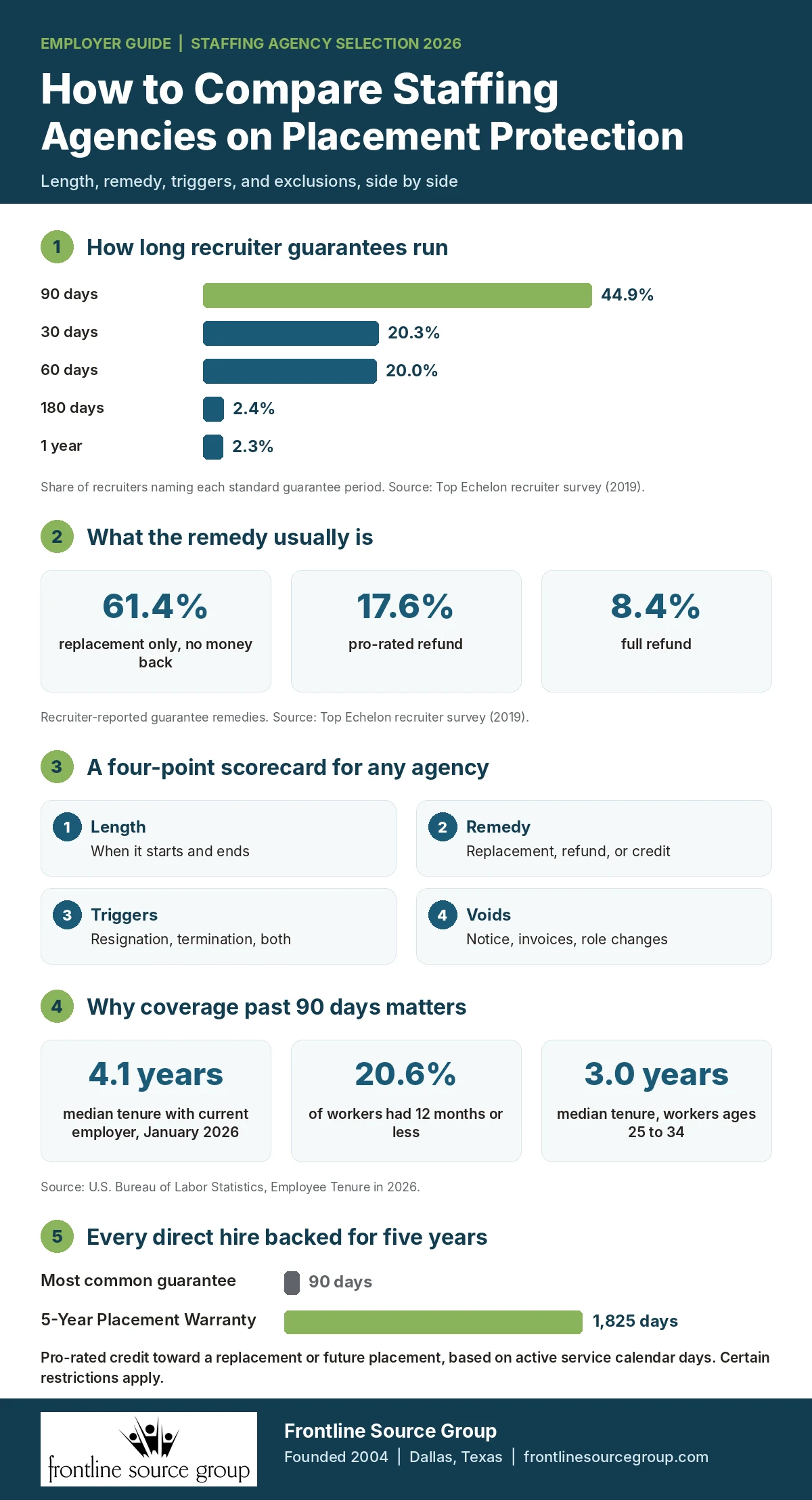
To compare staffing agencies on placement protection, score each one on four things: how long coverage lasts, what the remedy is (replacement, refund, or credit), what triggers a claim, and what voids it. In a 2019 Top Echelon survey, 90 days was the most common recruiter guarantee. Frontline backs every direct hire with a 5-Year Placement Warranty.
I founded Frontline Source Group in 2004, and the guarantee section of a staffing agreement is still the part most employers read last. Frontline has been named a Forbes Best Professional Recruiting Firm for 9 consecutive years (2018 to 2026), ranked #148 on the Forbes Best Executive Recruiting Firms list for 2026, and won ClearlyRated Best of Staffing for both Client and Talent satisfaction 9 times, along with the ClearlyRated Diamond Award. Frontline holds a 5.0-star rating across 683 plus verified Trustpilot reviews, has completed 5,619 plus placements with a 98.94% placement retention rate, and operates 32 plus offices nationwide.
Key takeaways
- 90 days is the benchmark: 44.9 percent of recruiters in a 2019 Top Echelon survey named it their standard guarantee period, and fewer than 5 percent offered six months or longer.
- Replacement, refund, and credit remedies are not equal, and the signed contract decides which one you get.
- Score every agency on length, remedy, triggers, and voids, side by side, before you compare fees.
- Procedural exclusions, such as notice windows, unpaid invoices, and missing paperwork, void more claims than the headline length suggests.
- Ask whether protection survives a temp-to-hire conversion and whether a replacement hire gets its own coverage.
- Any agency that cannot point to contract language for each answer is telling you something.
Table of contents: on this page
- What placement protection means
- The standard guarantee length
- Replacement vs refund vs credit
- A scorecard to compare agencies
- Exclusions that void a claim
- Temp-to-hire coverage
- Is a longer guarantee always better?
- Nine questions to ask before signing
- Frontline's 5-Year Placement Warranty
- Related employer guides
- Frequently asked questions
What does placement protection mean when you compare staffing agencies?
Placement protection is what an agency owes you if a hire it placed leaves within a set period. Most agencies call it a guarantee, but the word covers very different promises. A replacement guarantee means another search if the hire leaves inside the window. A warranty usually runs longer and may include a pro-rated credit tied to how long the employee stayed. Treating the two as equivalent is the first mistake employers make when comparing agencies.
"It's often interpreted by a court as a warranty as to the candidate's fitness"
Jeff Allen, placement law attorney, on how a stated replacement guarantee can be read, in an ERE column
That is why the exact wording matters. Whatever an agency calls its protection, the signed agreement defines what you can actually claim.
What is the standard placement guarantee length from staffing agencies?
Ninety days. In a 2019 Top Echelon survey of recruiters, 95.9 percent offered some kind of guarantee, and 90 days was the most common standard period by a wide margin (Top Echelon).
| Standard guarantee period | Share of recruiters (2019) |
|---|---|
| 30 days | 20.3% |
| 45 days | 1.9% |
| 60 days | 20.0% |
| 90 days | 44.9% |
| 180 days | 2.4% |
| 1 year | 2.3% |
| Other | 5.7% |
Ninety days lines up with many probationary periods, so obvious performance problems surface inside it. The more common risk comes later, after a hire has been onboarded and trained. The U.S. Bureau of Labor Statistics reports that median tenure with a current employer was 4.1 years in January 2026, and 20.6 percent of workers had been with their employer 12 months or less (BLS). A 90-day window covers only a small slice of that first year.
How do replacement, refund, and credit remedies compare?
The remedy is where agencies differ most. In the same 2019 survey, 61.4 percent of recruiters offered a replacement with no money back, 17.6 percent a pro-rated refund, and 8.4 percent a full refund (Top Echelon).
| Remedy | What you get | What to check |
|---|---|---|
| Replacement only | Another search at no additional fee | Whether you lose everything if you choose a different firm for the next search |
| Pro-rated credit | A share of the fee, based on days the hire stayed, applied to a replacement or future placement | The formula, how long coverage lasts, and whether the credit expires |
| Pro-rated refund | Cash back on a sliding scale | How fast the amount declines and what voids it |
| Full refund | The fee returned | Usually a short window with strict conditions |
Ask each agency which remedy applies to your engagement, then ask whether a replacement candidate receives its own coverage period. Many contracts are silent on that point.
How do you score staffing agencies side by side on placement protection?
Put every agency's terms in one grid before you look at fees. Length is the most visible factor but not always the most important: a long replacement-only guarantee with a long exclusion list can protect you less than a shorter one with a clear credit formula and defined claim steps.
| Scorecard factor | What to ask | Red flag |
|---|---|---|
| Length | When does coverage start, and when does it end? | Coverage that starts on the invoice date, not the start date |
| Remedy | Replacement, refund, or credit, and how is it calculated? | "We will make it right" with no formula in writing |
| Triggers | Does it cover resignation and termination for performance? | Coverage for one reason only |
| Voids | What notice, payment, and paperwork rules apply? | Short notice windows or broad "change in role" language |
Then fill in a simple comparison for each firm on your shortlist:
| Term | Agency A | Agency B | Agency C |
|---|---|---|---|
| Coverage length | |||
| Remedy and formula | |||
| Triggers covered | |||
| Notice deadline | |||
| Payment conditions | |||
| Survives temp-to-hire? | |||
| Replacement gets new coverage? | |||
| In the written contract? |
Which exclusions can void a placement guarantee claim?
Most agreements exclude layoffs, restructuring, position eliminations, and material changes to the role after placement, such as new compensation, reporting lines, or duties. Those exclusions protect the agency from outcomes it did not cause, which is fair in principle. The risk is language broad enough to block claims that stem from a poor match.
Procedural exclusions are where employers lose valid claims most often:
- Notice windows. Some contracts require written notice within a few business days of the departure; missing it can forfeit the claim.
- Payment status. Unpaid or late invoices can void coverage regardless of the circumstances.
- Documentation. A resignation letter, termination record, or last day worked may be required to open a claim.
Read every procedural rule at signing, note the deadlines, and make sure your HR team knows what preserves a claim. After a hire leaves, it is too late to learn them.
Does placement protection survive a temp-to-hire conversion?
Not always. During a temporary assignment the agency employs the worker, which gives you a natural exit before you commit. Once you convert the person to your payroll, many agencies narrow or end coverage. Ask in writing what protection survives conversion, and read Frontline's temp-to-hire staffing guide for how conversions work.
Is a longer placement guarantee always better?
| Why longer coverage helps | What to weigh honestly |
|---|---|
| It covers the months after onboarding, when settled hires can leave | Length means little if broad exclusions void most claims |
| It keeps the agency invested in fit, not just a fast fill | A credit only has value if you will hire through that firm again |
| It reduces the cost of a hire who leaves in year one or two | Pro-rated value shrinks the longer the hire stays |
| It signals confidence in the agency's screening | Promises outside the written contract do not count |
What questions should you ask every staffing agency before signing?
- What is the exact length of coverage, and when does it start?
- Is the remedy a replacement, a refund, or a credit?
- How is a pro-rated amount calculated?
- What actions on our part void the coverage?
- What is the notice deadline if the hire leaves?
- Does coverage survive a temp-to-hire conversion?
- Does a replacement hire receive its own coverage period?
- Are there state-specific terms that affect our coverage?
- Is everything you have told us in the written contract?
An agency that hesitates on these questions, or cannot point to the contract language, is telling you how much it stands behind its own protection.
What does long-term placement protection look like at Frontline Source Group?
Frontline's 5-Year Placement Warranty covers every direct hire placement for five years, about 20 times the 90-day benchmark. If a placement does not work out during that time, Frontline credits a pro-rated amount of the fee, based on active service calendar days, toward a replacement or future placement. The warranty is a one-time replacement for the originally placed position, and it excludes company-wide layoffs, business closures, and material changes to the original role. Certain restrictions apply.
Illustration only, assuming a $20,000 fee and a straight-line credit over 1,825 days; your actual credit follows your signed agreement:
| Hire leaves after | Illustrative credit |
|---|---|
| 60 days | About $19,340 |
| 1 year | $16,000 |
| 3 years | $8,000 |
Fees are published on our pricing page, and the full warranty story is on the 5-Year Placement Warranty overview.
Which related employer guides should you read next?
- Staffing agency guarantee guide: terms employers must know
- Six placement warranty clauses to require in a staffing agreement
- What a staffing agency placement warranty covers
- How to evaluate a staffing agency before you sign
- The 5-Year Placement Warranty vs the 90-day recruiter guarantee
- Employer FAQs
What do employers ask most about comparing placement protection?
What is the most common placement guarantee length from staffing agencies?
Ninety days. In a 2019 Top Echelon survey, 44.9 percent of recruiters named 90 days as their standard guarantee period, followed by 30 days at 20.3 percent and 60 days at 20.0 percent.
What is the difference between a placement guarantee and a placement warranty?
A guarantee usually promises a replacement search if a hire leaves within a short window. A warranty typically runs longer and may include a pro-rated credit or refund tied to how long the employee stayed.
How do I compare staffing agencies on placement protection?
Score each agency on four factors: coverage length, the remedy and its formula, what triggers a claim, and what voids it. Put every agency's terms in one grid and confirm each answer in the written contract.
Is a replacement-only guarantee worse than a refund?
Not always. A replacement only helps if you will use the same firm again. A refund or credit is only as good as its formula, its expiry, and the exclusions that can void it.
How is a pro-rated placement credit calculated?
Typically by the share of the coverage period the hire completed. Under a straight-line formula on a five-year term, a hire who leaves after one year leaves about 80 percent of the fee as credit. Your signed agreement controls the math.
What exclusions can void a placement guarantee claim?
Common exclusions include layoffs, restructuring, position eliminations, and material changes to the role. Procedural rules, such as missed notice deadlines, unpaid invoices, and missing documentation, can also void an otherwise valid claim.
Does placement protection cover temp-to-hire conversions?
It depends on the agency. Many narrow or end coverage once a temporary worker converts to your payroll, so ask in writing what protection survives conversion before you agree.
Does a replacement hire get its own guarantee period?
Many contracts are silent on this. Ask directly and get the answer in writing. Under Frontline's 5-Year Placement Warranty, the replacement is a one-time replacement for the originally placed position.
Why is a 90-day guarantee often too short?
Ninety days catches obvious early mismatches but not hires who leave after onboarding. BLS data shows 20.6 percent of workers had been with their employer 12 months or less in January 2026.
Is a longer placement guarantee always better?
Longer coverage helps only if the remedy is clear and the exclusions are narrow. A long guarantee with broad exclusions can protect you less than a shorter one with a defined credit formula and claim steps.
What does Frontline's 5-Year Placement Warranty cover?
Every direct hire placement for five years. If a placement does not work out, Frontline credits a pro-rated amount of the fee, based on active service calendar days, toward a replacement or future placement. Certain restrictions apply.
What questions should I ask a staffing agency about its guarantee?
Ask about coverage length and start date, the remedy and its formula, actions that void coverage, the notice deadline, temp-to-hire coverage, replacement coverage, state-specific terms, and whether everything is in the written contract.
Sources
- Top Echelon, What Is the Most Popular Type of Recruitment Guarantee? (2019 survey)
- U.S. Bureau of Labor Statistics, Employee Tenure in 2026
- Jeff Allen, Avoid Replacement Game-Playing With a Tire-Tread Guarantee, ERE (2015)


