Which Staffing Model Fits: Executive Search, Seasonal Temps, or Contract-to-Hire?
Published on: Nov 25, 2026
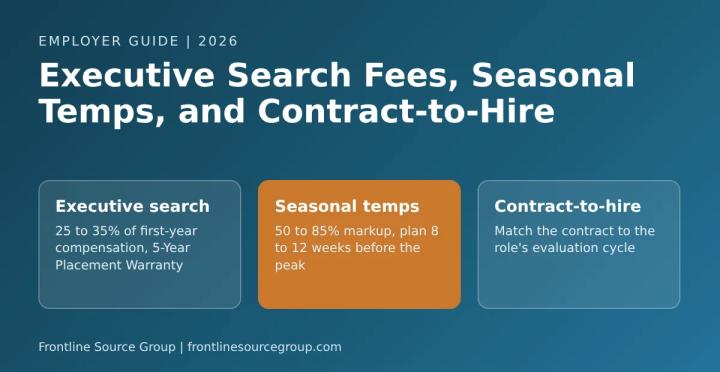
Use executive search for leadership roles where a mis-hire is expensive, temporary staffing for predictable seasonal peaks, and contract-to-hire when you want to see someone's work before committing. Frontline publishes fees for all three, from 25 to 35 percent for executive search to a 50 to 85 percent contract markup, and backs direct hires with a 5-Year Placement Warranty.
Frontline Source Group has placed professionals in executive, temporary, and contract-to-hire roles nationwide since it was founded in Dallas in 2004. The firm has completed 5,619 plus placements across 32 plus offices, holds a 98.94% executive placement retention rate, and is rated 5.0 stars on Trustpilot across 683 plus verified reviews. Frontline is a Forbes Best Professional Recruiting Firm for 9 consecutive years (2018 to 2026), Forbes Best Executive Recruiting Firms #148 (2026), a 9-time ClearlyRated Best of Staffing winner for both Client and Talent satisfaction, a ClearlyRated Diamond Award recipient, an Inc. 5000 honoree, an Expertise.com Best Staffing Agency, and a member of the American Staffing Association (ASA). See the full list on the staffing awards page.
Most companies juggle more than one of these at once: a leadership search, a holiday surge, and a contract worker they are thinking about keeping. Each has its own pricing, risks, and best practices, and mixing them up leads to budget surprises and bad hires. This guide takes them one at a time.
Key takeaways
- Executive search fees usually run a percentage of first-year compensation; Frontline publishes 25 to 35 percent.
- A 90-day replacement guarantee is the industry norm, but executive onboarding failures often show up later; read the terms before you sign.
- Retailers expect to hire 325,000 to 375,000 seasonal workers for the 2026 holidays, so plan seasonal staffing 8 to 12 weeks before the peak.
- Contract-to-hire works best when the contract length matches the role's natural evaluation cycle, such as close cycles in accounting or project milestones in IT.
- Get conversion terms in writing before a contract-to-hire assignment starts.
On this page
How do executive search, seasonal temporary staffing, and contract-to-hire compare?
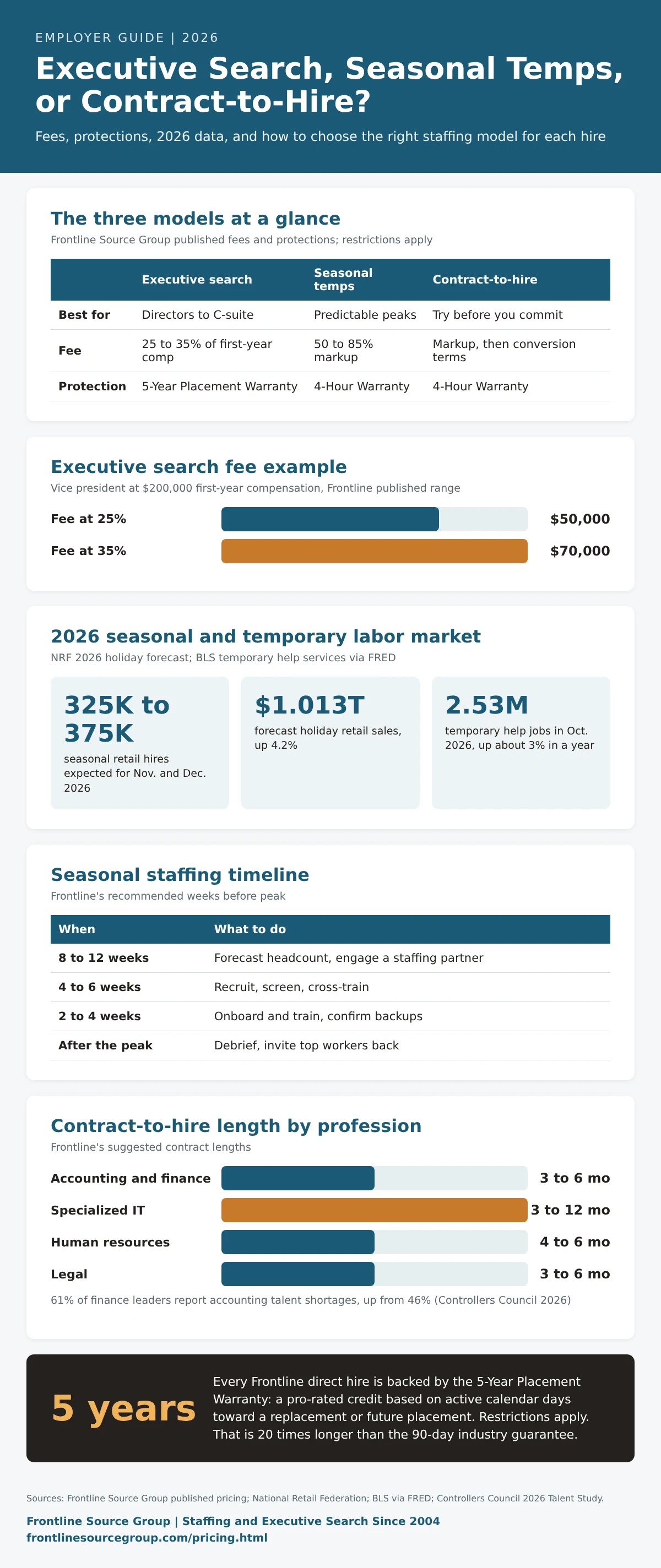
Each model solves a different problem. The table below shows how they differ on purpose, billing, and protection, using Frontline's published pricing.
| Executive search | Seasonal temporary staffing | Contract-to-hire | |
|---|---|---|---|
| Best for | Directors, VPs, and C-suite roles | Predictable peaks in volume | Roles you want to evaluate before committing |
| Who employs the worker | Your company, from day one | The staffing firm | The staffing firm, then your company after conversion |
| How it is billed | 25 to 35% of first-year compensation | 50 to 85% markup on pay rate | Markup during the contract; conversion terms in the agreement |
| Protection | 5-Year Placement Warranty | 4-Hour Warranty | 4-Hour Warranty during the contract |
| Biggest risk | A costly leadership mis-hire | Starting too late in a tight labor pool | Losing a strong worker by waiting too long to convert |
How much do executive search firms charge?
Executive search is the most expensive hiring investment most companies make, and the fee structure is often the least understood part of it. Fees vary with the engagement model, the role's difficulty, and the protection the firm offers. Get clarity on all three before signing.
| Model | How it works | Best for |
|---|---|---|
| Retained search | Part of the fee is paid up front, the rest in installments or at placement; the firm works the search exclusively | C-suite, board, and confidential searches |
| Contingency search | The fee is paid only when a hire is made | Director and some VP roles with larger candidate pools |
| Container search | A partial up-front payment that is credited toward the final fee | Roles that need dedicated effort without a full retainer |
Frontline's executive search fee is 25 to 35 percent of first-year compensation, on a contingency or retained basis. For a vice president earning $200,000, that is $50,000 to $70,000. Frontline also offers engaged search, a fixed-fee option for specialized roles that starts with a $2,500 initial engagement fee and a payment plan. Firms that will not share their fee structure before a sales call are telling you something about how the engagement will go. For a deeper comparison, see retained vs. contingency executive search, and for help deciding whether you need a search firm at all, see 10 signs it is time to hire an executive search firm.
Two details to confirm in writing: whether the percentage applies to base salary only or to total cash compensation including bonuses, and, for retained searches, what triggers each installment. SHRM's 2026 recruiting benchmarking puts the median executive cost per hire at $15,000 and median time to fill at 45 days, useful context when you weigh a search fee against the time and cost of running a search yourself.
What does an executive search guarantee actually cover?
Most search firms offer a replacement guarantee, and the industry standard is roughly 90 days. That headline number leaves a lot out: whether the replacement is free or credited, what counts as a failed placement, and what voids the coverage. Ask before you sign:
- Is the replacement search free, or is the original fee credited on a sliding scale?
- Does coverage include voluntary resignations, or only terminations?
- What voids it, such as a changed role, undisclosed compensation changes, or a layoff?
- Is there an option if the hire is promoted and you need to backfill the original role?
Ninety days is short for a senior hire. Michael D. Watkins of IMD, author of The First 90 Days, notes that studies have shown executive onboarding failure rates of 25 to 40 percent, and many of those failures surface well after the first three months. That is why coverage length is a real differentiator. Frontline backs every direct hire with the 5-Year Placement Warranty: if the hire leaves within five years, Frontline provides a pro-rated credit based on active calendar days toward a replacement or future placement. Restrictions apply. Frontline's article on what executive search guarantees protect covers the exclusions to look for.
How to structure the engagement. Define the role precisely before the first call: must-have competencies, reporting line, compensation band, and cultural non-negotiables. Get the fee model and payment schedule in writing. Review the guarantee and what voids it. Agree on how often you will get pipeline updates and how many qualified candidates you expect to see. Then plan onboarding before the offer goes out, including who owns the new leader's first 90 days and what success looks like at 30, 60, and 90 days.
How do you staff up for seasonal demand without overhiring?
Seasonal peaks are predictable; the companies that struggle with them are usually caught off guard by their own lack of preparation, not the volume. The National Retail Federation expects retailers to hire between 325,000 and 375,000 seasonal workers for November and December 2026, in line with an estimated 356,000 the year before, even as it forecasts holiday sales growth of 4.2 percent to $1.013 trillion. Mark Mathews, NRF Chief Economist and Executive Director of Research, described retailers and other industries working through what he called a
"...low hire, low fire environment."
Mark Mathews, Chief Economist and Executive Director of Research, National Retail Federation, as reported by Retail Dive (October 2026)
Temporary staffing is growing again. U.S. temporary help services employment reached about 2.53 million in October 2026, up roughly 74,000 jobs, or 3 percent, from a year earlier, according to Bureau of Labor Statistics data, and the American Staffing Association reported temporary and contract payroll up 3.8 percent year over year in the second quarter of 2026. Frontline's temporary staffing page covers how temporary placements work.
How do you forecast seasonal headcount?
Before you call a staffing partner or post a job, you need a number by role, by week, and by shift. Start with the last three to five years of peak-period data:
- Total labor hours worked during each peak
- Which roles hit capacity first
- Where productivity slipped or quality and safety issues rose
- How long the peak actually lasted compared with what you planned for
Then adjust for what has changed: new products or markets, automation that reduces some tasks, and the economic outlook. The math is simple: expected workload minus the capacity of your current team equals your temporary staffing gap. Build three scenarios, conservative, baseline, and high demand, so you already know what to do if the season over- or underperforms.
Set a workforce mix. Not every peak role should be temporary. Keep quality-sensitive work, training, and anything that depends on institutional knowledge with your permanent team, and use temporary workers for high-volume, repeatable tasks that scale with demand. Mixing experienced temporary workers with first-time seasonal hires gives you more stability than relying entirely on new people. Frontline's seasonal staffing plan framework goes deeper on building the plan.
What should you ask a staffing partner before peak season?
- Do you recruit regularly for my industry and role types?
- How many workers can you support at the peak, and what happens if demand jumps?
- What is your markup, and what does it include: payroll taxes, workers' compensation, unemployment insurance, benefits?
- What happens if a worker is not a fit on the first day?
- Who handles timekeeping and payroll, and how often?
Frontline's published contract and temporary staffing markup is 50 to 85 percent of the worker's pay rate, based on skill level and contract duration, and it covers payroll, benefits, and weekly timekeeping. Every temporary placement carries Frontline's 4-Hour Warranty: if you are not satisfied in the first four hours, the worker is replaced and those hours are not billed. Restrictions apply. Frontline's guides to temporary staffing pricing and bill rate vs. pay rate explain the math.
Onboard at scale without cutting corners. The most common seasonal failure is onboarding, not recruiting. Have logins, safety equipment, uniforms, and workstations ready before day one. Train each person on the tasks they will actually do first. Pair new workers with experienced team members for the first week, and hold short daily check-ins for the first two weeks to catch problems before they show up in output or safety.
When should you start releasing seasonal workers?
Most plans cover the ramp-up; far fewer cover the ramp-down. Decide your triggers before the season starts, such as order volume or transactions falling below a set level, overtime for your permanent team returning to normal, or the backlog clearing. Release people respectfully and with notice. Workers treated well are far more likely to come back next year, and a pool of returning seasonal workers cuts your recruiting work and raises quality every season.
Seasonal staffing planning timeline
| Weeks before peak | Key actions |
|---|---|
| 8 to 12 weeks | Finalize the headcount forecast, engage your staffing partner, write job descriptions |
| 4 to 6 weeks | Recruit and screen; cross-train your current team |
| 2 to 4 weeks | Onboard and train new workers; confirm backup coverage |
| Peak season | Monitor daily, recognize top performers, flag potential permanent hires |
| After the season | Debrief, document what worked, and invite your best workers back |
What is contract-to-hire, and how does it work?
In a contract-to-hire arrangement, the staffing firm employs the worker on its W-2 payroll for a defined contract period while you evaluate performance, fit, and long-term potential. At the end, you can convert the worker to a permanent employee, extend the contract, or end the assignment. It has become a mainstream way to hire, because it lets employers see real work before making a permanent commitment.
The key financial detail is the conversion fee. Many staffing firms charge one if you hire before the contract term ends, and terms vary widely after that. Confirm them in writing before the assignment starts. At Frontline, conversion terms are set in the written client agreement. Frontline's temp-to-hire staffing guide covers the costs and process in more detail, and our contract-to-hire article explains how fees and timing work.
Confirm the employment model, too. Under a proper W-2 arrangement, the staffing firm handles payroll taxes, withholding, and workers' compensation. If a firm places people as 1099 independent contractors, misclassification risk can shift to you. I am not a lawyer, and this is not legal advice; talk with employment counsel about your specific arrangement.
Which professions are best suited to contract-to-hire?
The model works differently by discipline. A 90-day evaluation fits some roles well and is far too short for others. Here is how to calibrate it.
How does contract-to-hire work for accounting and finance roles?
Accounting is facing a real talent squeeze. In the Controllers Council's 2026 Corporate Finance and Accounting Talent Study, 61 percent of finance leaders reported talent shortages, up from 46 percent a year earlier, and 44 percent named controllers and assistant controllers as the hardest finance roles to fill. Contract-to-hire works well for backfills and leave coverage that may become permanent, for year-end close, audit preparation, and ERP projects, and for controller-level hires where leadership style matters as much as technical skill. A contract of 3 to 6 months usually covers enough close cycles to give you real performance data. See Frontline's accounting and finance staffing practice.
How does contract-to-hire work for IT roles?
IT is where contract-to-hire is most established. It fits cybersecurity and data roles, where a trial period verifies hands-on skills that are hard to judge in an interview; cloud and DevOps work that naturally follows project milestones; and AI implementation, where the scope is still evolving and a permanent hire may be premature. Plan on 3 to 12 months and tie the length to a project milestone rather than a calendar date. See Frontline's IT staffing practice.
How does contract-to-hire work for HR and legal roles?
HR professionals are judged on influence and relationships, which take longer to see than technical output, so plan 4 to 6 months. Good fits include HR business partners during a reorganization, compensation and benefits analysts on a defined project, and talent acquisition specialists while permanent headcount is pending. In legal, contract-to-hire is common for in-house paralegals and legal operations specialists supporting a department build-out, contract attorneys on a defined matter, and compliance analysts during an audit or regulatory cycle; 3 to 6 months usually aligns with a natural matter or filing endpoint. See Frontline's HR staffing and legal staffing practices.
| Profession | Best uses | Suggested contract length | What to evaluate |
|---|---|---|---|
| Accounting and finance | Backfills, audit prep, ERP projects, controller evaluation | 3 to 6 months | Close cycle performance, accuracy, process improvement |
| IT (specialized) | Cybersecurity, cloud, AI implementation | 3 to 12 months | Project delivery, technical depth, documentation |
| Human resources | HRBP during a reorg, recruiting during growth, comp and benefits projects | 4 to 6 months | Relationships, business judgment, follow-through |
| Legal | In-house paralegal, contract attorney, compliance analyst | 3 to 6 months | Matter management, accuracy, communication with the business |
How should you make the conversion decision?
Treat the contract as an evaluation, not an automatic path to a permanent job. At the midpoint, sit down with the hiring manager and answer three questions: Is the worker performing at the level you expect from a permanent hire? Has the role changed in a way that affects the decision? Does the worker want to convert? If all three answers are yes, start the conversion conversation before the contract ends. Waiting until the final week creates uncertainty and risks losing the person to another offer, and any conversion fee is almost always cheaper than restarting the search.
What are the pros and cons of each staffing model?
| Model | Potential benefits | Potential drawbacks |
|---|---|---|
| Executive search | Access to employed leaders who are not looking; confidential process; long-term protection | Highest fee of the three; retained fees are paid before a hire is made |
| Seasonal temporary staffing | Flexible headcount; payroll and benefits handled by the staffing firm; no long-term commitment | Markup on every hour; onboarding and quality risk if you start late |
| Contract-to-hire | See real work before committing; lower risk of a bad permanent hire | Some strong candidates prefer permanent offers; conversion fees vary by firm |
How does Frontline Source Group price and protect each model?
Frontline publishes its fees on its pricing page: direct hire placements are 20 to 30 percent of first-year base salary, executive search is 25 to 35 percent of first-year compensation, engaged search starts at a $2,500 initial engagement fee, and contract and temporary staffing carry a 50 to 85 percent markup. Direct hires are backed by the 5-Year Placement Warranty, 20 times longer than the 90-day guarantee common in the industry, and the Promotion Protection Plan covers backfilling a placed employee who is promoted, at 50 percent of the placement percentage originally paid. Temporary and contract workers carry the 4-Hour Warranty. Restrictions apply to each.
AI helps Frontline respond to more candidates, but people make the decisions. Lexi Reed, Frontline's AI recruiter, may conduct a first-level phone interview, and Joy Lee, its AI executive recruiter, researches and maps the market for leadership searches. A human recruiter reviews every candidate, and candidates complete skills testing where the role calls for it.
How do you choose the right model for your next hire?
Start with the question each model answers. If the cost of getting it wrong is high and the right person is not looking, use executive search. If the need is predictable and temporary, plan seasonal staffing early. If you want to see the work before you commit, use contract-to-hire with clear conversion terms. Many companies use all three in the same year, and the staffing partner you choose for each sets the ceiling on the results. Employers can submit any of these through the employer request form, and job seekers can start at how to apply.
What do employers ask most about search fees, seasonal staffing, and contract-to-hire?
How much do executive search firms charge?
Most executive search fees are a percentage of the hire's first-year compensation. Frontline Source Group publishes its rate: 25 to 35 percent of first-year compensation on a contingency or retained basis, so a $200,000 vice president search runs $50,000 to $70,000. Engaged search starts with a $2,500 initial engagement fee. See frontlinesourcegroup.com/pricing.html.
What is the difference between retained, contingency, and engaged search?
Retained search is paid partly up front, with the rest in installments or at placement, and the firm works the search exclusively. Contingency search is paid only when a hire is made. Container search takes a partial payment up front that is credited toward the final fee. Frontline's engaged search is a fixed-fee option for specialized roles, starting with a $2,500 initial engagement fee and a payment plan.
What does an executive search guarantee cover?
Most firms offer a replacement guarantee of about 90 days. Ask whether a replacement is free or credited, whether voluntary resignations are covered, what voids the guarantee, and whether there is an option if the person is promoted. Frontline backs every direct hire with a 5-Year Placement Warranty, 20 times longer than the 90-day industry standard.
How does the 5-Year Placement Warranty work?
If a Frontline direct hire leaves within five years, Frontline provides a pro-rated credit based on active calendar days toward a replacement or future placement. Restrictions apply. A separate Promotion Protection Plan covers backfilling a placed employee who is promoted, at 50 percent of the placement percentage originally paid. Terms are at frontlinesourcegroup.com/5year-placement-guarantee.html.
How far ahead should I plan seasonal staffing?
Start well before the peak. Frontline recommends finalizing the headcount forecast and engaging a staffing partner 8 to 12 weeks before demand rises, recruiting 4 to 6 weeks out, and onboarding 2 to 4 weeks out, because the strongest temporary workers are placed early.
How many seasonal workers are retailers hiring in 2026?
The National Retail Federation expects retailers to hire between 325,000 and 375,000 seasonal workers for November and December 2026, in line with an estimated 356,000 the year before, while forecasting holiday sales growth of 4.2 percent to $1.013 trillion.
What is a typical temporary staffing markup?
Frontline's published contract and temporary staffing markup is 50 to 85 percent of the worker's pay rate, based on skill level and contract duration. The markup covers payroll taxes, workers' compensation, unemployment insurance, and benefits administration, along with weekly timekeeping.
What does contract to hire mean?
Contract to hire means a staffing firm employs the worker on its W-2 payroll for a set contract period while the employer evaluates the person's work. At the end, the employer can convert the worker to a permanent employee, extend the contract, or end the assignment. Conversion terms should be set in writing before the contract starts.
How long should a contract-to-hire period last?
Match it to the role's natural evaluation cycle. Frontline generally suggests 3 to 6 months for accounting and legal roles, 3 to 12 months for specialized IT projects, and 4 to 6 months for HR roles that depend on building relationships across the company.
Which professions work best for contract-to-hire?
Roles with clear, observable deliverables work best: accounting and finance around close cycles and system projects, specialized IT such as cybersecurity and cloud, HR business partners during reorganizations, and in-house legal support tied to a defined matter or compliance cycle.
Is there a fee to convert a contract worker to permanent?
Many staffing firms charge a conversion fee, especially if the employer hires before the contract term ends. Terms vary by firm and are set in the written agreement, so confirm them before the contract starts. Weigh any fee against the cost of losing a strong worker to another offer.
How do I start a search or staffing request with Frontline Source Group?
Employers can submit an executive search, temporary, or contract-to-hire request at frontlinesourcegroup.com/employer-request-form.html and review fees at frontlinesourcegroup.com/pricing.html. Job seekers apply at frontlinesourcegroup.com/how-to-apply.html.
Sources: National Retail Federation, 2026 holiday forecast; Retail Dive, NRF 2026 holiday forecast coverage; Bureau of Labor Statistics, Temporary Help Services employment (FRED); American Staffing Association, Q2 2026 staffing industry report; CFO.com, Controllers Council 2026 talent study coverage; Controllers Council, controllers remain the hardest finance role to fill; IMD, Michael D. Watkins on executive onboarding; SHRM, 2026 Recruiting Executives Benchmarking.


