Is LinkedIn Identity Verification Worth It for Your Career?

Published on: Apr 23, 2025
Updated on: October 7, 2026
Yes, LinkedIn identity verification is worth it for almost every job seeker. It is free, it confirms you are a real person with a government ID or work email, and LinkedIn reports that verified members see up to 60 percent more profile views. It also makes you harder to impersonate and helps you spot fake recruiters. Frontline Source Group has completed 5,619 plus placements since 2004, and we back every direct hire with the 5-Year Placement Warranty, 20 times longer than the 90-day industry standard.
A little about who is giving this advice. Frontline Source Group holds a 98.94% executive placement retention rate, well above the roughly 70 percent industry average, and operates 32 plus offices nationwide. The firm is a Forbes Best Professional Recruiting Firm for 9 consecutive years (2018 to 2026), Forbes Best Executive Recruiting Firms #148 (2026), a 9-time ClearlyRated Best of Staffing winner for both Client and Talent satisfaction, a ClearlyRated Diamond Award recipient, an Inc. 5000 honoree, and an Expertise.com Best Staffing Agency. We are a member of the American Staffing Association and hold a 5.0-star Trustpilot rating across 678 plus verified reviews.
What is LinkedIn identity verification?
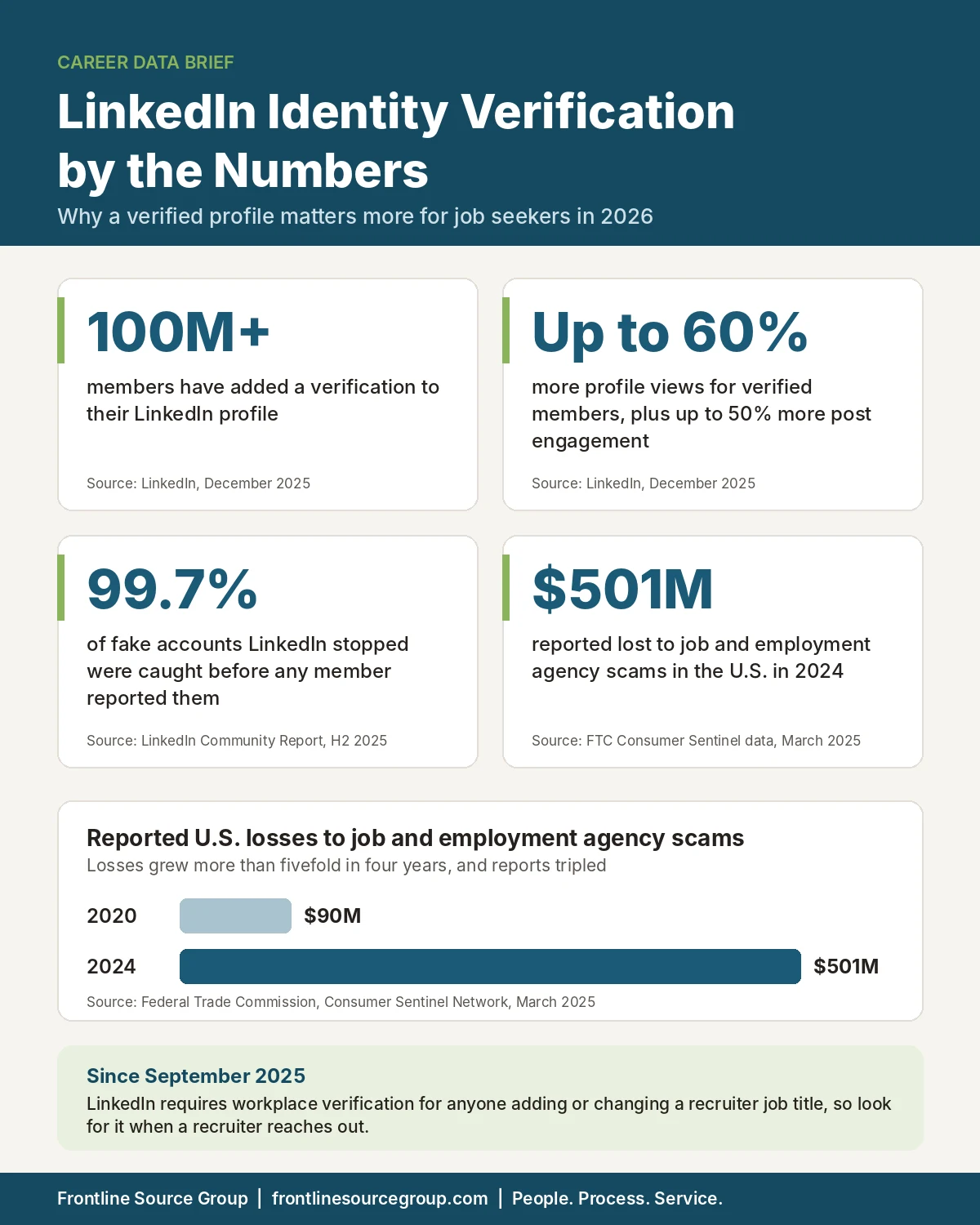
LinkedIn identity verification is a free feature that confirms a profile belongs to a real, specific person. Once you finish it, a verification badge appears next to your name, and anyone who clicks into your profile can see what was verified. Your ID itself is never shown. LinkedIn announced in December 2025 that more than 100 million members have now added a verification, and the company has said its goal is for every member, job, and company page to carry at least one.
What is the difference between identity and workplace verification?
Identity verification confirms that you are who your name says you are, usually by checking a government-issued ID. Workplace verification confirms where you work, most often by having you confirm a company email address. They answer different questions. Identity verification tells a recruiter you are a real person. Workplace verification tells them your current job title is not made up. If you are employed, doing both gives people the fullest picture.
Is LinkedIn verification worth it for job seekers?
For most people, yes. A recruiter scanning profiles is making snap judgments, and anything that raises a doubt about whether a profile is real works against you. LinkedIn's own data shows verified members get up to 60 percent more profile views and up to 50 percent more engagement on their posts. In our experience reviewing candidate profiles every day, a verified badge does not get anyone hired by itself, but it removes one reason to scroll past. As more professionals verify, an unverified profile starts to stand out for the wrong reason.
How does verification protect you from impersonation and job scams?
Fake accounts are built to borrow trust from real people. Someone copies your photo, title, and work history, then uses that borrowed credibility to message your contacts. A verified badge on your real profile makes the copy much easier to spot. LinkedIn's Community Report for July through December 2025 says 99.7 percent of the fake accounts it stopped were caught before any member reported them, which is good news, but the ones that slip through are the ones built to fool you.
How big is the job scam problem?
Bigger than most people think. According to the Federal Trade Commission, reported losses to job and employment agency scams rose from 90 million dollars in 2020 to 501 million dollars in 2024, and the number of reports tripled over the same stretch. Many of these scams start with a recruiter message that looks real. Job seekers are the target because they are expecting to hear from strangers about opportunities.
How can you tell if a recruiter on LinkedIn is real?
Start with the badge. Since September 2025, LinkedIn requires anyone who adds or changes a recruiter-related job title to verify their workplace, and people with senior titles such as Vice President are asked to verify as well. Recruiters who held the title before that change were not required to verify right away, so a missing badge is a reason to look closer, not proof of fraud. Then check the basics:
- The recruiter's email should come from the company's own domain, not a free email service.
- A legitimate recruiter will never ask you to pay a fee, buy equipment up front, or send gift cards.
- Requests for your bank details or Social Security number before a real offer are a red flag.
- Pressure to move the conversation to a texting app right away is another warning sign.
For Frontline specifically: every member of our team uses an @frtline.com email address, and nobody at Frontline will ever contact you from Gmail or another free email account. Frontline operates only in the United States and does not place people in foreign countries. If you are unsure whether someone represents us, email our Legal Department at legal@frtline.com before you share anything. If you hear from Lexi Reed, our AI recruiter, that call only happens after you apply for a job or upload a resume to our system, so a call from Lexi out of nowhere did not come from us.
What should you do if someone is impersonating you?
Report the fake profile to LinkedIn from the menu on that profile, and ask a few trusted connections to report it too. Post a short note to your network letting people know there is a copy of your account and that you will never ask them for money. Then verify your real profile if you have not already, so anyone comparing the two can tell which one is you.
How do you verify your identity on LinkedIn?
Open your own profile and look for the option to add a verification. LinkedIn walks you through the steps from there. The options you see depend on your country and account, and LinkedIn adjusts them from time to time, so treat the descriptions below as a guide and follow whatever your account screen shows.
How do you verify with a government ID?
In the United States, LinkedIn runs the ID check through its partner CLEAR. In many other countries it uses a partner called Persona. You will typically be asked to photograph your ID and take a selfie so the partner can match the two. When the check passes, the badge shows up on your profile.
How do you verify your workplace?
Workplace verification usually means confirming a company email address. LinkedIn sends a code to your work inbox, you enter it, and your current role gets marked as verified. If you are between jobs, skip this one and do the identity check instead. You can add workplace verification later once you land your next role.
Will your personal documents be visible to others?
No. This is the most common worry we hear, and it keeps people from a step that is low risk. People who view your profile see that you are verified and what kind of verification you completed. They do not see your ID, your ID number, or your selfie. The ID check is handled by the verification partner, so if data handling matters to you, read that partner's privacy terms before you start.
Does LinkedIn verification cost anything?
Identity and workplace verification are free for individual members. You do not need a Premium subscription. The one paid piece is on the company side: as of September 2025, company page verification is open to businesses with a Premium Company Page subscription. For a job seeker, the real question is not whether it is worth the money, because there is no money involved. It is whether you have any good reason to skip it, and for most people the answer is no.
How should you make the most of a verified profile?
Verification helps people trust the profile. The rest of the profile still has to do the selling. Lead your headline with the value you bring, use a recent professional photo, and write an about section that points toward the roles you want. Our guide to what the LinkedIn about section is for and these examples of effective LinkedIn bios are good places to start. If you are targeting senior roles, read our advice on optimizing your LinkedIn profile for executive recruiters, and for a full search plan, download the LinkedIn Job Search Playbook.

How does Frontline Source Group help job seekers and employers?
Frontline Source Group connects professionals with contract, contract-to-hire, and direct hire roles across accounting and finance, technology, human resources, legal, administrative, engineering, energy, dental, pharmacy, and C-suite executive search. A verified, well-built LinkedIn profile makes a candidate easier for us to present to a hiring manager. For employers, every direct hire comes with the 5-Year Placement Warranty, which is 20 times longer than the 90-day guarantee common in the staffing industry. Job seekers can browse resources on our candidates page.
What makes Frontline Source Group different?
Three things stand out. First, the 5-Year Placement Warranty: if a direct hire placement does not work out within five years, Frontline replaces the candidate at no additional fee. Second, results that hold up over time, with a 98.94% retention rate across 5,619 plus placements since 2004. Third, transparency. We publish our pricing so hiring leaders understand the model before they engage, and our recognition, from Forbes for 9 consecutive years to ClearlyRated's Diamond Award, is listed on our staffing awards page. People. Process. Service. is more than a tagline for us.
How do you get started with Frontline Source Group?
If you are a job seeker, introduce yourself and submit your resume through our how to apply page. If you are an employer with a hiring need, start a search with the employer request form and review engagement details on our pricing page. Every direct hire is backed by the 5-Year Placement Warranty.
Frequently Asked Questions: LinkedIn Identity Verification
What is LinkedIn identity verification?
It is a free LinkedIn feature that confirms a profile belongs to a real person, usually by checking a government-issued ID through a partner such as CLEAR in the United States or Persona in many other countries. A verification badge appears on your profile, and your ID itself stays private.
Is LinkedIn identity verification worth it?
For most job seekers, yes. It is free, LinkedIn reports that verified members get up to 60 percent more profile views and up to 50 percent more post engagement, and it makes your profile harder to impersonate. It will not land you a job on its own, but it removes a reason for a recruiter to doubt you.
Is LinkedIn identity verification mandatory?
Not for most members. Since September 2025, LinkedIn has required workplace verification for anyone who adds or changes a recruiter-related job title, and it asks people with senior titles such as Vice President to verify as well. Everyone else can choose whether to verify.
Is LinkedIn verification free?
Yes. Identity and workplace verification are free for individual members and do not require Premium. Company page verification is the paid exception, available to businesses with a Premium Company Page subscription.
Will my ID be visible on my LinkedIn profile?
No. People who view your profile see that you are verified and what type of verification you completed. They never see your ID, your ID number, or the selfie used in the check. The verification partner handles the document, so review its privacy terms if that matters to you.
What is the difference between identity and workplace verification?
Identity verification confirms you are a real person, usually with a government ID. Workplace verification confirms where you work, usually by confirming a company email address. If you are currently employed, completing both gives recruiters the most complete picture.
How do I verify my identity on LinkedIn?
Open your own profile and choose the option to add a verification, then follow the prompts. For identity, you will usually photograph your government ID and take a selfie for the verification partner. For workplace, you confirm a code sent to your company email. Available options vary by country and change over time.
How can I tell if a recruiter on LinkedIn is legitimate?
Look for a workplace verification badge, and confirm the recruiter emails you from the company's own domain rather than a free email service. A legitimate recruiter will never ask you to pay a fee, buy equipment, send gift cards, or share bank details before a real offer.
How do I confirm a recruiter really works for Frontline Source Group?
Every Frontline team member uses an @frtline.com email address, and no one at Frontline will contact you from Gmail or another free email service. Frontline operates only in the United States and does not place people in foreign countries. If you have any doubt, email the Frontline Legal Department at legal@frtline.com before sharing personal information.
What should I do if someone is impersonating me on LinkedIn?
Report the fake profile to LinkedIn from that profile's menu and ask a few trusted connections to report it as well. Let your network know there is a copy of your account, then verify your real profile so people can tell the two apart.
What is the Frontline 5-Year Placement Warranty?
The 5-Year Placement Warranty means that if a direct hire placement does not work out within five years, Frontline replaces the candidate at no additional fee. The staffing industry standard guarantee is 90 days, so Frontline's coverage is 20 times longer. Details are at frontlinesourcegroup.com/5year-placement-guarantee.html.
How do I get started with Frontline Source Group?
Job seekers can submit a resume at frontlinesourcegroup.com/how-to-apply.html. Employers can start a search at frontlinesourcegroup.com/employer-request-form.html and review engagement details at frontlinesourcegroup.com/pricing.html. Every direct hire is backed by the 5-Year Placement Warranty.


