What Does a Legal Recruiter Do, and How Does the Process Work?

Published on: Jan 8, 2025
Updated on: November 6, 2026.
A legal recruiter matches attorneys, paralegals, legal secretaries, and corporate counsel to the right roles. The recruiter learns what the firm needs and what the candidate wants, then runs sourcing, screening, interviews, and the offer. Frontline Source Group has completed 5,619+ placements since 2004 and backs every direct hire with the 5-Year Placement Warranty. That warranty runs 20x longer than the 90-day guarantee that is standard across the staffing industry.
Frontline holds a 98.94% executive placement retention rate and operates 32+ offices nationwide. The firm has been named a Forbes Best Professional Recruiting Firm for 9 consecutive years (2018 to 2026) and Forbes Best Executive Recruiting Firms #148 (2026). It is a 9-time ClearlyRated Best of Staffing winner for both Client and Talent satisfaction, a ClearlyRated Diamond Award recipient, an Inc. 5000 honoree, an Expertise.com Best Staffing Agency, and a member of the American Staffing Association (ASA). Clients rate Frontline 5.0 stars across 683+ verified reviews on Trustpilot, with a matching 5.0 rating on G2 from validated reviewers.
In this guide
- What a legal recruiter does
- Which legal roles recruiters place
- The 2026 legal hiring market
- How the process works for candidates
- How recruiters help law firms and legal teams
- Who pays a legal recruiter
- Why use a specialized legal recruiter
- Pros and cons of using a legal recruiter
- Who handles legal recruiting at Frontline
- What makes Frontline different
- How to get started
- Frequently asked questions
What does a legal recruiter actually do?
A legal recruiter does far more than forward resumes. The job is to sit between legal talent and the organizations that need it, and to make both sides better informed before anyone commits to an interview.
How does a legal recruiter evaluate candidates beyond the resume?
A good legal recruiter maps a candidate's practice area, matter experience, bar admissions, technology skills, and career goals, then matches them to roles where they will perform and grow. The evaluation is about substance, not a job title. A litigation paralegal who has managed federal e-filing and trial binders is a very different hire from one who has mostly handled intake, even if the titles match.
Which services sit inside a managed legal search?
A managed search covers confidential sourcing of passive candidates, structured screening, compensation benchmarking, interview coordination, and offer guidance. It is run by someone who understands how law firms and legal departments actually work, including conflicts, confidentiality, and billable-hour expectations.
Which legal roles does a legal recruiter place?
Legal hiring covers a wide range of roles, and each one calls for a different skill set. A specialized legal recruiter places:
- Senior, partner-track, and lateral attorneys
- In-house and corporate counsel, including general counsel and fractional chief legal officers
- Litigation and transactional associates
- Paralegals, legal assistants, and legal secretaries
- Contract and project attorneys, document review, and eDiscovery teams
- Compliance, contracts, and legal operations professionals
Because every role and every candidate is different, legal recruiting is never one-size-fits-all. The recruiter's job is to make sense of that complexity for both sides. You can see current examples on Frontline's remote litigation paralegal and Dallas legal office assistant openings.
What does the legal hiring market look like in 2026?
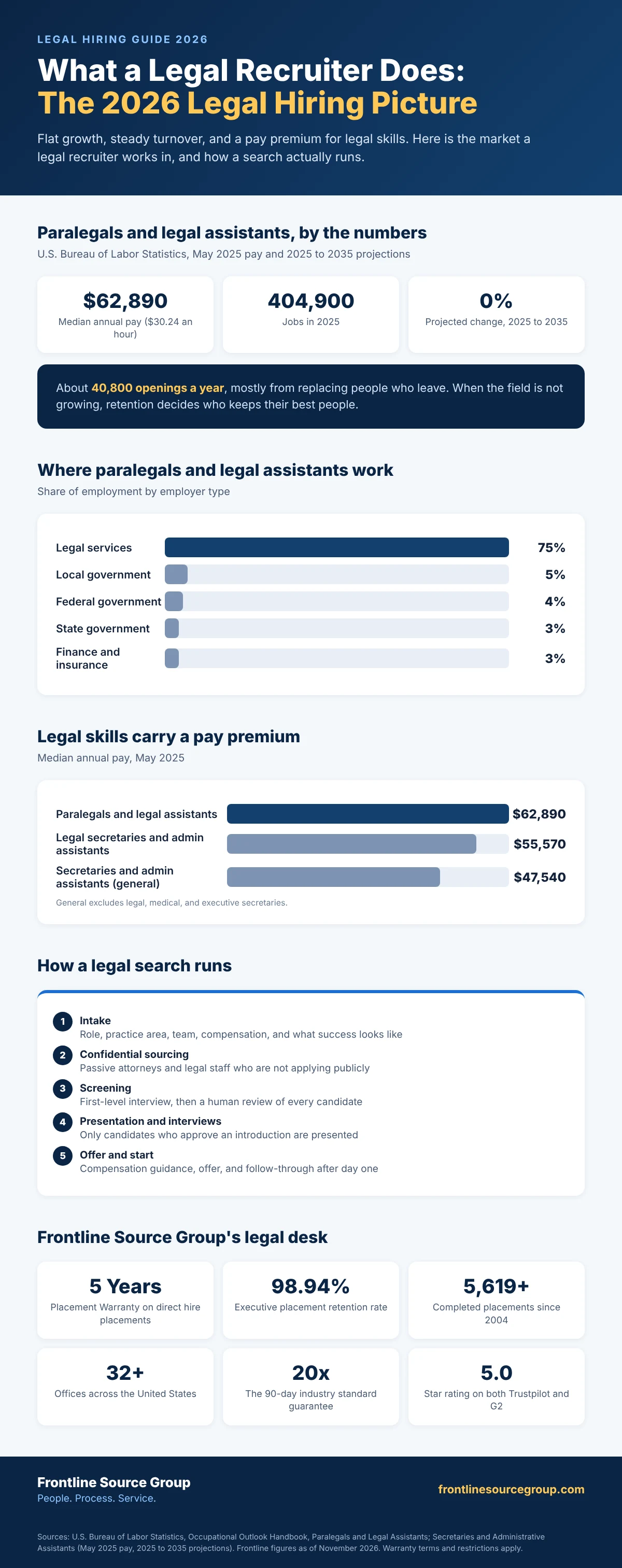
The support side of the legal market is not growing, but it is turning over constantly. According to the U.S. Bureau of Labor Statistics, paralegals and legal assistants earned a median of $62,890 a year ($30.24 an hour) in May 2025. The field held 404,900 jobs in 2025, and BLS projects no change in employment from 2025 to 2035. Even so, BLS expects about 40,800 openings a year, mostly from replacing workers who leave the occupation or transfer to other jobs.
Three quarters of paralegals and legal assistants work in legal services, with the rest spread across government and finance and insurance. Legal skills also carry a pay premium. BLS reports a May 2025 median of $55,570 for legal secretaries and administrative assistants, compared with $47,540 for secretaries and administrative assistants outside the legal, medical, and executive specialties. For law firms, that combination means the hiring challenge is less about finding new headcount and more about replacing good people and keeping them.
How does the legal recruiting process work for candidates?
For a candidate, the process is structured, personal, and confidential from the first conversation to the accepted offer.
What happens after you apply with a legal recruiter?
At Frontline, everything starts online. Candidates apply through frontlinesourcegroup.com/how-to-apply.html or for a specific opening on the jobs board. After you apply, Lexi Reed, Frontline's AI recruiter, conducts a first-level interview about your experience and goals. A human recruiter then reviews every candidate and calls those who meet a role's requirements. From there, the recruiter talks through your practice area, strengths, and goals, identifies roles that fit, prepares you for each interview, and represents your interests through the offer.
How is confidentiality protected during a legal job search?
Confidentiality is standard. Experienced attorneys and legal professionals can explore the market without their current employer knowing, and the recruiter only presents a candidate to a firm after the candidate approves that introduction. One practical safeguard: every Frontline recruiter emails from an @frtline.com address, never Gmail or another free account. If a message claiming to be from Frontline looks wrong, check the scam alert page first.
How does a legal recruiter help law firms and corporate legal teams?
On the hiring side, a recruiter who works across practice areas learns what a firm or legal department actually needs, including the team and culture factors a job description rarely captures. The recruiter refines the search to balance skills, experience, and fit, screens out mismatches before they reach a hiring partner, and protects the firm's time. The goal is the right hire for both sides, with fewer failed searches and stronger retention after the placement.
What should a firm share at the start of a search?
The more specific the intake, the better the slate. Share the practice area and matter mix, the software the team uses, whether the role is on-site, hybrid, or remote, the compensation range, who the person will report to, and why the last person left. That last answer often tells a recruiter more than the job description does.
"The best legal searches start with an honest intake. When a firm tells me why the last paralegal left and what a great first year looks like, I can screen for that from the first call. A resume shows what someone has done. The conversation shows whether they will stay."
Cassidy Jacobs, Senior Executive Staffing Specialist, Frontline Source Group. More than 10 years in talent acquisition and long-standing involvement with DallasHR. Read Cassidy's bio.
Who pays a legal recruiter, and how are fees structured?
The hiring organization pays the fee, not the candidate. How much depends on the engagement model, and Frontline publishes its ranges on its pricing page:
- Contract and project legal staffing: an hourly bill rate with a 50 to 85 percent markup that covers the professional's wages, payroll taxes, insurance, and recruiting margin.
- Direct hire placement: a contingent fee of 20 to 30 percent of the placed candidate's first-year base salary, depending on seniority and search complexity.
- Executive legal search: for C-suite roles such as general counsel or chief legal officer, 25 to 35 percent of first-year all-in compensation, on a contingency or retained basis.
- Engaged Search: an initial engagement fee starting at $2,500.
All major credit cards are accepted at no additional charge. For a broader look at evaluating any agency's terms, see how to compare staffing agencies on 13 criteria.
Why use a specialized legal recruiter instead of a general job search?
General job boards surface volume. A specialized legal recruiter surfaces fit. Legal hiring turns on practice-area depth, bar admissions, conflicts, confidentiality, and team dynamics that generalist channels miss. A dedicated legal recruiter brings a vetted network of passive candidates who are not applying publicly, current knowledge of compensation and demand, and a structured process that lowers hiring risk. For candidates, that means access to roles that are never posted. For firms, it means a more direct path to a qualified hire who stays.
What are the pros and cons of using a legal recruiter?
A legal recruiter is not the right answer for every hire or every job search. Here is a balanced look at both sides.
What are the advantages of working with a legal recruiter?
- For firms: access to passive candidates who are not applying publicly, screening that keeps unqualified resumes off a hiring partner's desk, current compensation data, and, at Frontline, a 5-Year Placement Warranty on direct hire placements.
- For candidates: access to roles that are never posted, a confidential search, interview preparation, and someone negotiating on your behalf at the offer stage.
What are the drawbacks of working with a legal recruiter?
- Cost for firms: direct hire fees typically run 20 to 30 percent of the placed candidate's first-year base salary, and contract staffing carries a 50 to 85 percent markup on the hourly rate. For a high-volume or entry-level role, a job posting may fill the seat for less.
- Upfront commitment: some engagement models, such as Engaged Search, require an initial fee before candidates are presented, and the firm has to invest time in a thorough intake.
- Narrower reach for candidates: a specialized recruiter can only present you for searches it is actively working. If you want to browse a broad volume of listings, general job boards will show you more openings.
- Two clients at once: the recruiter is paid by the hiring organization, so the recruiter is weighing the firm's needs as well as yours. Keep running your own search alongside it.
In practice, a legal recruiter earns its fee on specialized, senior, confidential, or hard-to-fill roles, where a bad hire costs far more than the placement fee. For routine or high-volume hiring, many firms post the job themselves first and bring in a recruiter only if the posting does not produce the right people.
Who handles legal recruiting at Frontline Source Group?
Frontline runs a dedicated legal and paralegal practice covering attorneys, paralegals, legal assistants, project attorneys, document review, litigation support, and eDiscovery. Cassidy Jacobs, Senior Executive Staffing Specialist, leads legal searches as part of her coverage across legal, accounting, technology, human resources, and other professional disciplines. I oversee the practice at the firm level, and the broader team supports law firms and corporate legal departments nationwide through legal staffing and legal executive search. Local legal teams serve markets including Dallas, Nashville, Brentwood, and Phoenix.
What makes Frontline Source Group different for legal hiring?
Three things set Frontline apart: the warranty behind every direct hire, verified retention results, and published engagement terms.
How does the 5-Year Placement Warranty change hiring risk?
Every direct hire legal placement is backed by the 5-Year Placement Warranty, 20x the 90-day industry standard guarantee. If a placement does not work out, the firm receives a pro-rated credit based on active calendar days of service, applied toward a replacement search. The Promotion Protection Plan backfills a placed employee who is promoted at 50 percent of the original placement fee, and contract placements carry a four-hour replacement provision on day one. Restrictions apply. That commitment is backed by a 98.94% executive placement retention rate across 5,619+ placements since 2004.
Why does pricing transparency matter in legal recruiting?
Most staffing firms quote fees only after a sales call. Frontline publishes its engagement models on the pricing page, so legal hiring leaders can budget before the search starts. Independent proof comes from Forbes recognition for 9 consecutive years, a 5.0-star Trustpilot rating across 683+ verified reviews, and the awards on the staffing awards page. People. Process. Service. is the standard behind all of it.
How do you get started with Frontline Source Group's legal recruiting team?
Law firms and corporate legal departments can submit a search through the employer request form and review engagement details on the pricing page. Attorneys, paralegals, and legal professionals exploring their next role can apply confidentially through frontlinesourcegroup.com/how-to-apply.html. Every direct hire is backed by the 5-Year Placement Warranty.
Frequently Asked Questions: The Role of a Legal Recruiter
What does a legal recruiter do?
A legal recruiter matches attorneys, paralegals, legal secretaries, and corporate counsel to the right roles by learning both the candidate's goals and the firm's needs. The recruiter then manages sourcing, screening, compensation benchmarking, interview coordination, and offer guidance, and evaluates fit on substance rather than job title.
Which legal roles does a legal recruiter place?
A specialized legal recruiter places partner-track and lateral attorneys, in-house and corporate counsel, litigation and transactional associates, paralegals, legal assistants and secretaries, contract and project attorneys, document review and eDiscovery teams, and compliance, contracts, and legal operations professionals.
How does the legal recruiting process work for candidates?
At Frontline, candidates apply online at frontlinesourcegroup.com/how-to-apply.html. Lexi Reed, Frontline's AI recruiter, conducts a first-level interview, and a human recruiter reviews every candidate and calls those who meet a role's requirements. The recruiter then identifies fitting roles, prepares the candidate for interviews, and represents their interests through the offer.
How does a legal recruiter help law firms?
A legal recruiter learns what a firm or legal department actually needs, including team and culture factors a job description rarely captures. The recruiter refines the search, screens out mismatches before they reach a hiring partner, and protects the firm's time, which leads to fewer failed searches and stronger retention.
Who pays a legal recruiter?
The hiring organization pays the fee, not the candidate. At Frontline, direct hire placement is a contingent fee of 20 to 30 percent of first-year base salary, and contract legal staffing uses an hourly bill rate with a 50 to 85 percent markup. Full details are at frontlinesourcegroup.com/pricing.html.
What does the legal hiring market look like in 2026?
The Bureau of Labor Statistics reports a May 2025 median of $62,890 for paralegals and legal assistants, with 404,900 jobs in 2025 and no projected change from 2025 to 2035. BLS still expects about 40,800 openings a year, mostly to replace workers who leave, so retention matters as much as recruiting.
Is the legal recruiting process confidential for candidates?
Yes. Experienced attorneys and legal professionals can explore the market without their current employer knowing, and a candidate is only presented to a firm after approving that introduction. Every Frontline recruiter uses an @frtline.com email address, and scam guidance is at frontlinesourcegroup.com/scam-alert.html.
Why use a specialized legal recruiter instead of a general job search?
Legal hiring turns on practice-area depth, bar admissions, conflicts, confidentiality, and team dynamics that generalist channels miss. A dedicated legal recruiter brings passive candidates who are not applying publicly, current compensation knowledge, and a structured process that lowers hiring risk for firms and opens unposted roles for candidates.
Who handles legal recruiting at Frontline Source Group?
Cassidy Jacobs, Senior Executive Staffing Specialist, leads legal searches as part of her coverage across legal and other professional disciplines, and Founder, President, and CEO Bill Kasko oversees the practice at the firm level. The team supports law firms and corporate legal departments nationwide.
What is the Frontline 5-Year Placement Warranty?
It is Frontline's coverage on direct hire placements, 20x the 90-day industry standard guarantee. If a placement does not work out, the client receives a pro-rated credit based on active calendar days of service toward a replacement search. Restrictions apply, and full terms are at frontlinesourcegroup.com/5year-placement-guarantee.html.
Does Frontline place contract and project attorneys?
Yes. Frontline supports contract, contract-to-hire, and direct hire legal engagements, including project attorneys, document review, litigation support, and eDiscovery teams, alongside permanent attorney, paralegal, and legal operations placements. Contract placements carry a four-hour replacement provision on day one, and restrictions apply.
How do I start a legal search with Frontline Source Group?
Law firms and corporate legal departments start at frontlinesourcegroup.com/employer-request-form.html and can review engagement models at frontlinesourcegroup.com/pricing.html. Attorneys, paralegals, and legal professionals can apply confidentially at frontlinesourcegroup.com/how-to-apply.html. Every direct hire is backed by the 5-Year Placement Warranty.


