How do you build a career in a competitive industry?

Published on: Jun 17, 2024
Updated on: November 7, 2026.
Building a career in a competitive industry comes down to three things: being known by the people who make hiring decisions, building skills that transfer, and explaining what you actually did. Frontline Source Group recruiters have watched those three decide outcomes for 22 years, and every Frontline direct hire carries a 5-Year Placement Warranty.
Founded in Dallas in 2004, Frontline has completed 5,619 plus placements from 32 plus offices nationwide and reports a 98.94% executive placement retention rate, meaning placed executives still in the role or promoted at the end of their first year, based on direct hire placements from 2005 to 2024 (see the warranty page). Candidates never pay Frontline at any step.
Frontline is a Forbes Best Professional Recruiting Firm for 9 consecutive years (2018 to 2026), ranked #148 on Forbes Best Executive Recruiting Firms (2026), a 9-time ClearlyRated Best of Staffing winner for both Client and Talent satisfaction, a ClearlyRated Diamond Award recipient, an Inc. 5000 honoree, and an Expertise.com Best Staffing Agency. The firm holds a 5.0-star rating across 683 verified reviews on Trustpilot, plus a 5.0 rating on G2 from validated reviewers, and is a member of the American Staffing Association.
In this article
- Key takeaways
- What makes an industry competitive
- Why most networking fails
- Which skills to build
- Finding a mentor
- Your value proposition
- Talking about your work
- Specialize or stay broad
- Working with a recruiter
- Advice worth ignoring
- Pros and cons of each approach
- How Frontline helps
- Sources
- Frequently asked questions
What are the key takeaways for building a career in a competitive industry?
- Diagnose first: Decide whether your problem is too many candidates or too little visibility; the fix is different.
- Be known: Referred candidates have historically been hired far more often than cold applicants.
- Go deep: One skill you can talk about for ten minutes beats six tools listed on a resume.
- Tell decision stories: Explain what you figured out, what you changed, and what happened.
- Specialize deliberately: Broad early, narrower by mid-career, chosen for work you genuinely enjoy.
What actually makes an industry competitive?
Worth being precise, because the answer changes the strategy. An industry is competitive when qualified people outnumber the roles at the level you want, which is different from a field where roles outnumber qualified people and hiring is still hard.
In the first case, you are being compared, and differentiation is the problem to solve. In the second, the constraint is visibility: employers cannot find you, and the people who get hired are the ones who were reachable at the right moment. Many professional fields are closer to the second, which means candidates spend enormous energy on differentiation when their real problem is that nobody knows they exist. Nationally, the demand is there: the Bureau of Labor Statistics counted 7.5 million job openings and 5.4 million hires in September 2026. How competitive it feels depends on your field, level, and city.
Diagnosing which situation you are in should come before any of the advice below.
Why does networking work, and why does most networking fail?
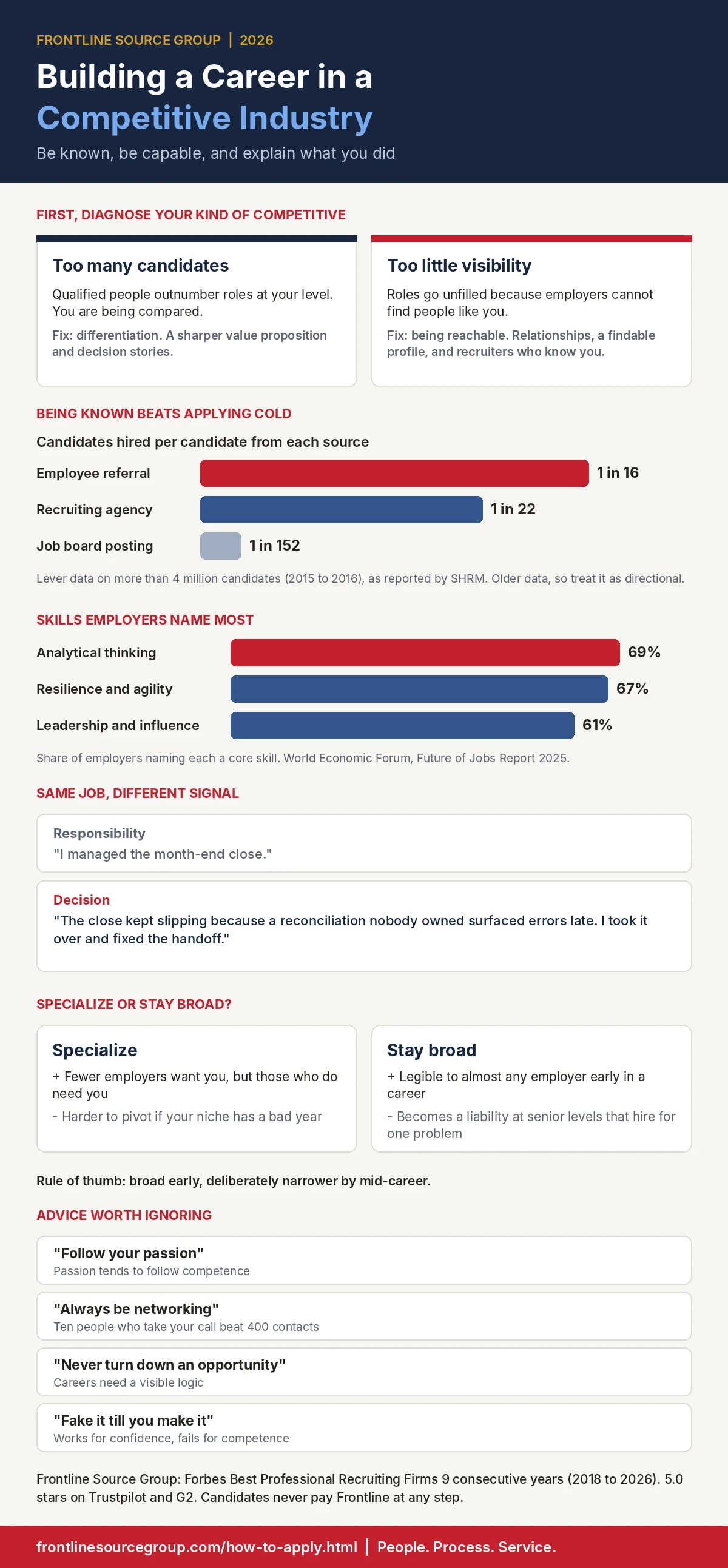
Networking works because hiring managers take the lowest-risk option available, and the lowest-risk option is a name someone already trusts. Someone thinks of a name, the name gets a call, and sometimes the role never goes public. The data shows how much that matters: in Lever data on more than 4 million candidates at about 1,000 employers, reported by SHRM, about 1 in 16 referred candidates was hired, compared with 1 in 22 agency candidates and 1 in 152 job board applicants. The data covers 2015 and 2016, so treat it as directional.
"The call goes to the name someone already trusts. Most of the people I have placed in senior roles were not the best applicants on paper; they were the ones a hiring manager had heard good things about before the search started."
Bill Kasko, Founder, President, and CEO, Frontline Source Group
Most networking fails because it is transactional and obviously so. Reaching out when you need something, after two years of silence, is a request wearing a relationship costume, and the person on the other end has received forty of those.
What works is unglamorous. Be useful to people before you need anything: make an introduction, answer a question in your area, send something genuinely relevant to a problem they mentioned. Stay in contact when there is no ask on the table. The people who get the call in three years are the ones who were present in the two years before it.
Are networking events worth your time?
Less than you might think. Events are the least efficient version of this. A conference produces contacts. Being good at your job in a small industry produces reputation, which is what actually generates the call. For more, see How Do You Find a Job Through Networking?
How do you know which skills to build?
Start from what the market is buying rather than what is being marketed to you. Read job postings for the role you want in two years, not the one you have. The requirements repeated across ten postings are the market speaking; the ones appearing once are somebody's wish list. It also helps to know what employers say they value most: in the World Economic Forum's 2025 survey, employers most often named analytical thinking (69 percent), resilience and agility (67 percent), and leadership and social influence (61 percent) as core skills.
Why go deep on one skill instead of listing many?
Go deep on one skill rather than adding four to a resume. Depth survives an interview and breadth does not. A candidate who can talk for ten minutes about something they built and what it changed is more compelling than one who lists six tools they have touched.
Build it on real work if you can, because a course teaches syntax and a project teaches judgment, and interviews test judgment. If your current role offers no chance to build anything, that is information about the role. A fuller treatment is in Understanding the Importance of Upskilling and Career Growth Strategies for 2026.
How do you find a mentor without asking someone to be your mentor?
Do not ask. "Will you be my mentor" is a request for an open-ended time commitment from someone who does not yet know whether you are worth it, and the honest answer is usually no.
What works is asking for something specific and small: one question about a decision they made, fifteen minutes on a problem you are stuck on. Then do something with the answer and tell them what happened. That closes a loop, which is rare, and it is what makes someone willing to take the next call.
Mentorship that lasts usually forms without either person naming it. The people who benefit most are the ones who made themselves easy to help. See What Is the Role of Mentoring in Career Development?
What is a value proposition, and how do you find yours?
Your value proposition is the specific problem you solve better than the obvious alternative hire. Not your strengths. The problem.
Most candidates describe themselves in adjectives: detail-oriented, collaborative, strategic. Those are impossible to disprove, and every competing candidate claims them. What sets you apart is a specific intersection: you have done this work in this context at this scale, and here is what happened as a result.
The test is whether a hiring manager could repeat it back after one conversation. If they cannot summarize why you rather than the other finalist, you have not given them a reason, and the decision will be made on something you do not control.
How do you talk about your work in a way that lands?
The pattern that fails is describing responsibilities: what you were assigned. The pattern that works is describing decisions: what you figured out, what you changed, and what happened.
Two people with identical experience produce completely different interviews on this basis alone. One says they managed the month-end close. The other says the close was taking too long because a reconciliation nobody owned kept surfacing errors late, and here is what they did about it. Same job, entirely different signal about how the person thinks.
"Tell me about a decision, not a duty. When a candidate explains what was broken, what they changed, and what happened, I can sell that to a client in one sentence."
Shelly Hubble, CSP, Senior Vice President of Operations, Frontline Source Group
Should you talk about failures in an interview?
Yes. Include the failures. A candidate who can explain something that did not work and what they learned is showing judgment. A candidate whose every story is a success is showing that they are curating, and experienced interviewers hear it. Interview preparation resources are on the interview instructions page.
Should you specialize or stay broad?
This is the real decision most career advice avoids, because the answer is a trade rather than an upgrade.
Specialization makes you valuable to fewer employers and much more valuable to them. A revenue accountant with deep oil and gas experience is essential to operators and hard to place with a manufacturing controller. That is a narrower market and a stronger position within it.
Breadth makes you legible everywhere and exceptional nowhere, which works well early and becomes a liability at senior levels, where companies hire for a specific problem rather than general capability.
The practical guidance: broad early, deliberate about narrowing by mid-career, and pick the specialization based on work you find genuinely engaging, because you will be doing it for a decade, and specialties chosen for market reasons alone rarely survive a bad year.
How do you work with a recruiter effectively?
A recruiter is not a job board with a person attached, and candidates who treat them that way get correspondingly little.
Be honest about compensation. A recruiter who knows your real number can tell you whether it is realistic and advocate for it. A candidate who inflates it wastes everyone's time and lands nowhere. Be honest about why you are leaving, because the reason determines which roles are actually a fit.
"Give your recruiter your real number and your real reason for leaving. I can work with almost any honest answer. What I cannot fix is placing you into the same problem you just left."
Lindsey Davidson, CDR, Senior Lead Executive Recruiter, Frontline Source Group
Why stay in touch with recruiters when you are not looking?
The best time to build the relationship is when you need nothing, because that is when the conversation is honest. The candidates recruiters call first are the ones they already know.
And listen to the feedback. A recruiter telling you that your resume is not landing, or that you interviewed poorly, is giving you information the market will otherwise withhold. There is never a cost to the candidate.
What career advice is worth ignoring?
"Follow your passion." Passion follows competence more reliably than it precedes it. People tend to enjoy what they are good at, and getting good at something is the part that requires no passion at all, just repetition.
"Always be networking." Volume is not a network. Ten people who would take your call beat four hundred connections who would not recognize your name.
"Never turn down an opportunity." Taking every opportunity is how careers become incoherent. A resume that reads as a series of unrelated jumps is harder to place than one with a visible logic, and recruiters read for that logic constantly. For context, the Bureau of Labor Statistics put median tenure with a current employer at 4.1 years in January 2026, and 3.0 years for workers ages 25 to 34.
"Fake it till you make it." This works for confidence and fails for competence. Overclaiming gets discovered in the first month, and the industries worth building a career in are smaller than they look.
What are the pros and cons of each career-building approach?
Every approach in this article has a cost. Here is an honest summary.
| Approach | Upside | Drawback or limitation to weigh |
|---|---|---|
| Specializing | Fewer employers want you, but those who do need you, which strengthens your position | A narrower market, and harder to pivot if your niche has a bad year |
| Staying broad | Legible to almost any employer and flexible early in a career | Becomes a liability at senior levels, where companies hire for a specific problem |
| Relationship-first networking | Referred candidates have historically been hired far more often than cold applicants | Slow to pay off, and it only works if you keep it up when you need nothing |
| Credential stacking | Easy to show on a resume and screened for in some fields | A credential without real work behind it rarely survives an interview |
| Working with a recruiter | Market pay data, candid feedback, and introductions at no cost to candidates | Recruiters are paid by employers and focus on roles they are hired to fill, so keep your own network active |
When does this advice not apply?
Some fields run on formal gates rather than relationships: licensing exams, residency matches, union apprenticeships, or civil service lists. In those, meeting the formal requirement comes first, and networking and storytelling help most once you are past the gate.
How does Frontline Source Group help candidates?
Frontline recruits across accounting and finance, technology, human resources, legal, administrative, energy, and C-suite leadership, with recruiters who work their field rather than rotating between requisitions. That means introductions to roles that are not always publicly posted, market pay data for your discipline rather than a national average, and candid feedback about fit.
To get started, apply online. After you apply or upload a resume, you may receive a first-level interview from Lexi Reed, Frontline's AI recruiter, and a Frontline recruiter reviews every candidate. You can show your proficiency through skills testing, and more resources are on the candidates hub. Candidates never pay Frontline at any step; see the scam alert page. All interviews are set by appointment only, and office locations are on the locations page.
Employers can submit a request through the employer request form. Every qualifying direct hire is backed by the 5-Year Placement Warranty, 20 times the 90-day period many firms offer, which aligns Frontline's incentive with a placement that actually works. The warranty provides a pro-rated credit toward a replacement or future placement, not a cash refund, and certain restrictions apply.
People. Process. Service. That is how Frontline has helped professionals build careers for 22 years.
What sources support the figures in this article?
- Lever, source-of-hire data from more than 4 million candidates and about 1,000 employers, August 2015 to July 2016, as reported by SHRM (October 2016): shrm.org
- Staffing Industry Analysts, "World to add 170 million jobs by 2030, lose 92 million," summarizing the World Economic Forum Future of Jobs Report 2025 (January 9, 2025): staffingindustry.com
- U.S. Bureau of Labor Statistics, Job Openings and Labor Turnover Survey, September 2026 (November 3, 2026): bls.gov
- U.S. Bureau of Labor Statistics, "Employee Tenure in January 2026" (September 24, 2026): bls.gov
Frequently Asked Questions: Building a Career in a Competitive Industry
What actually makes an industry competitive?
An industry is competitive when qualified people outnumber the roles at the level you want, which is different from a field where roles outnumber qualified people and hiring is still hard. In the first case you are being compared, so differentiation is the problem to solve. In the second, the constraint is visibility, so being reachable matters most.
Why does networking work, and why does most networking fail?
Networking works because hiring managers lean on people they already trust; in Lever data reported by SHRM, about 1 in 16 referred candidates was hired, compared with 1 in 152 job board applicants. Most networking fails because it is transactional. What works is being useful before you need anything and staying in touch when there is no ask.
How do you know which skills to build?
Read job postings for the role you want in two years, not the one you have. Requirements repeated across ten postings are the market speaking; ones that appear once are somebody's wish list. Then go deep on one skill and build it on real work, because depth survives an interview and breadth does not.
How do you find a mentor without asking someone to be your mentor?
Do not ask. Ask for something specific and small instead: one question about a decision they made, or fifteen minutes on a problem you are stuck on. Then act on the answer and tell them what happened. Closing that loop is rare, and it is what makes someone willing to take the next call.
What is a value proposition, and how do you find yours?
Your value proposition is the specific problem you solve better than the obvious alternative hire. Skip adjectives like detail-oriented, which every candidate claims. Name the intersection instead: you have done this work, in this context, at this scale, and here is what happened. If a hiring manager cannot repeat it after one conversation, it is not clear enough.
How do you talk about your work in a way that lands?
Describe decisions, not responsibilities: what you figured out, what you changed, and what happened. One candidate says they managed the month-end close; another explains that a reconciliation nobody owned kept surfacing errors late and how they fixed it. Include a failure and what you learned, because a story that is all success sounds curated.
Should you specialize or stay broad?
It is a trade, not an upgrade. Specialization makes you valuable to fewer employers and much more valuable to them. Breadth keeps you legible everywhere and works well early, but it becomes a liability at senior levels, where companies hire for a specific problem. Stay broad early and narrow deliberately by mid-career.
How do you work with a recruiter effectively?
Be honest about your compensation and your reason for leaving, because both determine which roles actually fit. Stay in touch when you are not looking, since the candidates recruiters call first are the ones they already know. And listen to feedback about your resume or interviews; it is information the market otherwise withholds.
What career advice is worth ignoring?
Follow your passion, because passion tends to follow competence. Always be networking, because ten people who would take your call beat hundreds of connections who would not. Never turn down an opportunity, because careers need a visible logic. And fake it till you make it, which works for confidence but fails for competence.
How long should you stay in a job before moving?
There is no single rule, but context helps. The Bureau of Labor Statistics put median tenure with a current employer at 4.1 years in January 2026, and 3.0 years for workers ages 25 to 34. A resume with a visible logic, where each move builds on the last, is easier to place than a series of unrelated short stints.
What is the 5-Year Placement Warranty?
The 5-Year Placement Warranty covers qualifying direct hire and executive search placements for five years, 20 times the 90-day period many firms offer. If a covered placement does not work out, the client receives a pro-rated credit based on active calendar days in the role, applied toward a replacement or future placement. It is not a cash refund, and certain restrictions apply.
Is there a cost for candidates to work with Frontline Source Group?
No. Candidates never pay Frontline at any step. Apply at frontlinesourcegroup.com/how-to-apply.html; after you apply or upload a resume, you may receive a first-level interview from Lexi Reed, Frontline's AI recruiter, and a Frontline recruiter reviews every candidate.


