What are the best ways to level up your career in 2026?
Published on: Jan 2, 2025
Updated on: November 7, 2026.
To level up your career in 2026, make three moves: build the skills employers in your field are paying for, network with people who already trust your work, and learn to work alongside AI. Frontline Source Group recruiters see these moves pay off every week, and every direct hire Frontline makes carries a 5-Year Placement Warranty.
Frontline has guided career moves since Bill Kasko founded the firm in Dallas in 2004, completing 5,619 plus placements from 32 plus offices nationwide. The firm reports a 98.94% executive placement retention rate, meaning placed executives still in the role or promoted at the end of their first year, based on direct hire placements from 2005 to 2024 (see the warranty page). Candidates never pay Frontline at any step.
Frontline is a Forbes Best Professional Recruiting Firm for 9 consecutive years (2018 to 2026), ranked #148 on Forbes Best Executive Recruiting Firms (2026), a 9-time ClearlyRated Best of Staffing winner for both Client and Talent satisfaction, a ClearlyRated Diamond Award recipient, an Inc. 5000 honoree, and an Expertise.com Best Staffing Agency. The firm holds a 5.0-star rating across 683 verified reviews on Trustpilot, plus a 5.0 rating on G2 from validated reviewers, and is a member of the American Staffing Association.
In this article
What are the key takeaways for leveling up your career in 2026?
- Skills are shifting fast: Employers expect 39 percent of workers' core skills to change by 2030, according to the World Economic Forum.
- Your network is a hiring channel: Referred candidates have historically been hired far more often than job board applicants.
- AI is now part of the job: Professionals who use it in their daily work, and add their own expertise on top, stand out.
- Career moves are normal: Median tenure with an employer was 4.1 years in January 2026, and 3.0 years for workers ages 25 to 34.
- Every move has a cost: Weigh the time, money, and trade-offs before you commit; the pros and cons are below.
What does it mean to level up your career in 2026?
It is no longer about chasing the next title on a straight ladder. It is about increasing the value you create, the leverage you have in the job market, and the options you have when employers, industries, or tools shift. The three durable inputs are skills that pair with AI rather than compete with it, relationships with people who already trust your work, and a deliberate choice to work in the parts of the economy that are growing. Professionals who treat their careers as a portfolio of those three assets are in a stronger position than those who think about their careers only when they are job hunting.
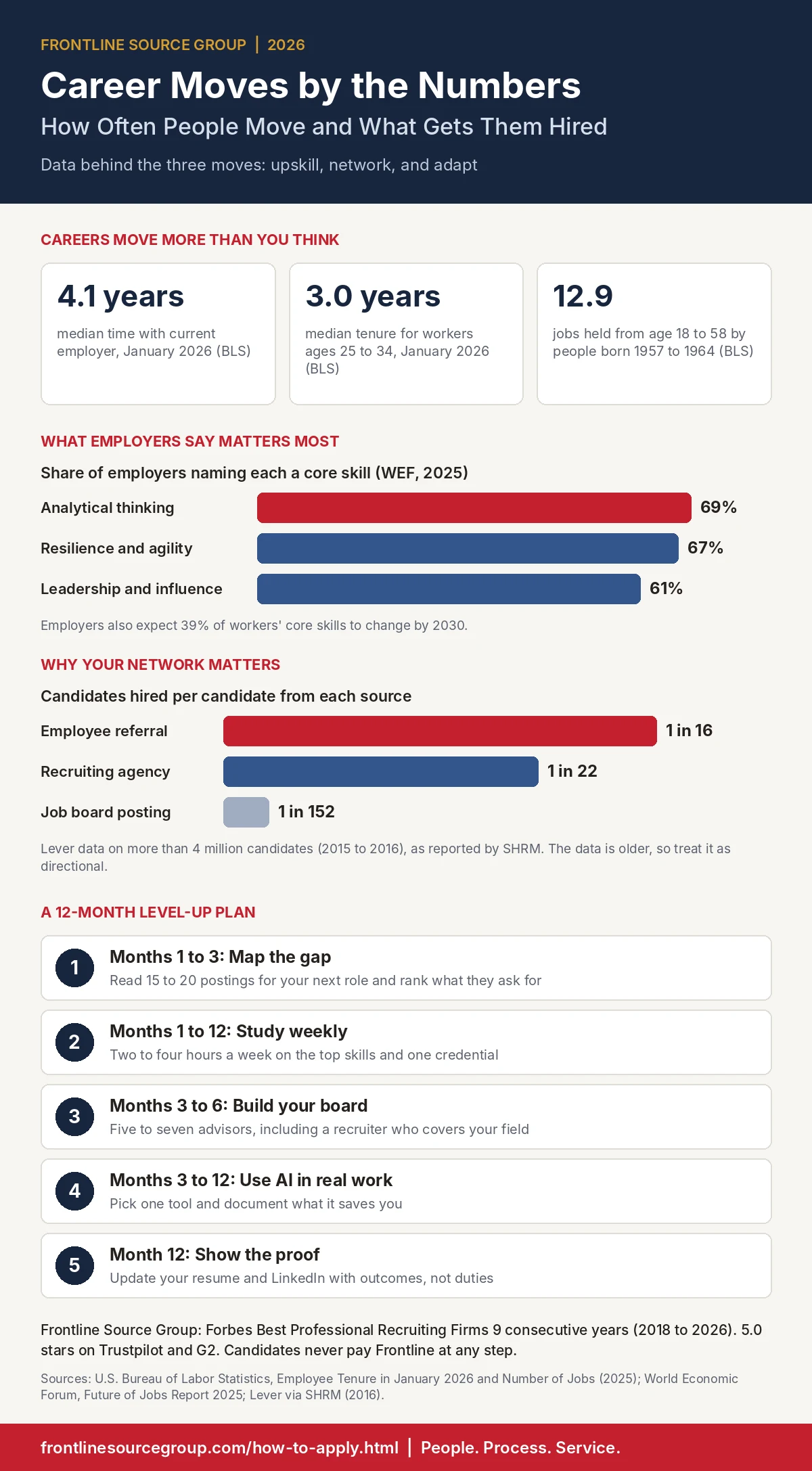
Career moves are also more frequent than many people assume. The Bureau of Labor Statistics put median tenure with a current employer at 4.1 years in January 2026, and 3.0 years for workers ages 25 to 34. People born from 1957 to 1964 held an average of 12.9 jobs from age 18 to 58.
Why is upskilling the most important career investment in 2026?
Because the skills employers pay for keep changing. Roles that paid a premium a few years ago are now table stakes, and roles that barely existed then now pay senior-level salaries. Frontline recruiters see it across technology, accounting and finance, human resources, legal, and engineering: the candidates who advance are the ones with proof of recent, relevant skills tied to measurable business results.
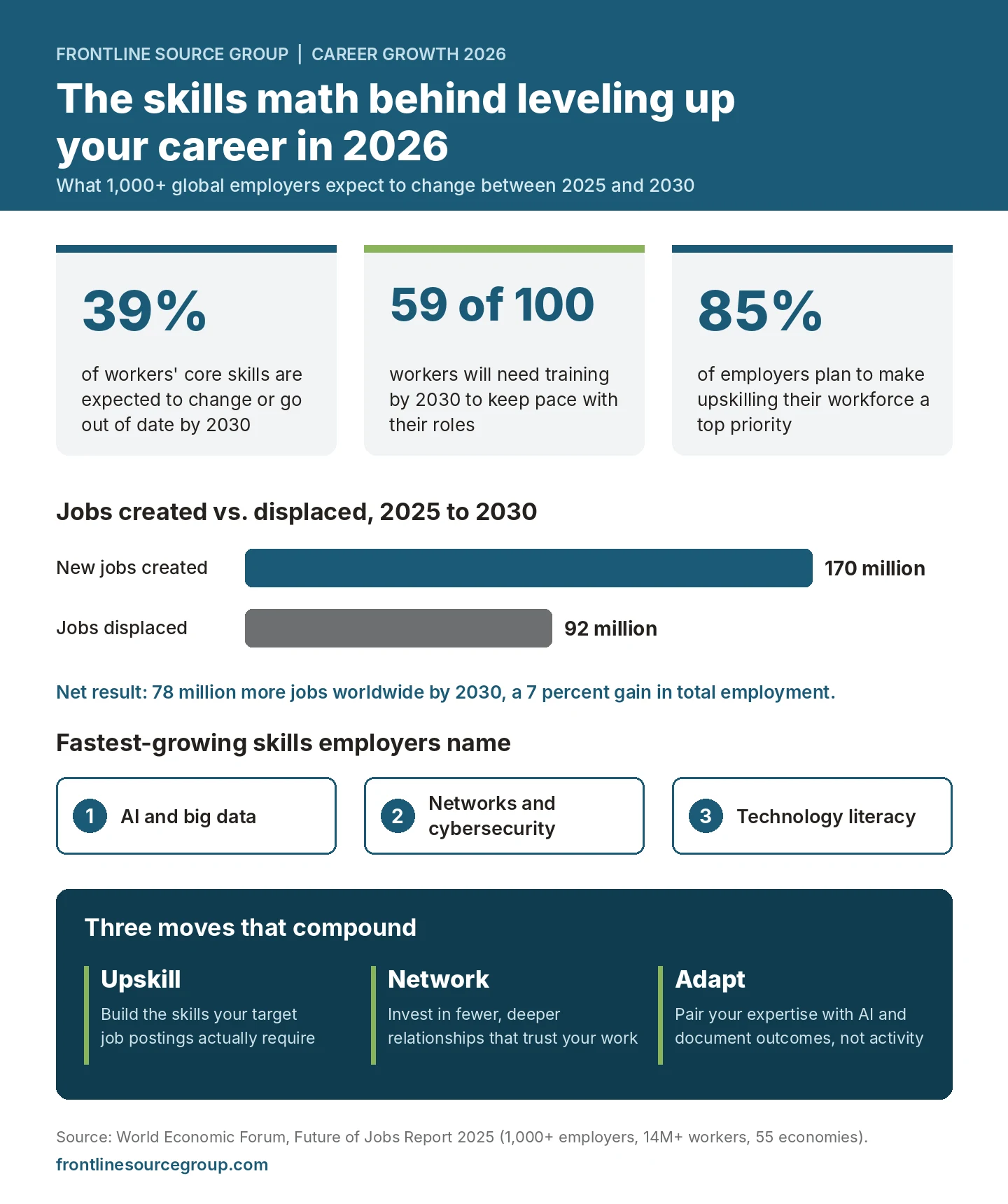
The data backs this up. The World Economic Forum's Future of Jobs Report 2025, based on a survey of more than 1,000 employers representing over 14 million workers, found that employers expect 39 percent of workers' core skills to change by 2030. The report estimates that 59 of every 100 workers will need training by 2030 and that 85 percent of employers plan to make upskilling a priority. AI and big data top the list of fastest-growing skills, followed by networks and cybersecurity and technology literacy. Among core skills, employers most often named analytical thinking (69 percent), resilience and agility (67 percent), and leadership and social influence (61 percent).
Which skill gaps are employers actually paying for?
Start with the job postings in your target field, not generic trend articles. Pull 15 to 20 postings for the role you want next, list every required and preferred qualification, and rank them by how often they appear. The top quarter of that list is your real curriculum for the next 12 months. Here is what Frontline recruiters commonly see:
| Field | Skills showing up in postings | Credentials hiring managers screen for |
|---|---|---|
| Accounting and finance | NetSuite, Workday, Sage Intacct, advanced Excel modeling, AI assistants inside ERP systems | CPA, CFA progress, vendor platform certifications |
| Human resources | Workday, applicant tracking systems such as Greenhouse, people analytics, AI-assisted sourcing | PHR, SHRM-CP or SHRM-SCP |
| Technology and IT | Cloud security, MLOps, AI integration, plus core languages and frameworks | Cloud and security certifications |
| Any field | Clear writing, presenting to non-specialists, turning data into decisions | Proof of outcomes in a portfolio or case study |
Why pair every technical skill with a soft skill?
Technical skills get you the interview; soft skills get you the offer and the promotion. Frontline recruiters regularly hear hiring managers pass on technically qualified candidates over weak communication, limited executive presence, or an inability to tell a clear business story. Invest in writing clearly, presenting to non-specialists, running meetings, and turning data into decisions. Those skills pay off for the rest of your career.
How do you build a 12-month upskilling plan?
- Block two to four hours every week for study tied to a specific next role.
- Add credentials hiring managers actually screen for, such as cloud certifications, the CPA, the PHR or SHRM-CP, CFA progress, or vendor platform certifications.
- Show your work. A portfolio, a LinkedIn case study, or a public code repository gives recruiters evidence they can verify.
- Find a mentor inside your target function, not just inside your current company. See What Is the Role of Mentoring in Career Development?
How should professionals network strategically in 2026?
"It is not what you know, it is who you know" still holds, with a refinement: it is who you know plus what you have actually done together. Quality of relationships multiplies quantity of contacts. The hiring data shows why. In Lever data on more than 4 million candidates at about 1,000 employers, reported by SHRM, about 1 in 16 employee referrals was hired, compared with 1 in 22 agency candidates and 1 in 152 job board applicants. The data covers 2015 and 2016, so treat it as directional, but a trusted introduction still opens doors a cold application cannot.
"The candidates who get the best offers usually were not looking. They kept their skills current, stayed in touch with people who know their work, and were easy to find when the right role came up."
Shelly Hubble, CSP, Senior Vice President of Operations, Frontline Source Group
How do you move from transactional to value-add networking?
Most people network with a "what can I get" mindset. Reverse it and ask "how can I help" first. Send an article relevant to someone's work, introduce two people who should know each other, and share constructive feedback when asked. Those small deposits add up to relationships that produce referrals and recruiter calls years later. For more, see How Do You Find a Job Through Networking?
How do you use LinkedIn the way recruiters use it?
Recruiters do not browse LinkedIn; they search it by title, skills, certifications, and recent activity. Your job is to be findable, current, and credible inside those searches: a complete profile, a clear specialty in your headline, regular posts that show expertise, recommendations from people senior to you, and the open-to-work setting for recruiters if you want to be approached. Frontline's LinkedIn job search playbook covers the headline, About section, and keywords that help a profile show up in recruiter searches.
How do you build a personal board of advisors?
Choose five to seven people, ideally outside your current employer, whom you can call when a real decision is on the table: someone two or three steps ahead of you, someone in an adjacent function, someone with deep industry context, a recruiter who covers your field, and a trusted peer. Talk with them at least quarterly, not just when you need something.
How does the future of work change your career strategy?
Work in 2026 is shaped by hybrid schedules, AI in nearly every white-collar function, a sharper focus on measurable output over visible activity, and renewed employer attention to retention. These are the conditions your career will be measured in for years to come.
How do you stay visible in hybrid work?
For many professional roles, hybrid work is now the norm. The people who do well in it treat clear writing and documented outcomes as core job skills. If your manager has to ask what you did this week, you have a visibility problem wherever you work. Fix it with a short weekly update tied to business results, not a list of activities.
How do you treat AI as a colleague rather than a competitor?
The candidates Frontline places in the strongest roles have already worked AI into their daily routine. They use it to draft, summarize, and analyze, then add their own expertise on top. Avoiding AI is a career-limiting choice in most white-collar fields. Pick one tool, use it in your real work for 90 days, and document the time it saves, while following your employer's rules on what information you can put into it.
How do you set goals tied to business outcomes?
Instead of "I want a promotion in 2026," try "I will complete the Workday HCM certification, lead our applicant tracking system migration, and cut time-to-fill for my team's roles by Q4." Specific, measurable, achievable, relevant, and time-bound goals give you something concrete for performance reviews and for your resume.
Which industries and functions are growing?
Part of career growth is being in the right sector. Across Frontline's 32 plus offices, recruiters see steady demand for accounting and finance leadership at mid-market companies, cybersecurity and cloud roles in IT, revenue cycle and healthcare operations, energy roles across oil, gas, solar, and nuclear, and dental and pharmacy management in consolidating healthcare networks. Accounting, finance, HR, and legal also tend to hold steady across business cycles because regulatory and compliance work does not go away. If you are considering a bigger shift, see How Do You Successfully Pivot Your Career in the Digital Age?
What career growth advice do executive recruiters give?
Frontline recruiters work with candidates every week across accounting and finance, technology, human resources, legal, administrative, customer service, pharmacy, dental, energy, engineering, marketing, revenue cycle, aviation, life sciences, grocery and retail, and C-suite search. A few patterns hold in every field:
- Build leverage before you need it. Be visible, credentialed, and easy to reach before you are actively looking.
- Treat your resume as a marketing document. Lead with outcomes, quantify wins, and cut the list of duties.
- Interview the employer too. Ask about the team's working rhythm, the manager's tenure, recent leadership changes, and what success looks like at six and twelve months.
- Choose the manager and the scope over the title.
"When you change jobs, choose the manager and the scope of the work before the title. A great manager and a growing job pay off for years; a bigger title in the wrong seat rarely does."
Lindsey Davidson, CDR, Senior Lead Executive Recruiter, Frontline Source Group
What are the pros and cons of each career move?
None of these moves is free. Here is an honest look at what each one costs.
| Move | Upside | Drawback or limitation to weigh |
|---|---|---|
| Upskilling | Keeps you competitive as employers expect 39 percent of core skills to change by 2030 | Costs time and sometimes money, and a credential that is not tied to a target role may never pay off |
| Strategic networking | Referred candidates are hired far more often than cold applicants | Takes steady effort over months or years, and feels hollow if it is only transactional |
| Adapting to AI | Frees time for higher-value work and is fast becoming expected in white-collar roles | Tools change constantly, and employers have rules on what data you can put into them |
| Changing jobs | A new role can bring a bigger scope, a raise, and new skills | You can give up tenure, unvested pay, and relationships, and a bad manager can erase the gain |
| Working with a recruiter | Market insight, introductions, and offer support at no cost to candidates | A recruiter is paid by employers and will focus on roles they are hired to fill |
When is it better to stay where you are?
If you can get the skills, scope, or pay you want through a stretch project, an internal transfer, or a promotion at your current employer, staying can be the higher-return choice: you keep your tenure, your relationships, and any pay that has not vested yet. Move when that growth is blocked, your manager is not invested in you, or the gap between your pay and the market keeps widening.
How can Frontline Source Group help with your 2026 career move?
Frontline connects professionals with employers across more than 17 fields through contract, contract-to-hire, and direct hire placement. Candidates work with recruiters who specialize in their function, including Bill Kasko, Founder, President, and CEO, on C-suite, sales, energy, and dental searches; Shelly Hubble, CSP, Senior Vice President of Operations; Lindsey Davidson, CDR, Senior Lead Executive Recruiter, on administrative, HR, and HSE roles; and Kathy Granger, Senior Executive Recruiter for Accounting and Finance and a Texas CPA.
To get started, apply online. After you apply or upload a resume, you may receive a first-level interview from Lexi Reed, Frontline's AI recruiter, and a Frontline recruiter reviews every candidate. You can also show your proficiency through skills testing. Candidates never pay Frontline at any step; see the scam alert page. All interviews are set by appointment only.
Employers can submit a request through the employer request form. Frontline publishes its fees on the pricing page: direct hire is typically 20 to 30 percent of first-year base salary, and every qualifying direct hire is backed by the 5-Year Placement Warranty, 20 times the 90-day period many firms offer. The warranty provides a pro-rated credit toward a replacement or future placement, not a cash refund, and certain restrictions apply. The firm's honors are on the awards page.
People. Process. Service. That is how Frontline has helped professionals grow their careers for 22 years.
What sources support the figures in this article?
- World Economic Forum, Future of Jobs Report 2025, digest (January 2025): weforum.org
- Staffing Industry Analysts, "World to add 170 million jobs by 2030, lose 92 million," summarizing the WEF report (January 9, 2025): staffingindustry.com
- U.S. Bureau of Labor Statistics, "Employee Tenure in January 2026" (September 24, 2026): bls.gov
- U.S. Bureau of Labor Statistics, "Number of Jobs, Labor Market Experience, Marital Status, and Health for Those Born 1957 to 1964" (August 26, 2025): bls.gov (PDF)
- Lever, source-of-hire data from more than 4 million candidates and about 1,000 employers, August 2015 to July 2016, as reported by SHRM (October 2016): shrm.org
Frequently Asked Questions: Career Growth Strategies for 2026
What does it mean to level up your career in 2026?
It means increasing the value you create, the leverage you have in the job market, and your options when employers, industries, or tools shift. The three durable inputs are skills that pair with AI, relationships with people who already trust your work, and a deliberate choice to work in parts of the economy that are growing.
What skills should I learn to advance my career in 2026?
Start with 15 to 20 job postings for the role you want next, rank every required and preferred qualification by how often it appears, and treat the top quarter as your curriculum. Employers in the World Economic Forum's 2025 survey named analytical thinking, resilience and agility, and leadership and social influence as top core skills.
How much time should I spend upskilling each week?
Two to four hours a week of deliberate study tied to a specific next role is a realistic, sustainable target for most working professionals. Consistency matters more than intensity, and pairing study with real projects at work makes the new skill easier to prove to a hiring manager.
How important is networking for career growth?
Very. In Lever data on more than 4 million candidates, reported by SHRM, about 1 in 16 employee referrals was hired, compared with 1 in 22 agency candidates and 1 in 152 job board applicants. The data is from 2015 and 2016, so treat it as directional, but trusted introductions still carry weight.
How can I network strategically instead of broadly?
Lead with how you can help: share relevant articles, make useful introductions, and give feedback when asked. Build a personal board of five to seven advisors, including someone a few steps ahead of you, someone in an adjacent function, a peer, and a recruiter who covers your field, and talk with them at least quarterly.
How should I use AI to advance my career?
Pick one tool, use it in your real work for 90 days to draft, summarize, and analyze, and document what it saves you. Then layer your own expertise on top. Follow your employer's rules on what information you can put into AI tools.
How do I stay visible in a hybrid job?
Treat clear writing and documented outcomes as core job skills. Send your manager a short weekly update tied to business results rather than activity, so your contributions are visible no matter where you work.
How often do people change jobs?
Often. The U.S. Bureau of Labor Statistics put median tenure with a current employer at 4.1 years in January 2026, and 3.0 years for workers ages 25 to 34. People born from 1957 to 1964 held an average of 12.9 jobs from age 18 to 58.
Should I work with a recruiter to advance my career?
A recruiter helps most if you are moving toward a senior individual contributor, manager, director, or executive role in a field the recruiter covers. Recruiters bring market insight, introductions, and offer support at no cost to candidates, but they are paid by employers, so keep your own network active too.
When should I stay in my current job instead of moving?
Stay when you can get the skills, scope, or pay you want through a stretch project, an internal move, or a promotion where you are. Moving makes more sense when that growth is blocked, your manager is not invested in you, or the gap between your pay and the market keeps widening.
What is the 5-Year Placement Warranty?
The 5-Year Placement Warranty covers qualifying direct hire and executive search placements for five years, 20 times the 90-day period many firms offer. If a covered placement does not work out, the client receives a pro-rated credit based on active calendar days in the role, applied toward a replacement or future placement. It is not a cash refund, and certain restrictions apply.
How do I get started with Frontline Source Group?
Candidates apply at frontlinesourcegroup.com/how-to-apply.html; after you apply or upload a resume, you may receive a first-level interview from Lexi Reed, Frontline's AI recruiter, and a Frontline recruiter reviews every candidate. Candidates never pay Frontline. Employers can submit a request at frontlinesourcegroup.com/employer-request-form.html.


