How Do You Successfully Pivot Your Career in the Digital Age?

Published on: Apr 2, 2024
Updated on: November 7, 2026.
A successful career pivot in the digital age builds on skills you already have, adds two or three digital skills employers want, and uses a focused network in the target field to get you seen. Frontline Source Group recruiters see the same pattern: pivots that work are deliberate steps sideways, not a reinvention from scratch.
Frontline has placed professionals since Bill Kasko founded the firm in Dallas in 2004, completing 5,619 plus placements from 32 plus offices nationwide. Candidates never pay Frontline at any step, and every direct hire is backed by the 5-Year Placement Warranty.
Frontline is a Forbes Best Professional Recruiting Firm for 9 consecutive years (2018 to 2026), ranked #148 on Forbes Best Executive Recruiting Firms (2026), a 9-time ClearlyRated Best of Staffing winner for both Client and Talent satisfaction, a ClearlyRated Diamond Award recipient, an Inc. 5000 honoree, and an Expertise.com Best Staffing Agency. The firm holds a 5.0-star rating across 683 verified reviews on Trustpilot, plus a 5.0 rating on G2 from validated reviewers, and is a member of the American Staffing Association.
In this article
- Key takeaways
- What a career pivot is
- Why pivots are more common
- Signs it is time to pivot
- First steps
- The most valuable digital skills
- How long a pivot takes
- Networking into a new field
- Thinking about pay
- Using a recruiter
- Common mistakes
- Pros and cons of a career pivot
- How Frontline helps
- Sources
- Frequently asked questions
What are the key takeaways for a career pivot?
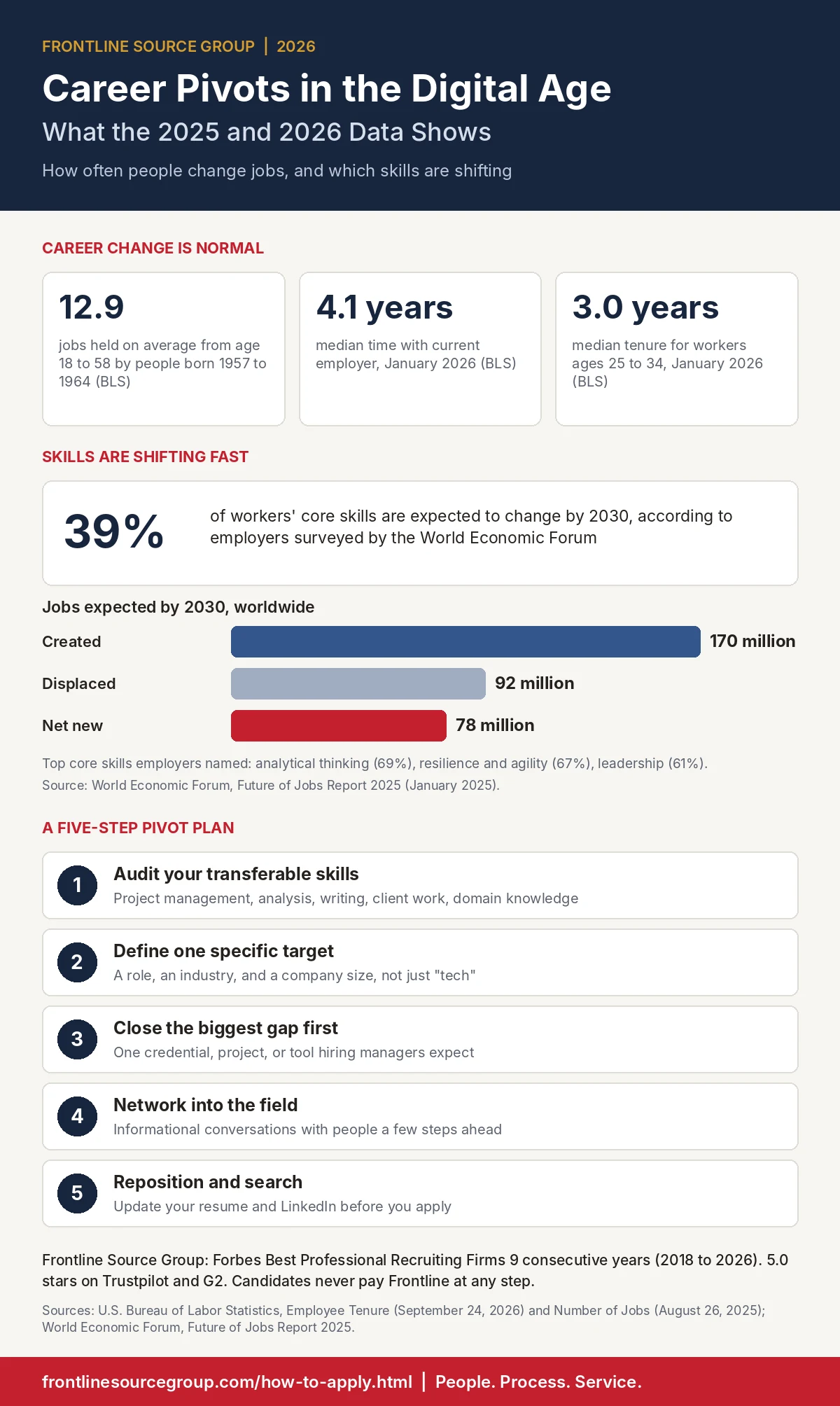
- Changing jobs is normal: Americans born from 1957 to 1964 held 12.9 jobs on average from age 18 to 58, per the BLS.
- Skills are moving: Employers expect 39 percent of workers' core skills to change by 2030, per the World Economic Forum.
- Build on what you have: Adjacent moves that reuse your skills succeed far more often than total reinventions.
- Close one gap at a time: Focus on the credential or skill hiring managers care about most.
- Keep your job while you pivot: Financial pressure is the most common reason pivots stall.
What is a career pivot in the digital age?
A career pivot is a deliberate move into a new role, function, or industry that builds on skills you already have rather than starting over. In the digital age, most pivots add technology fluency, data skills, or remote-work capability to an existing foundation. A finance manager moving into financial planning and analysis at a software company, a marketing director moving into product marketing, or a paralegal moving into legal operations are all examples. The common thread is using transferable skills as the bridge.
Why are career pivots more common in the digital age?
Because careers have always involved change, and the pace of skill change is rising.
How often do people change jobs?
Often. The U.S. Bureau of Labor Statistics found that people born from 1957 to 1964 held an average of 12.9 jobs from age 18 to 58. BLS data from January 2026 put median tenure with a current employer at 4.1 years overall and 3.0 years for workers ages 25 to 34.
How fast are skills changing?
Faster than before. Employers surveyed for the World Economic Forum's Future of Jobs Report 2025 expect 39 percent of workers' core skills to change by 2030. They project about 170 million jobs created and 92 million displaced worldwide over that period, a net gain of roughly 78 million, with big data, financial technology, and AI and machine learning among the fastest-growing roles. Online courses, certifications, and AI tools have also made new skills faster and cheaper to learn than ever.
How do you know if it is time to pivot your career?
Several signals usually show up together:
- The work no longer challenges you, and the upside in your current track has flattened.
- Your industry is shrinking or being disrupted by automation, regulation, or falling demand.
- Your energy has been low for months, not just during a hard quarter.
- You keep gravitating toward a different field in what you read, discuss, and browse.
- Your pay has stalled while peers in adjacent fields move ahead.
If three or more are true, a pivot is worth exploring seriously.
What are the first steps in planning a career pivot?
- Audit your transferable skills honestly: project management, stakeholder management, analysis, writing, tools you know well, and industry knowledge. Most people underestimate how much carries over.
- Define a specific target: not "tech," but "financial planning and analyst at a growing software company with 50 to 200 employees." Specificity makes every next step easier.
- Close the biggest gap first: find the one or two credentials, tools, or experiences hiring managers in that field expect, and start there.
"The pivots that work are almost never a leap. They are a step sideways onto ground the person already half knows. A controller who learns the systems side becomes a strong systems lead. The skills carry over; the job is showing a hiring manager that they do."
Cassidy Jacobs, Senior Executive Staffing Specialist, Frontline Source Group
Which digital skills are most valuable for a career pivot?
Employers in the WEF survey named analytical thinking (69 percent), resilience and agility (67 percent), and leadership and social influence (61 percent) as top core skills. On the practical side, these give most professionals the best return:
| Skill area | What to learn | Example by target field |
|---|---|---|
| Data literacy | Intermediate spreadsheets, basic SQL, reading dashboards | Useful in almost every pivot |
| Analytics | One business intelligence tool | Power BI, Tableau, or Looker |
| AI fluency | Using AI assistants to research, draft, and analyze | ChatGPT, Claude, or Copilot |
| Collaboration | Remote and project workflows | Slack, Teams, Asana, or Notion |
| Role platform | The core system of the target role | NetSuite for finance, HubSpot for marketing, Workday for HR |
Pick one platform per category rather than dabbling in many. Frontline's skills testing can help candidates show proficiency in common tools.
How long does a successful career pivot take?
It depends on how far the move is and how much you can do while still employed. An adjacent move can come together much faster than a change of both function and industry. Most pivots move through three phases.
What happens in each phase of a pivot?
| Phase | What happens |
|---|---|
| Assess and build credibility | Audit transferable skills, pick a specific target, and start closing the biggest gap with a course, certification, or project |
| Network and build skills | Informational conversations, deeper skill-building, and visible proof such as a portfolio or a stretch project at work |
| Search | Targeted applications, referrals, recruiter conversations, and interviews |
Treat the pivot as a project with milestones and check-ins, not a vague intention. Rushing usually fails because credibility takes time to build, and drifting loses momentum.
How important is networking when pivoting careers?
It is one of the two most important activities in a pivot, along with building credibility. In a new field you need introductions, market context, and people willing to vouch for your direction. The most effective approach is informational conversations with people a few steps ahead in your target field: ask about their path, what their days look like, and what they look for when hiring. Referrals also convert to hires far more often than cold applications; see How Do You Find a Job Through Networking? and What Is the Role of Mentoring in Career Development?
Should you expect a pay cut when you pivot?
Sometimes, but many candidates take a bigger cut than they need to because they undervalue what carries over. Research pay for the target role before you negotiate, lead with the skills that transfer, and consider an adjacent first move that preserves more of your current value. A step back in pay can make sense when it buys a much stronger long-term path, but make it a choice, not a default.
Should you use a recruiter when making a career pivot?
A recruiter helps most when the pivot is adjacent: a function change within the same industry, or an industry change within the same function. For more radical moves, a recruiter is usually a supporting channel, because most searches require direct experience in the target role.
What should you ask a recruiter about a pivot?
Ask which moves are realistic in the current market, which industries value your skills, what pay range to expect, and which gap to close first. A good recruiter will give you a candid answer even when it is not the one you hoped for.
"Keep the job you have while you build toward the one you want. Money pressure is the fastest way to end up back in the role you were trying to leave."
Shelly Hubble, CSP, Senior Vice President of Operations, Frontline Source Group
What are the most common career pivot mistakes to avoid?
- Trying to close every gap at once instead of the one or two that matter most.
- Taking a deeper pay cut than necessary.
- Quitting before the target role is clearly in view.
- Building skills without updating your resume and LinkedIn, so no one in the new field can find you.
- Going it alone without mentors, peers in the same transition, or a recruiter who knows the target market.
What are the pros and cons of a career pivot?
A pivot can renew a career, but it carries real costs, and honest planning accounts for both.
| Benefit of a career pivot | Trade-off to weigh |
|---|---|
| Moves you toward growing fields and away from shrinking ones | Projections like the WEF's are employer expectations, not promises for any one role |
| Renews engagement and long-term earning potential | You may take a step back in title or pay at first |
| Builds skills that carry into future moves | Learning while working takes evenings, weekends, and sometimes money |
| Transferable skills shorten the path | Hiring managers often prefer direct experience, so you must show how your skills translate |
When is it better to stay and grow where you are?
If what you want is more challenge or a new skill rather than a new field, a stretch project, an internal move, or a new specialty at your current employer may get you there with far less risk. Pivot when the gap between where you are and where you want to be cannot be closed inside your current path.
How does Frontline Source Group help candidates considering a career pivot?
Frontline's recruiters work across accounting and finance, technology, human resources, legal, administrative, customer service, energy, engineering, marketing, revenue cycle, life sciences, and executive search, so they can give candid context on which moves are realistic in today's market. The process starts when you apply online. After you apply or upload a resume, you may receive a first-level interview from Lexi Reed, Frontline's AI recruiter, and a Frontline recruiter reviews every candidate. Candidates never pay Frontline at any step; see the scam alert page. For more help, visit the candidates hub, the LinkedIn job search playbook, and What Is the Purpose of a Cover Letter? Employers can request talent through the employer request form.
People. Process. Service. That is how Frontline has helped professionals with their careers for 22 years.
What sources support the figures in this article?
- U.S. Bureau of Labor Statistics, "Number of Jobs, Labor Market Experience, Marital Status, and Health for Those Born 1957 to 1964" (August 26, 2025): bls.gov (PDF)
- U.S. Bureau of Labor Statistics, "Employee Tenure in January 2026" (September 24, 2026): bls.gov
- World Economic Forum, Future of Jobs Report 2025, as reported by Staffing Industry Analysts (January 9, 2025): staffingindustry.com
Frequently Asked Questions: Career Pivot Strategies in the Digital Age
What is the best way to pivot your career in the digital age?
Make it deliberate and incremental: audit your transferable skills, choose one specific target role and industry, close the one or two gaps hiring managers care about most, network into the field, and update your resume and LinkedIn before you start applying.
How common are career changes?
Very. The U.S. Bureau of Labor Statistics found that people born from 1957 to 1964 held an average of 12.9 jobs from age 18 to 58. In January 2026, median tenure with a current employer was 4.1 years, and 3.0 years for workers ages 25 to 34.
How long does a career pivot usually take?
It varies with how far the move is and how much of the gap you can close while still employed. Most pivots move through three phases: assessment and credibility-building, networking and skill-building in the target field, and the active search. Treat it like a project with milestones rather than a vague intention.
Which digital skills should I learn first for a career pivot?
Start with data literacy, such as intermediate spreadsheets and basic SQL; one analytics tool such as Power BI or Tableau; practical AI fluency with tools like ChatGPT, Claude, or Copilot; and the core platform used in your target role, such as NetSuite for finance, HubSpot for marketing, or Workday for HR. Pick one platform per category.
Which skills do employers say matter most through 2030?
In the World Economic Forum's Future of Jobs Report 2025, employers named analytical thinking, resilience and agility, and leadership and social influence as top core skills. They also expect 39 percent of workers' core skills to change by 2030.
How do I know when it is time to pivot my career?
Watch for several signals together: the work no longer challenges you, your industry is shrinking or being disrupted, your energy has been low for months rather than weeks, you keep gravitating toward a different field, and your pay has stalled while peers in adjacent fields move ahead.
Is networking important for a career pivot?
Very. Informational conversations with people a few steps ahead in your target field give you market knowledge, introductions, and someone who can vouch for your direction. Referrals also convert to hires far more often than cold applications.
Should I take a pay cut to pivot careers?
Sometimes, but many candidates take a bigger cut than necessary because they undervalue their transferable experience. Research pay for the target role, lead with the skills that carry over, and consider an adjacent move first that keeps more of your current value.
Should I leave my current job before starting a career pivot?
Usually not. Leaving before the target is in clear view creates financial pressure that can push you back into a near-copy of your old role. Build skills and relationships on the side, then make the move once the path is real.
Can a recruiter help with a career pivot?
Yes, especially for adjacent pivots, such as changing function within the same industry or changing industry within the same function. For a more radical change, a recruiter is usually a supporting channel, because most searches require direct experience in the target role.
What are the most common career pivot mistakes?
Trying to close every gap at once, taking a deeper pay cut than necessary, quitting too early, failing to update your resume and LinkedIn as you build skills, and going it alone without mentors, peers, or a recruiter who knows the target market.
How do I get started with Frontline Source Group?
Apply online at frontlinesourcegroup.com/how-to-apply.html. After you apply or upload a resume, you may receive a first-level interview from Lexi Reed, Frontline's AI recruiter, and a Frontline recruiter reviews every candidate. Candidates never pay Frontline at any step; see frontlinesourcegroup.com/scam-alert.html.


