What is upskilling, and why does it matter for employers and employees?

Published on: May 6, 2024
Updated on: Oct 12, 2026
Upskilling is the practice of building new competencies within an existing role so a person stays effective as the work changes. For employers it is cheaper than replacing people; for employees it is what keeps a career durable. Frontline Source Group sees both sides across 5,619 plus placements and backs every direct hire with a 5-Year Placement Warranty.
Founded in Dallas in 2004, Frontline Source Group has grown to 32 plus offices nationwide across 22 years in business. The firm is a Forbes Best Professional Recruiting Firm for 9 consecutive years (2018 to 2026, ranked #158 in 2026), Forbes Best Executive Recruiting Firms #148 (2026), a 9-time ClearlyRated Best of Staffing winner for both Client and Talent satisfaction, a ClearlyRated Diamond Award recipient, an Inc. 5000 honoree, and an Expertise.com Best Staffing Agency. Frontline holds a 98.94% executive placement retention rate, a 5.0-star Trustpilot rating across 683 plus verified reviews, and is a member of the American Staffing Association (ASA). People. Process. Service.
What is upskilling?
Upskilling is the process of acquiring new competencies that extend what someone can do in the role they already hold. An accountant learning to build the automation that replaces their manual reconciliation is upskilling. A marketing manager learning to interrogate the attribution model rather than accept the dashboard is upskilling. The role title does not change; the capability underneath it does.
The distinction that matters is between upskilling and training. Training teaches a defined procedure. Upskilling builds capability that transfers, which means it usually cannot be completed in an afternoon and cannot be measured by attendance.
What is the difference between upskilling and reskilling?
Upskilling deepens capability within a career track. Reskilling moves someone to a different one.
The distinction has practical consequences for how an employer funds and structures each. Upskilling is generally lower risk and shorter horizon: the person already understands the business, the customers, and the internal politics, and you are adding a capability on top of context they already have. Reskilling is a longer bet, because you are asking someone to be a beginner again inside a company where they were competent, which is harder on them than most leaders account for.
Companies conflate the two and then wonder why the program stalls. A six-week course does not reskill anyone. It might upskill them if they already had the foundation.
Why is the skills gap widening?
Two forces are pulling in opposite directions. The capability requirements of most professional roles are expanding, because every function is absorbing tools and expectations that did not exist a few years ago. Meanwhile, the pipeline of people who have those capabilities has not expanded at the same rate, because building them takes years and the demand signal arrived recently.
The result is a market where the job description a company writes describes a person who is rare, expensive, and already employed. The gap tends to be most acute in the middle of the org chart, where the operational leadership sits.
The uncomfortable implication for employers: if the person you have described does not exist in sufficient supply, you have two options. Pay well above market to win the few who exist, or build the capability in someone who has most of it. Most companies do neither and leave the requisition open for two quarters.
What does the research say about the skills gap?
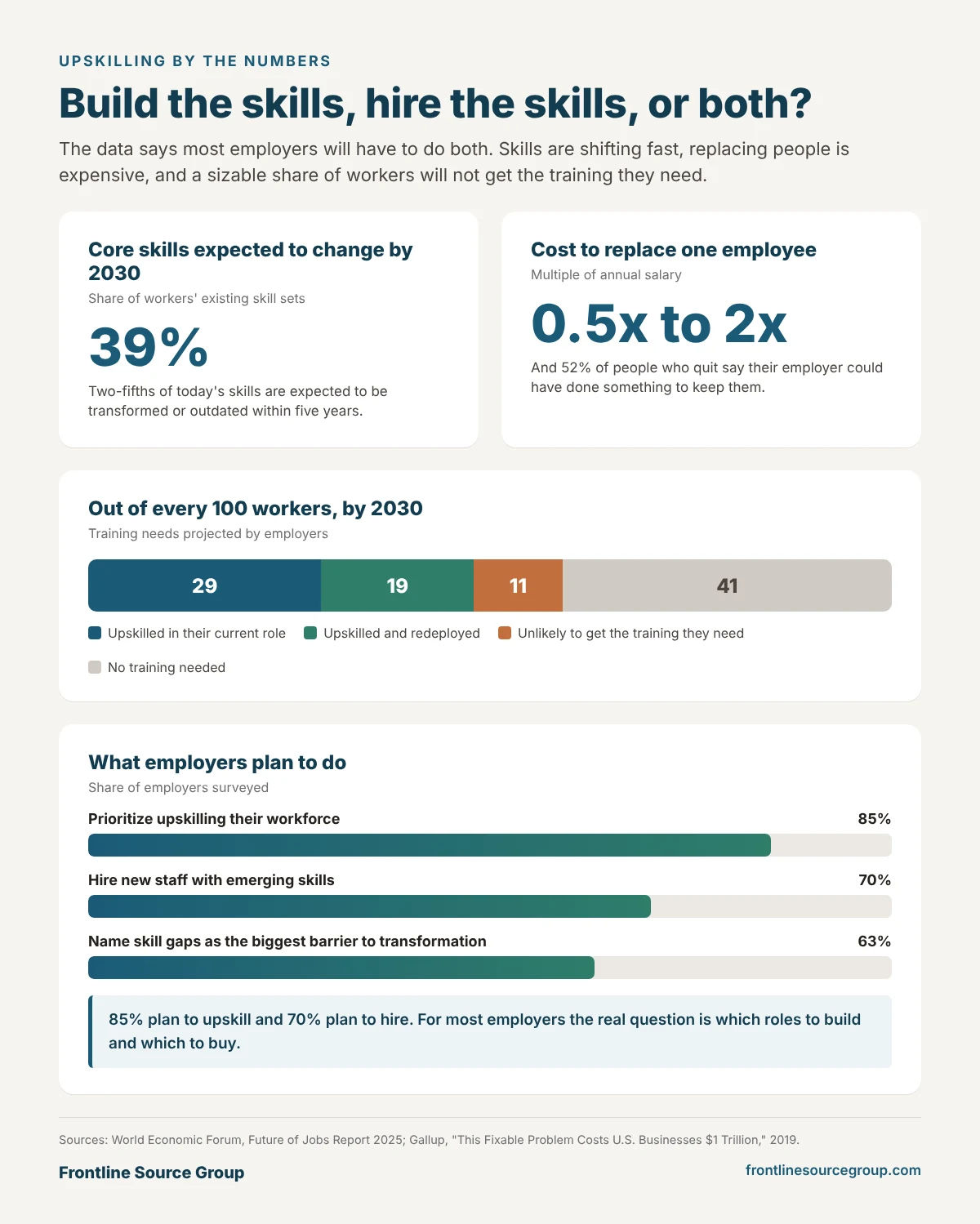
The numbers are hard to ignore. Employers surveyed for the World Economic Forum's Future of Jobs Report 2025 expect 39 percent of workers' core skills to change by 2030. Of every 100 workers, they expect 59 to need training by then: 29 upskilled in their current roles, 19 upskilled and moved elsewhere in the organization, and 11 unlikely to get the training they need. Sixty-three percent of employers named skill gaps as the biggest barrier to transforming their business, 85 percent plan to prioritize upskilling, and 70 percent plan to hire people with new skills. In other words, most employers expect to build and buy at the same time.
Why should employers invest in upskilling?
Replacement costs more than development. Losing an experienced employee means losing the institutional knowledge, the internal relationships, and the judgment that took years to build, and then paying to recruit, onboard, and ramp someone who has none of it. The cost of a mis-hire compounds further; a fuller treatment is at frontlinesourcegroup.com/blog-cost-of-a-bad-hire-the-hidden-numbers-most-employers-miss.html.
It changes who applies. A company known for developing people attracts candidates who want to grow, and those are disproportionately the candidates worth hiring. The reverse is also true, and candidates find out.
It is a retention instrument, not a perk. The strongest people leave when they stop learning, not when they stop being paid enough. Compensation keeps someone from leaving for money; development keeps them from leaving out of boredom.
It reduces the requisitions you have to open. Every capability built internally is a search you do not have to run in a market where the candidate does not exist.
How much does it cost to replace an employee instead of developing one?
More than most budgets assume. Gallup estimates that replacing an individual employee costs one-half to two times that person's annual salary, and calls that a conservative estimate. The same research found that 52 percent of employees who voluntarily left said their manager or organization could have done something to keep them. Development is one of the few things on that list an employer fully controls.
Why should employees invest in upskilling?
The career logic is simpler than the corporate case. The roles that exist now are not the roles that will exist, and the professionals who stay employable are the ones who can demonstrate they learned something new recently and used it.
What that looks like in a hiring conversation matters. A recruiter or hiring manager is not impressed by a certificate. They are listening for whether you can explain what problem you solved, what you did not know when you started, and what you would do differently. A candidate who can narrate that is demonstrating the capacity to learn, which is the thing being purchased. A candidate who lists a course is demonstrating that they enrolled.
The other honest point: upskilling into a domain you have no interest in produces a shallow, unconvincing version of the skill. The professionals who do this well pick something adjacent to work they already find engaging, which is why the effort survives past week three.
How do you build an upskilling program that works?
Where should an upskilling program start?
Start from the capability gap, not the course catalog. Identify what the business will need in eighteen months that the team cannot currently do. Programs that begin with a vendor's platform and work backward toward relevance produce completion rates and nothing else.
Why do employees need protected time to upskill?
Give people time, not just access. A license to a learning platform plus a full workload is not an upskilling program. It is a benefit nobody can use, and employees read it accurately as a gesture.
Why does upskilling have to be tied to real work?
Make it applied. Capability that is never used decays. The programs that work attach the learning to a real project with a real deliverable, so the person has to actually operate the skill under conditions where it matters.
How should employers measure an upskilling program?
Measure capability change, not participation. Completion rates and hours logged measure activity. The only question that matters is whether the team can now do something it could not do before. A program that cannot answer that is a budget line, and budget lines get cut.
Why should promotions reflect upskilling?
Promote the people who do it. If upskilling does not visibly change anyone's trajectory, the organization has taught everyone that it does not count. That lesson sticks harder than any announcement.
What are the most common upskilling mistakes?
Treating it as a communications exercise. Announcing a learning culture is not building one. Employees calibrate on whether time is protected and whether skill development shows up in promotion decisions.
Buying a platform and calling it a strategy. The platform is the easiest part of the problem and the most expensive way to avoid solving the hard part.
Upskilling the wrong people. Programs default to volunteers, who are usually the people already learning on their own. The capability gap frequently sits with people who are not raising their hands.
No follow-through. A person who builds a capability and returns to the same work they were doing before will conclude, correctly, that the investment was decorative.
When is hiring the right answer instead of upskilling?
Upskilling is not always the correct call, and pretending otherwise wastes a year. Hiring is the right answer when the capability is needed now rather than in twelve months, when nobody on the team has the foundation to build on, when the role requires credentialed expertise that cannot be self-taught, or when the capability is genuinely new to the organization and there is no one internally who could evaluate whether it is being done well.
The failure mode in both directions is the same: choosing based on which option feels cheaper rather than which one solves the problem. An upskilling program launched because a search felt difficult defers the problem at full cost. A hire made because development felt slow ignores the person already on the team who was two months from being ready.
Frontline Source Group's engagement models cover both sides of that decision, including contract and contract-to-hire coverage while an internal capability is being built. Full service detail is at frontlinesourcegroup.com/services-offered.html, and engagement pricing is published openly at frontlinesourcegroup.com/pricing.html.
How does upskilling change what a staffing partner does?
A recruiting partner working the same discipline across many companies sees which capabilities are actually being demanded versus which ones are showing up in job descriptions because someone copied a template. That is useful intelligence for an employer designing a program, and it is the kind of thing an internal team cannot see from inside one company.
It also changes how candidates should be evaluated. A recruiter screening only for exact-match experience will systematically miss the candidate who has most of the foundation and demonstrably learns fast, which in a tight market is often the only viable hire. Frontline's skills assessment resources are at frontlinesourcegroup.com/skills-testing.html, and HR recruiting detail is at frontlinesourcegroup.com/human-resources.html.
How do you work with Frontline Source Group?
Companies with a professional or executive opening can submit a request at frontlinesourcegroup.com/employer-request-form.html or reach the team through frontlinesourcegroup.com/contact.html. Professionals exploring opportunities should start at frontlinesourcegroup.com/how-to-apply.html. Interview preparation resources are at frontlinesourcegroup.com/interview-instructions.html, executive search capability is detailed at frontlinesourcegroup.com/executive-search-c-level.html, and client outcomes are documented at frontlinesourcegroup.com/testimonials.html.
Frequently Asked Questions: Upskilling
What is upskilling?
Upskilling is the process of acquiring new competencies that extend what someone can do in the role they already hold. An accountant learning to build the automation that replaces their manual reconciliation is upskilling. The role title does not change; the capability underneath it does. The distinction that matters is between upskilling and training: training teaches a defined procedure, while upskilling builds capability that transfers.
What is the difference between upskilling and reskilling?
Upskilling deepens capability within a career track. Reskilling moves someone to a different one. Upskilling is generally lower risk and shorter horizon, because the person already understands the business, the customers, and the internal politics, and you are adding capability on top of context they already have. Reskilling is a longer bet, because you are asking someone to be a beginner again inside a company where they were competent.
Why is the skills gap widening?
The capability requirements of most professional roles are expanding as every function absorbs tools and expectations that did not exist a few years ago, while the pipeline of people who have those capabilities has not expanded at the same rate. Industry research consistently suggests employers report persistent difficulty filling roles requiring this hybrid profile, and the gap is most acute in the middle of the org chart where operational leadership sits.
Why should employers invest in upskilling?
Replacement costs more than development, since losing an experienced employee means losing institutional knowledge, internal relationships, and judgment built over years. It changes who applies, because companies known for developing people attract candidates who want to grow. It is a retention instrument rather than a perk, since the strongest people leave when they stop learning. And every capability built internally is a search you do not have to run.
Why should employees invest in upskilling?
The roles that exist now are not the roles that will exist, and the professionals who stay employable can demonstrate they learned something new recently and used it. A recruiter is not impressed by a certificate; they are listening for whether you can explain what problem you solved, what you did not know when you started, and what you would do differently. Upskilling into a domain you have no interest in produces a shallow version of the skill.
How do you build an upskilling program that works?
Start from the capability gap rather than the course catalog. Give people time, not just platform access, since a license plus a full workload is a benefit nobody can use. Make it applied, because capability that is never used decays. Measure capability change rather than participation, since completion rates measure activity. And promote the people who do it, because if upskilling does not visibly change anyone's trajectory, the organization has taught everyone it does not count.
What are the most common upskilling mistakes?
Treating it as a communications exercise, since announcing a learning culture is not building one. Buying a platform and calling it a strategy, which is the most expensive way to avoid the hard part. Upskilling the wrong people, because programs default to volunteers who are usually already learning on their own while the capability gap sits with people not raising their hands. And no follow-through, which teaches employees the investment was decorative.
When is hiring the right answer instead of upskilling?
Hiring is right when the capability is needed now rather than in twelve months, when nobody on the team has the foundation to build on, when the role requires credentialed expertise that cannot be self-taught, or when the capability is new enough to the organization that no one internally could evaluate whether it is being done well. The failure mode in both directions is choosing based on which option feels cheaper rather than which solves the problem.
How does upskilling change what a staffing partner does?
A recruiting partner working the same discipline across many companies sees which capabilities are actually being demanded versus which ones appear in job descriptions because someone copied a template. It also changes candidate evaluation: a recruiter screening only for exact-match experience will systematically miss the candidate who has most of the foundation and demonstrably learns fast, which in a tight market is often the only viable hire.
What is the 5-Year Placement Warranty?
The 5-Year Placement Warranty is Frontline Source Group's direct hire commitment: if a placed professional does not work out, the firm replaces them. The staffing industry standard is a 90-day guarantee, so Frontline's warranty runs 20 times longer. It is backed by a 98.94% executive placement retention rate against an industry average near 70 percent. Full details are at frontlinesourcegroup.com/5year-placement-guarantee.html.
What awards has Frontline Source Group won?
Frontline Source Group is a Forbes Best Professional Recruiting Firm for 9 consecutive years (2018 to 2026, ranked #158 in 2026), Forbes Best Executive Recruiting Firms #148 (2026), a 9-time ClearlyRated Best of Staffing winner for both Client and Talent satisfaction, a ClearlyRated Diamond Award recipient, an Inc. 5000 honoree, and an Expertise.com Best Staffing Agency. The firm holds a 5.0-star Trustpilot rating across 683 plus verified reviews and is a member of the American Staffing Association.
How do you work with Frontline Source Group?
Companies with a professional or executive opening can submit a request at frontlinesourcegroup.com/employer-request-form.html or reach the team through frontlinesourcegroup.com/contact.html. Professionals exploring opportunities should start at frontlinesourcegroup.com/how-to-apply.html. Executive search capability is detailed at frontlinesourcegroup.com/executive-search-c-level.html, and client outcomes are documented at frontlinesourcegroup.com/testimonials.html.


