How Do Recruitment Agencies Help Businesses Achieve Their Objectives?

Published on: Aug 19, 2024
Updated on: November 7, 2026.
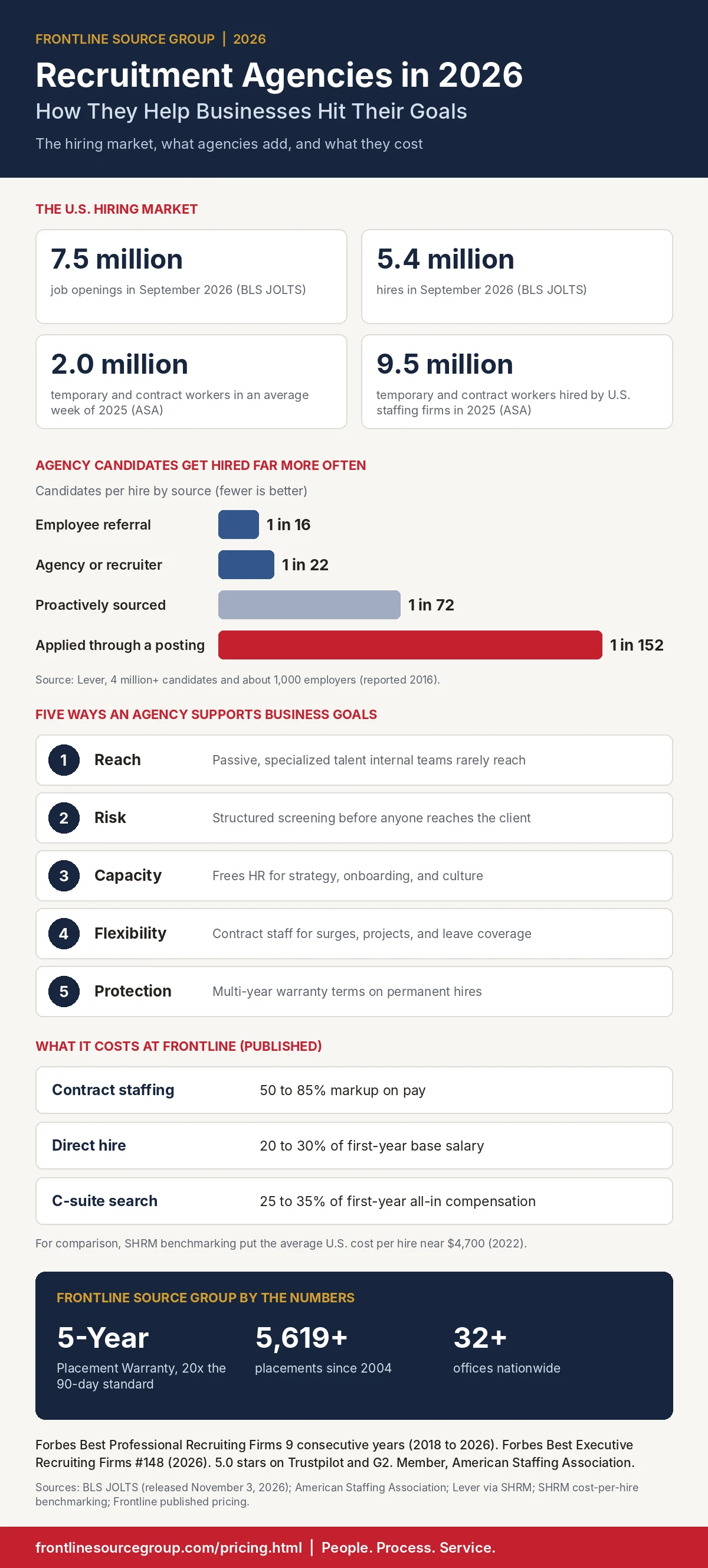
Recruitment agencies help businesses hit their goals in five ways: reaching specialized talent internal teams rarely find, lowering hiring risk through screening, freeing HR capacity, supplying flexible contract staff, and backing permanent hires with warranty terms. Frontline Source Group publishes its fees and backs every direct hire with a 5-Year Placement Warranty, 20 times the 90-day standard.
Frontline was founded in Dallas in 2004 and works from 32 plus offices nationwide. The firm has completed 5,619 plus placements and reports a 98.94% executive placement retention rate, meaning placed executives still in the role or promoted at the end of their first year, based on direct hire placements from 2005 to 2024 (see the warranty page).
Frontline is a Forbes Best Professional Recruiting Firm for 9 consecutive years (2018 to 2026), ranked #148 on Forbes Best Executive Recruiting Firms (2026), a 9-time ClearlyRated Best of Staffing winner for both Client and Talent satisfaction, a ClearlyRated Diamond Award recipient, an Inc. 5000 honoree, and an Expertise.com Best Staffing Agency. Clients rate the firm 5.0 stars across 683 verified reviews on Trustpilot, plus a 5.0 rating on G2 from validated reviewers. Frontline is a member of the American Staffing Association.
In this article
- Key takeaways
- What a recruitment agency does
- The 2026 hiring market
- How agencies reduce hiring risk
- What an agency costs
- Roles agencies fill best
- Supporting HR teams at capacity
- Contract, contract-to-hire, and direct hire
- How to choose an agency
- Pros, cons, and limits
- What makes Frontline different
- How to get started
- Sources
- Frequently asked questions
What are the key takeaways about recruitment agencies and business goals?
- Demand is steady: U.S. employers had 7.5 million job openings in September 2026, per the Bureau of Labor Statistics.
- Agency candidates convert: About 1 in 22 agency candidates was hired in Lever's data, versus 1 in 152 job board applicants.
- Flexible staffing is mainstream: U.S. staffing firms hired 9.5 million temporary and contract workers in 2025.
- Costs are knowable: Frontline publishes its fees, from contract markups to C-suite search.
- Protection varies widely: A 90-day guarantee is typical; Frontline's warranty runs five years.
What does a recruitment agency actually do for a business?
A recruitment agency connects an open seat with the person who will fill it well, doing the work an internal team either lacks the time or the network to do. That includes mapping the role to the talent market, finding active and passive candidates, screening for skills and fit, presenting a short list, coordinating interviews, managing the offer, and handling background checks and paperwork. For senior and specialized roles, a good agency also brings market intelligence: what comparable employers pay, what the candidate pool really looks like, and which competing offers a finalist is weighing.
What does the hiring market look like for employers in 2026?
Busy. The Bureau of Labor Statistics JOLTS report released November 3, 2026, counted 7.5 million job openings in September 2026, a 4.5 percent openings rate, with 5.4 million hires and 3.4 million quits in the month. Flexible staffing is a big part of how employers keep up: the American Staffing Association reports that U.S. staffing firms employed nearly 2.0 million temporary and contract workers in an average week of 2025 and hired 9.5 million over the year.
How does a recruitment agency reduce hiring risk?
Hiring risk comes from two places: hiring the wrong person, and leaving the seat empty too long. A good agency reduces both, and a warranty covers what is left.
How does an agency lower the risk of a wrong hire?
Every candidate Frontline presents has been interviewed by a recruiter, completed role-relevant skills assessments where appropriate, and been reference-checked before a resume reaches the client. The match is made for long-term fit, not just availability.
How does an agency shorten the time a seat sits empty?
By starting with people, not postings. An agency keeps relationships with passive candidates who are not reading job boards, so it can approach qualified people as soon as a search opens. In Lever data from more than 4 million candidates, about 1 in 22 agency candidates was hired, compared with 1 in 152 applicants from job postings and careers sites.
What happens if a placement does not work out?
A 90-day guarantee is the norm: in a Top Echelon poll of recruiting firms, 59.2 percent named 90 days as their guarantee period, and the recruiting marketplace BountyJobs uses 90 days for placements billed at 20 percent or more. Frontline's 5-Year Placement Warranty covers qualifying direct hire and executive search placements for five years, with a pro-rated credit based on active calendar days of service toward a replacement or future placement. Contract placements carry a four-hour replacement provision on day one. Restrictions apply.
What does a recruitment agency cost, and is it worth it?
Agency fees depend on the engagement model. Frontline publishes its rates on the pricing page, which is still rare in staffing, and accepts all major credit cards at no additional charge.
| Service | Published price at Frontline | When it is paid |
|---|---|---|
| Contract and temporary staffing | Worker's pay plus a 50 to 85 percent markup, billed as one hourly rate | As hours are worked |
| Direct hire placement | 20 to 30 percent of first-year base salary | After the candidate starts; no upfront retainer for most engagements |
| C-suite executive search | 25 to 35 percent of first-year all-in compensation | Contingency on hire, or retained in installments |
| Engaged Search | Initial engagement fee starting at $2,500 | Initial fee, then a payment plan |
How does an agency fee compare with hiring in-house?
An agency fee is higher than the average internal cost per hire, which SHRM benchmarking put near $4,700 in 2022. The comparison that matters is not fee against fee, though. It is the fee against the cost of a long vacancy, an internal team pulled off other work, and a hire that does not last. For hard-to-fill or high-stakes roles, a higher conversion rate and written warranty terms usually make the agency the cheaper path overall.
How does contract staffing pricing work?
Contract staff are billed at one hourly rate: the worker's pay plus a markup that covers payroll taxes, insurance, benefits, timekeeping, and the recruiting fee. The employer adds capacity without adding permanent headcount.
What kinds of roles do recruitment agencies fill best?
- Senior and specialized roles where the candidate pool is small and passive: finance leadership, IT architecture, legal counsel, life sciences, and C-suite executive search.
- Surge and project roles where the business needs trained people now but not permanently: year-end close, ERP rollouts, leave coverage, seasonal call center ramps, and project engineering.
- Roles that have stalled after job postings and internal referrals have not worked.
Frontline recruits across accounting and finance, technology and IT, human resources, legal, administrative, customer service, engineering, and many more specialties, plus fractional executives.
How do recruitment agencies support HR teams that are already at capacity?
Internal HR is most stretched during high-volume hiring, after a sudden senior departure, and during a merger or acquisition. In each case, an agency adds capacity without adding permanent headcount: it absorbs sourcing and screening during volume hiring, runs a confidential replacement search alongside daily HR work, and helps fill gaps during integration. A good agency coordinates with the HR leader rather than working around them. For a longer-term version of this, see What Is a Strategic Talent Partnership?
"A good agency is not there to replace your HR team. It is there so your HR team can spend its time on the people you already have, while we do the searching, screening, and chasing that eats up a week."
Bill Kasko, Founder, President, and CEO, Frontline Source Group
How do contract, contract-to-hire, and direct hire engagements compare?
Frontline supports all three, and many employers use more than one at once.
| Model | Best for | What protects you |
|---|---|---|
| Contract | Projects, surges, year-end close, system rollouts, leave coverage | Four-hour replacement provision on day one |
| Contract-to-hire | Testing fit on the job before a permanent offer | Evaluation period before you commit |
| Direct hire | Permanent roles where long-term fit is essential | 5-Year Placement Warranty |
How do you choose the right recruitment agency for your business goals?
- Retention, not just fills: How many placements are still in the role a year later, and how is that measured?
- Depth by discipline: Which specialties does the agency recruit for every day, and which only occasionally?
- Screening: What happens to a candidate before you see a resume? Look for recruiter interviews, skills assessments, and reference checks.
- Protection: What happens if a placement does not work out, and for how long? Get it in writing.
- Pricing: Are fees published, or does every conversation start with a custom quote?
"Ask every agency what happens when a placement does not work out, and ask them to show you in writing. The answer tells you how much they trust their own screening."
Shelly Hubble, CSP, Senior Vice President of Operations, Frontline Source Group
What are the pros and cons of using a recruitment agency?
An agency is not the right answer for every hire, and it is worth weighing the trade-offs honestly.
| Advantage | Trade-off to weigh |
|---|---|
| Agency candidates convert to hires far more often than job board applicants | The Lever conversion data is from 2015 and 2016, and results vary by role and employer |
| Access to passive and specialized candidates | Agency fees are higher than the average internal cost per hire |
| Contract staff add capacity without permanent headcount | Contract bill rates include taxes, insurance, and margin, so they exceed the worker's wage |
| Written warranty terms on permanent hires | Frontline's warranty is a pro-rated credit toward a replacement or future placement, not a cash refund |
| Frees HR for strategic work | You still own culture, onboarding, and every final hiring decision |
When should you hire in-house instead?
For an easy-to-fill role with plenty of qualified local applicants, a job posting and an internal recruiter will usually cost less. Agencies earn their fee on roles that are hard to find, expensive to get wrong, confidential, or needed at high volume.
What does Frontline Source Group offer that other recruitment agencies do not?
A five-year warranty on qualifying direct hire and executive search placements, 20 times the 90-day norm. Published pricing on its pricing page. A national footprint of 32 plus offices, so multi-location employers can work through one relationship. And independent recognition: nine consecutive years on the Forbes Best Professional Recruiting Firms list, Forbes Best Executive Recruiting Firms #148 in 2026, nine ClearlyRated Best of Staffing wins, and the ClearlyRated Diamond Award. See the staffing awards page and client testimonials. For a deeper look at fees, read How Much Does a Staffing Agency Cost?
How do you get started with Frontline Source Group?
Employers can request talent through the employer request form or review the pricing page. Candidates looking for a new role should apply online.
People. Process. Service. That is how Frontline has helped businesses reach their goals for 22 years.
What sources support the figures in this article?
- U.S. Bureau of Labor Statistics, Job Openings and Labor Turnover Survey, September 2026 (released November 3, 2026): bls.gov
- American Staffing Association, Staffing Industry Statistics (2025 data): americanstaffing.net
- Lever, source-of-hire data from more than 4 million candidates, as reported by SHRM (October 2016): shrm.org
- SHRM, "The Real Costs of Recruitment" (April 11, 2022): shrm.org
- Top Echelon, The Pinnacle, "What Is Your Recruiting Firm's Guarantee Period?" (December 17, 2015): pinnacle.topechelon.com
- BountyJobs, "Understanding Recruitment Agency Contract Guarantees" (updated July 2024): blog.bountyjobs.com
- Frontline Source Group, published pricing and warranty terms: frontlinesourcegroup.com/pricing.html and frontlinesourcegroup.com/5year-placement-guarantee.html
Frequently Asked Questions: Recruitment Agencies and Business Objectives
What is the difference between a recruitment agency and a staffing agency?
Today the terms overlap, and full-service firms such as Frontline Source Group do both. Staffing agency has traditionally meant contract and temporary placement, while recruitment agency has leaned toward permanent and executive hiring. Most firms now offer contract, contract-to-hire, and direct hire placement.
How do recruitment agencies help businesses achieve their objectives?
In five main ways: reaching specialized and passive candidates internal teams rarely reach, lowering hiring risk through structured screening, freeing HR capacity for strategic work, providing flexible contract staff for surges and projects, and backing permanent hires with written warranty terms.
How much does a recruitment agency cost?
It depends on the engagement. At Frontline, contract staffing is billed as the worker's pay plus a 50 to 85 percent markup, direct hire runs 20 to 30 percent of first-year base salary, and C-suite search runs 25 to 35 percent of first-year all-in compensation. Pricing is published at frontlinesourcegroup.com/pricing.html.
Is a recruitment agency worth the cost?
It is when the role is hard to fill, important to get right, or urgent for the business. An agency fee is higher than the average internal cost per hire, which SHRM benchmarking put near $4,700 in 2022, but agency candidates convert to hires far more often than job board applicants, and a warranty protects the investment.
What is the 5-Year Placement Warranty?
The 5-Year Placement Warranty covers qualifying direct hire and executive search placements for five years, 20 times the 90-day guarantee common in the industry. If a covered placement leaves, Frontline applies a pro-rated credit based on active calendar days of service toward a replacement or future placement. Certain restrictions apply; see frontlinesourcegroup.com/5year-placement-guarantee.html.
What happens if a placed candidate does not work out?
For direct hire placements, the 5-Year Placement Warranty applies a pro-rated credit toward a replacement or future placement. For contract placements, a four-hour replacement provision on day one applies, and those first hours are not billed. Restrictions apply.
Does using a recruitment agency add steps to the hiring process?
Usually not, because the agency takes on steps the internal team would otherwise do: sourcing, outreach, screening, skills assessments, reference checks, and shortlist preparation. The hiring manager sees fewer, better-qualified candidates.
How does a recruitment agency improve hire quality?
By reaching passive candidates who do not apply to postings, screening every candidate with recruiter interviews, skills assessments, and reference checks before presenting them, and matching for long-term fit rather than availability alone.
How do recruitment agencies help with confidential or replacement searches?
The agency runs outreach under its own name, screens candidates without naming the employer, and shares the employer's identity only with finalists under confidentiality terms. That lets a company replace an incumbent or hire for a sensitive role without the search becoming public.
How do recruitment agencies handle high-volume hiring?
The agency takes on the sourcing and screening load so internal HR can focus on offers, onboarding, and the candidate experience. Frontline's Volume Hiring program uses custom tiered pricing with a dedicated project recruitment team and custom reporting.
What industries does Frontline Source Group recruit for?
Frontline recruits across accounting and finance, technology and IT, human resources, legal, administrative, customer service, pharmacy, dental, oil, gas, and energy, engineering, marketing, revenue cycle, aviation, life sciences, grocery and retail, fractional executives, and C-suite executive search, from 32 plus offices nationwide.
How do I get started with Frontline Source Group?
Employers can request talent at frontlinesourcegroup.com/employer-request-form.html or review engagement pricing at frontlinesourcegroup.com/pricing.html. Candidates looking for a new role should apply at frontlinesourcegroup.com/how-to-apply.html.


