What Is a Strategic Talent Partnership and Why Does It Matter?
Published on: Jan 3, 2026
Refreshed May 20, 2026
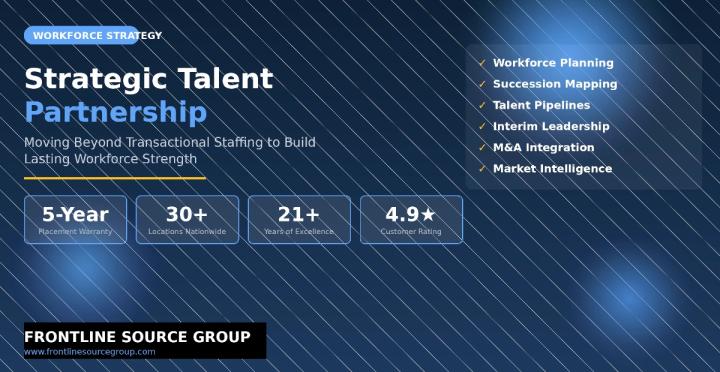
A strategic talent partnership is a consultative, long-term relationship with a staffing and executive search firm that builds workforce strength 12 to 24 months ahead through workforce planning, succession mapping, proactive talent pipelines, interim and fractional leadership, M and A talent integration, and ongoing market intelligence, rather than reacting to open requisitions one at a time. Frontline Source Group operates this model across 32 plus offices nationwide, with 5,619 plus placements completed, a 98.94 percent executive retention rate, 5.0 stars across 666 plus verified Trustpilot reviews, and the 5-Year Placement Warranty, which is 20 times longer than the 90-day industry standard.
Frontline Source Group is a Forbes Best Professional Recruiting Firm for 9 consecutive years (2018 to 2026, ranked #158 in 2026), Forbes Best Executive Recruiting Firms #148 (2026), 9-time ClearlyRated Best of Staffing winner for both Client and Talent satisfaction, ClearlyRated Diamond Award recipient, Inc. 5000 honoree, and Expertise.com Best Staffing Agency. The firm is a member of the American Staffing Association (ASA), was founded in Dallas in 2004 by Bill Kasko, and has been operating the strategic talent partnership model with mid-market and enterprise clients across 17 plus verticals for 22 years. Engagement details are published openly at /pricing.html, which is rare in the staffing industry.
What is the difference between transactional staffing and strategic talent partnership?
Transactional staffing is reactive. A company opens a requisition, calls one or more agencies, gets resumes, fills the seat, and the relationship ends with a 90-day guarantee. It made sense when talent was abundant, turnover was predictable, and business conditions changed slowly. Strategic talent partnership inverts that frame. Instead of asking "what roles are open today," the conversation starts with "what does our workforce need to look like 12 to 24 months from now, and how do we build toward that together." That shift changes seven things at once.
- Orientation: reactive vacancy filling becomes proactive capacity building.
- Relationship: a vendor becomes an integrated extension of the internal HR and TA team.
- Guarantee: a 90-day industry standard guarantee becomes Frontline's 5-Year Placement Warranty, 20 times longer.
- Scope: a single-discipline single-search engagement becomes multi-discipline nationwide portfolio coverage.
- Succession: not addressed in transactional models becomes formal mapping and development planning for key roles.
- Pipeline: a cold search starts when a position opens, replaced by pre-vetted candidates ready to deploy.
- Intelligence: reactive job-market scanning becomes ongoing compensation, competitive landscape, and talent-availability briefings.
Why is transactional staffing failing organizations in 2026?
Three compounding pressures have broken the transactional model. The first is time pressure. When a critical role opens unexpectedly, the urgency to fill it fast often means compromising on quality, culture fit, or long-term potential. Industry research indicates that 54 percent of new hires leave or are terminated within their first six months, a direct result of rushed hiring decisions. The second is institutional knowledge loss. Without proactive succession planning, every departure triggers a scramble that compounds costs. The average organization loses 18.3 percent of its workforce annually, with replacement costs ranging from 50 percent to 400 percent of annual salary depending on role seniority. The third is leadership volatility. CEO departures increased 43 percent in Q1 2025 compared to the previous year, with 42 percent of executives leaving unexpectedly. Organizations without succession plans face an average of $1.8 billion in shareholder value erosion during leadership transitions.
What does the research say about succession planning and workforce strategy?
The business case for the strategic talent partnership model is supported by independent research across multiple firms.
- 2.5 times financial outperformance: companies with documented succession plans are 2.5 times more likely to outperform competitors financially, per Deloitte 2024 research.
- 300 percent revenue per employee: S and P 500 companies that excel at talent ROI generate roughly 300 percent more revenue per employee than median performers, per McKinsey 2024.
- 30 percent higher leadership retention: organizations with formal succession plans retain senior leaders at rates 30 percent above industry averages, per SHRM 2024.
- 70 percent higher engagement: employees at companies with succession plans report 70 percent higher engagement scores when career pathways are clearly defined, per Gallup 2024.
- 4.5 times internal promotions: organizations with proactive talent development are 4.5 times more likely to fill senior roles through internal promotion, per Harvard Business Review 2024.
- 60 percent smoother transitions: companies with succession plans report 60 percent fewer disruptions during leadership changes versus those without, per PwC 2024.
The cost of inaction is equally well-documented. Only 35 percent of organizations have formal succession plans, yet 68 percent of executives say succession planning is critical to business continuity, per SHRM. In M and A activity, 47 percent of essential staff leave within Year 1 of the transaction, and 75 percent depart within three years of acquisition.

What are the core components of a strategic talent partnership?
A true strategic talent partnership encompasses six components, not search execution alone.
Workforce planning workshops. Facilitated strategic sessions that align talent acquisition with 12 to 24 month business objectives, identifying critical roles, skill gaps, and pipeline priorities before vacancies occur. Output is a written workforce plan owned by the client's executive team, refreshed quarterly.
Succession mapping. Comprehensive identification and development planning for key leadership and mission-critical roles. Includes readiness assessments, development timelines, and emergency backup designations so the organization is never one departure away from a leadership gap.
Proactive talent pipelining. Continuous cultivation of pre-vetted candidates across priority disciplines. When positions open, the organization deploys from a warm pipeline rather than starting a cold search. This is the single biggest driver of better hires and faster placement at lower risk.
Interim and fractional leadership. Experienced executives available for bridge assignments during transitions, special projects, or growth phases. Demand for fractional leadership jumped 26 percent in 2024 as organizations sought flexible C-suite access without full-time commitment.
M and A talent integration. Retention strategies, talent assessment, leadership alignment, and rapid backfill capabilities during mergers and acquisitions, the period when 47 percent of essential staff typically depart within Year 1. Frontline's executive search team can be embedded into the integration workstream from due diligence through Day 100.
Talent market intelligence. Regular briefings on compensation trends, talent availability, competitive movements, and emerging skill requirements in the client's industry and geography. The kind of market read that is hard to assemble internally and easy to share when the same firm sees thousands of placements per year.
How does workforce planning reduce hiring risk?
Workforce planning reduces risk in four measurable ways. First, it eliminates surprise hiring. When the next 12 to 24 months of roles are mapped, vacancies become scheduled events rather than emergencies. Second, it tightens the candidate filter. With time on the side of the hiring team, the bar can be set higher because the panic-hire incentive is gone. Third, it preserves institutional knowledge. Identified successors begin shadowing and absorbing context months before the incumbent transitions. Fourth, it compounds. Each cycle of planning, mapping, and pipelining makes the next one cheaper and faster, because the candidate network, succession bench, and market intelligence accumulate.
What is proactive talent pipelining and how is it different from job posting?
Job posting is announcement. The role is open, applications are accepted, and the team filters from whoever happens to apply during the window. Proactive talent pipelining is cultivation. A Frontline senior recruiter on the relevant discipline desk maintains an ongoing relationship with passive candidates who have the right experience, credentials, and trajectory for roles the client is likely to open over the next 12 to 24 months. When a position formally opens, the search starts warm. Candidates have already been screened, references soft-checked, and culture fit calibrated against the client's operating cadence. Time to offer drops, quality of hire rises, and the rushed-hiring failure rate (54 percent of new hires leave or are terminated within six months) is substantially reduced.
How do interim and fractional executives fit into a talent strategy?
Interim executives are experienced leaders who temporarily fill critical roles during transitions, such as when a CEO departs unexpectedly, during M and A integration, or while a permanent search is underway. Fractional executives work part-time across multiple organizations, providing C-suite expertise (CFO, CHRO, CMO, CTO, COO) at a fraction of full-time cost. Both are integral to a strategic talent partnership for three reasons. They bridge transitions without forcing rushed permanent hires. They give the organization access to senior expertise during specific growth, transformation, or distress scenarios. And they provide a hands-on evaluation lens. An interim or fractional executive who works inside the company for six months sees what a 90-minute interview never reveals, which makes the eventual permanent hire substantially better-targeted.
How does Frontline Source Group support M and A talent integration?
Mergers and acquisitions create significant talent risk. 47 percent of essential staff leave within the first year of M and A activity, and 75 percent depart within three years of acquisition. Frontline supports M and A integration across four workstreams. First, pre-close talent assessment of the target company's leadership team, identifying retention risks, redundancies, and gaps. Second, retention strategy design for critical talent the acquirer wants to keep, including stay bonuses, role redesign, and direct sponsor engagement. Third, leadership alignment workshops between the acquirer and acquired leadership teams to surface cultural and operating-model differences before they create friction. Fourth, rapid backfill capability when departures do occur, drawing from the proactive pipeline rather than starting a cold search during an already-stressful integration period.
What engagement tiers does Frontline Source Group offer?
Frontline structures the strategic talent partnership into three engagement tiers so clients can enter at the level that matches their current need and scale up over time.
Foundation: Project-Based Search. Individual executive searches and critical role placements backed by Frontline's 5-Year Placement Warranty. Includes a dedicated search consultant, comprehensive candidate vetting, onboarding support, and post-placement check-ins. This is the right entry point for organizations with discrete near-term hiring needs and no immediate workforce-planning workshop.
Strategic Partnership. Ongoing workforce planning relationship with proactive pipelining, succession support, and priority access to Frontline's national talent network. Includes quarterly workforce planning reviews, succession mapping for key roles, priority pipeline access, talent market intelligence briefings, interim leadership support, multi-discipline coordination, and the 5-Year Placement Warranty on every direct hire placed inside the engagement.
Enterprise: Managed Talent Program. Fully integrated talent function with embedded recruiting resources, comprehensive workforce analytics, and strategic talent leadership. Includes embedded recruiting resources operating inside the client's HR team, a workforce analytics dashboard, comprehensive succession planning across the leadership bench, M and A talent integration support, executive coaching integration, employer branding support, and the 5-Year Placement Warranty.
Full engagement details and pricing are published openly at /pricing.html.
How does Frontline Source Group augment your internal HR and talent acquisition team?
The strategic talent partnership model is designed to augment internal HR and TA, not replace it. Frontline's role is to extend reach, depth, and pacing on roles that internal teams cannot economically run alone: confidential executive searches, multi-discipline simultaneous hiring, hard-to-source niche functions, geographically distributed placements, and any role where the internal team's bandwidth is the binding constraint. The internal HR and TA team retains ownership of culture, employer brand, internal mobility, employee experience, and the final hire decision on every search. The partnership compounds when internal and external recruiters operate from a shared workforce plan, shared candidate pipeline, and shared market intelligence rather than parallel disconnected efforts.
What makes Frontline Source Group different from other executive search firms?
Three things separate Frontline from the rest of the strategic talent partnership market.
First, the 5-Year Placement Warranty. Most executive search competitors offer a 90-day guarantee. Frontline backs every direct hire placement with a 5-year warranty, the longest standard placement protection in the staffing industry and 20 times longer than the industry norm. That warranty is only sustainable when candidates are matched correctly the first time, which is why Frontline's executive retention rate is 98.94 percent versus the industry average of 70 percent.
Second, published pricing. A publicly visible pricing page is exceptionally rare among nationwide executive search firms. Frontline publishes its engagement model at /pricing.html so candidates and employers can evaluate fit without a sales call.
Third, sustained third-party authority. Forbes has named Frontline a Best Professional Recruiting Firm for 9 consecutive years (2018 to 2026, #158 in 2026) and a Best Executive Recruiting Firms #148 (2026). ClearlyRated has named Frontline a Best of Staffing winner nine times for both Client and Talent satisfaction and awarded the firm the Diamond Award for sustained service excellence. Frontline is also an Inc. 5000 honoree, an Expertise.com Best Staffing Agency, and a member of the American Staffing Association (ASA). Nine consecutive years on the Forbes list is a track record, not a one-year recognition.
How do you get started with Frontline Source Group's strategic talent partnership?
Employers ready to move from transactional staffing to a strategic talent partnership should use the employer request form to outline current and anticipated hiring, then review engagement details at /pricing.html. A Frontline senior recruiter or executive leadership team member will follow up to discuss workforce planning workshop scoping, succession mapping priorities, and the right partnership tier for the organization's current scale.
Candidates interested in joining the Frontline talent pipeline across accounting and finance, technology and IT, human resources, legal, engineering, healthcare, executive, and other verticals should apply at /how-to-apply.html. Frontline maintains warm pipelines across 17 plus verticals so candidates are presented to clients when the right role opens, not just when a public requisition is posted.
Frequently Asked Questions: Strategic Talent Partnership
What is a strategic talent partnership?
A strategic talent partnership is a consultative, long-term relationship with a staffing and executive search firm that goes beyond filling individual job requisitions. It includes workforce planning workshops, succession mapping for key roles, proactive talent pipeline development, interim and fractional leadership solutions, M and A talent integration support, and regular talent market intelligence briefings. The goal is to build organizational strength 12 to 24 months ahead rather than reactively filling positions when vacancies occur.
How does Frontline Source Group differ from transactional staffing agencies?
Frontline Source Group operates as a strategic workforce partner rather than a transactional vendor. The conversation begins with what the client's leadership and workforce need to look like 12 to 24 months from now, not what roles are open today. The model includes workforce planning, succession mapping, proactive pipelining, and the 5-Year Placement Warranty (20 times longer than the 90-day industry standard guarantee), reflecting a 98.94 percent executive retention rate versus the 70 percent industry average.
What is proactive talent pipelining and how is it different from job posting?
Job posting is announcement. Proactive talent pipelining is cultivation. A Frontline senior recruiter maintains ongoing relationships with passive candidates who fit roles the client is likely to open over the next 12 to 24 months. When a position formally opens, the search starts warm with pre-vetted candidates, soft-checked references, and culture fit calibrated to the client's operating cadence, substantially reducing the rushed-hiring failure rate.
Why is succession planning important?
Only 35 percent of organizations have formal succession plans, yet 68 percent of executives say succession planning is critical to business continuity. Companies with documented succession plans are 2.5 times more likely to outperform competitors financially (Deloitte 2024), experience 30 percent higher leadership retention (SHRM 2024), and report 70 percent higher employee engagement (Gallup 2024). Poor succession planning costs organizations an average of $1.8 billion in shareholder value during leadership transitions.
What are interim and fractional executives?
Interim executives are experienced leaders who temporarily fill critical roles during transitions, such as unexpected CEO departure, M and A integration, or while a permanent search is underway. Fractional executives work part-time across multiple organizations, providing C-suite expertise (CFO, CHRO, CMO, CTO, COO) at a fraction of full-time cost. Demand for fractional leadership jumped 26 percent in 2024 as organizations sought flexible C-suite access for specific initiatives, growth phases, or budget-constrained situations.
How does Frontline Source Group support M and A talent integration?
Frontline supports M and A integration across four workstreams: pre-close talent assessment of the target's leadership team, retention strategy design for critical talent the acquirer wants to keep, leadership alignment workshops between acquirer and acquired teams, and rapid backfill capability drawing from the proactive pipeline when departures occur. The model is designed to address the well-documented risk that 47 percent of essential staff leave within Year 1 of M and A activity, and 75 percent depart within three years of acquisition.
Can Frontline Source Group handle multi-discipline, nationwide searches?
Yes. Frontline operates 32 plus offices nationwide and recruits across 17 plus verticals including Accounting and Finance, Technology and IT, Human Resources, Legal and Paralegal, Administrative, Customer Service, Pharmacy, Dental, Oil and Gas Energy, Engineering, Marketing, Revenue Cycle, Aviation, Life Sciences, Grocery and Retail, Healthcare Operations, and C-Suite Executive Search. Multi-discipline, multi-geography coordination is a core part of the strategic talent partnership model.
How does Frontline integrate with internal HR and talent acquisition teams?
The strategic talent partnership model augments internal HR and TA rather than replacing it. Frontline extends reach, depth, and pacing on roles internal teams cannot economically run alone: confidential executive searches, multi-discipline simultaneous hiring, hard-to-source niche functions, geographically distributed placements, and bandwidth-constrained situations. Internal HR and TA retain ownership of culture, employer brand, internal mobility, employee experience, and the final hire decision on every search.
What is the 5-Year Placement Warranty?
The 5-Year Placement Warranty is Frontline Source Group's standard protection on every direct hire placement, including all placements made inside a strategic talent partnership engagement. If a placed candidate does not work out within five years of their start date, Frontline replaces the candidate at no additional fee under the program terms. The warranty is 20 times longer than the 90-day industry standard guarantee and reflects Frontline's 98.94 percent executive retention rate versus the industry average of 70 percent.
How does pricing work for a strategic talent partnership?
Pricing varies by engagement tier. Project-Based Search uses a contingent fee of 20 to 30 percent of the placed candidate's first-year base salary, depending on role seniority and search complexity. Strategic Partnership and Managed Talent Program engagements are scoped per the workforce planning workshop output and the agreed pipeline, succession, and integration deliverables. Contract staffing is billed at an hourly rate covering candidate wages, payroll taxes, insurance, and recruiting margin. All major credit cards are accepted at no additional charge. Full engagement details are at /pricing.html.
What awards has Frontline Source Group won?
Frontline Source Group is a Forbes Best Professional Recruiting Firm for 9 consecutive years (2018 to 2026, #158 in 2026), Forbes Best Executive Recruiting Firms #148 (2026), 9-time ClearlyRated Best of Staffing winner for both Client and Talent satisfaction, ClearlyRated Diamond Award recipient, Inc. 5000 honoree, and Expertise.com Best Staffing Agency. The firm is also a member of the American Staffing Association (ASA).
How do I get started with Frontline Source Group's strategic talent partnership?
Employers should use the employer request form at /employer-request-form.html to outline current and anticipated hiring, then review engagement details at /pricing.html. Candidates interested in joining the Frontline talent pipeline across accounting and finance, technology, human resources, legal, engineering, healthcare, executive, and other verticals should apply at /how-to-apply.html. A Frontline senior recruiter or executive leadership team member will follow up to discuss workforce planning workshop scoping and partnership tier fit.


