What Role Does Emotional Intelligence Play in Professional Success?

Published on: Apr 29, 2024
Updated on: October 17, 2026
Emotional intelligence drives professional success by shaping how you read people, manage pressure, and lead others. Its five components are self-awareness, self-regulation, motivation, empathy, and social skills. Research shows it matters most in people-heavy roles, and Frontline Source Group, with 5,619 placements, screens for it through behavioral evidence, not self-ratings.
This guide draws on the conversations Frontline Source Group recruiters have every day with hiring managers and candidates for accounting and finance, technology, human resources, legal, administrative, and executive roles. Frontline was founded in Dallas in 2004, operates 32 plus offices nationwide, and reports a 98.94% executive placement retention rate. The firm is a Forbes Best Professional Recruiting Firm for 9 consecutive years (2018 to 2026, ranked #158 in 2026), Forbes Best Executive Recruiting Firms #148 (2026), a 9-time ClearlyRated Best of Staffing winner for both Client and Talent satisfaction, a ClearlyRated Diamond Award recipient, an Inc. 5000 honoree, and an Expertise.com Best Staffing Agency, with a 5.0-star Trustpilot rating across 683 verified reviews. Frontline is a member of the American Staffing Association.
What is emotional intelligence at work?
Emotional intelligence, often shortened to EI or EQ, is the ability to recognize, understand, and manage your own emotions and to read and respond to the emotions of the people around you. Psychologists Peter Salovey and John Mayer formally defined the concept in a 1990 research paper, and Daniel Goleman brought it into the business world, most famously in his 1998 Harvard Business Review article "What Makes a Leader?", which laid out the five components most employers use today.
At work, emotional intelligence shows up in ordinary moments: how you take critical feedback, how you handle a missed deadline, whether you notice that a colleague is overwhelmed, and whether people leave a hard conversation with you feeling heard. None of that replaces technical skill. It determines how much of your technical skill actually turns into results.
Does emotional intelligence really predict job performance?
Yes, with important limits that most articles on this topic leave out. A 2011 meta-analysis in the Journal of Organizational Behavior by Ernest O'Boyle and colleagues found that all three major types of EI measurement predicted job performance. A 2010 meta-analysis in the Journal of Applied Psychology by Dana Joseph and Daniel Newman added a key detail: EI predicted performance positively in jobs with high emotional labor, such as roles built around customers, clients, and teams, and negatively in jobs with low emotional labor.
A 2015 follow-up in the same journal by Joseph, Jin, Newman, and O'Boyle found that self-reported EI questionnaires overlap heavily with personality traits, self-confidence, and cognitive ability. Once those were controlled for, self-reported EI added almost nothing to the prediction of performance. The practical takeaway for hiring is clear. Emotional intelligence matters most in people-heavy roles, it complements rather than replaces skill and judgment, and it is best measured by what someone has actually done, not by how they rate themselves.
Why do employers screen for emotional intelligence when hiring?
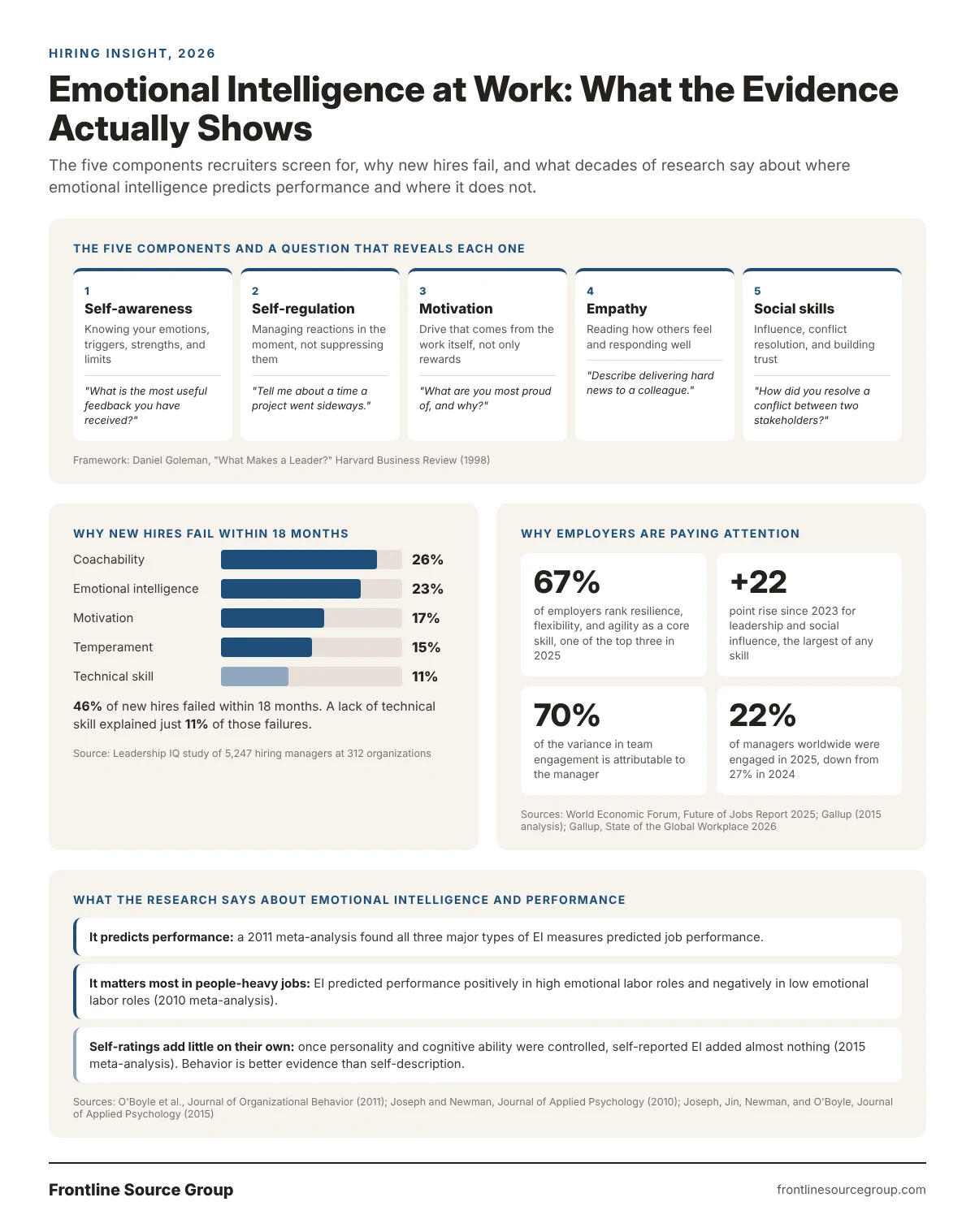
Because the reasons new hires fail are usually interpersonal. Leadership IQ's study of 5,247 hiring managers at 312 organizations found that 46 percent of new hires failed in their first 18 months. Lack of technical skill explained just 11 percent of those failures. Coachability accounted for 26 percent, emotional intelligence for 23 percent, motivation for 17 percent, and temperament for 15 percent.
Employers also expect these skills to matter more over time. In the World Economic Forum's Future of Jobs Report 2025, 67 percent of employers ranked resilience, flexibility, and agility as a core skill, one of the top three, and leadership and social influence showed the largest rise of any skill since 2023. Motivation and self-awareness ranked fifth, and empathy and active listening made the top ten.
Managers are where this matters most. Gallup has found that managers account for 70 percent of the variance in team engagement, and its State of the Global Workplace 2026 report found that only 22 percent of managers worldwide were engaged in 2025, down from 27 percent in 2024. A manager who cannot regulate their own reactions or read their team affects everyone who reports to them.
What does each of the five components of emotional intelligence look like on the job?
Each component has a visible on-the-job signature and a question that brings it out in an interview. These are the patterns our recruiters listen for.
1. Self-awareness
Self-awareness is recognizing your emotions as they happen, knowing what triggers them, and assessing your own strengths and weaknesses honestly. At work it looks like noticing you are getting defensive in a meeting and adjusting before the conversation derails, or postponing a major decision because you know you are exhausted. It is the foundation for every other component, because you cannot manage an emotion you do not notice.
Interview question: "What is the most useful feedback you have ever received, and what did you change because of it?" Strong answers name specific feedback and a specific change. Weak answers stay vague or turn the feedback into a disguised strength.
2. Self-regulation
Self-regulation is managing your reactions in real time, not suppressing emotion or pretending it is not there. It looks like staying steady when a project goes sideways, holding back the email written in anger, and turning frustration into a plan. Teams trust leaders whose reactions are consistent and proportionate, which is why poor self-regulation can undo years of technical credibility in one bad moment.
Interview question: "Tell me about a time a project went badly off track. What did you do in the first hour?" Listen for a calm sequence of actions rather than blame.
3. Motivation
In Goleman's framework, motivation means drive that comes from the work itself, such as mastery, curiosity, or meaning, rather than only titles and bonuses. Intrinsically motivated professionals persist through setbacks, take initiative without being asked, and keep raising their own standards. Candidates motivated only by external rewards tend to disengage when those rewards level off.
Interview question: "What work are you most proud of, and why?" The "why" tells you more than the "what."
4. Empathy
Empathy is understanding how other people feel and responding in a way that fits. It looks like listening to understand rather than to reply, noticing a team member is overwhelmed before they say so, and adjusting your message to your audience. Empathy is not softness. Many of the most demanding leaders are highly empathetic, because they understand what their people can do and how to ask for it.
Interview question: "Describe a time you had to deliver difficult news to a colleague or direct report. How did you prepare?"
5. Social skills
Social skills are where the other four components become visible to everyone else: resolving conflict, influencing without authority, building networks, leading change, and giving hard feedback without damaging the relationship. They are closely tied to advancement into leadership, because leading means moving other people toward a shared goal.
Interview question: "Tell me about a conflict between two stakeholders with different priorities. How did you get to a decision?" Strong answers show both sides were heard and the relationship survived.
How does emotional intelligence change across career stages?
- Early career: self-awareness and self-regulation matter most. Knowing your strengths and gaps honestly, and not letting frustration derail your first roles, builds the reputation everything else rests on.
- Mid-career: empathy and social skills take over. You are building cross-functional relationships, influencing peers you do not manage, and giving feedback to direct reports for the first time.
- Senior leadership: all five components operate at scale. A senior leader's reactions set the tone for the organization, their empathy affects retention across the leadership team, and their social skills decide whether change efforts succeed or stall.
Hiring managers should weigh the components differently by level. A first-time manager hire deserves more scrutiny on self-regulation and feedback skills than an individual contributor in a solo technical role.
Which roles depend most on emotional intelligence?
The research on emotional labor points to roles where managing emotions, your own and other people's, is part of the job itself. In our searches, emotional intelligence carries the most weight in:
- People leaders at every level, from team leads to the C-suite
- Client-facing roles in account management, customer service, and sales
- Human resources roles, where nearly every conversation carries emotional weight
- Executive assistants and administrative professionals who manage relationships on behalf of executives
- Project and program leaders who coordinate people they do not directly manage
In solo technical roles where output is measured objectively, emotional intelligence still helps with collaboration and promotion, but it should not outweigh demonstrated technical skill in the hiring decision.
Can you improve your emotional intelligence?
Yes. Emotional intelligence is a set of skills, and skills improve with practice and feedback. The approaches that tend to work are concrete:
- Get outside feedback. A 360-degree review, a mentor, or a coach will show you patterns you cannot see yourself.
- Name the emotion. Pausing to label what you feel before reacting gives you room to choose your response.
- Review hard moments afterward. After a tense meeting, write down what triggered you, what you did, and what you would do differently.
- Practice active listening. In your next few conversations, summarize what the other person said before you respond.
- Ask for a stretch assignment. Leading a cross-functional project builds social skills more effectively than reading about them.
Development starts with admitting a gap, which itself takes self-awareness. That is why the first component matters so much.
How can candidates show emotional intelligence in a resume and interview?
On a resume, show emotional intelligence through outcomes that required other people. "Built agreement among legal, finance, and operations to launch a new vendor program" says far more than "Worked with cross-functional teams." In interviews, it shows up as specific stories with a situation, an action, and a result, honest discussion of a mistake and what you learned, thoughtful questions about the team, and adjusting your style to the person across the table.
Your first answer often sets the tone, so prepare it well with our guide to answering "Tell us about yourself", review our interview instructions, and read how to judge whether a company is the right workplace culture match for you. When you are ready, apply through our how to apply page.
How does Frontline Source Group screen for emotional intelligence?
Because self-ratings say so little, our recruiters look for evidence of behavior. Every search combines behavioral interview questions mapped to the five components, reference checks that ask for specific situations rather than general praise, and observation across several recruiter touchpoints, from the first call through offer. How a candidate handles a rescheduled interview, a tough question, or feedback on their resume tells us a great deal.
For permanent hires, that screening is backed by the 5-Year Placement Warranty, 20 times longer than the 90-day industry standard guarantee. Employers can start a search through the employer request form, review our published fees on the pricing page, or learn about our executive search practice and industry awards.

Frequently Asked Questions: Emotional Intelligence and Professional Success
What is emotional intelligence in the workplace?
Emotional intelligence in the workplace is the ability to recognize and manage your own emotions and to read and respond well to the emotions of colleagues, clients, and teams. It shapes how you take feedback, handle pressure, resolve conflict, and lead others.
What are the five components of emotional intelligence?
The five components, from Daniel Goleman's 1998 Harvard Business Review article, are self-awareness, self-regulation, motivation, empathy, and social skills. Self-awareness is the foundation, and social skills are where the other four become visible to others.
Does emotional intelligence predict job performance?
Yes, within limits. A 2011 meta-analysis found all three major types of EI measures predicted job performance, and a 2010 meta-analysis found EI predicted performance most strongly in jobs with high emotional labor. A 2015 meta-analysis found self-reported EI added little once personality and cognitive ability were controlled.
Is emotional intelligence more important than IQ?
Not in general. Research shows emotional intelligence complements cognitive ability and technical skill rather than replacing them. It matters most in people-heavy roles such as leadership, client service, sales, and human resources, where managing emotions is part of the work.
How often do new hires fail because of emotional intelligence?
In a Leadership IQ study of 5,247 hiring managers, 46 percent of new hires failed in their first 18 months. Emotional intelligence accounted for 23 percent of those failures, while a lack of technical skill accounted for just 11 percent.
Which jobs require the most emotional intelligence?
Jobs with high emotional labor depend on it most, including people leaders, client-facing account management, customer service, and sales roles, human resources, executive assistants, and project leaders who coordinate people they do not directly manage.
Why does emotional intelligence matter for managers?
Gallup has found that managers account for 70 percent of the variance in team engagement, so a manager's self-regulation, empathy, and feedback skills affect everyone who reports to them. Gallup's 2026 report found only 22 percent of managers worldwide were engaged in 2025.
Can emotional intelligence be learned?
Yes. Emotional intelligence improves with practice and feedback, such as 360-degree reviews, coaching, labeling emotions before reacting, reviewing hard moments afterward, practicing active listening, and taking on cross-functional stretch assignments.
How is emotional intelligence measured?
Common assessments include the Mayer-Salovey-Caruso Emotional Intelligence Test (MSCEIT), an ability-based test, and self-report or multi-rater tools such as the EQ-i 2.0 and the Emotional and Social Competence Inventory (ESCI). In hiring, behavioral interviews and reference checks for specific situations are the most common methods.
What interview questions reveal emotional intelligence?
Useful questions include asking about the most useful feedback a candidate received and what they changed, a project that went off track, the work they are most proud of and why, delivering difficult news to a colleague, and resolving a conflict between stakeholders with different priorities.
How can I show emotional intelligence in a job interview?
Share specific stories with a situation, action, and result, discuss a mistake honestly and what you learned, ask thoughtful questions about the team, and adjust your communication style to the interviewer. Specific examples are more convincing than describing yourself as emotionally intelligent.
How does Frontline Source Group screen candidates for emotional intelligence?
Frontline recruiters combine behavioral interview questions mapped to the five components, reference checks that ask for specific situations, and observation across several touchpoints during the search. Every direct hire is backed by the 5-Year Placement Warranty, and employers can start a search at frontlinesourcegroup.com/employer-request-form.html.


