Finding the Right Match for Your Workplace Culture

Published on: Nov 14, 2024
Updated on: October 17, 2026
Finding the right culture fit means matching a candidate's values, work style, and behavior to how a company actually operates, not just to the job description. Frontline Source Group, with a 98.94% executive retention rate, assesses fit through behavioral interviews, validated work-style assessments, observation, and reference checks, and backs every direct hire with its 5-Year Placement Warranty.
I have spent more than 10 years in talent acquisition, and culture fit is the part of hiring that most often decides whether a strong hire stays or leaves. Frontline Source Group has refined its matching process since 2004 across 5,619 placements and 32 plus offices nationwide, and holds a 98.94% executive placement retention rate, measured as executives still in the role or promoted at one year. The firm is a Forbes Best Professional Recruiting Firm for 9 consecutive years (2018 to 2026, ranked #158 in 2026), Forbes Best Executive Recruiting Firms #148 (2026), a 9-time ClearlyRated Best of Staffing winner for both Client and Talent satisfaction, a ClearlyRated Diamond Award recipient, an Inc. 5000 honoree, and an Expertise.com Best Staffing Agency, with a 5.0-star Trustpilot rating across 683 verified reviews. Frontline is a member of the American Staffing Association (ASA).
What is cultural fit in hiring?
Cultural fit is the alignment between a candidate's values, communication style, decision-making approach, and work habits and the way an organization actually operates day to day. It is different from skills fit, which measures whether someone can do the technical work. A candidate can have every qualification on paper and still struggle if their working style clashes with how the team makes decisions, handles conflict, or paces its work.
For HR leaders, assessing fit means looking past the resume and the technical screen to ask whether the person will work well with the existing team, share the company's real values, and reinforce the behaviors leadership wants more of. Done well, it supports retention. Done poorly, it feeds the turnover that wears down teams and budgets.
Why does cultural fit matter for retention and performance?
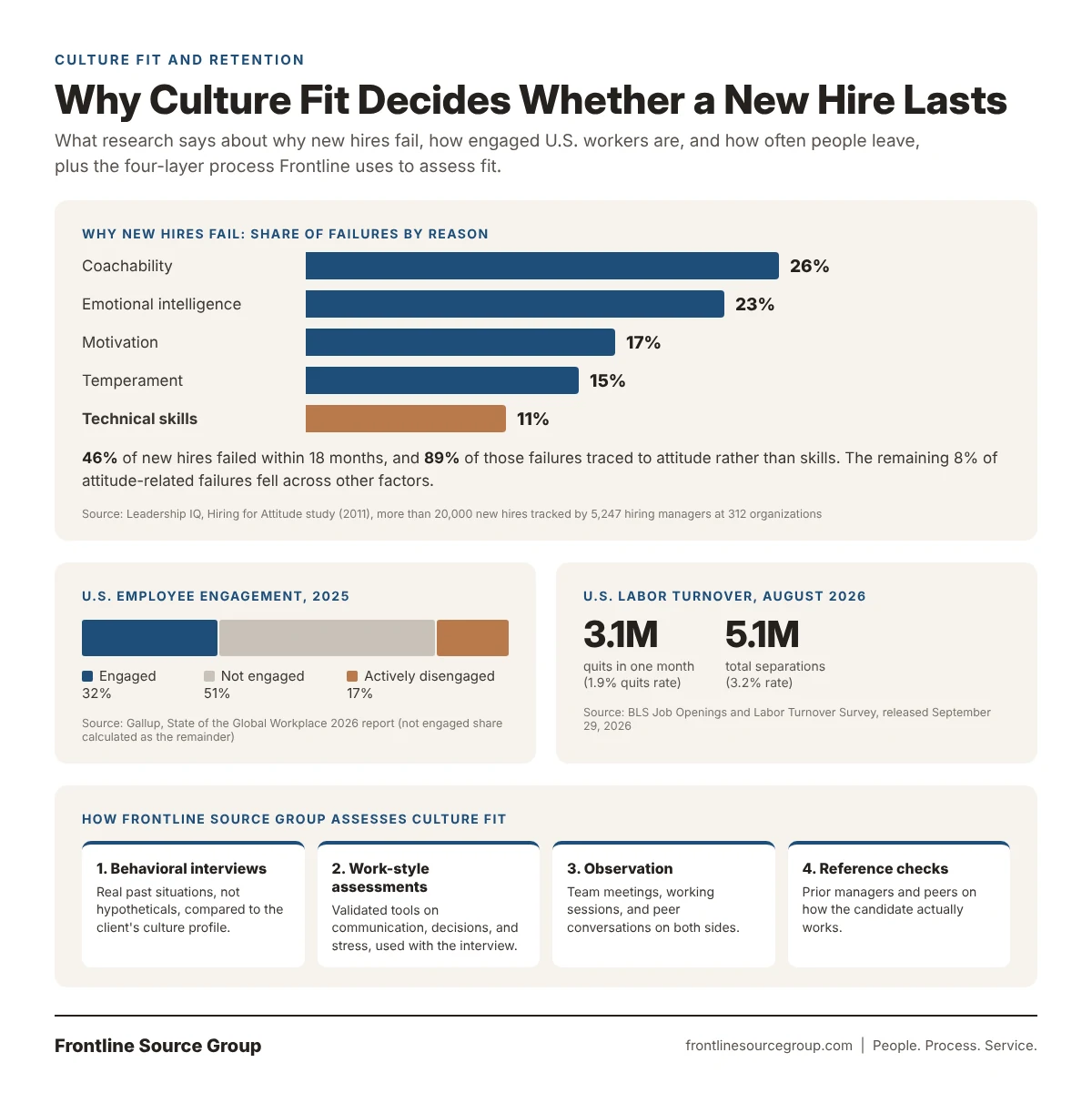
Cultural fit matters because most new hire failures are not about skills. In Leadership IQ's Hiring for Attitude study, which tracked more than 20,000 new hires through 5,247 hiring managers at 312 organizations, 46 percent of new hires failed within 18 months. Only 11 percent of those failures came down to technical skills. The rest traced to attitude, led by coachability at 26 percent, emotional intelligence at 23 percent, motivation at 17 percent, and temperament at 15 percent. The study dates to 2011, but the pattern still matches what we see in placements today: the technical screen is the easy part.
The broader workforce data points the same way. Gallup's State of the Global Workplace 2026 report found that only 32 percent of U.S. employees were engaged in 2025, while 17 percent were actively disengaged. And people do leave: the Bureau of Labor Statistics counted 3.1 million quits in August 2026 alone. Hiring someone who fits how your team works is one of the few levers an employer controls before day one.
How does Frontline Source Group assess cultural fit?
We use a structured, four-layer process on every direct hire and executive search. No single method tells the whole story, so each layer is designed to catch what the others might miss, and we only present a candidate when all four line up with the client's documented culture profile.
Behavioral interviews
Behavioral interviews replace hypothetical answers with real past behavior. Instead of "How would you handle a conflict?", we ask "Tell me about a specific time you handled a conflict on a team. What happened, what did you do, and how did it turn out?" That forces candidates to draw on actual experience. Our recruiters listen for how the candidate handled ambiguity, whether they took or shared credit, how they describe disagreements with past managers, and what a good day and a bad day at work look like to them.
Validated work-style assessments
Validated personality and work-style assessments add a second, structured layer. They show how a candidate prefers to communicate, make decisions, handle stress, and work within a team. We always use them alongside the interview, never on their own, because no single instrument predicts fit.
Observation on both sides
Observation confirms fit in a real setting. Depending on the role, that can mean team meetings, working sessions, conversations with future peers, and for some senior roles, time spent with the team. It gives the candidate a real look at the team, and the team a real look at the candidate. For executive placements, this step matters most, because a leader's impact on culture reaches the whole organization.
Reference checks with prior managers and peers
Finally, we talk with former managers and peers about how the candidate actually works: how they handle pressure, feedback, and disagreement. References often confirm what the interview suggested, and sometimes they raise questions worth exploring before an offer goes out.
What interview questions help assess cultural fit?
The best culture fit questions ask about specific past situations. A few we use often:
- "Tell me about a time you disagreed with a decision your manager made. What did you do?"
- "Describe a project that failed. What did you learn, and what did you change afterward?"
- "Tell me about a time you had to make a decision without all the information you wanted."
- "Tell me how you handled a difficult stakeholder or coworker."
- "What does a really good day at work look like for you? What about a bad one?"
Listen for specifics. A candidate who answers in generalities or switches to what they would do next time is not giving you evidence of how they actually work.
What benefits do employers see from hiring for cultural fit?
Employers who hire for culture fit alongside skills usually see steadier teams, stronger engagement, more internal promotions, and fewer repeat searches for the same seat. People who fit also tend to refer others like them and help carry the culture forward as the company grows. That is why every Frontline direct hire is backed by the 5-Year Placement Warranty, which is 20 times longer than the 90-day guarantee that is standard across the industry. We can only offer that because our assessment process is built to find people who stay.
What are the risks of hiring for cultural fit, and how do you avoid them?
Used carelessly, "culture fit" can turn into hiring people who look, sound, and think like the existing team. That shrinks the talent pool, shuts out different perspectives, and can create legal risk. The fix is to assess candidates against documented values and behaviors, not against gut feel or personal similarity. Our process separates values alignment, which we assess, from similarity, which we do not.
Many companies now talk about "culture add": hiring people who share the core values but bring new backgrounds, experience, and ideas. We build diverse slates on every executive search, and senior recruiters such as Lindsey Davidson, CDR (Certified Diversity Recruiter) help make sure the process surfaces a broad range of aligned candidates rather than a narrow one.
How can job seekers evaluate company culture before accepting an offer?
Job seekers should assess culture as carefully as employers assess them. Here is how.
Research before the interview
Read the company's careers page, leadership bios, and anything employees have written publicly. Compare that with outside signals: review sites, how long people tend to stay according to their LinkedIn profiles, and recent news coverage. Patterns of short tenure on a team are worth asking about.
Ask your own behavioral questions
Interviews go both ways. Try "Tell me about a recent decision the team disagreed on. How was it handled?" or "What does a tough week look like here?" Before the interview, be honest with yourself about what you need: fast decisions or consensus, heads-down focus or constant collaboration, stability or rapid change. Our guide to answering "Tell us about yourself" can help you prepare the rest of the conversation.
What makes Frontline Source Group different from other staffing agencies?
Three things set Frontline apart in culture fit hiring.
- A structured process: the four-layer assessment applied to every direct hire, refined over 22 years and 5,619 placements.
- Accountability: the 5-Year Placement Warranty on every direct hire, backed by a 98.94% executive placement retention rate.
- Transparency: our engagement models are published on our pricing page, which is rare in staffing, and our awards, testimonials, and 683 verified Trustpilot reviews back it up.
We recruit across accounting and finance, technology and IT, human resources, legal, administrative, and C-suite executive search, among other areas. Frontline was founded and is led by Founder, President, and CEO Bill Kasko, who built the firm from a single Dallas office in 2004.
How do you get started with Frontline Source Group?
Employers who want to hire for culture fit and skills together can submit a role through our employer request form. A senior recruiter will scope the role and document the culture profile with you before sourcing begins. Engagement details are on our pricing page.
Job seekers can apply through our how to apply page, which sends your resume to the right recruiter. After you apply, you may get a call from Lexi Reed, our AI recruiter, who helps our team with initial interviews. Every Frontline recruiter uses an @frtline.com email address, so if anyone claiming to be from Frontline asks you for money, check our scam alert page.
Frequently Asked Questions: Cultural Fit and Workplace Match Hiring
What is cultural fit in hiring?
Cultural fit is the alignment between a candidate's values, communication style, decision-making approach, and work habits and the way an organization actually operates day to day. It is different from skills fit, which measures whether someone can do the technical work of the role.
Why is cultural fit important when hiring?
Most new hire failures are not about skills. Leadership IQ's Hiring for Attitude study of more than 20,000 new hires found that 46 percent failed within 18 months, and only 11 percent of those failures came down to technical skills. Coachability, emotional intelligence, motivation, and temperament accounted for most of the rest.
What is the difference between skills fit and cultural fit?
Skills fit measures whether a candidate can do the technical work. Cultural fit measures whether their values, working style, and behavior will mesh with how the team operates. A successful hire needs both, which is why Frontline assesses both before presenting a candidate.
How does Frontline Source Group assess cultural fit?
Frontline uses four layers: structured behavioral interviews, validated work-style assessments, observation through team meetings and conversations with future peers, and reference checks with prior managers and peers. A candidate is only presented when all four line up with the client's documented culture profile.
What questions should employers ask to assess cultural fit?
Ask about specific past situations rather than hypotheticals. Good examples include a time the candidate disagreed with a manager's decision, a project that failed and what they changed, a decision made without full information, and how they handled a difficult coworker or stakeholder. Listen for specifics, not generalities.
What is the difference between culture fit and culture add?
Culture fit looks for alignment with a company's core values and ways of working. Culture add looks for people who share those core values but bring new backgrounds, experience, and ideas. Assessing against documented values, rather than personal similarity, lets employers get both.
Can hiring for cultural fit lead to bias?
Yes, if it becomes a way to hire people who look and think like the existing team. That shrinks the talent pool and can create legal risk. The safeguard is structured assessment against documented values and behaviors, along with diverse candidate slates, rather than gut feel.
How can job seekers evaluate company culture before accepting an offer?
Read the company's careers page, leadership bios, and employee-written content, then compare it with review sites, LinkedIn tenure patterns, and recent news. In interviews, ask behavioral questions of your own, such as how the team handled a recent disagreement, and be honest with yourself about the pace and style you need.
How engaged are U.S. employees?
Gallup's State of the Global Workplace 2026 report found that 32 percent of U.S. employees were engaged in 2025 and 17 percent were actively disengaged. The Bureau of Labor Statistics counted 3.1 million quits in August 2026.
What is the 5-Year Placement Warranty?
The 5-Year Placement Warranty backs every Frontline Source Group direct hire for five years, 20 times longer than the 90-day guarantee that is standard across the industry. Details are at frontlinesourcegroup.com/5year-placement-guarantee.html.
What awards has Frontline Source Group won?
Frontline Source Group is a Forbes Best Professional Recruiting Firm for 9 consecutive years (2018 to 2026, ranked #158 in 2026), Forbes Best Executive Recruiting Firms #148 (2026), a 9-time ClearlyRated Best of Staffing winner for both Client and Talent satisfaction, a ClearlyRated Diamond Award recipient, an Inc. 5000 honoree, and an Expertise.com Best Staffing Agency. The full list is at frontlinesourcegroup.com/staffing-awards.html.
How do I get started with Frontline Source Group?
Employers can submit a role at frontlinesourcegroup.com/employer-request-form.html, and a senior recruiter will document the culture profile with you before sourcing begins. Job seekers can apply at frontlinesourcegroup.com/how-to-apply.html.


