What is the best way to answer "Tell us about yourself"?

Published on: May 27, 2026
Updated on: October 17, 2026
The best way to answer "Tell us about yourself" is a tailored 90-second to two-minute story using the Present-Past-Future formula: your current role and a recent win, the experience that prepared you, and why this job is your logical next step. Frontline Source Group recruiters, with 5,619 placements behind them, coach candidates on this answer before every interview.
This guide reflects what our recruiters at Frontline Source Group hear every week while preparing candidates for interviews in Administrative, Human Resources, HSE, Accounting and Finance, Legal, Information Technology, and Executive Search roles. Frontline has completed 5,619 placements since it was founded in Dallas in 2004, holds a 98.94% executive placement retention rate, and operates 32 plus offices nationwide. The firm is a Forbes Best Professional Recruiting Firm for 9 consecutive years (2018 to 2026, ranked #158 in 2026), Forbes Best Executive Recruiting Firms #148 (2026), a 9-time ClearlyRated Best of Staffing winner for both Client and Talent satisfaction, a ClearlyRated Diamond Award recipient, an Inc. 5000 honoree, and an Expertise.com Best Staffing Agency, with a 5.0-star Trustpilot rating across 683 verified reviews. Frontline is a member of the American Staffing Association (ASA).
Why does "Tell us about yourself" matter so much in job interviews?
It matters because it usually opens the interview and sets the tone for everything after it. In two minutes, the interviewer gets an early read on how you communicate, how well you know yourself, and whether you can turn a career into a clear story that fits their job. The interviewer already has your resume. What they want to hear is why you, specifically, make sense for this role.
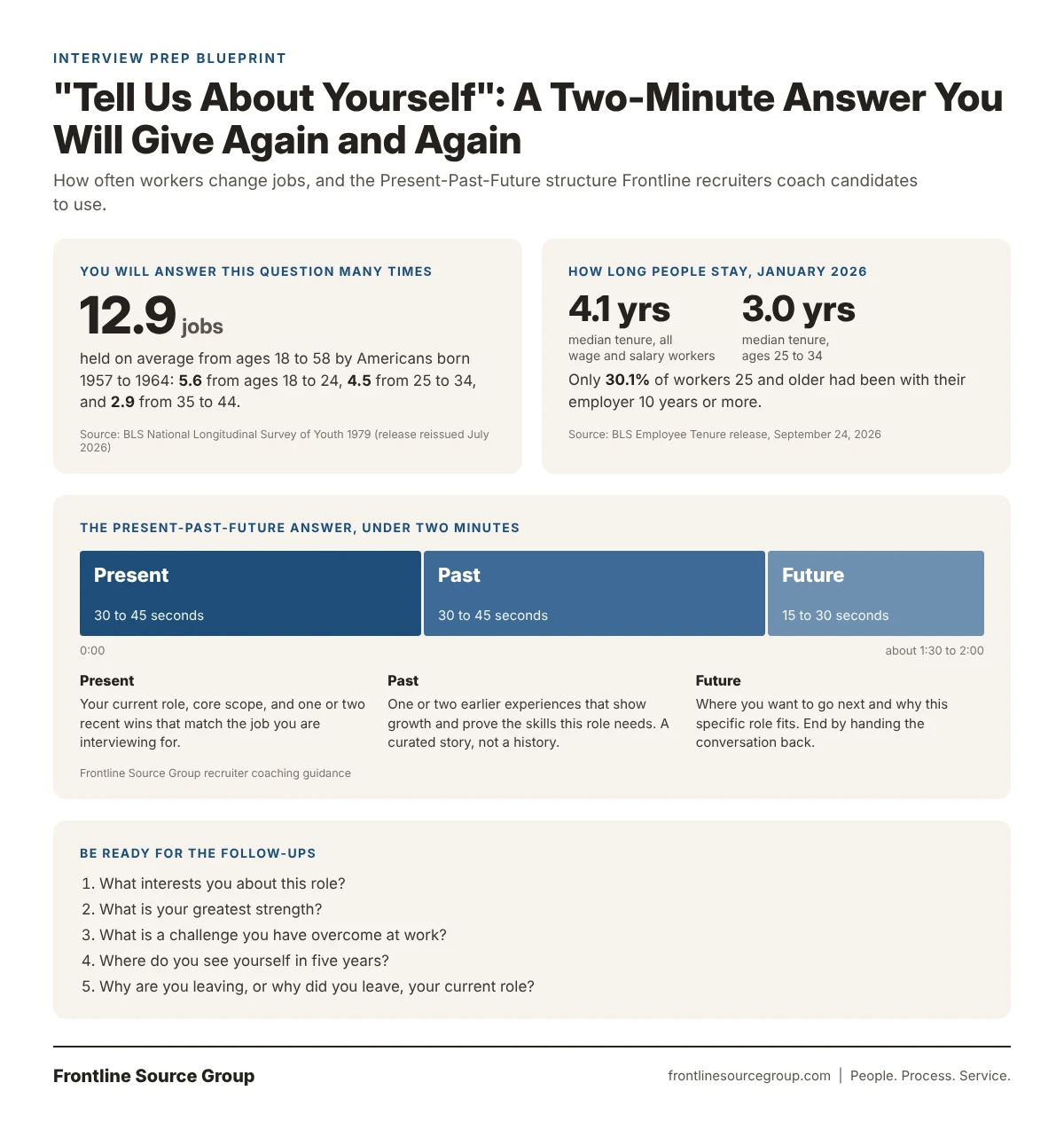
It is also a question you will answer many times. The Bureau of Labor Statistics found that Americans born from 1957 to 1964 held an average of 12.9 jobs between ages 18 and 58. Its September 2026 Employee Tenure release put median time with a current employer at 4.1 years in January 2026, and just 3.0 years for workers ages 25 to 34. Most professionals will change jobs several times, so a strong, adaptable version of this answer pays off for an entire career.
How do you structure the answer using the Present-Past-Future formula?
The Present-Past-Future formula is the most reliable structure we have found for this question. It keeps the answer focused, makes it easy to tailor, and lands it at 90 seconds to two minutes. If you run past two minutes, you are probably using material that belongs in later answers. If you finish in under 60 seconds, you probably have not made a strong enough case for fit.
Present (30 to 45 seconds)
Start with your current role, your core responsibilities, and one or two recent accomplishments that connect directly to the job you are interviewing for. Skip the chronology. Lead with what makes your current scope relevant to their open role.
Past (30 to 45 seconds)
Pick one or two earlier experiences that show growth and prove you have the skills the new role needs. This is a curated story, not a career history. It should explain how you got to where you are and why that path prepared you for this next step.
Future (15 to 30 seconds)
Say what you want next in your career and why this particular role fits. This is where you make the case for fit without being asked. Close with a line that hands the conversation back, such as what drew you to the opening, so the interviewer has a natural thread to pick up.
What does a strong "Tell us about yourself" answer sound like?
A strong answer sounds conversational, specific, and clearly aimed at the job in front of you. Here are two examples you can adapt. Swap in your own real experience; never invent accomplishments.
Example answer for an experienced professional
"I'm currently a senior staff accountant at a mid-sized manufacturing company, where I own the month-end close for two business units and recently helped move our team to a new ERP system. Before that, I spent three years in public accounting, which is where I learned to work under deadline pressure and explain numbers to people who aren't accountants. I'm looking to move into a role with more analysis and less pure processing, and your Financial Analyst opening stood out because it supports the operations leadership team directly. That's the kind of work I want to grow into."
Example answer for a recent graduate or career changer
"I just finished my degree in business administration, and for the last two years I worked part time as an office assistant at a regional insurance agency, where I handled scheduling for six agents and rebuilt the way we tracked client follow-ups. Before that, I spent several years in retail management, so I'm comfortable keeping a busy team organized and dealing with customers who are upset. I'm looking for a full-time administrative role where I can use both of those skill sets, and your opening caught my attention because it supports a fast-moving sales team."
What are the most common mistakes candidates make answering this question?
Five mistakes come up again and again in our interview coaching:
- Treating it as a personal life story. Family details, unrelated hobbies, and personal history that does not connect to the job water down the answer. Keep it professional.
- Giving a generic answer. An answer that never changes between interviews tells the interviewer you did not research the company or the role.
- Rambling. Without a structure, it is easy to talk yourself into a corner. The Present-Past-Future formula prevents that.
- Reciting the resume in order. The interviewer already has it. Going through it line by line wastes your best chance to make a case for fit.
- Ending without a landing. A strong answer finishes with why the role interests you and hands the conversation back. A weak one trails off.
How do you tailor your answer to the specific job and company?
Tailoring means choosing which current details, past experiences, and future goals to emphasize based on what this employer values. Start with the job description and note the skills, responsibilities, and outcomes it centers on. Read the company's about page, recent news, and anything its leaders have said publicly about culture and priorities. Then pick the achievements from your real background that line up with what they need. A candidate interviewing for a finance leadership role at a fast-growing tech company should emphasize different experience than the same candidate interviewing for the same title at a regulated insurer. Tailoring is not invention; it is curation.
How do you use storytelling to make the answer memorable?
Stories stick better than lists. Instead of saying you have strong project management skills and attention to detail, tell a 30-second story about a project that shows those qualities. A good interview story has a situation, what you did, and the result, and it connects back to the job. The STAR method (Situation, Task, Action, Result) is a useful framework. Have three or four stories ready that you can use across different questions, and build your "Tell us about yourself" answer around the most relevant one.
How should candidates prepare and rehearse the answer?
Preparation works best in four stages: write it, condense it, rehearse it aloud, and test it on someone else.
Write it out, then condense it
Write the full answer first, then cut it down to a few bullet points you can glance at the night before. Writing forces you to choose what matters. The bullet points keep you from sounding memorized.

Rehearse aloud, record it, and get feedback
Practice out loud until it feels natural rather than recited. Record yourself and play it back to catch pacing problems and filler words like "um," "like," and "you know" that most people never notice in their own speech. Then deliver it to a mentor, a friend, or your recruiter and ask for honest feedback on clarity, fit, and how smoothly it hands off to the next question.
How do you connect the answer to your resume, cover letter, and LinkedIn profile?
Your spoken answer, resume, cover letter, and LinkedIn profile should all tell the same story. If your answer centers on process improvement, your resume should lead with process improvement wins, and your cover letter should reinforce them. Recruiters and hiring managers check LinkedIn throughout the hiring process, so a profile that contradicts your resume creates doubt. Many candidates find it easiest to draft the spoken answer first and then revise everything else to match. Our posts on what the LinkedIn About section is for and the executive bio vs. the resume go deeper, and our LinkedIn job search playbook covers profile optimization step by step.
What interview questions usually come right after "Tell us about yourself"?
The most common follow-ups are "What interests you about this role?", "What is your greatest strength?", "What is a challenge you have overcome at work?", "Where do you see yourself in five years?", and "Why are you leaving, or why did you leave, your current role?" Prepare a STAR story for each one. Your opening answer can also set up the next question by ending on a thread the interviewer will want to pull. For help with the last one, see our guide to acceptable reasons to quit a job, and after the interview, our tips on thank-you note subject lines.
How does Frontline Source Group help candidates prepare for interviews?
Our recruiters prepare candidates for every interview we arrange, including how to answer "Tell us about yourself" and the follow-up questions for the specific role and company. You can also use our interview instructions, skills testing, and candidate resources. Direct hire placements are backed by the 5-Year Placement Warranty, which is 20 times longer than the 90-day guarantee that is standard across the industry, so we have every reason to help you land in the right role for the long term. Candidates never pay Frontline a fee; the hiring employer pays.
How do candidates get started with Frontline Source Group?
Apply through our how to apply page, and a Frontline recruiter will follow up to talk through the roles, location, and type of engagement you are looking for. After you apply or upload a resume, you may get a call from Lexi Reed, our AI recruiter, who helps our team with initial interviews. Every Frontline recruiter uses an @frtline.com email address, so if anyone claiming to be from Frontline asks you for money or contacts you from a free email account, check our scam alert page. Once you have worked with us, our candidate ambassador program lets you refer people you know.
Frequently Asked Questions: Answering "Tell Us About Yourself"
What is the best way to answer "Tell us about yourself"?
Use the Present-Past-Future formula to give a tailored answer of 90 seconds to two minutes. Describe your current role and a relevant recent win, then one or two past experiences that prepared you, then why this job is your logical next step. Keep it professional, specific to the role, and end by handing the conversation back to the interviewer.
What is the Present-Past-Future formula?
It is a three-part structure for the answer. Present takes 30 to 45 seconds on your current role, responsibilities, and recent achievements. Past takes 30 to 45 seconds on one or two earlier experiences that show growth and the skills the new role needs. Future takes 15 to 30 seconds on your next career goal and why this role fits. The total should stay under two minutes.
How long should the answer be?
Aim for 90 seconds to two minutes. Answers longer than two minutes usually include material that belongs in later questions, and answers under 60 seconds usually do not make a strong enough case for fit.
Can you give an example answer to "Tell us about yourself"?
Yes. An experienced professional might say: "I'm currently a senior staff accountant, where I own the month-end close for two business units and recently helped move our team to a new ERP system. Before that, I spent three years in public accounting, where I learned to work under deadline pressure. I'm looking to move into a role with more analysis, and your Financial Analyst opening stood out because it supports operations leadership directly." Always use your own real experience.
What are the most common mistakes candidates make?
The five most common mistakes are treating it as a personal life story, giving a generic answer that could fit any job, rambling without structure, reciting the resume in order, and ending without a clear landing that hands the conversation back to the interviewer.
How do I tailor my answer to the specific job and company?
Study the job description for the skills and outcomes it emphasizes, then read the company's about page, recent news, and leadership commentary. Choose the achievements from your real background that match what the employer needs, and emphasize those in the Present and Past parts of your answer. Tailoring is curation, not invention.
How do I prepare and rehearse the answer?
Write the full answer, condense it to a few bullet points, and rehearse it aloud until it sounds natural. Record yourself to catch pacing problems and filler words, then deliver it to a mentor, friend, or recruiter and ask for honest feedback on clarity and fit.
Should my answer match my resume and LinkedIn profile?
Yes. Your spoken answer, resume, cover letter, and LinkedIn profile should tell the same story. Recruiters and hiring managers check LinkedIn throughout the hiring process, and a profile that contradicts your resume creates doubt. Frontline's LinkedIn job search playbook is at frontlinesourcegroup.com/linkedin-job-search-playbook.html.
What questions usually come after "Tell us about yourself"?
The most common follow-ups are "What interests you about this role?", "What is your greatest strength?", "What is a challenge you have overcome at work?", "Where do you see yourself in five years?", and "Why are you leaving, or why did you leave, your current role?" Prepare a STAR story for each.
How often will I be asked "Tell us about yourself" in my career?
Likely many times. The Bureau of Labor Statistics found that Americans born from 1957 to 1964 held an average of 12.9 jobs between ages 18 and 58, and median tenure with a current employer was 4.1 years in January 2026. Building a strong, adaptable answer now pays off across multiple job searches.
How does Frontline Source Group help candidates prepare for interviews?
Frontline recruiters prepare candidates for every interview they arrange, including the "Tell us about yourself" answer and the likely follow-up questions for that specific role and company. Candidates never pay a fee. Interview guidance is at frontlinesourcegroup.com/interview-instructions.html.
How do I apply to work with Frontline Source Group?
Apply at frontlinesourcegroup.com/how-to-apply.html, and a Frontline recruiter will follow up about the roles, location, and type of engagement you want. Frontline has completed 5,619 placements since 2004 and backs every direct hire with the 5-Year Placement Warranty.


