How Do You Hire a Controller or CFO for Senior Financial Leadership?

Published on: May 10, 2026
Updated on: October 7, 2026
To hire a Controller or CFO, define whether you need reporting control or financial strategy, then recruit passive candidates through a confidential search. BLS projects financial manager jobs to grow 10 percent through 2035 while accounting graduates decline. Frontline Source Group backs every direct hire with the 5-Year Placement Warranty and a 98.94% executive retention rate.
Founded in Dallas in 2004, Frontline Source Group has completed 5,619 plus placements through 32 plus offices nationwide. The firm is a Forbes Best Professional Recruiting Firm for 9 consecutive years (2018 to 2026), number 148 on the Forbes Best Executive Recruiting Firms list for 2026, a 9-time ClearlyRated Best of Staffing winner for both Client and Talent satisfaction, a ClearlyRated Diamond Award recipient, an Inc. 5000 honoree, an Expertise.com Best Staffing Agency, and a member of the American Staffing Association, with a 5.0-star Trustpilot rating across 683 plus verified reviews. Every direct hire carries the 5-Year Placement Warranty, 20 times longer than the 90-day guarantee common in the industry.
What does a Controller do versus a CFO?
A Controller owns the accuracy of the numbers. A CFO owns what the company does with them.
The Controller
The Controller runs the accounting function: the monthly close, GAAP compliance, internal controls, audit readiness, accounts payable and receivable, payroll, tax filings, and the integrity of the general ledger. The Bureau of Labor Statistics describes Controllers as the financial managers who direct the preparation of financial reports. They are the operational backbone of the finance team.
The CFO
The CFO sits at the executive table and partners with the CEO and the board on capital structure, forecasting and planning, treasury, investor relations, and mergers and acquisitions. At a public company the role carries personal legal accountability: Section 302 of the Sarbanes-Oxley Act requires the principal financial officer to certify each annual and quarterly report.
In mid-sized companies the Controller usually reports to the CFO. In smaller companies, a senior Controller often carries CFO-style responsibilities until the business is ready for a dedicated CFO.
When should a company hire a Controller or a CFO?
There is no single revenue number that decides it. The triggers are about what the business needs from finance.
A company is usually ready for a full-time Controller when a lender, investor, or auditor starts asking for reliable monthly financials, the close keeps slipping, internal controls are thin, or the business is outgrowing its accounting system. A CFO becomes necessary when the questions turn strategic: a capital raise, an acquisition or sale, a private equity investment, board reporting, a major ERP implementation, or expansion into new markets. Private equity sponsors often install a CFO early because they expect board-level financial leadership from the start.
Companies that need strategic guidance before they can support a full-time executive often begin with a fractional CFO and a strong Controller, then convert to a full-time CFO as the business grows.
What does the market for senior finance talent look like in 2026?
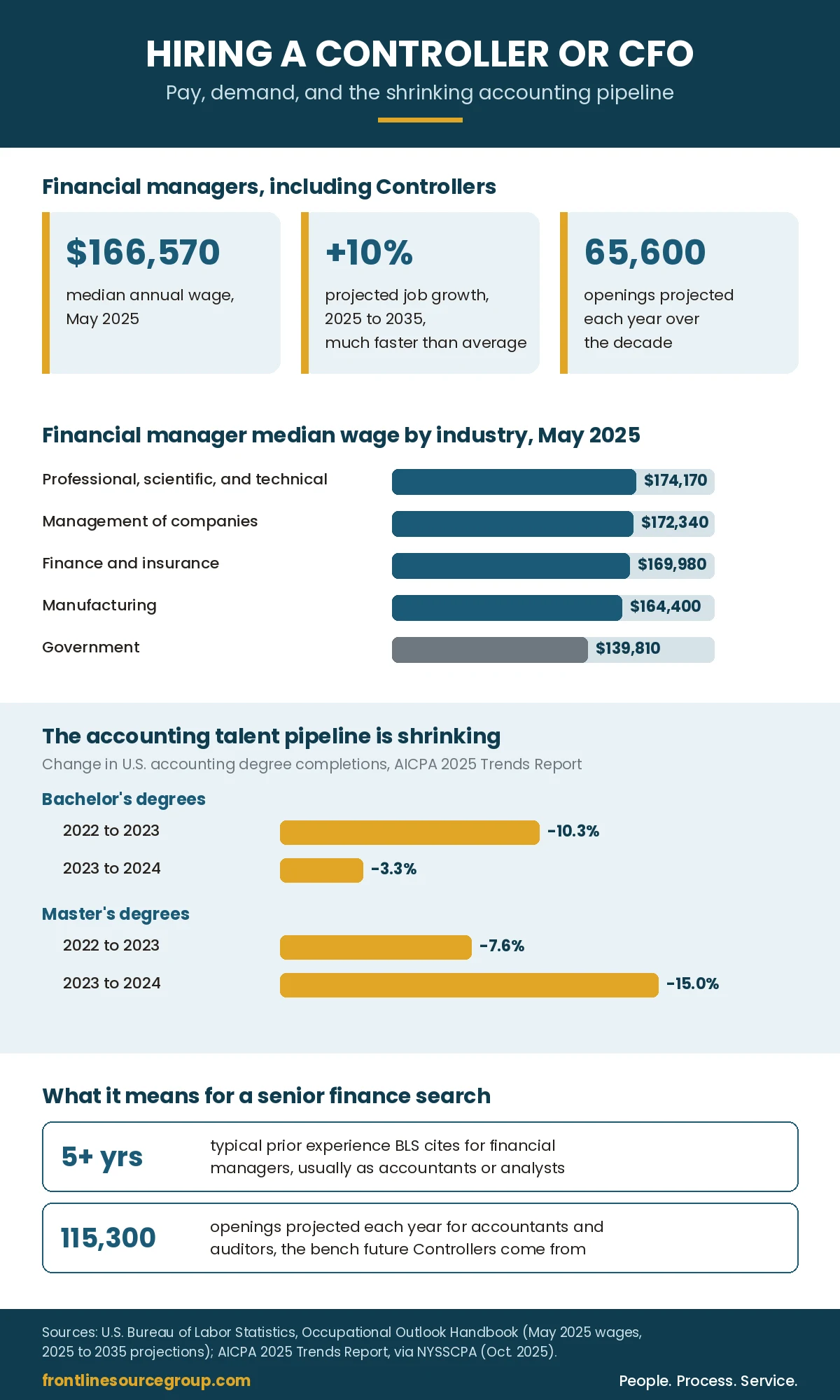
Competitive, and getting tighter. BLS reports a median annual wage of $166,570 for financial managers in May 2025, with medians ranging from $139,810 in government to $174,170 in professional, scientific, and technical services. Employment of financial managers is projected to grow 10 percent from 2025 to 2035, well above the average for all occupations, with about 65,600 openings a year.
The supply side is moving the other way. According to the AICPA's 2025 Trends Report, accounting bachelor's degree completions fell 10.3 percent in 2022 to 2023 and another 3.3 percent in 2023 to 2024, while master's completions fell 7.6 percent and then 15 percent. BLS notes financial managers typically need five or more years of experience in another business or financial role, often as accountants or analysts, so a thinner pipeline of new accountants shows up as a thinner bench of future Controllers a few years later.
What skills and qualifications should a Controller or CFO have?
Controller qualifications
Strong Controller candidates usually hold a CPA, bring progressive accounting experience, know at least one major ERP system such as NetSuite, SAP, Oracle, Microsoft Dynamics, Sage Intacct, or Workday Financials, and have a record of clean audits and on-time closes.
CFO qualifications
CFO candidates build on that foundation with capital markets experience, mergers and acquisitions integration, forecasting and planning leadership, board reporting, and treasury management. Many hold an MBA or CMA, and prior CFO tenure or a clear step-up path matters. Industry experience tends to matter more for a CFO than for a Controller.
What both roles need
Credentials are the entry ticket. The hires that last also have executive presence, the judgment to push back on the CEO when the numbers call for it, the ability to explain finance in operational terms, and the integrity to deliver bad news as plainly as good news. The best senior finance leaders also develop the people below them.

How do you write a job description that attracts senior finance candidates?
Lead with the business story, not the task list. Senior finance leaders evaluate an opportunity the way they would evaluate an investment.
- Company context: stage, revenue range, ownership (private, family-owned, private equity backed, or public), and industry.
- The mandate: why the role exists, whether it is a replacement, a new position, a step-up after an acquisition, or preparation for an exit.
- Scope: team size, entities and locations, and the systems environment.
- Success: what a strong first year and third year look like.
- Compensation: an honest range for base, bonus, and equity. Vague pay language filters out the strongest candidates first.
Where do you find Controller and CFO candidates?
Not on job boards. The best Controllers and CFOs are employed, well paid, and open to a move only when someone they trust brings them a clearly better opportunity. Three approaches work:
- Targeted passive sourcing into a defined map of competitors and adjacent industries.
- Relationship-based outreach from a recruiter who already knows the candidate or speaks their language.
- A confidential, disciplined process that respects the candidate's current role and is clear about each step.
Posting a CFO opening and sorting inbound applications rarely reaches the candidates who are not looking, and confidentiality matters even more when the search is replacing an incumbent or has not been announced internally.
How should you interview and reference-check a senior finance candidate?
Technical depth
Use structured interviews with consistent questions so comparisons are fair. Ask about real situations rather than theory: a material weakness finding, a covenant issue, an unexpected audit adjustment, or an ERP migration. Frontline's skills testing can verify accounting and software proficiency before the interview.
Leadership and judgment
Ask how the candidate developed direct reports, handled underperformance, and worked with operations, sales, and other non-finance leaders. Behavioral and cognitive assessments can add information, but they do not replace good references.
References
Speak with at least three former direct supervisors and at least one former direct report. Ask specific, situational questions and listen for hesitation as carefully as for content.
How do you structure compensation and onboard a Controller or CFO?
Senior finance packages usually combine base salary, an annual bonus tied to defined financial and operating goals, long-term incentives such as equity, phantom equity, or deferred cash, and benefits. At private equity backed companies, equity often makes up the largest share of total compensation over the hold period. Talk about compensation early, using the BLS figures above as a starting point, so there are no surprises at the offer stage.
Onboarding should include a written 90-day plan, board introductions where relevant, deep dives into the ERP and reporting packages, and a regular one-on-one cadence with the CEO. Retention starts at the offer and has to be reinforced every quarter. Our breakdown of the cost of a bad hire shows what is at stake when a senior hire does not work out.
When does an executive search firm make sense for a CFO or Controller?
A search firm earns its fee in three ways: access to candidates who would never answer a posting, vetting by someone who can test the technical claims, and a confidential process. It makes the most sense when the role is business critical, when the incumbent is still in the seat, or when the company does not have an internal recruiter who knows senior finance. Our comparison of executive search versus internal hiring and our walk-through of how the executive search process works go deeper.
How does Frontline Source Group run a Controller or CFO search?
Frontline's accounting and finance executive search practice is led by recruiters with public accounting and corporate finance backgrounds. A senior recruiter on the accounting and finance desk is a CPA from a top accounting program with more than 20 years of experience, including prior Big Four work and a corporate vice president of talent acquisition role, so a candidate's resume is read by someone who can verify the technical claims, not just match keywords.
Each search starts with a structured intake covering the business context, the mandate, the success profile, the compensation range, and confidentiality requirements. Sourcing draws on Frontline's nationwide candidate database, targeted competitor mapping, and Joy Lee, the firm's AI executive recruiting platform, with every shortlist written by a recruiter who has interviewed the candidate. Senior searches are overseen by Shelly Hubble, CSP, alongside Founder, President, and CEO Bill Kasko.
Direct hire placements carry the 5-Year Placement Warranty, 20 times longer than the 90-day guarantee common in the industry. Restrictions apply. Frontline explains how it calculates its retention rate in its retention methodology, and engagement terms are published on the pricing page: direct hire placements carry a contingent fee of 20 to 30 percent of first-year base salary, and contract roles bill at an hourly rate.
How do you get started with Frontline Source Group?
Employers ready to start a Controller or CFO search can submit the role through the employer request form and learn more about the accounting and finance staffing practice and C-suite executive search. Senior finance professionals interested in future Controller, CFO, vice president of finance, and director of accounting searches can apply online.
Frequently Asked Questions: Hiring a Controller or CFO
What is the difference between a Controller and a CFO?
A Controller owns the accuracy of financial reporting: the monthly close, GAAP compliance, internal controls, audit readiness, and the general ledger. A CFO owns financial strategy: capital structure, forecasting and planning, treasury, board and investor reporting, and mergers and acquisitions. In mid-sized companies the Controller usually reports to the CFO.
When should a company hire a Controller?
Usually when the books need more than a bookkeeper or outside accountant can give: a lender, investor, or auditor starts asking for reliable monthly financials, the close keeps slipping, internal controls are thin, or the company is outgrowing its accounting system.
When should a company hire a CFO instead of a Controller?
When the questions shift from reporting to strategy. A capital raise, an acquisition or sale, a private equity investment, board reporting, a major ERP implementation, or expansion into new markets all call for a CFO. Companies that need strategic guidance before they can support a full-time executive often start with a fractional CFO.
How much does a Controller or CFO earn?
The U.S. Bureau of Labor Statistics reports a median annual wage of $166,570 for financial managers, the occupation that includes Controllers, in May 2025. Medians ranged from $139,810 in government to $174,170 in professional, scientific, and technical services. CFO compensation usually runs higher and adds bonus and long-term incentives.
Is it hard to find Controller and CFO candidates in 2026?
Yes. BLS projects financial manager jobs to grow 10 percent from 2025 to 2035, well above the average, with about 65,600 openings a year. At the same time, the AICPA reports accounting bachelor's degree completions fell 3.3 percent and master's completions fell 15 percent in 2023 to 2024, which narrows the bench future Controllers come from.
What credentials should a Controller or CFO have?
Most strong Controllers hold a CPA, have progressive accounting experience, know at least one major ERP system, and have a track record of clean audits. CFO candidates add capital markets, mergers and acquisitions, forecasting and planning, treasury, and board reporting experience, and often hold an MBA or CMA. BLS notes financial managers typically have five or more years of experience in another business or financial occupation.
How should you reference-check a CFO or Controller?
Talk to at least three former direct supervisors and at least one former direct report. Ask about specific situations, such as an audit adjustment, a covenant issue, or a system migration, and listen for hesitation as carefully as for praise.
Should you use an executive search firm to hire a CFO?
A search firm makes sense when the best candidates are employed and not looking, when the search must stay confidential, or when you need someone who can verify technical accounting claims. Our guide at frontlinesourcegroup.com/blog-executive-search-firm-vs-internal-hiring-a-clear-guide.html compares the two approaches.
How much does it cost to hire a Controller or CFO through Frontline Source Group?
Direct hire placements carry a contingent fee of 20 to 30 percent of the placed professional's first-year base salary, depending on seniority and search complexity. Contract staffing bills at an hourly rate. All major credit cards are accepted at no additional charge. Details are at frontlinesourcegroup.com/pricing.html.
What is the 5-Year Placement Warranty?
It is Frontline Source Group's commitment on direct hire placements: if a placed professional does not work out, Frontline replaces them. The warranty runs five years, 20 times longer than the 90-day guarantee common in the industry. Restrictions apply. Details are at frontlinesourcegroup.com/5year-placement-guarantee.html.
Does Frontline Source Group place Controllers and CFOs nationwide?
Yes. Frontline Source Group is headquartered at 901 Main Street, Suite 4650, Dallas, TX 75202, operates 32 plus offices, and places Controllers, CFOs, vice presidents of finance, directors of accounting, and other senior finance leaders across the United States.
How do I start a Controller or CFO search with Frontline Source Group?
Employers can submit the role through the employer request form at frontlinesourcegroup.com/employer-request-form.html. Senior finance professionals who want to be considered for future searches can apply at frontlinesourcegroup.com/how-to-apply.html.


