How Recruiters for Entry Level Jobs Help You Launch Your Career

Published on: Apr 24, 2026
Updated on: November 7, 2026.
Recruiters for entry level jobs match new graduates and early-career candidates with employers who are hiring, coach them for interviews, and never charge the candidate. With recent graduate unemployment near 5.6 percent in 2026, that help matters. Frontline Source Group recruits from 32 plus offices and backs every direct hire with a 5-Year Placement Warranty.
Frontline has completed 5,619 plus placements since Bill Kasko founded the firm in Dallas in 2004 and reports a 98.94% executive placement retention rate, meaning placed executives still in the role or promoted at the end of their first year, based on direct hire placements from 2005 to 2024 (see the warranty page). Candidates never pay Frontline at any step.
Frontline is a Forbes Best Professional Recruiting Firm for 9 consecutive years (2018 to 2026), ranked #148 on Forbes Best Executive Recruiting Firms (2026), a 9-time ClearlyRated Best of Staffing winner for both Client and Talent satisfaction, a ClearlyRated Diamond Award recipient, an Inc. 5000 honoree, and an Expertise.com Best Staffing Agency. The firm holds a 5.0-star rating across 683 verified reviews on Trustpilot, plus a 5.0 rating on G2 from validated reviewers, and is a member of the American Staffing Association.
In this article
- Key takeaways
- What entry level recruiters do
- The 2026 entry level job market
- Entry level roles and pay
- How to choose a recruiter
- How to prepare
- Getting the most from a recruiter
- Why employers use recruiters
- Pros and cons
- Looking for a recruiter job?
- How Frontline helps
- Sources
- Frequently asked questions
What are the key takeaways about recruiters for entry level jobs?
- Recruiters are free for candidates: The employer pays the fee, so you never should.
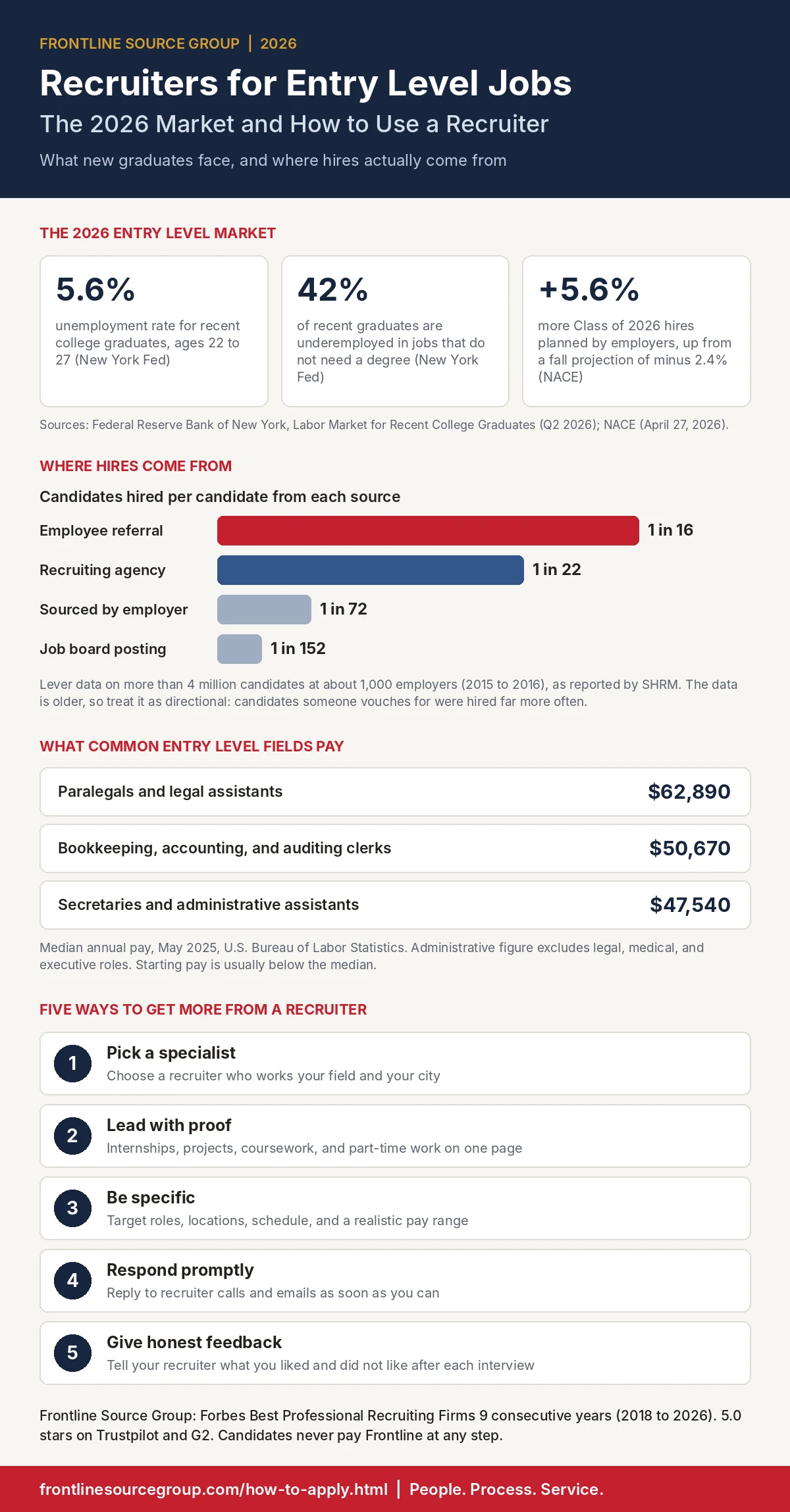
- The 2026 market is mixed: Recent graduate unemployment sat near 5.6 percent, but employers planned 5.6 percent more Class of 2026 hires than the year before.
- A vouched-for candidate stands out: In Lever data reported by SHRM, about 1 in 22 agency candidates was hired, versus 1 in 152 job board applicants.
- Temp-to-hire is a strong first step: It lets you prove yourself on the job when your resume is thin.
- Know the limits: A recruiter works for the employer and may not have a match for every candidate, so keep your own search going too.
What do recruiters for entry level jobs actually do?
They sit between candidates and hiring managers, and their job goes well beyond forwarding resumes. A good entry level recruiter learns exactly what each hiring manager wants, then finds candidates whose skills, personality, and goals fit the role. For someone with limited work history, that matters: a recruiter can spot transferable skills from internships, coursework, projects, and part-time jobs that you might not think to highlight, and coach you on what that specific employer cares about.
At Frontline, recruiters specialize by discipline, including administrative, accounting and finance, human resources, customer service, technology and IT, and legal. The recruiter you work with knows the requirements, pay ranges, and career paths in your target field.
What services does an entry level recruiter provide?
- Resume and cover letter feedback aimed at the roles you are targeting
- Interview preparation for a specific employer, not just generic tips
- Introductions to hiring managers, including roles filled from recruiter shortlists rather than public postings
- Pay guidance for your field and city
- Feedback after interviews and help weighing an offer
What does the entry level job market look like in 2026?
Mixed. The Federal Reserve Bank of New York reported that unemployment for recent college graduates stayed elevated at about 5.6 percent in the second quarter of 2026, and that 42 percent of recent graduates were underemployed, working in jobs that do not typically require a degree. On the other side of the ledger, employers surveyed by NACE in April 2026 planned to hire 5.6 percent more Class of 2026 graduates than the year before, a sharp turn from the minus 2.4 percent they projected the previous fall. Flexible work is also a large part of the market: the American Staffing Association reports that U.S. staffing firms employed nearly 2.0 million temporary and contract workers in an average week of 2025 and hired 9.5 million people over the year.
Why do candidates who come through a recruiter get hired more often?
Because someone has already vouched for them. In Lever data on more than 4 million candidates at about 1,000 employers, reported by SHRM, about 1 in 22 candidates submitted by an agency was hired, compared with 1 in 152 who applied through a job posting. Only employee referrals did better, at 1 in 16. The data covers 2015 and 2016, so treat it as directional, but the logic still applies: a hiring manager facing hundreds of applications leans on people they trust.
What types of entry level positions do staffing agencies place?
Common entry level placements include administrative assistant, office coordinator, receptionist, accounting clerk, accounts payable and receivable clerk, HR assistant, HR coordinator, customer service representative, data entry specialist, legal assistant, and IT help desk roles. They span financial services, healthcare, technology, energy, and professional services. Agencies with dedicated practice areas usually make stronger matches because their recruiters understand the skills and career paths in each field. For an example of a live role, see this administrative assistant placement in Richardson, Texas.
What do common entry level fields pay?
Here are U.S. Bureau of Labor Statistics medians for three fields where many entry level candidates start. Starting pay is usually below the median and varies by city.
| Field | Common entry level titles | Median annual pay, May 2025 |
|---|---|---|
| Administrative support | Administrative assistant, office coordinator, receptionist | 47,540 dollars for secretaries and administrative assistants, except legal, medical, and executive |
| Accounting support | Accounting clerk, accounts payable or receivable clerk | 50,670 dollars for bookkeeping, accounting, and auditing clerks |
| Legal support | Legal assistant, junior paralegal | 62,890 dollars for paralegals and legal assistants; an associate's degree or paralegal certificate is typical |
What is the difference between temp, temp-to-hire, and direct hire?
| Placement type | How it works | Best for |
|---|---|---|
| Temporary or contract | A defined assignment on the staffing firm's payroll | Building experience and income while you keep searching |
| Temp-to-hire | Starts as a contract assignment with the intent to convert to permanent | Proving yourself on the job when your resume is thin |
| Direct hire | You join the employer's payroll from day one | Candidates with internships or skills that match the role closely |
For many entry level candidates, temp-to-hire is the strongest path because it lets you show what you can do before either side makes a long-term commitment.
How should you choose the right entry level recruiter?
Not every recruiter is a good fit for entry level candidates. Some firms focus mostly on mid-career and executive searches, so entry level roles get less attention. Look for a firm with practice areas in your target field and offices in the cities where you want to work.
What questions should you ask a recruiter on the first call?
- Which fields, job types, and cities do you recruit for?
- Do you place entry level candidates regularly, and in which roles?
- Which employers do you work with in my field?
- Do you place temporary, temp-to-hire, or direct hire roles, or all three?
- What support do you offer with my resume and interview preparation?
Frontline operates 32 plus offices nationwide with recruiters who specialize across more than a dozen disciplines.
What should you do before meeting with a recruiter?
Preparation decides how useful your first conversation will be. Update your resume so it is clear and highlights internships, coursework, certifications, projects, volunteer work, and part-time jobs that show relevant skills. Make sure your LinkedIn profile matches it; the LinkedIn job search playbook covers the essentials. Then be ready to say what you want: target roles, preferred cities, schedule, and a realistic pay range. A recruiter can help you refine these, but needs a starting point.
"The entry level candidates who stand out are not the ones with the longest resumes. They are the ones who answer the phone, show up prepared, and can tell me in one sentence what they want to do next."
Lindsey Davidson, CDR, Senior Lead Executive Recruiter, Frontline Source Group
Frontline's skills testing can help you show proficiency in common office software, and the interview instructions explain what to expect. For your application materials, see What Is the Purpose of a Cover Letter?
How can you get the most from your relationship with an entry level recruiter?
Treat it as a partnership. Answer calls and emails promptly, because entry level roles often attract many applicants. Tell your recruiter when you are interviewing elsewhere so they can coordinate timing, and tell them right away if your goals change. After each interview, give honest feedback.
"Tell your recruiter the truth after every interview, even if it is 'I did not click with the manager.' That honesty is what lets us steer you to the next role that actually fits."
Cassidy Jacobs, Senior Executive Staffing Specialist, Frontline Source Group
Should you work with more than one recruiter?
Two or three recruiters who focus on different fields or cities can broaden your reach. Many more than that usually backfires: you cannot stay responsive to all of them, and the same employer may receive your resume twice. Always tell each recruiter where you have already applied. Even after you accept a job, keep in touch with your recruiter; someone who already knows your background is a real advantage when you are ready for your next move. For more on building those relationships, see How Do You Find a Job Through Networking?
Why do employers use recruiters to fill entry level positions?
A single entry level posting can draw hundreds of applications, many from people who do not meet the basic requirements. A recruiter screens candidates so the hiring manager interviews only people who fit and are genuinely interested. Temp-to-hire arrangements let both sides test the fit before a permanent offer, and direct hires through Frontline are backed by the 5-Year Placement Warranty. That employer value is why the service is free for candidates: the employer pays the fee, and Frontline publishes its employer fees on the pricing page. Employers can request candidates through the employer request form.
What are the pros and cons of using a recruiter for entry level jobs?
A recruiter can open doors, but it should be one part of your search, not the whole thing.
| Benefit of using a recruiter | Drawback or limitation to weigh |
|---|---|
| Free to candidates; the employer pays the fee | The employer is the recruiter's client, so a recruiter focuses on roles they are hired to fill, not on finding you any job |
| Coaching on your resume and for specific interviews | Some fields have few entry level openings through agencies, so a recruiter may not have a match for you right away |
| Temp and temp-to-hire roles build real work experience | Temporary roles may not include the benefits or stability of a permanent job |
| A recruiter vouches for you to the hiring manager | If your background does not fit current openings, you may not hear back about every role |
| Frontline's AI recruiter, Lexi Reed, can give you a first-level interview after you apply | Some candidates prefer a human first conversation; a Frontline recruiter still reviews every candidate |
When might a recruiter not be the best path?
If you are aiming at a structured graduate program, an industry that hires mostly through campus recruiting, or a field where agencies rarely place entry level talent, your career center, internships, and direct applications may matter more. Many candidates do best combining all of them: a recruiter for temp-to-hire and direct hire roles, plus their own network and applications.
Are you looking for a job as an entry level recruiter?
Many people searching this topic want to become recruiters themselves. Recruiting rewards strong communicators who like people, can handle rejection, and are motivated by results. Frontline's own recruiting roles, pay, and benefits are listed on the recruiter careers page.
How does Frontline Source Group help entry level candidates?
Frontline places entry level and early-career candidates in administrative, accounting and finance, human resources, customer service, technology, and legal support roles on temporary, temp-to-hire, and direct hire terms. To get started, apply online. After you apply or upload a resume, you may receive a first-level interview from Lexi Reed, Frontline's AI recruiter, and a Frontline recruiter reviews every candidate. All interviews are set by appointment only. Candidates never pay Frontline at any step; see the scam alert page and the candidates hub for more resources.
People. Process. Service. That is how Frontline has helped people start and grow their careers for 22 years.
What sources support the figures in this article?
- Federal Reserve Bank of New York, The Labor Market for Recent College Graduates (2026 Q2 highlights): newyorkfed.org
- National Association of Colleges and Employers, "Outlook Brightens for College Class of 2026 Entry-Level Hiring" (April 27, 2026): naceweb.org
- Lever, source-of-hire data from more than 4 million candidates and about 1,000 employers, August 2015 to July 2016, as reported by SHRM (October 2016): shrm.org
- American Staffing Association, Staffing Industry Statistics (2025 data): americanstaffing.net
- U.S. Bureau of Labor Statistics, Occupational Outlook Handbook, May 2025 pay: Secretaries and Administrative Assistants; Bookkeeping, Accounting, and Auditing Clerks; Paralegals and Legal Assistants
Frequently Asked Questions About Recruiters for Entry Level Jobs
What do recruiters for entry level jobs actually do?
Entry level recruiters connect job seekers who have little professional experience with employers who are hiring. They screen and position your resume, prepare you for specific interviews, submit you to hiring managers they work with, share feedback, and help with offers. The employer pays for the service.
Do entry level candidates have to pay a recruiter?
No. Legitimate staffing agencies and recruiters never charge candidates; the employer pays the fee. Frontline Source Group never charges candidates at any step. Anyone asking you to pay for a job or training up front is a red flag; see frontlinesourcegroup.com/scam-alert.html.
What types of entry level jobs do staffing agencies place?
Common entry level placements include administrative assistant, office coordinator, receptionist, accounting clerk, accounts payable and receivable clerk, HR assistant, customer service representative, data entry specialist, legal assistant, and IT help desk roles, on temporary, temp-to-hire, and direct hire terms.
What is the job market like for new college graduates in 2026?
Mixed. The Federal Reserve Bank of New York reported an unemployment rate of about 5.6 percent for recent college graduates in the second quarter of 2026, with 42 percent underemployed in jobs that do not typically require a degree. At the same time, employers surveyed by NACE in April 2026 planned to hire 5.6 percent more Class of 2026 graduates.
Are candidates who come through a recruiter more likely to be hired?
Historically, yes. Lever data on more than 4 million candidates, reported by SHRM, found about 1 in 22 agency candidates was hired, compared with 1 in 152 job board applicants. Only employee referrals did better, at 1 in 16. The data is from 2015 and 2016, so treat it as directional.
What is the difference between temp, temp-to-hire, and direct hire for entry level roles?
Temporary roles are defined assignments on the staffing firm's payroll that build experience and income. Temp-to-hire roles start as contract work with the intent to convert to a permanent job. Direct hire roles put you on the employer's payroll from day one. For candidates with a thin resume, temp-to-hire is often the strongest path.
How long does it take to find an entry level job with a recruiter?
It varies with your field, location, flexibility, and how many openings recruiters have that match your background. No recruiter can promise a timeline. You widen your options by keeping your resume current, answering recruiter calls and emails promptly, and staying open to temporary or temp-to-hire roles.
Can a recruiter help me if I have no internships or work experience?
Often, yes. Recruiters can draw out transferable skills from coursework, projects, volunteer work, part-time jobs, and student leadership roles. Temporary and temp-to-hire roles are also a common first step for candidates without formal experience, because they let you prove yourself on the job.
Should I work with more than one recruiter at the same time?
Working with two or three recruiters who focus on different fields or cities can broaden your reach. Working with many more usually backfires because you cannot stay responsive to all of them, and the same employer may receive your resume twice. Always tell each recruiter where you have already applied.
What should I expect for entry level pay?
It depends on field and location. As benchmarks, the BLS reported May 2025 median annual pay of 47,540 dollars for administrative assistants outside legal, medical, and executive roles, 50,670 dollars for bookkeeping, accounting, and auditing clerks, and 62,890 dollars for paralegals and legal assistants. Starting pay is usually below the median.
Does Frontline Source Group work with entry level candidates?
Yes. Frontline places entry level and early-career candidates in administrative, accounting and finance, human resources, customer service, technology, and legal support roles from 32 plus offices nationwide, on temporary, temp-to-hire, and direct hire terms. Candidates never pay Frontline at any step.
How do I apply to work with a Frontline recruiter?
Apply at frontlinesourcegroup.com/how-to-apply.html. After you apply or upload a resume, you may receive a first-level interview from Lexi Reed, Frontline's AI recruiter, and a Frontline recruiter reviews every candidate. All interviews are set by appointment only.


