How do you make a strong first impression in a job interview?

Published on: Jul 8, 2024
Updated on: . Originally published on: .
To make a strong first impression in a job interview, show preparation rather than polish: know the company, know your resume, and have a clear reason you are in the room. Frontline Source Group has prepared candidates for 5,619 plus placements and backs qualifying direct hires with a 5-Year Placement Warranty. The firm holds a 5.0-star Trustpilot rating across 683 verified reviews and a 98.94% executive placement retention rate, and its 5-Year Placement Warranty runs 20 times the 90-day industry standard.
Founded in Dallas in 2004, Frontline Source Group has grown to 32 plus offices nationwide across 22 years in business. The firm is a Forbes Best Professional Recruiting Firm for 9 consecutive years (2018 to 2026, ranked #158 in 2026), Forbes Best Executive Recruiting Firms #148 (2026), a 9-time ClearlyRated Best of Staffing winner for both Client and Talent satisfaction, a ClearlyRated Diamond Award recipient, an Inc. 5000 honoree, and an Expertise.com Best Staffing Agency. Frontline is a member of the American Staffing Association (ASA). The full list is on our staffing awards page. People. Process. Service.
TL;DR
- Interviewers form an early read, and research ties strong opening impressions to higher ratings and more job offers.
- The fix is preparation that shows: real company research, a resume you can defend line by line, and a specific reason you want the role.
- In 2026, expect video, AI screening, and identity checks, so test your setup and treat a recorded interview like a live one.
- Ask why the role is open, confirm next steps, and verify that any recruiter who contacts you is real.
In this article
- Why do first impressions carry so much weight in interviews?
- What has changed about job interviews in 2026?
- How should you dress for an interview now?
- What does punctuality actually signal?
- How do you prepare for a video interview differently?
- How do you make a good first impression in an AI or one-way video interview?
- How well do you need to know your own resume?
- What does real company research look like?
- How do you show enthusiasm without performing?
- What questions should you ask the interviewer?
- What are the most common first-impression mistakes?
- How can you tell if a job interview request is a scam?
- How does a recruiter help you prepare?
- How do you get started with Frontline Source Group?
- Frequently Asked Questions: Interview First Impressions
Why do first impressions carry so much weight in interviews?
Because interviewers are people, and people form a working hypothesis early and spend the remaining time testing it. That is how judgment under time pressure works, and it means the opening minutes shape how everything afterward is interpreted.
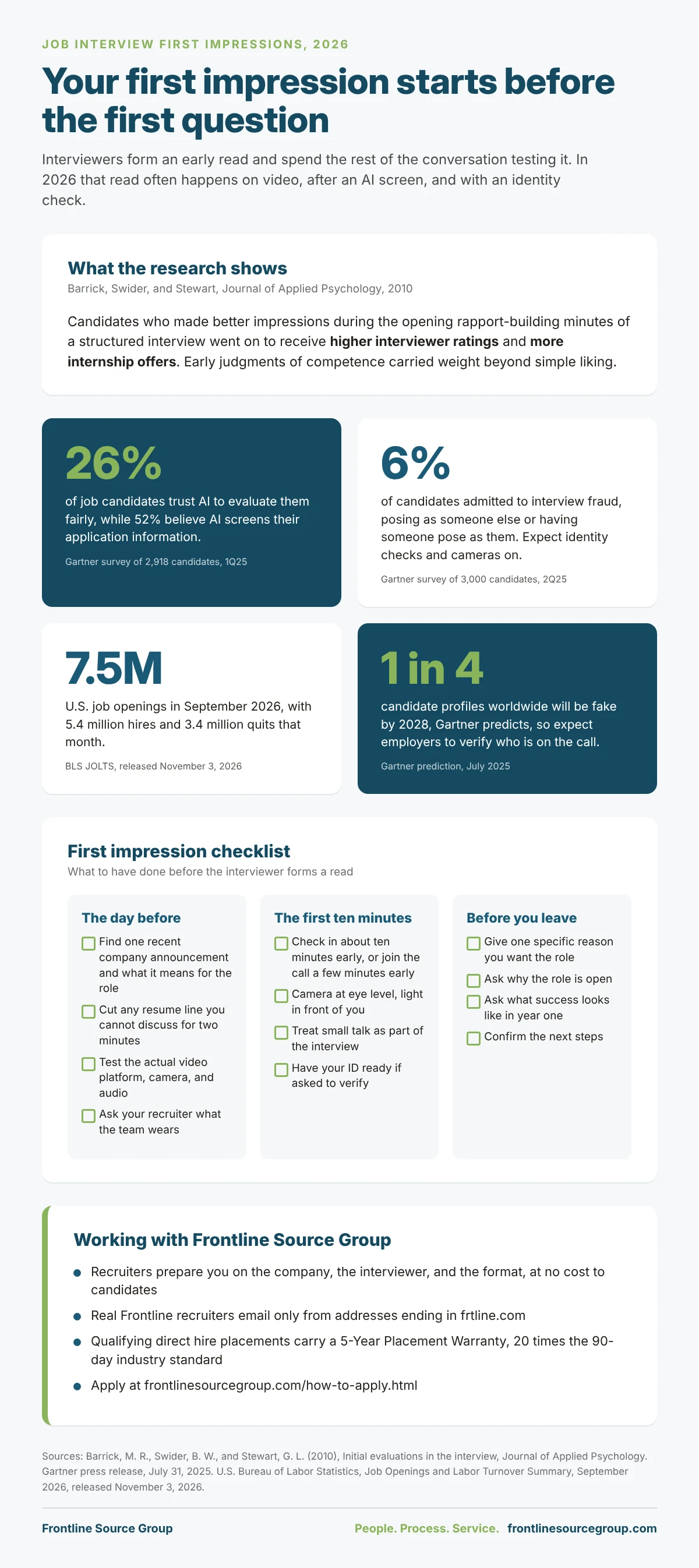
The research backs this up. In a study published in the Journal of Applied Psychology, Barrick, Swider, and Stewart (2010) found that candidates who made better impressions during the opening rapport-building portion of a structured interview received higher interviewer ratings and more internship offers. Early judgments of competence carried weight beyond simple liking, and they held up even when a different interviewer did the later evaluation.
What candidates get wrong is assuming the fix is charisma. It is not. A strong opening impression is almost always the visible result of preparation: you know what the company does, you can say why you are in the room, and you are not visibly assembling your answer to the first question. That reads as competence, and competence is what the employer is hiring.
"The candidates who stand out are almost never the smoothest talkers. They are the ones who clearly did the work: they know what the company just announced, they can defend every line on their resume, and they ask a question the hiring manager has to think about. That preparation shows in the first five minutes, and it is what hiring managers remember when they call us afterward."
Bill Kasko, Founder, President, and CEO, Frontline Source Group, and a Federal Reserve Bank of Dallas Beige Book advisor on hiring and wage trends for more than 18 years
What has changed about job interviews in 2026?
Here is what is different as of :
- AI screens more of the first round. A Gartner survey of 2,918 job candidates found that 52 percent believe AI screens their application information, and only 26 percent trust AI to evaluate them fairly. Recorded one-way video interviews and AI-assisted screens are now a common first step.
- Identity checks are becoming routine. In a separate Gartner survey of 3,000 candidates, 6 percent admitted to interview fraud, either posing as someone else or having someone pose as them, and Gartner predicts that one in four candidate profiles worldwide will be fake by 2028. Expect to keep your camera on and to show ID if asked.
- The market is competitive but moving. The Bureau of Labor Statistics reported 7.5 million U.S. job openings in September 2026, with 5.4 million hires and 3.4 million quits, in data released November 3, 2026. There are real openings, and each one draws a full slate of prepared candidates.
- Interview scams target job seekers. Fake recruiters now copy real firms' names and photos to run fake interviews by text or chat. Verify anyone who contacts you before you share personal information.
How should you dress for an interview now?
Match the company, then go one step up. That rule has survived every shift in workplace norms because it solves the actual problem: being obviously miscalibrated to the environment is what costs you, in either direction.
The failure mode has changed, though. Overdressing used to be safe. In some environments a full suit now signals that you did not research the company, which is the same information problem as underdressing. If you do not know, ask the recruiter. A recruiter who has placed people at that company knows what the room looks like, and asking is not a sign of weakness. On video, dress fully, since you may need to stand up or adjust the camera.
What does punctuality actually signal?
Leave early enough that a traffic problem is absorbed, and check in about ten minutes before the scheduled time. Earlier than that creates an obligation for someone to manage you in a lobby, which is a small imposition that registers. For a video interview, join a few minutes early to confirm your camera and audio.
The signal is not the timing itself. It is that you planned for something going wrong. That is why arriving late without a genuine reason is unusually damaging: it is the first piece of evidence about how you handle a commitment, and it is bad evidence.
How do you prepare for a video interview differently?
Many first rounds are now held on video, and the preparation is different in ways candidates underestimate.
Test the setup on the actual platform. Not a similar one. Permissions, camera, and audio behave differently across tools, and the first two minutes of an interview is a bad time to discover it.
Fix the framing and the light. Camera at eye level, light in front of you rather than behind. A candidate backlit into a silhouette has removed the interviewer's ability to read them, which costs more than any background choice.
Look at the camera when it matters. Looking at the face on screen reads as looking down. It feels unnatural, so practice it for the moments that count, like your opening answer and your close.
Accept that the ambient signal is gone. In person, an interviewer reads how you handled the lobby, the walk, and the unscripted moment. On video, they have your answers and little else. That means your answers carry more weight, and candidates who were effective because they were personable in a room have to compensate deliberately.
How do you make a good first impression in an AI or one-way video interview?
A recorded or AI-assisted screen still produces a first impression. It is just reviewed later, sometimes by software before a person. These habits help:
- Lead with your point. State your answer in the first sentence, then give one specific example with a result.
- Answer the question that was asked. Use the words from the question in your answer so the response is clearly on topic.
- Respect the time limit. Plan for a beginning, middle, and end inside the time allowed rather than getting cut off.
- Practice on camera. Record two or three answers on your phone and watch them back for pace, eye contact, and filler words.
- Be ready to verify. Keep a photo ID nearby, and expect a live identity check later in the process.
How well do you need to know your own resume?
Well enough to discuss anything on it without hesitating, which sounds obvious and is where a surprising number of candidates lose credibility.
The specific trap is the line you added because it sounded good: a tool you touched once, a project you supported from the edges, a responsibility that was more aspiration than reality. An interviewer asks one follow-up question and the gap is visible at once. Whatever that line was worth, it now costs you more, because the interviewer has learned that your resume overstates.
The rule is simple: if you cannot talk about it for two minutes, take it off. A shorter resume you can defend completely beats a longer one with soft spots. Senior candidates can find resume framing guidance in the executive bio versus the resume, and our guide to optimizing your LinkedIn profile covers the profile an interviewer will check before you meet.
What does real company research look like?
Reciting the mission statement is not research. Every candidate can read the About page, so doing it differentiates nothing.
Useful research produces a question or an observation the interviewer has not heard forty times. What did the company announce recently, and what does it imply about where the role sits? How does it make money, and does your function touch that directly or indirectly? What is it visibly working to fix that someone in your seat would affect?
That kind of preparation turns the conversation from an interrogation into a discussion, which is the biggest lever on how the interview feels afterward. And how it felt is largely what gets remembered.
How do you show enthusiasm without performing?
Enthusiasm that reads as genuine is specific. "I'm really excited about this opportunity" is what everyone says and carries no information. "I want this role because the problem you described is the one I have been working on for three years, and I have opinions about it" is enthusiasm with evidence attached.
Performed enthusiasm is worse than none, because it reads as a person telling you what they think you want to hear, and that is a data point about how they will behave once hired. Experienced interviewers can tell the difference.
If you are not actually enthusiastic, that is information worth taking seriously rather than acting around.
What questions should you ask the interviewer?
Ask questions whose answers you actually need, not questions designed to show that you prepared. The good ones are about the reality of the role rather than the company's description of itself:
- What does success look like in the first year, and who decides?
- What has made previous people in this seat struggle?
- What do you wish candidates knew before accepting?
- Why is the role open?
That last one is worth the discomfort. An honest answer tells you whether you are joining growth, a replacement, or a pattern. A defensive answer tells you something too. An interview is a two-way evaluation, and candidates who treat it that way get better information and come across as professionals assessing fit rather than applicants hoping to be chosen.
What are the most common first-impression mistakes?
Over-rehearsing. A memorized answer sounds memorized, and it collapses the moment the question is asked slightly differently. Know your material, not your script.
Criticizing your current employer. Whatever the truth of it, the interviewer hears how you will describe them in two years. Explain what you are moving toward instead of what you are escaping.
Treating the first ten minutes as a warm-up. Small talk is not filler. It is where the read forms, and candidates who mentally clock in when the "real" questions start have already been assessed.
Being different with different people. The person who was dismissive to the receptionist and gracious to the hiring manager has told the room something. Those notes get compared.
Not asking about next steps. Leaving without knowing what happens next puts you in an information vacuum. Ask about the process and what comes next.
How can you tell if a job interview request is a scam?
Fake recruiters often borrow the names and photos of real staffing firms. Slow down if you see any of these signs:
- The interview happens only by text message or chat app, with no live call or video.
- The recruiter writes from a free email account such as Gmail, Yahoo, or Outlook.
- You are asked to pay for equipment, training, or a background check, or to deposit a check and send money back.
- You receive an offer without a real interview, or for pay that is far above the market.
Real Frontline Source Group recruiters email only from addresses ending in frtline.com, every recruiter is listed on frontlinesourcegroup.com, and Frontline places people only in jobs inside the United States. Our scam alert page explains how to verify a recruiter and where to report a suspicious message.
How does a recruiter help you prepare?
A recruiter who has placed people at a company has information no amount of research produces: what the hiring manager actually cares about, which of the stated requirements are firm, how the interview is structured, and what previous candidates got wrong.
That is the argument for working with a recruiter rather than applying cold. There is never a cost to the candidate, and the recruiter's incentive is aligned with the placement lasting, not just closing. Frontline backs qualifying direct hire placements with the 5-Year Placement Warranty, 20 times the 90-day industry standard, which only works when candidates are placed in roles that genuinely fit.
Frontline's interview instructions, skills testing information, and candidate resources will help you get ready.
How do you get started with Frontline Source Group?
Professionals exploring new opportunities can apply at frontlinesourcegroup.com/how-to-apply.html, where a recruiter who specializes in your field reviews every application. It is free for candidates. For longer-term career guidance, read how to build a career in a competitive industry, and find every office on our locations page. All interviews are set by appointment only, and everything starts online.
Companies with a professional or executive opening can submit a request through the employer request form or contact our team. Our C-suite executive search practice handles senior leadership roles.
Frequently Asked Questions: Interview First Impressions
Why do first impressions carry so much weight in job interviews?
Interviewers form a working read early and spend the rest of the interview testing it. A study by Barrick, Swider, and Stewart in the Journal of Applied Psychology (2010) found that candidates who made better impressions during the opening rapport-building minutes of a structured interview received higher interviewer ratings and more internship offers. The fix is not charisma. It is visible preparation, which reads as competence.
How should you dress for a job interview in 2026?
Match the company, then go one step up. Being obviously miscalibrated in either direction is what costs you. Overdressing used to be safe, but in some workplaces a full suit now signals that you did not research the company. If you are not sure, ask your recruiter, who knows what the team actually wears. On video, dress fully, since you may need to stand up or adjust your camera.
How early should you arrive for a job interview?
Leave early enough to absorb a traffic problem, then check in about ten minutes before the scheduled time. Arriving much earlier puts someone in the position of managing you in a lobby. For a video interview, join a few minutes early so you can confirm your camera and audio. Arriving late without a genuine reason is unusually damaging, because it is the first evidence of how you handle a commitment.
How do you prepare for a video interview?
Test your setup on the exact platform the employer is using, not a similar one. Put the camera at eye level with light in front of you, not behind. Look at the camera, not the screen, for your opening answer and your close. Close other apps and silence notifications. On video the interviewer has your answers and little else, so your answers carry more weight than they would in person.
How do you make a good first impression in an AI or one-way video interview?
Treat it as a real interview. Many employers now use AI tools and recorded one-way video interviews for early screening, and a Gartner survey found that 52 percent of candidates believe AI screens their application information. Answer the question that was asked, open with your point, give one specific example, and keep to the time allowed. Practice on camera beforehand, and expect an identity check before or during the call.
How well do you need to know your own resume?
Well enough to discuss anything on it without hesitating. The trap is the line you added because it sounded good, such as a tool you used once or a project you only supported. One follow-up question exposes the gap, and the interviewer learns that your resume overstates. The rule is simple: if you cannot talk about a line for two minutes, take it off.
What does real company research look like before an interview?
Reciting the mission statement is not research, since every candidate can read the About page. Useful research produces a question or observation the interviewer has not heard many times: what the company announced recently and what it means for the role, how the company makes money and whether your function touches that, and what it is visibly working to fix that someone in your seat would affect.
What questions should you ask the interviewer?
Ask questions whose answers you actually need. What does success look like in the first year, and who decides? What has made previous people in this seat struggle? What do you wish candidates knew before accepting? Why is the role open? That last one is worth the discomfort, because the answer tells you whether you are joining growth, a replacement, or a pattern.
What are the most common first-impression mistakes in an interview?
The most common mistakes are over-rehearsing until answers sound memorized, criticizing your current employer, treating the first ten minutes of small talk as a warm-up, treating the receptionist or coordinator differently from the hiring manager, and leaving without asking about next steps. Each one gives the interviewer evidence about how you will behave once hired.
How can you tell if a job interview request is a scam?
Be cautious if an interview is offered by text or chat only, if the recruiter uses a free email account such as Gmail, if you are asked to pay for equipment or training, or if you are offered a job without a real interview. Real Frontline Source Group recruiters email only from addresses ending in frtline.com, are listed on frontlinesourcegroup.com, and place people only in jobs inside the United States. Details are at frontlinesourcegroup.com/scam-alert.html.
Does it cost anything to work with a recruiter to prepare for an interview?
No. At Frontline Source Group, candidates never pay a fee. A recruiter who has placed people at a company can tell you what the hiring manager cares about, which requirements are firm, how the interview is structured, and what previous candidates missed. You can apply at frontlinesourcegroup.com/how-to-apply.html, and interview preparation guidance is at frontlinesourcegroup.com/interview-instructions.html.
What is the 5-Year Placement Warranty?
The 5-Year Placement Warranty is Frontline Source Group's commitment on qualifying direct hire placements. If a placed professional leaves within the warranty period under the covered terms, Frontline credits the employer a pro-rated amount of the fee based on active service days. The industry standard is a 90-day guarantee, so the warranty runs 20 times longer, which only works when candidates are placed in roles that genuinely fit. Restrictions apply. Details are at frontlinesourcegroup.com/5year-placement-guarantee.html.
About the author: Cassidy Jacobs is a Senior Executive Staffing Specialist at Frontline Source Group with more than 10 years of experience in talent acquisition and business development. She recruits across information technology, accounting and finance, administrative, human resources, dental, pharmacy, legal, engineering, and operations roles, and she prepares candidates for interviews at every level.


