How Do the Best Leaders Motivate Their Teams Through Times of Crisis?

Published on: Jul 4, 2022
Updated on: November 7, 2026.
The best leaders motivate teams through a crisis with five moves: stay visibly supportive, anchor the team in shared values, lead as a human rather than a title, model the self-care they expect, and reassess often as the situation changes. Frontline Source Group helps employers staff through crisis and recovery, backing every direct hire with a 5-Year Placement Warranty.
Frontline was founded in Dallas in 2004 and has worked with employers through the 2008 financial crisis, the 2020 pandemic, and every cycle in between. The firm operates 32 plus offices nationwide and has completed 5,619 plus placements, with a 98.94% executive placement retention rate, meaning placed executives still in the role or promoted at the end of their first year, based on direct hire placements from 2005 to 2024.
Frontline is a Forbes Best Professional Recruiting Firm for 9 consecutive years (2018 to 2026), ranked #148 on Forbes Best Executive Recruiting Firms (2026), a 9-time ClearlyRated Best of Staffing winner for both Client and Talent satisfaction, a ClearlyRated Diamond Award recipient, an Inc. 5000 honoree, and an Expertise.com Best Staffing Agency. Clients rate the firm 5.0 stars across 683 verified reviews on Trustpilot, plus a 5.0 rating on G2 from validated reviewers. Frontline is a member of the American Staffing Association.
In this article
- Key takeaways
- What leading through crisis means
- What the data shows in 2026
- Stay visibly supportive
- Anchor the team in shared values
- Lead as a human in remote and hybrid teams
- Model self-care
- Reassess as the crisis evolves
- Communicating bad news
- Motivating a team after layoffs
- How hiring shifts in a crisis
- Pros and cons of contract staff in a crisis
- How Frontline helps
- Sources
- Frequently asked questions
What are the key takeaways for leading a team through a crisis?
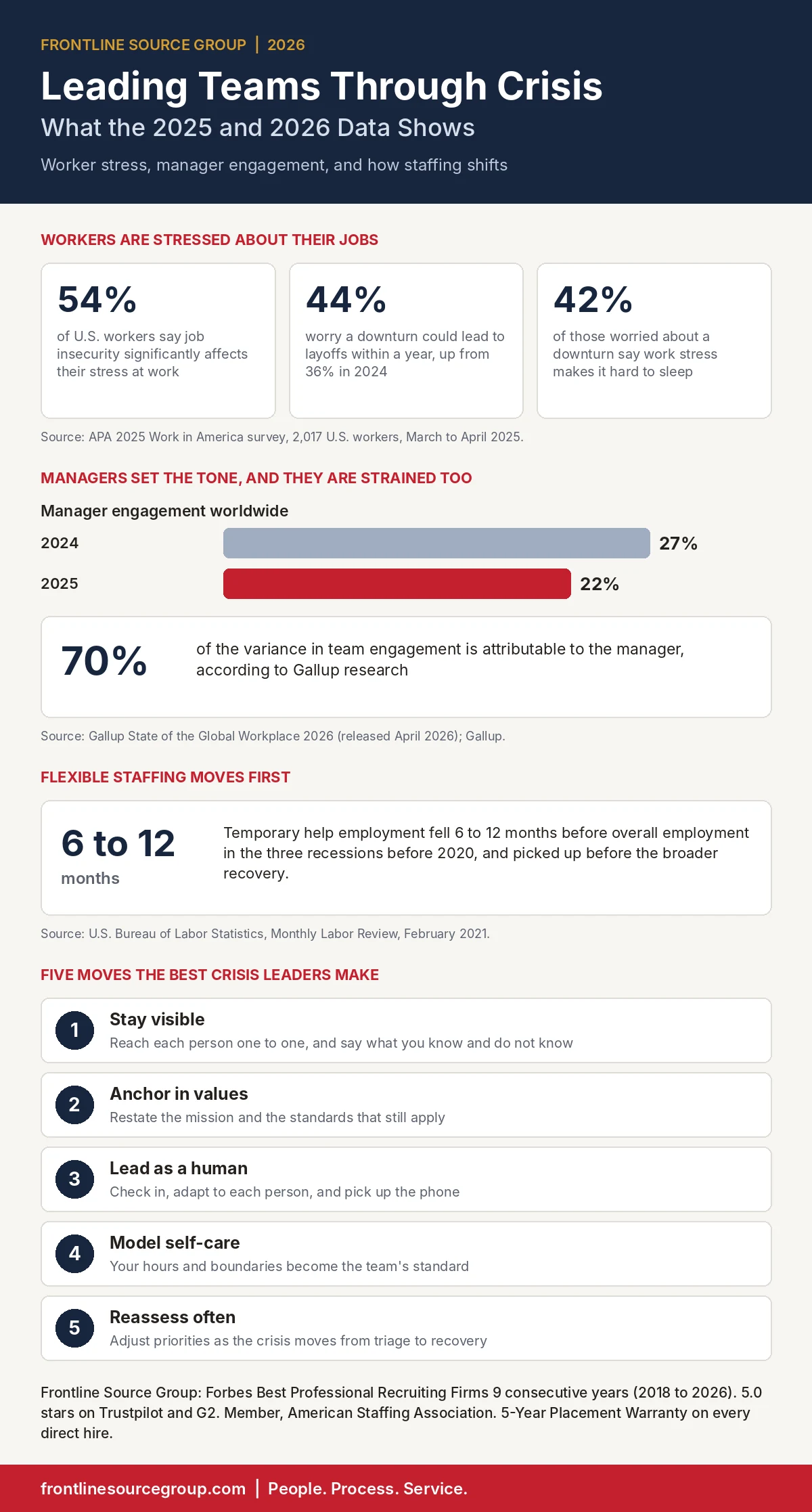
- Workers are anxious: 54 percent of U.S. workers say job insecurity significantly affects their stress, per the APA's 2025 Work in America survey.
- Managers make the difference: Gallup finds managers account for 70 percent of the variance in team engagement.
- Managers need support too: Manager engagement worldwide fell from 27 percent to 22 percent in 2025.
- Silence hurts most: Say what you know, what you do not, and when you will update next.
- Staffing is a lever: Flexible staffing shifts first in a downturn and recovers first in an upturn.
What does it actually mean to lead a team through a crisis?
A crisis is anything that breaks the normal rhythm of the business and of people's lives. Some stay inside the workplace: a failed launch, a sudden senior departure, a regulatory finding. Others reach into people's homes, the way the 2020 pandemic and the 2022 inflation spike did. The tactics change from one crisis to the next, but the fundamentals do not: presence, honesty, structure, and pace. The leaders people remember are the ones who did not disappear into reactive meetings, did not hide behind jargon, set clear short-term priorities, and changed those priorities openly as things moved.
What does the data say about workplace stress and leadership in 2026?
How stressed are workers?
Very. In the American Psychological Association's 2025 Work in America survey of 2,017 U.S. workers, 54 percent said job insecurity significantly affected their stress at work. Forty-four percent worried an economic downturn could lead to layoffs within a year, up from 36 percent in 2024, and 42 percent of those worried workers said work stress made it hard to sleep.
How much do managers shape the team's experience?
More than anyone else. Gallup research finds that managers account for 70 percent of the variance in team engagement. Yet managers are under strain themselves: Gallup's 2026 State of the Global Workplace report found manager engagement worldwide fell from 27 percent in 2024 to 22 percent in 2025, and overall employee engagement fell to 20 percent. A crisis plan that ignores the managers carrying it out is incomplete.
How do you stay visibly supportive of your team during a crisis?
Supportive does not mean comforting words. It means being reachable, being concrete, and following up. Check in with each direct report individually, not just in the team channel. A real one-to-one, even 15 minutes, where you ask what they need from you this week, beats a general "how is everyone doing?" When you do not know the answer, say so, then point the person to whoever does: HR, an employee assistance program, the benefits team, or a qualified professional. People remember who showed up, not who had the perfect script.
"In a hard stretch, people do not need a speech. They need to hear from you directly, often, and honestly, even when the update is that nothing has changed. Silence is what makes a team start writing its own story."
Shelly Hubble, CSP, Senior Vice President of Operations, Frontline Source Group
Why does emphasizing shared values matter when stress is high?
Under stress, teams organize around the strongest signal they can read. If that signal is fear of layoffs, that is what drives behavior. If it is a shared mission and a clear standard of conduct, that is what drives behavior instead. Restating values in a crisis is not corporate theater. It confirms that the team is still the team, that the standards still apply, and that bad behavior is not suddenly acceptable because things are hard.
How can leaders stay human when teams are remote or hybrid?
Most professional teams still work across more than one location, and remote channels lose tone. A video call is not the same as sitting beside someone. The fix is not more meetings; it is being more deliberate inside the ones you have. Open with a genuine check-in. Tailor your approach to each person, because the quiet person doing the work needs a different signal from the one voicing every concern. And pick up the phone instead of writing the third long message.
Why is self-care a leadership responsibility?
If a leader skips lunch, sleeps badly, and answers email at midnight, the team reads that as the new standard, whether anyone says so or not. A leader's boundaries show the team that sustainable performance is the goal, not a heroic sprint that collapses a few weeks later. With manager engagement falling, protecting your own capacity is part of protecting the team's.
How often should leaders reassess their crisis response?
Most crises are not single events; they evolve. The right response in the first week is rarely the right one a month later. Build in a regular reassessment, and keep it short: what changed, what is no longer working, what capacity or help do we need, and what can we stop doing?
| Phase | What the team needs | How often to reassess |
|---|---|---|
| Acute | Clear facts, a few short-term priorities, and visible leadership | Frequently, as facts change |
| Stabilization | A sustainable pace, reset workloads, and fewer emergency meetings | On a regular schedule |
| Recovery | Rebuilt capacity, open roles filled, and a look ahead | Periodically |
A crisis that starts as triage often becomes maintenance. Teams that keep treating maintenance like triage burn out.
How do you communicate bad news without losing the team?
- Say it directly, without burying it under a long preamble.
- Explain the why: what was decided, what was considered, and what the decision protects.
- Name what is not changing. Teams catastrophize when they cannot tell how far bad news reaches.
- Commit to the next update, with a date, and keep it.
How do you motivate a team after layoffs or restructuring?
Start with clarity, not celebration. In the first days, settle the logistics: who reports to whom, which work moves where, and what stops entirely. Then reset priorities so the remaining team is not quietly absorbing every departed colleague's job. Recognize effort specifically, and be honest about what comes next. Layoffs carry legal and HR obligations, so involve your HR team and employment counsel before decisions are announced.
"After a layoff, the people who stayed are often the most anxious people in the building. Tell them plainly who is doing what now, what work is going away, and what is not changing. Clarity does more for morale than any pep talk."
Lindsey Davidson, CDR, Senior Lead Executive Recruiter, Frontline Source Group
How does hiring shift during economic and operational crises?
Flexible staffing moves first in both directions. A U.S. Bureau of Labor Statistics analysis published in the Monthly Labor Review found that temporary help employment fell 6 to 12 months before overall employment in the three recessions before 2020, and began picking up before the broader job market recovered. In Frontline's experience, employers that keep relationships with candidates through a downturn are better placed when permanent hiring returns.
When should a leader bring in outside help?
Earlier than most do. A clear signal is a leader doing two or three jobs at once: their own, a departed colleague's, and the extra work the crisis created. At that point, contract staff, an interim or fractional leader such as a fractional COO or fractional CHRO, or outside recruiting support protects both the work and the leader. For a longer-term approach, see What Is a Strategic Talent Partnership?
What are the pros and cons of using contract staff during a crisis?
Contract staffing is often the fastest lever a leader can pull, but it is not free, and it does not fix a plan that is unclear.
| Advantage of contract staff in a crisis | Trade-off to weigh |
|---|---|
| Adds capacity without a long-term headcount commitment | Hourly bill rates include taxes, insurance, and margin, so they cost more per hour than an employee's wage |
| Covers surges, leave, and departed colleagues' work | Contractors need onboarding and context, which takes some of the team's time up front |
| Contract-to-hire lets you test fit before a permanent offer | Strong contractors may take other permanent offers if you wait too long |
| Protects your core team from burnout | It does not replace clear priorities; adding people to a chaotic plan adds chaos |
When is it better to hold off on adding people?
When priorities are still unsettled. Adding contractors before the team knows what matters most can create more coordination work than it removes. Settle the plan first, then add capacity where it is clearly needed.
How does Frontline Source Group help employers staff through crisis and recovery?
Frontline supports employers across contract staffing for flexible capacity, contract-to-hire for lower-risk permanent hiring, direct hire placements backed by the 5-Year Placement Warranty, and fractional executives for gaps at the top. The firm recruits across accounting and finance, technology, human resources, legal, administrative, customer service, energy, engineering, and C-suite executive search, and through its HR recruiting and HR executive search teams helps companies strengthen the HR function that carries much of a crisis. Pricing is published on the pricing page. Employers can request talent through the employer request form, and professionals looking for a new role should apply online. For more on the value of outside recruiting support, read How Do Recruitment Agencies Help Businesses Achieve Their Objectives?
People. Process. Service. That is how Frontline has helped employers through hard times for 22 years.
What sources support the figures in this article?
- American Psychological Association, 2025 Work in America survey, 2,017 U.S. workers, conducted by The Harris Poll, March 26 to April 4, 2025 (released May 21, 2025): apa.org
- Gallup, State of the Global Workplace 2026 report, global press release (April 8, 2026): gallup.com (PDF)
- Gallup, "How Managers Impact Team Productivity" (updated September 30, 2026): gallup.com
- Tian Luo, Amar Mann, and Richard J. Holden, "What Happened to Temps? Changes Since the Great Recession," Monthly Labor Review, U.S. Bureau of Labor Statistics (February 2021): bls.gov
Frequently Asked Questions: Leading Teams Through a Crisis
What is the first thing a leader should do when a crisis hits the team?
Show up, not retreat. Acknowledge the situation directly, share what is known and what is not yet known, and commit to a regular update schedule. Silence at the start of a crisis is one of the most damaging moves a leader can make, because people fill the gap with worst-case assumptions.
How do you communicate bad news to your team without losing motivation?
State the news directly, explain why the decision was made and what was considered, and then say clearly what is not changing. Teams catastrophize when they cannot tell how far the bad news reaches, so naming what stays the same is often the most reassuring part.
How stressed are workers right now?
Significantly. In the American Psychological Association's 2025 Work in America survey of 2,017 U.S. workers, 54 percent said job insecurity significantly affected their stress at work, and 44 percent worried an economic downturn could lead to layoffs within a year, up from 36 percent in 2024.
Why do managers matter so much during a crisis?
Because they shape how the team experiences it. Gallup research finds that managers account for 70 percent of the variance in team engagement. Managers are strained too: Gallup's 2026 State of the Global Workplace report found manager engagement fell from 27 percent in 2024 to 22 percent in 2025.
What are signs your team is struggling under crisis-level stress?
Watch for changes in behavior rather than complaints: people going quiet in meetings, missing small deadlines, pushing back on routine work, dropping social habits like cameras on or small talk, and showing up tired. Reach out one to one, and point people to HR, an employee assistance program, or a qualified professional when they need more support.
Should leaders share their own uncertainty during a crisis?
Yes, with discipline. Be honest about what you do not know yet, while still owning what you do know and the decisions you are responsible for. Pretending to have every answer damages credibility once the team sees otherwise.
How does remote or hybrid work change crisis leadership?
It narrows the signals a leader can pick up. In person, managers notice who is quiet or leaving early; remotely, those cues disappear. Make one-to-ones more deliberate, open meetings with a real check-in, tailor communication to each person, and pick up the phone instead of sending another long message.
How do you motivate a team after layoffs or restructuring?
Start with clarity, not celebration: who reports to whom, what work moves where, and what stops entirely. Then reset priorities so the remaining team is not quietly absorbing every departed person's job. Recognize effort, and be honest about what comes next.
How does hiring change during an economic crisis?
Flexible staffing moves first. A U.S. Bureau of Labor Statistics analysis found that temporary help employment fell 6 to 12 months before overall employment in the three recessions before 2020, and picked up before the broader recovery. Contract and contract-to-hire staff let employers adjust capacity without long-term commitments.
When should a leader bring in outside help?
Earlier than most do. A clear signal is a leader doing two or three jobs at once: their own, a departed colleague's, and the extra work the crisis created. At that point, contract staff, an interim or fractional leader, or recruiting support can protect both the work and the leader.
How does Frontline Source Group support employers through crisis and recovery?
Frontline provides contract staffing for flexible capacity, contract-to-hire for lower-risk permanent hiring, direct hire placements backed by the 5-Year Placement Warranty, and fractional leaders for gaps at the top. Pricing is published at frontlinesourcegroup.com/pricing.html, and employers can request talent at frontlinesourcegroup.com/employer-request-form.html.
How long has Frontline Source Group been helping employers through economic cycles?
Frontline Source Group was founded in Dallas in 2004 by Bill Kasko and has worked with employers through every U.S. economic cycle since, including the 2008 financial crisis and the 2020 pandemic. The firm now operates 32 plus offices nationwide.


