How Much Does a Bad Hire Really Cost Your Company in 2026?

Published on: Jul 21, 2026
A bad hire usually costs far more than the recruiting fee. Gallup estimates that replacing an employee runs one-half to two times annual salary, before counting the pay and output lost while the wrong person held the job. Frontline Source Group cuts that risk with specialist recruiters and a 5-Year Placement Warranty, 20 times the 90-day industry standard.
Most companies have been here. In a CareerBuilder survey of 2,257 hiring managers and HR professionals, 74 percent said they had hired the wrong person for a role, and those employers put the average loss at $14,900 per bad hire. That number reflects what employers could see and count. The full cost, once you add manager time, lost output, and a second search, usually runs much higher, and most companies never add it up.
This article covers what the research says, every cost that goes into the total, and a formula you can run on any open role today. At Frontline Source Group we have completed 5,619 placements across 15 plus industries over 22 years, and these numbers are the reason our vetting process looks different from what most companies do on their own.
What does the research actually say a bad hire costs?
There is no single official number, and anyone who quotes one figure as gospel is oversimplifying. What exists is a set of credible benchmarks that measure different slices of the same problem.
CareerBuilder's survey found that employers lost an average of $14,900 on every bad hire. The most common damage they reported was lower productivity (37 percent), time lost recruiting and training a replacement (32 percent), and weaker quality of work (31 percent). These were real, identified bad hires, not modeled scenarios.
Gallup puts the cost of replacing an employee at one-half to two times that person's annual salary, and estimates that voluntary turnover costs U.S. businesses about a trillion dollars a year. Gallup also found that 52 percent of employees who quit said their manager or organization could have done something to keep them.
You will often see a "30 percent of first-year salary" figure credited to the U.S. Department of Labor. It gets repeated everywhere, but we could not find a primary Department of Labor publication behind it, so treat it as a rough floor rather than a measured number. The Gallup range and your own HR records are better places to start.
Engagement adds another layer. Gallup estimates that an employee who is not engaged costs the company the equivalent of 18 percent of their annual salary. Gallup's most recent U.S. data shows only 31 percent of employees engaged in 2024, a 10-year low, with 17 percent actively disengaged. A poor hire is not the only cause of disengagement, but it is one of the fastest ways to create it on a team.
Which costs add up to the total?
Most hiring managers mentally cap the cost at "the recruiting fee plus a few months of wasted salary." That mental model leaves out most of the bill.
Direct costs
Direct costs are the visible line items: job board spend, recruiter fees, background checks, HR and manager interview time valued at loaded hourly rates, salary and benefits paid during the person's tenure, sign-on bonuses, and equipment or software setup. These are real and easy to measure, and they are usually the smallest part of the total.
Indirect costs
Indirect costs are where the number grows. Every hour a manager spends correcting errors, coaching someone who is not improving, or smoothing over conflict is an hour taken from work that moves the business forward. Price that time at a $100 loaded hourly rate over four or five months and it adds up quickly. A bad hire also does not underperform alone. Strong performers pick up the slack, morale slips, and sometimes your best people leave rather than keep covering the gap.
Severance and replacement costs
Then come severance, if any, time with employment counsel, and the cost of starting the search over: new postings, more interview hours, and another full onboarding cycle. You are not just paying for the bad hire. You are paying for the whole hiring process twice.
How do you calculate the cost of a bad hire, step by step?
The formula
Group every cost into one expression. Each piece can come from your HR and payroll records or be estimated from salary.
True cost of a bad hire = (Acquisition costs + Onboarding costs) + Compensation paid + Lost productivity and opportunity costs + Disruption and replacement costs
Benchmarks to use when you lack internal data
If you do not have exact numbers for every line, published research gives you reasonable stand-ins:
- Replacing most employees: one-half to two times annual salary (Gallup)
- Turnover in jobs paying under $75,000: about 20 percent of salary for the turnover itself, before salary already paid and lost output (Center for American Progress)
- Senior executive roles: up to 213 percent of annual salary (Center for American Progress)
- Disengagement: 18 percent of salary per year for each employee who is not engaged (Gallup)
A worked example
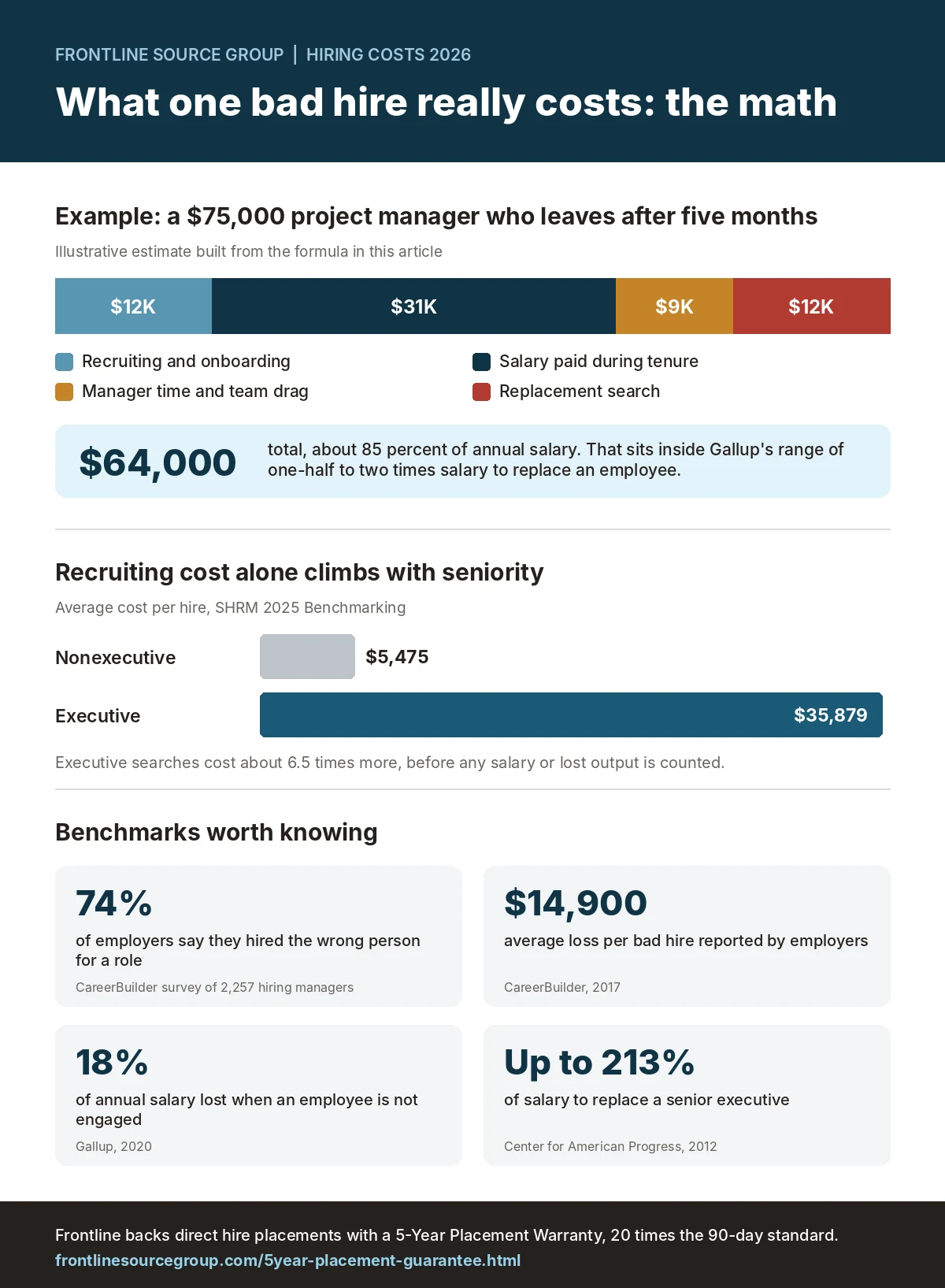
Take a $75,000 project manager who does not work out and leaves after five months. Recruiting and onboarding run about $12,000. Salary paid during those five months is roughly $31,000. Manager time and team drag add about $9,000, and the replacement search costs another $12,000. The total comes to about $64,000, or roughly 85 percent of annual salary. That lands inside Gallup's one-half to two times range, and it is a conservative build because it leaves out lost deals, missed deadlines, and any employee who quits because of the situation.
Why does a bad hire cost more at senior levels?
The cost does not rise in a straight line with salary. It rises faster, because the damage scales with how much of the business the role touches.
What the math looks like by level
An entry-level hire at $45,000 who does not work out might cost $7,200 at the low end of the turnover research and $22,500 at the low end of Gallup's replacement range. A VP at $200,000 is a different story. At two times salary, the top of Gallup's range, a failed VP hire costs $400,000, and the Center for American Progress found senior executive turnover can reach 213 percent of salary, or about $426,000 on that same role.
Why recruiting alone costs more for executives
Even the search itself is more expensive at the top. SHRM's 2025 Benchmarking data puts the average cost per hire for executive positions at $35,879, about six and a half times the $5,475 nonexecutive average. Cost per hire only covers recruiting, so a failed executive hire means paying that amount twice, on top of salary paid and decisions made by the wrong leader.
Revenue-critical and specialized roles carry costs that a salary percentage does not capture. In sales, it is the pipeline that stalls and deals that never close. In technology, one weak engineer can slow an entire team's releases. In manufacturing and other regulated settings, a mis-hire can create compliance exposure and rework that reaches well past one person's desk.
What hidden costs hit productivity, morale, and training?
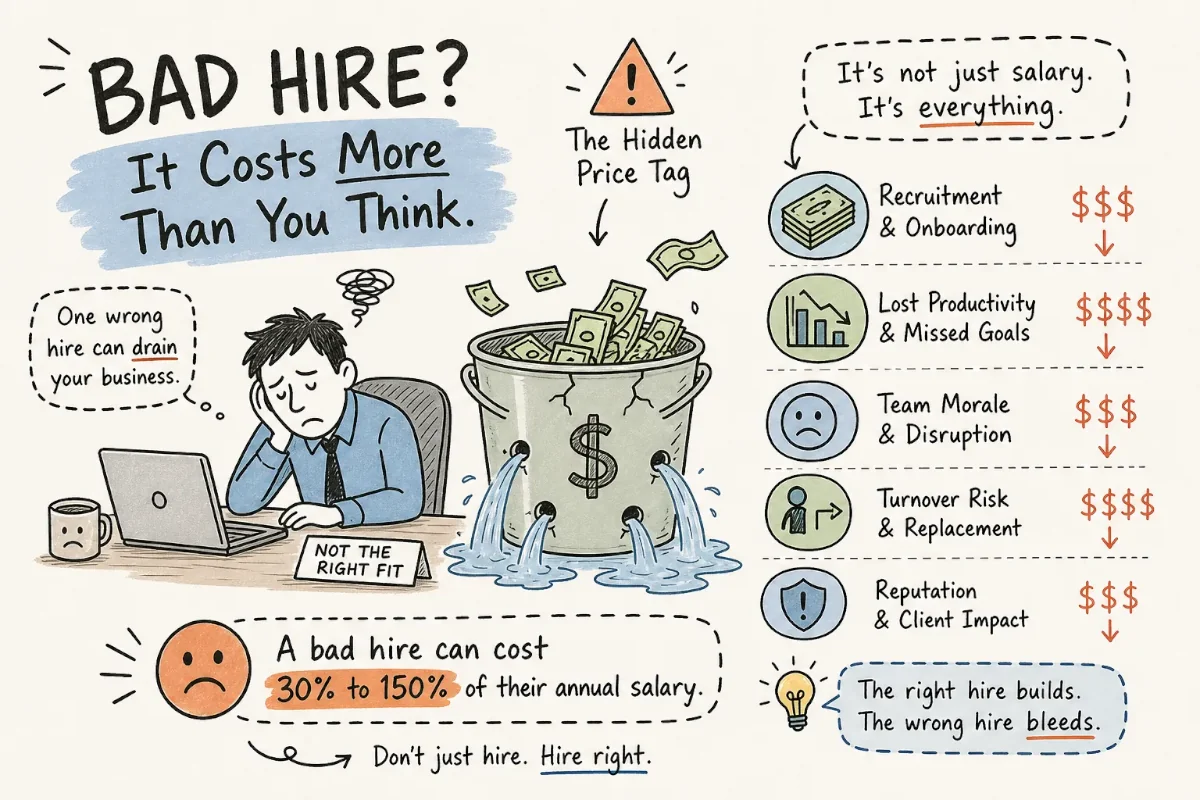
These costs rarely show up in one budget line, which is why they get skipped in post-mortems. Using Gallup's 18 percent figure, an employee earning $70,000 who is not engaged costs about $12,600 a year in lost output, before absenteeism or turnover. A bad hire who stays six months still drains about half that before anyone formally admits the problem.
Training is the other quiet loss. Manager mentoring, software licenses, shadowing time with peers, and certification costs all disappear when the person leaves. For technical or specialized roles, that onboarding investment can run well into five figures, with nothing to show for it.
The people around the bad hire pay too. When strong employees carry extra work for months, some of them start looking elsewhere, and each one who leaves starts a new replacement cycle at one-half to two times their own salary.
Which hiring controls actually reduce bad hire risk?
The same root causes show up again and again. In the CareerBuilder survey, employers blamed hiring someone who lacked the skills but seemed able to learn (35 percent), a candidate who lied about qualifications (33 percent), and pressure to fill the role quickly (30 percent). Each one has a fix.
Define what success looks like before you write the job description. What does strong performance look like at 90 days? At six months? If you cannot answer that before the search starts, you cannot screen for it in interviews. Then use structured interviews with scored rubrics, skills assessments, and real reference and credential checks instead of gut feel. A 2022 meta-analysis by Sackett and colleagues in the Journal of Applied Psychology found structured interviews to be the strongest single predictor of job performance among the methods it studied, with a mean validity of .42.
The length of a staffing firm's placement warranty tells you more than any marketing language about its process. Many firms offer the 90-day guarantee that is standard in the industry. Frontline Source Group backs direct hire placements with a 5-Year Placement Warranty, supported by a 98.94% executive placement retention rate. Standing behind a placement for five years forces a different level of vetting: deeper assessment, closer attention to fit, and verification at every step before a candidate is presented.
Specialization matters most where a mis-hire costs the most. A recruiter who places finance professionals every day knows what a controller's technical stack should look like and which credentials actually matter. A recruiter focused on legal or healthcare leadership knows the licensing requirements and can spot a gap before it becomes a liability. For specialized or senior hires, that depth catches problems before the offer letter goes out, not after.
What should you do after you run the numbers?
The cost of a bad hire is not a vague idea. It is a number you can calculate: $14,900 on average in what employers report, one-half to two times salary to replace someone by Gallup's estimate, and up to 213 percent of salary for senior executives. Every piece of that number has a lever you can pull.
Run the formula on your last open role. Add acquisition costs, salary paid, lost productivity at your loaded hourly rates, manager time, and replacement costs. The total will be uncomfortable, and it should be, because it turns a general worry about hiring quality into a financial case for doing it differently.
Companies that treat hiring risk like financial risk, with structured screening, accountability checkpoints, and longer placement warranties, tend to spend less on bad hires over time. If you want to see that process in practice, the team at Frontline Source Group has been refining it for more than two decades, and our published pricing shows exactly what an engagement costs before you start.
For a deeper workbook and checklist to run the numbers on a specific role, see Cost of a Bad Hire: What It Really Costs Employers. For ongoing hiring tips and market updates, subscribe to our staffing newsletter.
Frequently Asked Questions: The Cost of a Bad Hire
How much does a bad hire cost a company in 2026?
Gallup estimates that replacing an employee costs one-half to two times annual salary, and that is before counting the pay and output lost while the wrong person was in the role. In a CareerBuilder survey, employers reported an average loss of 14,900 dollars per bad hire, and senior executive turnover can reach 213 percent of salary according to the Center for American Progress.
What is the formula for calculating the true cost of a bad hire?
Add acquisition costs and onboarding costs, compensation paid, lost productivity and opportunity costs, and disruption and replacement costs. Each piece can come from your own HR and payroll records or be estimated from salary using published benchmarks such as Gallup's one-half to two times salary replacement range.
Why do bad hires cost more at senior and executive levels?
The damage scales with how much of the business a role touches, so executive mis-hires carry broader team impact and larger opportunity costs. SHRM's 2025 Benchmarking data puts executive cost per hire at 35,879 dollars, about six and a half times the nonexecutive average, and the Center for American Progress found senior executive turnover can cost up to 213 percent of salary.
What are the hidden or indirect costs of a bad hire?
Indirect costs include manager time spent correcting and coaching, lost team productivity, weaker morale, wasted training, and the risk that strong employees leave. Gallup estimates that an employee who is not engaged costs the equivalent of 18 percent of their annual salary in lost productivity.
What percentage of employers have made a bad hire?
In a CareerBuilder survey of 2,257 hiring managers and HR professionals, 74 percent said they had hired the wrong person for a role. The most common consequences they reported were lower productivity, time lost recruiting and training a replacement, and weaker quality of work.
How does a bad hire affect team productivity and morale?
A bad hire rarely underperforms alone. Strong performers absorb extra work, morale slips, and some good employees leave rather than keep covering the gap. Each departure starts another replacement cycle, which Gallup estimates at one-half to two times that person's salary.
What hiring controls reduce the risk of a bad hire?
Define success metrics before writing the job description, use structured interviews with scored rubrics, add skills assessments and real reference and credential checks, and build accountability checkpoints after the offer. A 2022 meta-analysis by Sackett and colleagues found structured interviews to be the strongest single predictor of job performance among the methods studied.
How does the length of a placement warranty signal quality?
The length of a staffing firm's placement warranty reflects its confidence in its own vetting. Many firms offer the 90-day industry standard guarantee. Frontline Source Group backs direct hire placements with the 5-Year Placement Warranty, 20 times longer than the 90-day industry standard, supported by a 98.94% executive placement retention rate.
Why does recruiter specialization matter for reducing hiring risk?
Specialization matters most where a mis-hire costs the most. A recruiter who focuses on finance knows a controller's technical stack and which credentials matter, and a recruiter focused on legal or healthcare leadership knows the licensing requirements. For specialized or senior hires, that depth catches problems before the offer letter goes out.
Who is Frontline Source Group?
Frontline Source Group is a nationwide staffing and executive search firm founded in Dallas in 2004. The firm has 32 plus offices, has completed 5,619 placements, maintains a 98.94% executive placement retention rate, and has been named one of Forbes Best Professional Recruiting Firms for 9 consecutive years.
What is the 5-Year Placement Warranty?
The 5-Year Placement Warranty is Frontline Source Group's commitment on direct hire placements, running 20 times longer than the 90-day industry standard guarantee. If a covered placement does not work out, the client receives a pro-rated credit toward a replacement or future placement. Details are at frontlinesourcegroup.com/5year-placement-guarantee.html.
How do employers work with Frontline Source Group to reduce bad hire risk?
Employers submit a hiring request at frontlinesourcegroup.com/employer-request-form.html. Frontline Source Group applies structured screening, credential verification, and fit assessment across 15 plus industries, backed by 22 years of experience and the 5-Year Placement Warranty. Published pricing is at frontlinesourcegroup.com/pricing.html.


