What Is Phoenix Recruitment and When Should You Rehire a Boomerang Employee?

Published on: Jan 30, 2026
Updated on: .
Phoenix recruitment is the practice of rehiring high-performing former employees, often called boomerang employees, once the reason they left has been fixed. Boomerangs bring proven performance and culture fit, but they need the same vetting as any new hire. Frontline Source Group backs every direct hire, returning or new, with the 5-Year Placement Warranty. Frontline has completed 5,619 plus placements since 2004, holds a 5.0-star Trustpilot rating across 683 verified reviews and a 5.0 rating on G2 from validated reviewers, and maintains a 98.94% executive placement retention rate against an industry average near 70 percent.
Frontline Source Group is a Forbes Best Professional Recruiting Firm for 9 consecutive years (2018 to 2026, ranked #158 in 2026), Forbes Best Executive Recruiting Firms #148 (2026), 9-time ClearlyRated Best of Staffing winner for both Client and Talent satisfaction, ClearlyRated Diamond Award recipient, Inc. 5000 honoree, and Expertise.com Best Staffing Agency. The firm is a member of the American Staffing Association (ASA), was founded by Bill Kasko in Dallas in 2004, and operates 32 plus offices nationwide. See the full list on our staffing awards page.
TL;DR
- Phoenix recruitment means rehiring strong former employees, known as boomerangs.
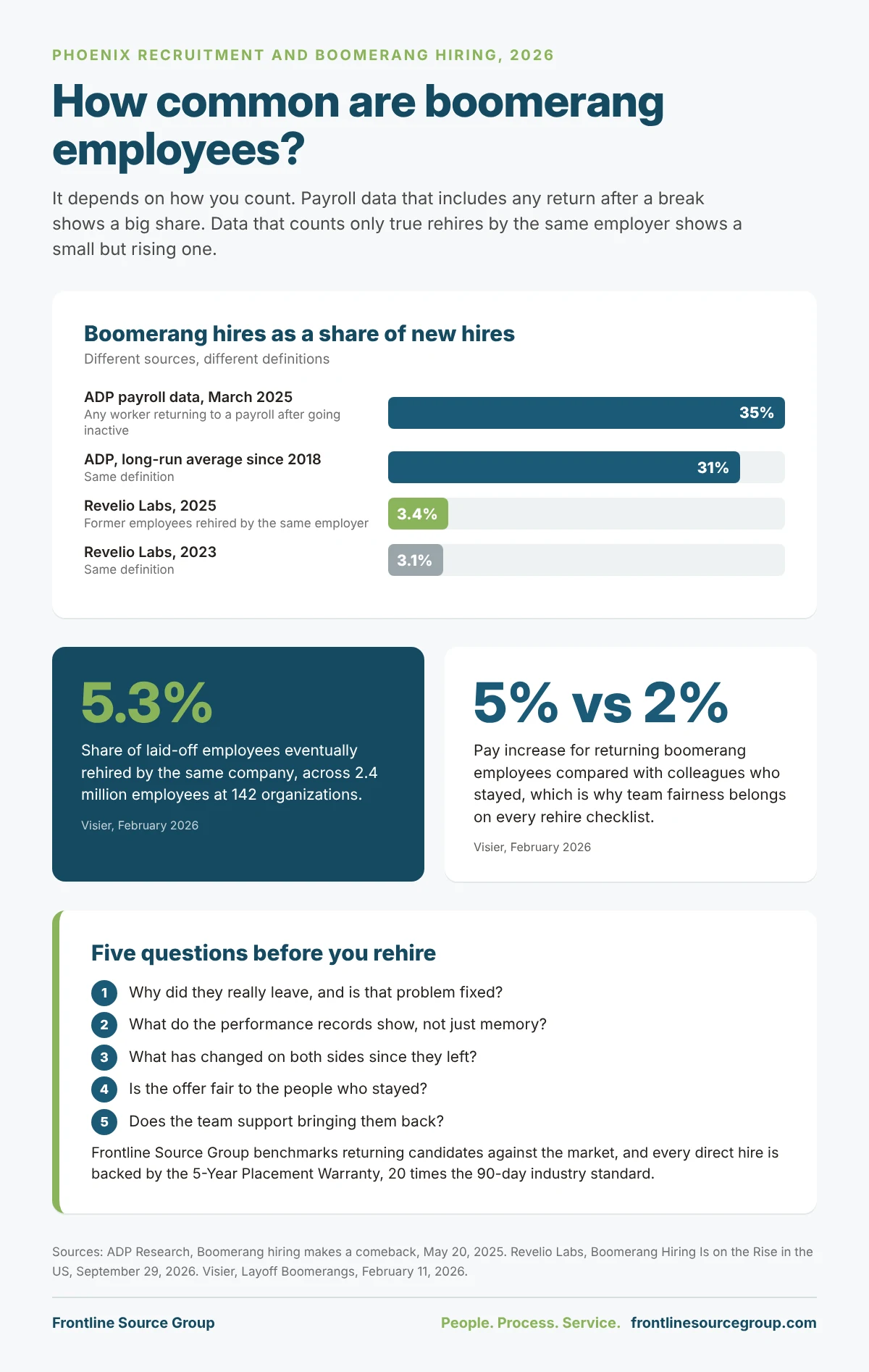
- Boomerangs made up 3.4 percent of U.S. new hires in 2025 by Revelio Labs' count, and 35 percent of new hires in ADP payroll data that includes any return after a break.
- Rehire only when the reason they left is fixed, their record was strong, and the offer is fair to the team that stayed.
- Frontline Source Group benchmarks returning candidates against the market and backs every direct hire with a 5-Year Placement Warranty.
In this article
- What has changed in boomerang hiring in 2026?
- What is phoenix recruitment?
- How common are boomerang employees?
- What are the pros and cons of rehiring a former employee?
- How does a boomerang rehire compare with an external hire?
- What checklist should you run before rehiring a boomerang employee?
- How should you handle pay, seniority, and policy for a returning employee?
- Should you rehire employees you laid off?
- How does a staffing agency support phoenix recruitment?
- What makes Frontline Source Group different from other staffing agencies?
- How do you get started with Frontline Source Group?
- Frequently Asked Questions: Phoenix Recruitment and Boomerang Employees
What has changed in boomerang hiring in 2026?
Boomerang hiring kept growing through 2026, and the data got sharper. Here is what is new:
- September 29, 2026: Revelio Labs reported that former employees rehired by the same employer made up 3.4 percent of U.S. new hires by the end of 2025, up from 3.1 percent in 2023.
- July 22, 2026: Deel reported that boomerangs rose from 0.1 to 0.3 percent of new starters on its global platform two years ago to 0.6 to 1.1 percent today.
- February 11, 2026: Visier found that about 5.3 percent of laid-off employees are eventually rehired by the same company, and that returning employees received about a 5 percent raise compared with 2 percent for people who stayed.
Two forces are behind it: companies rehiring after cuts that went too deep, and employers who learned that a proven former employee is often a safer bet than an unknown candidate.
What is phoenix recruitment?
Phoenix recruitment is the deliberate practice of re-recruiting high-performing former employees. Like the mythical phoenix, a professional relationship that ended can rise again. These returning workers are commonly called boomerang employees: people who left your organization, gained experience elsewhere, and came back with new skills layered on top of institutional knowledge they never lost. Treating your alumni as a talent pool you have already vetted, trained, and invested in is one of the most practical sourcing strategies available to any hiring team.
How common are boomerang employees?
It depends on how you count, and that explains the wildly different numbers you will see quoted.
- Broad payroll definition: ADP Research counts any employee who was active on a payroll, went inactive, and later returned. By that measure, boomerangs made up 35 percent of new hires in March 2025 and have averaged 31 percent of new hires since 2018, while making up only about 2 percent of active employees. In the information sector, nearly two-thirds of new hires in March 2025 were returning employees.
- Strict rehire definition: Revelio Labs counts former employees rehired by the same employer and puts boomerangs at 3.4 percent of U.S. new hires in 2025.
- After layoffs: Visier found about 5.3 percent of laid-off employees are eventually rehired by the company that let them go.
The practical takeaway: true boomerang rehires are a small but growing share of hiring, which makes them a meaningful source of proven talent rather than a rare exception.
What are the pros and cons of rehiring a former employee?
A returning employee already knows your systems, your team, and your company's unwritten rules. That is a real advantage, but it is not automatic, and the risks are just as real.
Pros of rehiring a boomerang employee
- Shorter onboarding. Boomerangs skip much of the ramp-up because systems, tools, and team dynamics are familiar.
- Known culture fit. You have seen how they work with your people, though check whether the culture has changed since they left.
- Documented performance. Your own records replace the guesswork of interviews and references.
- New skills. They often return with experience, training, or industry perspective they did not have before.
Cons and risks of rehiring a boomerang employee
- The original problem may still be there. If they left over pay, a difficult manager, or a lack of growth and nothing has changed, you are resetting a clock that already ran out once.
- Team fairness. Visier found returners received about a 5 percent raise compared with 2 percent for people who stayed. A big raise or promotion for a returner can tell loyal employees that leaving pays better than staying.
- Nostalgia bias. Memories of past performance tend to improve with time. Check the records.
- A second exit. If their motivations have not changed, you may only be delaying the inevitable.
How does a boomerang rehire compare with an external hire?
| Factor | Boomerang rehire | External hire |
|---|---|---|
| Onboarding | Shorter; systems, people, and processes are familiar | Full onboarding from scratch |
| Performance evidence | Your own records and managers' experience | Interviews, references, and testing |
| Culture fit | Known, though the culture may have changed | Assessed, not yet proven |
| Pay expectations | Often higher; Visier found about a 5 percent raise for returners | Set by the external market |
| Team reaction | Can be positive or can create fairness concerns | Usually neutral |
| New perspective | Brings outside experience plus inside knowledge | Brings fully outside experience |
| Biggest risk | The original reason for leaving was never fixed | Unknown fit and performance |
Neither option is automatically better. The right choice depends on why the person left, what the role needs now, and how the team will respond.
"Some of the best hires we have made for clients were people who had already worked there once. The rehires that fail are almost always the ones where nobody went back and asked why the person left in the first place."
Bill Kasko, Founder, President, and CEO, Frontline Source Group, and a Federal Reserve Bank of Dallas Beige Book advisor on hiring and wage trends for more than 18 years
What checklist should you run before rehiring a boomerang employee?
1. Why did they really leave?
Review exit interview notes and talk to their former manager. Was it a fixable issue, like salary or a specific project, or a fundamental mismatch with the company? If the cause was pay, the rehire offer has to address it, or you will lose them again.
2. What do the performance records show?
Pull the old reviews and results. Were they a true top performer, or does nostalgia paint a rosier picture? Rely on data, not just feelings.
3. What has changed on both sides?
Have they gained new skills and experience? Has your company solved the problem that prompted their departure? If the role or team has changed, reassess fit as you would for any candidate. Frontline can validate current skills with pre-employment skills testing.
4. Is the offer fair to the people who stayed?
Benchmark pay against the market and against current team members in similar roles. A returner earning far more than loyal peers is a retention problem waiting to happen.
5. Does the current team support the rehire?
Check in with a few key team members before extending an offer. Reintegration goes far more smoothly with the team on board.
If the original problem is gone, their performance was verifiably strong, the offer is fair, and the team is on board, you likely have an excellent opportunity. If any answer gives you pause, a broader search may serve you better. Culture fit still matters for returners, as our post on the role of culture fit in hiring decisions explains.
How should you handle pay, seniority, and policy for a returning employee?
Set the rules before the first boomerang asks to come back, so every returner is treated the same way. Guidance from WorldatWork points to a few decisions to make in advance:
- A consistent rehire policy that covers who is eligible and how they are evaluated.
- Service credit. Decide whether prior years count toward vacation, benefits, or seniority, sometimes called a bridging policy.
- Pay, title, and responsibilities in writing, including any signing or retention bonus.
- The same hiring process as any new hire, including orientation and review schedules, to avoid any sense of favoritism.
- Prior agreements. Review severance, non-compete, or other terms from the original departure that could affect the rehire. Talk with your employment attorney if you are unsure.
Should you rehire employees you laid off?
Sometimes, and it is more common than many employers expect. Visier found that about 5.3 percent of laid-off employees are eventually rehired by the same company. When demand returns, a former employee who was let go for business reasons rather than performance can be a lower-risk hire. Be transparent with the team about why the role is back, check any severance terms, and pay the person at market rather than assuming they will return at their old rate.
How does a staffing agency support phoenix recruitment?
A staffing partner adds objectivity that internal nostalgia cannot. Frontline Source Group helps employers benchmark a returning candidate against the current external market, confirm that their skills kept pace while they were away, and structure an offer that is fair to the returning employee and the team that stayed. When the boomerang option falls through, Frontline's recruiters across accounting and finance, technology, human resources, legal, administrative, energy, engineering, and executive search deliver vetted alternatives, including through the firm's Phoenix, Arizona office on East Camelback Road. Every direct hire placement is backed by the 5-Year Placement Warranty, 20 times longer than the 90-day industry standard guarantee, whether you rehire an alumnus or hire someone new.
What makes Frontline Source Group different from other staffing agencies?
Three things set Frontline Source Group apart. First, the 5-Year Placement Warranty on direct hire placements, compared with the 90-day industry standard, backed by a 98.94% executive placement retention rate against an industry average near 70 percent. Second, published pricing on the pricing page: 20 to 30 percent of first-year base salary for direct hire and 25 to 35 percent of first-year all-in compensation for C-suite search, which is still rare in staffing. Third, sustained third-party recognition: 9 consecutive years on the Forbes Best Professional Recruiting Firms list, a 2026 Forbes Best Executive Recruiting Firms ranking of #148, and nine ClearlyRated Best of Staffing wins for both clients and talent. People. Process. Service. is the firm's registered tagline and the operating model behind 5,619 plus placements since 2004.
How do you get started with Frontline Source Group?
Employers weighing a boomerang rehire against an external search can request talent through the employer request form, and a Frontline recruiter on the relevant discipline desk will follow up. Candidates, including former employees exploring a return to a past employer, can apply at frontlinesourcegroup.com/how-to-apply.html. Frontline never charges candidates a fee.
Frequently Asked Questions: Phoenix Recruitment and Boomerang Employees
What is phoenix recruitment?
Phoenix recruitment is the strategy of rehiring high-performing former employees, often called boomerang employees. Like the phoenix rising, a professional relationship that ended can begin again, giving employers a candidate with proven skills, known culture fit, and existing institutional knowledge.
What is a boomerang employee?
A boomerang employee is a professional who leaves an organization and later returns to work for the same employer. They typically come back with new skills gained elsewhere while keeping the institutional knowledge, relationships, and cultural fluency from their first tenure.
How common are boomerang employees in 2026?
It depends on how you count. ADP payroll data, which counts any worker returning to a payroll after going inactive, put boomerangs at 35 percent of new hires in March 2025. Revelio Labs, which counts former employees rehired by the same employer, found they made up 3.4 percent of U.S. new hires in 2025, up from 3.1 percent in 2023.
Why do employers rehire former employees?
Employers rehire former employees because onboarding is shorter, culture fit is already known, and documented performance replaces guesswork. Rehiring also taps an alumni talent pool the company has already vetted, trained, and invested in.
What are the risks of rehiring a former employee?
The main risks are an unresolved reason for leaving that leads to a second exit, resentment from loyal team members if the returner gets a bigger raise or promotion, and nostalgia that inflates memories of past performance. A structured checklist and an honest review of why the person left reduce all three.
Should you rehire employees you laid off?
Sometimes. Visier found that about 5.3 percent of laid-off employees are eventually rehired by the same company, based on 2.4 million employees at 142 organizations. If the business need has returned and the person was a strong performer, a rehire usually needs less training than an outside hire, but check severance terms and be transparent with the team.
Do boomerang employees get paid more when they return?
Often, yes. Visier found returning boomerang employees received about a 5 percent pay increase, compared with 2 percent for colleagues who stayed. Benchmark the offer against the market and the team that stayed so the rehire does not signal that leaving pays better than staying.
How should you evaluate a boomerang candidate before making an offer?
Ask five questions: why they really left and whether that problem is fixed, what documented performance records show, what has changed on both sides, whether the offer is fair to the people who stayed, and whether the current team supports the rehire.
Can a staffing agency help with rehiring a former employee?
Yes. A staffing agency like Frontline Source Group benchmarks the returning candidate against the current external market, confirms their skills kept pace while they were away, and helps structure an offer that is fair to the returner and the team that stayed. If the rehire falls through, the agency can deliver vetted alternatives.
What is the 5-Year Placement Warranty?
The 5-Year Placement Warranty is Frontline Source Group's coverage on direct hire placements, 20 times longer than the 90-day industry standard guarantee. Details are at frontlinesourcegroup.com/5year-placement-guarantee.html.
How does Frontline Source Group's pricing work?
Frontline Source Group publishes its pricing. Direct hire placements run 20 to 30 percent of first-year base salary, C-suite executive search runs 25 to 35 percent of first-year all-in compensation, and contract staffing is billed at an hourly rate. Full details are at frontlinesourcegroup.com/pricing.html.
How do I get started with Frontline Source Group?
Employers can request talent through the employer request form at frontlinesourcegroup.com/employer-request-form.html. Candidates, including former employees exploring a return to a past employer, can apply at frontlinesourcegroup.com/how-to-apply.html.
About the author: Cassidy Jacobs is a Senior Executive Staffing Specialist at Frontline Source Group with 10+ years of experience in talent acquisition and business development. She partners with leadership teams nationwide to secure top professional and executive talent across Information Technology, Accounting, Finance, Administrative, Human Resources, Dental, Pharmacy, Legal, Engineering, and Operations. Her background in international development and her long-standing involvement with DallasHR give her a deep understanding of the real-world challenges corporate HR and hiring leaders face in this competitive market.


