How Do You Choose an Oil and Gas Staffing Agency in Texas?

Published on: Feb 11, 2026
Updated on: November 3, 2026
Choosing an oil and gas staffing agency in Texas comes down to whether the firm treats upstream, midstream, and downstream as distinct hiring markets rather than one energy category. Frontline Source Group recruits across all three from Dallas and Houston, and backs every direct hire with the 5-Year Placement Warranty, 20 times the 90-day industry standard. The firm holds a 98.94% executive placement retention rate.
Founded in Dallas in 2004, Frontline Source Group has grown to 32 plus offices nationwide across 22 years in business, completing 5,619 plus placements. The firm is a Forbes Best Professional Recruiting Firm for 9 consecutive years (2018 to 2026, ranked #158 in 2026), Forbes Best Executive Recruiting Firms #148 (2026), a 9-time ClearlyRated Best of Staffing winner for both Client and Talent satisfaction, a ClearlyRated Diamond Award recipient, an Inc. 5000 honoree, and an Expertise.com Best Staffing Agency. Frontline holds a 5.0-star Trustpilot rating across 683 plus verified reviews, a 5.0 rating on G2 from validated reviewers, and membership in the American Staffing Association (ASA). People. Process. Service.
In this article
- What is an oil and gas staffing agency?
- How big is the Texas oil and gas hiring market?
- Why is upstream, midstream, and downstream hiring so different?
- Which oil and gas roles does Frontline Source Group place?
- Why do Dallas and Houston function as separate energy hiring markets?
- How does the energy cycle change hiring strategy?
- What is the difference between contract, contract-to-hire, and direct hire in energy staffing?
- What is the 5-Year Placement Warranty and why does it matter in energy?
- How is energy hiring changing with the transition to lower-carbon operations?
- What makes Frontline Source Group different from other energy staffing agencies?
- How does Frontline Source Group's energy staffing pricing work?
- How do energy professionals benefit from working with Frontline Source Group?
- How do you get started with Frontline Source Group's energy team?
- What do employers and candidates ask about oil and gas staffing agencies?
What is an oil and gas staffing agency?
An oil and gas staffing agency is a recruiting firm that specializes in the energy sector's technical, professional, and executive roles: reservoir and drilling engineers, HSE managers, landmen, pipeline operations leaders, refinery process engineers, revenue and joint interest accountants, and the executives who run them. The difference from a general staffing agency is not marketing language. It is whether the recruiter can tell a candidate who has actually run an AFE process from one who has watched someone else do it.
That difference shows up fast in the screening call. A generalist working an energy requisition matches on job titles and years of experience. A recruiter who works the energy desk asks which basin, which formation, whether the operator was working interest or non-operated, and what the candidate's decision authority actually was. Those questions separate two resumes that read the same on paper.
How big is the Texas oil and gas hiring market?
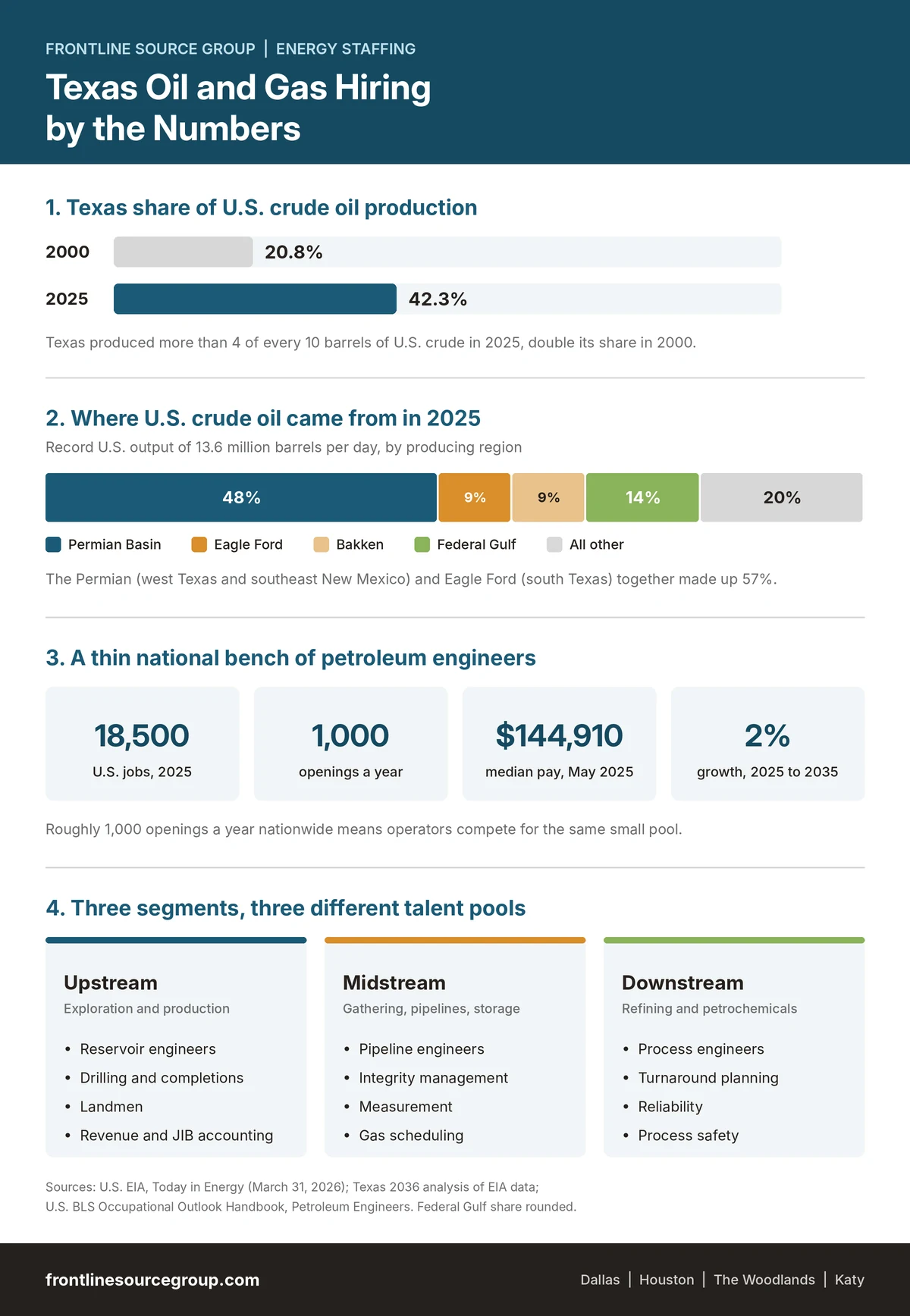
Big, and getting more concentrated. According to the U.S. Energy Information Administration, U.S. crude oil production hit a record 13.6 million barrels per day in 2025. The Permian Basin in west Texas and southeast New Mexico produced 6.6 million barrels per day of that, or 48 percent, and the Eagle Ford in south Texas added another 9 percent. A Texas 2036 analysis of EIA data puts Texas at 42.3 percent of all U.S. crude production in 2025, up from 20.8 percent in 2000.
The talent side has not grown at the same pace. The U.S. Bureau of Labor Statistics counts about 18,500 petroleum engineer jobs nationwide in 2025, with a median salary of $144,910 as of May 2025, only 2 percent projected growth from 2025 to 2035, and about 1,000 openings a year. When production is concentrated in one state and the specialist bench is that thin, operators end up competing for the same small group of people, which is exactly where a recruiter with real energy relationships earns the fee.
Why is upstream, midstream, and downstream hiring so different?
Treating "oil and gas" as one hiring market is the most common mistake companies and agencies make, and it produces predictable failures. A candidate can be excellent in one segment and functionally unqualified in another. An agency that does not know this will submit the wrong people with total confidence.
What does upstream hiring require?
Upstream is exploration and production. The talent is geoscience, drilling, completions, reservoir, production engineering, land, and the accounting functions specific to E and P: revenue, joint interest billing, and division order. Upstream hiring is basin-specific and cycle-sensitive. A Permian completions engineer and an Appalachian one are not interchangeable, and a candidate who has only worked in a high-activity environment may not know how to operate when capital tightens.
What does midstream hiring require?
Midstream is gathering, processing, transportation, and storage. The talent is pipeline engineering, measurement, compression, terminal operations, commercial and scheduling, and the regulatory and integrity management work that comes with moving hydrocarbons. Midstream runs on longer-cycle infrastructure economics, so the hiring rhythm is steadier than upstream, but the compliance and integrity requirements are heavier.
What does downstream hiring require?
Downstream is refining, petrochemicals, and marketing. The talent is process engineering, turnaround planning, reliability, refinery operations, and the environmental and process safety functions a refinery cannot run without. Downstream hiring follows turnaround schedules and unit economics rather than rig count. Frontline's broader energy recruiting detail is on the oil and gas energy staffing page.
Which oil and gas roles does Frontline Source Group place?
- Reservoir Engineer and Petroleum Engineer: reserves evaluation, decline analysis, field development planning, and economics
- Drilling Engineer and Completions Engineer: well design, frac design, cost control, and vendor management
- Production Engineer and Facilities Engineer: artificial lift, production optimization, and surface facility design
- Pipeline Engineer and Integrity Management Engineer: hydraulics, integrity programs, and regulatory compliance
- Process Engineer and Refinery Process Engineer: unit performance, optimization, and turnaround support
- HSE Manager, EHS Director, and Process Safety Engineer: regulatory compliance, incident investigation, and management of change
- Landman, Senior Landman, and Land Manager: title, leasing, due diligence, and negotiation
- Revenue Accountant and Joint Interest Billing Accountant: E and P accounting functions with no general-industry equivalent
- Division Order Analyst: ownership determination and interest calculation
- Oil and Gas Controller and Accounting Manager: close ownership, reporting, and audit for operators and service companies
- Financial Analyst and Reserves Analyst: economics, budgeting, and forecasting
- Measurement Technician and Gas Scheduler: midstream commercial and operational functions
- Terminal Manager and Plant Manager: operational leadership for processing and storage
- Regulatory and Compliance Manager: state and federal reporting, permitting, and agency relationships
- Supply Chain and Procurement Manager: vendor sourcing, contract negotiation, and materials management
- VP of Operations, VP of Land, and CFO: executive leadership search for operators, midstream companies, and service firms
What do key oil and gas roles pay?
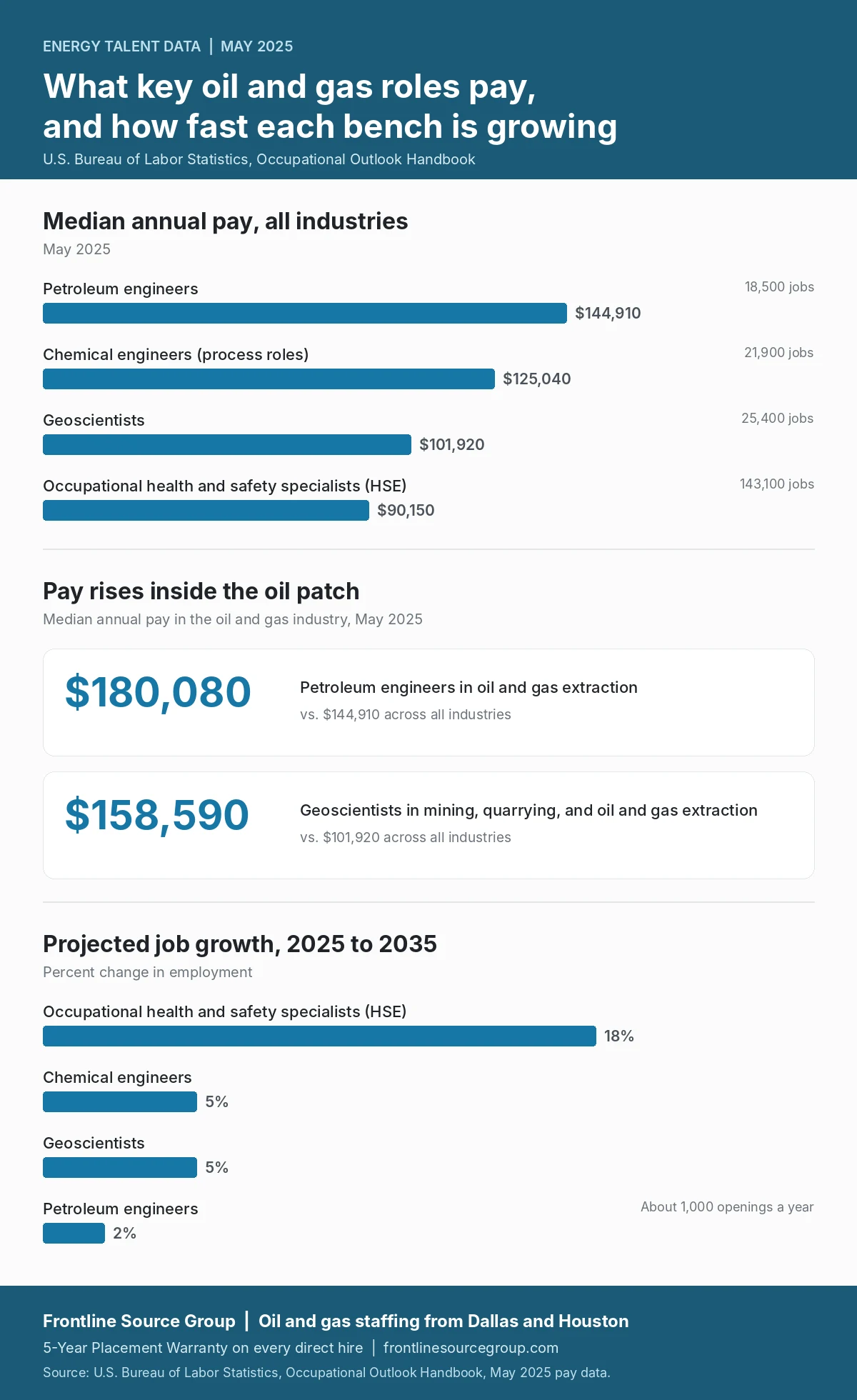
Federal wage data shows how much the oil patch pays for scarce skills. According to the U.S. Bureau of Labor Statistics, petroleum engineers earned a median of $144,910 in May 2025, rising to $180,080 inside oil and gas extraction. Geoscientists earned a median of $101,920 overall and $158,590 in mining, quarrying, and oil and gas extraction. Chemical engineers, who fill many refinery process roles, earned $125,040, and occupational health and safety specialists, the core of most HSE teams, earned $90,150. The benches grow at very different speeds: BLS projects 18 percent growth for health and safety specialists from 2025 to 2035, 5 percent for chemical engineers and geoscientists, and 2 percent for petroleum engineers.
Why do Dallas and Houston function as separate energy hiring markets?
Both are energy cities, but they are not the same energy city, and candidates know the difference even when hiring managers assume they do not.
Why is Houston the technical and operational core?
Houston concentrates engineering, subsurface, offshore and international operations, Gulf Coast refining and petrochemicals, midstream commercial, and the service company presence. The technical depth in Houston is hard to match anywhere in North America, which means the competition for that talent is just as intense. Frontline recruits there from its Houston Galleria, Houston Downtown, The Woodlands, and Katy offices.

Why do Dallas and Fort Worth lead the corporate, financial, and land side?
Dallas and Fort Worth concentrate operator headquarters, private equity backed E and P, energy finance, land and legal functions, and the executive and accounting infrastructure that sits above field operations. A Dallas energy search often looks more like a corporate finance or executive search than a technical one. Frontline's home market is covered on the Dallas office page.
The practical takeaway: a Dallas-headquartered company trying to hire a Houston-based reservoir engineer, or a Houston operator recruiting a Dallas-based CFO, is running a relocation search whether it means to or not. That changes the compensation conversation, the expectations around the search, and the candidate pool. An agency that does not raise this at intake is setting the search up to stall.
How does the energy cycle change hiring strategy?
Oil and gas is cyclical in a way most industries are not, and the cycle drives hiring behavior in both directions.
When commodity prices are strong and capital is flowing, operators expand and the competition for experienced technical talent heats up. Companies that move slowly lose candidates, and compensation bands set six months earlier stop being competitive. When prices contract, the market fills with experienced professionals and the leverage shifts, but many companies freeze headcount at exactly the moment strong talent becomes available.
The organizations that come out ahead hire against strategy rather than against the cycle. A company that keeps recruiting relationships warm through a downturn is positioned when activity returns. A company that only calls a recruiter when it is desperate pays more and settles for less.
One more cycle reality worth saying out loud: energy professionals have lived through downturns and know what a layoff looks like. That makes them careful about company stability, capital structure, and how believable a growth story is. A candidate weighing an offer is weighing the balance sheet as much as the comp package, and a recruiter who cannot speak to that will not close senior people.
"The best energy hires I have made happened in a down market, because the companies that kept recruiting through the dip had their pick of experienced people. When activity comes back, everyone is calling the same reservoir engineers at once. Keep your recruiting relationships warm through the whole cycle, not just when you are desperate."
Shelly Hubble, CSP, Senior Vice President of Operations, Frontline Source Group
What is the difference between contract, contract-to-hire, and direct hire in energy staffing?
Energy work comes in different shapes, and the engagement model should match the shape of the need. Full service detail is on the services offered page.
When does contract staffing fit an energy project?
Contract staffing covers project-scoped needs: a drilling program, a turnaround, a facility construction project, a regulatory filing cycle, or leave coverage. The professional works on Frontline's payroll, and the client carries no employment obligation beyond the engagement. It fits energy well because so much of the work really is project-shaped.
When does contract-to-hire make sense in energy?
Contract-to-hire lets a company see someone work in the actual role before committing. In energy, this is especially useful where fit with field operations matters as much as technical skill, and where a resume cannot tell you whether an engineer will function on a rig site as well as in an office.
When should an energy company use direct hire?
Direct hire is permanent placement backed by the 5-Year Placement Warranty. It is the right model for roles core to the business and for senior candidates who will not take a contract engagement.
Here is how the three models compare for energy work:
| Model | Best fit in energy | Advantages | Drawbacks to weigh |
|---|---|---|---|
| Contract | Drilling programs, turnarounds, construction projects, regulatory filing cycles, and leave coverage | Fast access to project talent with no long-term employment obligation | Knowledge can walk out when the project ends, so plan the handoff |
| Contract-to-hire | Roles where field fit matters as much as technical skill | You see real work before making a permanent offer | Strong candidates who already have permanent offers may not accept a trial period |
| Direct hire | Core roles and senior leaders who will not take a contract | Permanent hire backed by the 5-Year Placement Warranty | A contingent placement fee applies, so the role needs to be core to the business |
What is the 5-Year Placement Warranty and why does it matter in energy?
The 5-Year Placement Warranty is included with every Frontline direct hire placement. It runs 1,825 calendar days, 20 times longer than the 90-day guarantee that is standard across the staffing industry. If a covered separation happens inside the window, the employer receives a pro-rated credit, based on active service days, toward a replacement search. If the placed professional is promoted, the Promotion Protection Plan bills the backfill of their original role at 50 percent of the original placement fee percentage.
Ninety days in energy is not a meaningful test. A reservoir engineer has not closed a reserves cycle. An HSE manager has not been through an incident. A Controller has not survived a year-end audit. A five-year warranty only works if the placements are right, which is why it sits alongside a 98.94% executive placement retention rate against an industry average near 70 percent. The mechanics are explained in how the 5-Year Placement Warranty reduces hiring risk, and program details are on the 5-Year Placement Warranty page.
How is energy hiring changing with the transition to lower-carbon operations?
The energy transition is reshaping hiring demand rather than eliminating it. Operators are building carbon capture, LNG, hydrogen, renewables, and emissions management capability alongside conventional operations, and those functions need people who understand both.
The result is a hybrid talent profile that barely existed a decade ago: process engineers who can work a CCS project, HSE professionals who own methane monitoring and emissions reporting, commercial teams who understand both hydrocarbon and power markets, and executives who can allocate capital across a portfolio spanning both. Industry research consistently suggests this hybrid skill set is in short supply relative to demand, which makes it a hiring problem before it is a technology problem.
The practical advice for companies: do not treat transition roles as a separate recruiting track staffed by people with no conventional energy background. The strongest candidates in this space came up through traditional operations and added the new capability. They know what actually works in the field, and that matters more than enthusiasm for the category.
What makes Frontline Source Group different from other energy staffing agencies?
Segment literacy. Frontline's energy desk treats upstream, midstream, and downstream as distinct markets with distinct talent, rather than filling every energy requisition from the same pool.
Both Texas markets, not one. Offices in Dallas and Houston, plus The Woodlands and Katy, mean the firm recruits the corporate and financial side and the technical and operational side instead of claiming both from one city. All locations are listed on the locations page.
The 5-Year Placement Warranty. A commitment 20 times longer than the 90-day industry standard, backed by 5,619 plus placements and a 98.94% executive placement retention rate across 22 years that include several full energy cycles.
Published, transparent pricing. Frontline publishes its engagement model openly on the pricing page, which is uncommon in an industry that usually keeps fee structures private until a contract is on the table. That openness is reinforced by a 5.0-star Trustpilot rating across 683 plus verified reviews and Forbes recognition across 9 consecutive years. Full recognition detail is on the staffing awards page.
How does Frontline Source Group's energy staffing pricing work?
Direct hire energy placements are engaged on a contingent fee basis, calculated as a percentage of the placed professional's first-year base salary, with the rate depending on role seniority and search complexity. Contract and contract-to-hire staffing is billed at an hourly rate that covers the professional's wages, payroll taxes, insurance, and Frontline's recruiting margin. All major credit cards are accepted at no additional charge. Full engagement details are on the pricing page.
How do energy professionals benefit from working with Frontline Source Group?
Energy professionals working with Frontline get access to Texas and nationwide openings that are often never posted publicly, including confidential searches at operators and private equity backed companies that will not advertise. A recruiter on the energy desk gives honest compensation data for the specific segment and basin instead of a generic energy average, along with a candid read on company stability, which matters more in this industry than most. There is no cost to the candidate.
Energy professionals can start at frontlinesourcegroup.com/how-to-apply.html. Skills assessment resources are on the skills testing page.
How do you get started with Frontline Source Group's energy team?
Operators, midstream companies, refiners, and service firms with an engineering, HSE, land, accounting, or leadership opening can submit a request through the employer request form or reach the team through the contact page. Energy professionals should start at frontlinesourcegroup.com/how-to-apply.html. Executive-level capability is detailed on the C-suite executive search page, and client outcomes are on the testimonials page.
What do employers and candidates ask about oil and gas staffing agencies?
What is an oil and gas staffing agency?
An oil and gas staffing agency is a recruiting firm specializing in the energy sector's technical, professional, and executive roles: reservoir and drilling engineers, HSE managers, landmen, pipeline operations leaders, refinery process engineers, revenue and joint interest accountants, and the executives who run them. The difference from a general agency shows up in screening. A specialist asks which basin, which formation, whether the operator was working interest or non-operated, and what the candidate's decision authority actually was.
How much of U.S. oil production comes from Texas?
A Texas 2036 analysis of U.S. Energy Information Administration data puts Texas at 42.3 percent of U.S. crude oil production in 2025, up from 20.8 percent in 2000. The EIA reports that the Permian Basin alone produced 48 percent of record 2025 U.S. output of 13.6 million barrels per day.
Why is upstream, midstream, and downstream hiring so different?
Upstream is exploration and production, with basin-specific and cycle-sensitive talent across geoscience, drilling, completions, reservoir, land, and E and P accounting. Midstream is gathering, processing, transportation, and storage, running on longer-cycle infrastructure economics with heavier integrity and compliance requirements. Downstream is refining and petrochemicals, driven by turnaround schedules rather than rig count. A candidate can be excellent in one segment and functionally unqualified in another.
Which oil and gas roles does Frontline Source Group place?
Frontline Source Group places Reservoir and Petroleum Engineers, Drilling and Completions Engineers, Production and Facilities Engineers, Pipeline and Integrity Management Engineers, Process and Refinery Process Engineers, HSE Managers and Process Safety Engineers, Landmen and Land Managers, Revenue and Joint Interest Billing Accountants, Division Order Analysts, Oil and Gas Controllers, Financial and Reserves Analysts, Measurement Technicians and Gas Schedulers, Terminal and Plant Managers, Regulatory and Compliance Managers, Supply Chain and Procurement Managers, and executive leadership including VP of Operations, VP of Land, and CFO.
Why do Dallas and Houston function as separate energy hiring markets?
Houston concentrates the technical and operational core: engineering, subsurface, offshore and international operations, Gulf Coast refining and petrochemicals, midstream commercial, and the service company presence. Dallas and Fort Worth concentrate the corporate, financial, and land side: operator headquarters, private equity backed E and P, energy finance, and executive and accounting infrastructure. A Dallas company hiring a Houston engineer is running a relocation search whether it means to or not.
What is the difference between contract, contract-to-hire, and direct hire in energy staffing?
Contract staffing covers project-scoped needs such as a drilling program, turnaround, facility construction project, or regulatory filing cycle, with the professional on Frontline's payroll. Contract-to-hire lets a company evaluate someone in the actual role, useful where fit with field operations matters as much as technical skill. Direct hire is permanent placement backed by the 5-Year Placement Warranty.
What is the 5-Year Placement Warranty?
The 5-Year Placement Warranty is included with every Frontline Source Group direct hire placement and runs 1,825 calendar days, 20 times longer than the 90-day industry-standard guarantee. A covered separation inside the window earns a pro-rated credit toward a replacement search, and the Promotion Protection Plan bills the backfill of a promoted placement's original role at 50 percent of the original fee percentage. Details are at frontlinesourcegroup.com/5year-placement-guarantee.html.
How is energy hiring changing with the transition to lower-carbon operations?
The energy transition is reshaping hiring demand rather than eliminating it. Operators are building carbon capture, LNG, hydrogen, renewables, and emissions management capability alongside conventional operations, creating a hybrid talent profile: process engineers who can work a CCS project, HSE professionals who own methane monitoring and emissions reporting, and executives allocating capital across both. Industry research consistently suggests this hybrid skill set is in short supply relative to demand.
What makes Frontline Source Group different from other energy staffing agencies?
Segment literacy, meaning upstream, midstream, and downstream are treated as distinct markets with distinct talent. Coverage of both Texas energy markets through offices in Dallas, Houston Galleria, Houston Downtown, The Woodlands, and Katy. The 5-Year Placement Warranty, 20 times the 90-day industry standard, backed by 5,619 plus placements across 22 years and several full energy cycles. And published, transparent pricing at frontlinesourcegroup.com/pricing.html.
How does Frontline Source Group's energy staffing pricing work?
Direct hire energy placements are engaged on a contingent fee basis, calculated as a percentage of the placed professional's first-year base salary, with the rate depending on role seniority and search complexity. Contract and contract-to-hire staffing is billed at an hourly rate covering wages, payroll taxes, insurance, and recruiting margin. All major credit cards are accepted at no additional charge. Full details are at frontlinesourcegroup.com/pricing.html.
Is there a cost for energy professionals to work with Frontline Source Group?
No. There is never a cost to the candidate. Energy professionals get access to Texas and nationwide openings that are often never posted publicly, including confidential searches at operators and private equity backed companies, plus honest compensation data for their segment and basin and a candid read on company stability. Professionals can begin at frontlinesourcegroup.com/how-to-apply.html.
What awards has Frontline Source Group won?
Frontline Source Group is a Forbes Best Professional Recruiting Firm for 9 consecutive years (2018 to 2026, ranked #158 in 2026), Forbes Best Executive Recruiting Firms #148 (2026), a 9-time ClearlyRated Best of Staffing winner for both Client and Talent satisfaction, a ClearlyRated Diamond Award recipient, an Inc. 5000 honoree, and an Expertise.com Best Staffing Agency. The firm holds a 5.0-star Trustpilot rating across 683 plus verified reviews and is a member of the American Staffing Association. The full list is at frontlinesourcegroup.com/staffing-awards.html.


