How to Answer Tell Me About Yourself for a Career Change, Gap, or First Job

Published on: Mar 17, 2026
Updated on: October 8, 2026.
The best way to answer "Tell me about yourself" is a 60 to 90 second story in three parts: where you are now, the past experience that qualifies you for this job, and why this role is your next step. Prepare it from the job posting, practice it out loud, and adjust it for your situation. Frontline Source Group recruiters prepare candidates for this question before client interviews, and the firm has completed 5,619 placements with a 98.94% executive placement retention rate, backed by a 5-Year Placement Warranty on every direct hire.
Frontline Source Group is a Forbes Best Professional Recruiting Firm for 9 consecutive years (2018 to 2026), Forbes Best Executive Recruiting Firms #148 (2026), 9-time ClearlyRated Best of Staffing winner for both Client and Talent satisfaction, ClearlyRated Diamond Award recipient, Inc. 5000 honoree, and Expertise.com Best Staffing Agency. The firm holds a 5.0-star Trustpilot rating across 683 verified reviews.
This guide focuses on preparation, delivery, and the situations that make this question harder: a career change, a gap in your work history, a first job, an executive interview, or a phone screen. If you want sample answers written for specific roles such as accounting, IT, and administrative positions, see our Tell me about yourself answer formula and examples.
Why do interviewers ask you to tell them about yourself?
Interviewers use this question to see how you communicate, how well you know your own background, and whether you understand the role. Your resume already lists your history. What the interviewer wants to hear is which parts of that history you think matter for this job, and whether you can explain them clearly in about a minute and a half.
It is also a test of judgment. A candidate who picks the right two or three accomplishments and connects them to the job description shows the same skill they will need on the job: deciding what is important and saying it concisely. Because it is so often the first question, a strong answer sets the tone for everything that follows.
How should you structure your answer?
Use the Present, Past, Future structure. It keeps you from reciting your resume in order and puts the most relevant information first.
Present. Start with your current role or situation and one recent accomplishment that shows a skill the employer cares about.
Past. Give two or three highlights from earlier roles that connect directly to the job. Choose results you can measure over a list of duties.
Future. Close with why this role is the logical next step for you and what you want to contribute to the company.
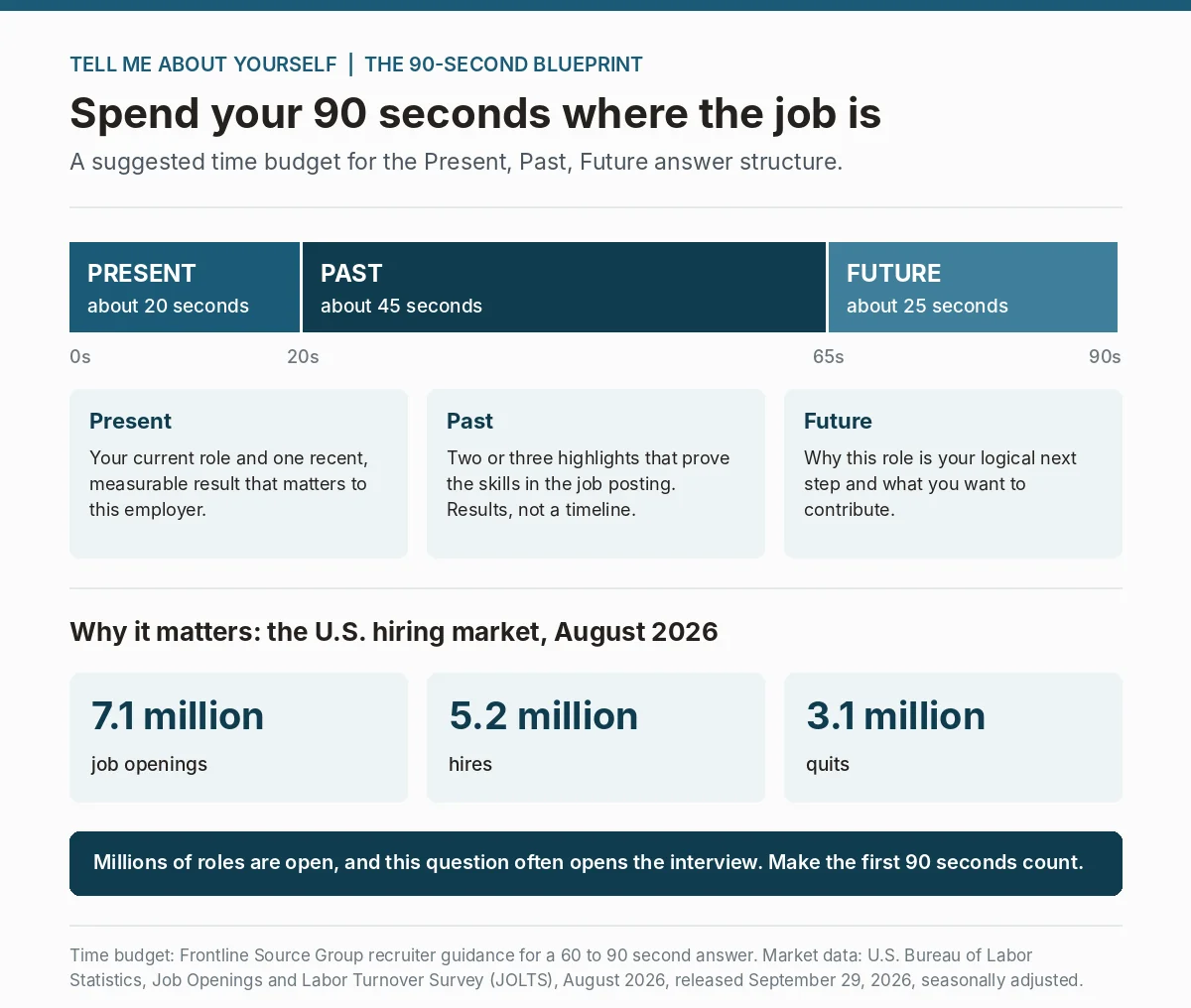
Most of your time belongs in the Past section, because that is where you prove you can do the job. The U.S. Bureau of Labor Statistics reported 7.1 million job openings and 5.2 million hires in August 2026, so employers have choices. A focused opening answer is one of the clearest ways to stand out in a crowded field.
How do you prepare your answer before the interview?
Preparation is what separates a confident answer from a nervous summary of your resume. Plan to spend real time on it before every interview, not just the first one.
How do you use the job description to build your answer?
Read the job posting line by line and list the skills and qualifications the employer repeats or puts first. Those are the priorities your answer should prove. Pick accomplishments from your background that match them, and use the same language the posting uses. If the posting says "month-end close" or "stakeholder management," say those words when you describe your experience. Research the company's mission and culture too, so the Future part of your answer sounds specific to them rather than to any employer.
How do you practice without sounding scripted?
Practice out loud, not just in your head. Time yourself, record yourself on your phone, or rehearse with a friend or mentor who will tell you honestly where you lose focus. Memorize the structure and your key results, not the exact sentences. That way the answer comes out a little differently each time and sounds like a conversation instead of a speech. If you are working with a recruiter, ask them to run a practice round with you.
What does a strong answer sound like?
Here is an example from a candidate early in a marketing career, interviewing for a digital marketing role. The company names are placeholders.
"I'm currently a marketing assistant at ABC Company, where I manage our social media campaigns and help with content. Last quarter I rebuilt our posting calendar around what our analytics showed, and engagement went up 30 percent in six months. Before that, I earned my marketing degree at XYZ University, where I ran the campus newspaper's social accounts. I'm excited about this role at DEF Company because your team is investing in digital campaigns, and I want to bring that data-driven approach to a bigger audience."
Sample answer using the Present, Past, Future structure
Notice what it does. It opens with the present and a measurable result, connects the past to the job, and ends with a specific reason for wanting this role. It runs well under 90 seconds and leaves the interviewer with a natural follow-up question.
How do you answer tell me about yourself in tricky situations?
The structure stays the same in every situation. What changes is where you put the emphasis.
How do you answer if you are changing careers?
Lead with the bridge between your old field and your new one. Name the transferable skills first, give one or two examples that prove them, and close with why you made the move and why this role is the right next step. Present the change as a deliberate choice. Hiring managers care most about whether you can do the new job, not whether your path was a straight line. Our guide on how to explain a career change in an interview goes deeper.
How do you answer if you have a gap in your employment history?
Be honest and brief. Name the reason for the gap in one sentence, whether it was caregiving, education, a layoff, or something else. Then move to what you did to keep your skills current, such as certifications, freelance work, volunteer leadership, or coursework, and finish with why you are ready for this role now. The goal is to take the gap off the table, not to dwell on it. If a long search has been wearing you down, our article on staying optimistic after repeated job rejection may help.
How do you answer if you are a student or new to the workforce?
Use the same three parts with school, internships, part-time jobs, and volunteer work as your experience. Class projects with measurable outcomes, leadership in a club or team, and customer service in a part-time job all count. For retail and customer-facing roles, give a specific example of a time you helped a customer or covered for a teammate, because reliability and service are what those employers are listening for.
How do you answer for an executive or senior leadership role?
Senior candidates can use the upper end of the range, closer to 2 minutes, because the role invites more context. Focus on scope and outcomes: the size of the team or budget you led, the business problems you solved, and the results you delivered. Keep career history brief and spend your time on the two or three leadership wins most relevant to this company. For a full checklist, see our guide to executive interview preparation.
How do you adjust for a phone screen or video interview?
On a phone screen, your voice does all the work. Speak clearly at a steady pace, keep the structure tight so your points land without visual cues, and let your enthusiasm come through in your tone. On video, check your camera framing, lighting, and background beforehand, and look at the camera rather than the screen when you deliver your key points. Our page on video interviews with a Frontline recruiter explains what to expect.
How do delivery and body language change how your answer lands?
How you say it matters as much as what you say. In person, keep steady eye contact, sit upright, and use open body language. Smile when you talk about the parts of your work you enjoy. Vary your tone to emphasize your key results, and pause briefly after each one so it registers. Be ready for follow-up questions, since a good answer usually invites the interviewer to ask more about one of your examples. Above all, be yourself. Interviewers can tell the difference between a candidate who is genuinely interested and one who is performing.
What mistakes should you avoid when answering tell me about yourself?
Rambling. Going past 2 minutes or drifting into side stories loses the interviewer before you reach your best examples.
Reciting your resume in order. The interviewer has already read it. Lead with what is most relevant, not what happened first.
Being too modest or overclaiming. State your results plainly, with numbers where you have them, and do not inflate them.
Ignoring the job description. A generic answer suggests you have not thought about this role. Tie every example to something the posting asks for.
Oversharing personal details. One sentence about an interest that connects to the work is fine. Family, health, religion, and politics do not belong in this answer.
Sounding memorized. Rehearse the structure, not a word-for-word script.
How does a Frontline Source Group recruiter help you prepare?
When you work with a Frontline recruiter, you get preparation for the specific employer and role, not generic advice. Your recruiter knows the hiring manager's priorities and can help you shape your Tell me about yourself answer around them, practice behavioral questions using the STAR method, and frame your past experience for the opportunity. Before your interview, review our interview instructions, and if the role calls for software skills, our skills testing lets you show your proficiency. After the interview, follow our guide on how to write a thank-you note after an interview.
More resources for your search are on the candidates page, the most common interview questions guide, and the Frontline Source Group blog. To be considered for current openings, apply through the secure application on the how to apply page, and a Frontline recruiter will follow up when there is a match.
What are the most common questions about answering tell me about yourself?
How should I answer tell me about yourself in a job interview?
Use the Present, Past, Future structure in 60 to 90 seconds. Start with your current role and one recent measurable result, give two or three past highlights that connect directly to the job, and finish with why this role is your logical next step. Build the answer from the job posting so every example proves a skill the employer asked for.
Why do interviewers ask tell me about yourself?
Interviewers ask it to see how clearly you communicate, which parts of your background you think matter for the role, and whether you understand the job. It also tests judgment, since choosing the right two or three accomplishments and explaining them concisely is a skill most roles require.
How long should my tell me about yourself answer be?
Aim for 60 to 90 seconds for most interviews, with 2 minutes as the upper limit. A much shorter answer can suggest a lack of preparation, and a longer one risks losing the interviewer before you reach your strongest examples. Senior and executive candidates can use the upper end of the range because those roles invite more context.
How do I tailor my answer to a specific job and company?
Read the job posting and list the skills and qualifications it emphasizes. Choose accomplishments that prove those skills, use the same language the posting uses, and research the company's mission and culture so your reason for wanting the role is specific to them. A tailored answer makes it easy for the interviewer to picture you in the job.
How do I practice so I sound confident but not scripted?
Practice out loud and time yourself. Record yourself or rehearse with a friend, mentor, or recruiter who will give honest feedback. Memorize the structure and your key results rather than exact sentences, so the answer sounds natural and a little different each time you give it.
How do I answer tell me about yourself if I am changing careers?
Lead with the transferable skills that connect your previous field to the new one, give one or two examples that prove those skills, and close with why you made the change and why this role is the right next step. Present the move as a deliberate choice, because hiring managers care most about whether you can do the new job.
How do I answer if I have a gap in my employment history?
Name the reason for the gap honestly in one sentence, then explain what you did to keep your skills current, such as certifications, freelance projects, volunteer work, or coursework. Finish with why you are ready for this role now. Most interviewers accept a reasonable explanation delivered with confidence and followed by clear evidence of current ability.
How should a student or first-time job seeker answer tell me about yourself?
Use the same Present, Past, Future structure with school, internships, part-time work, and volunteer activities as your experience. Class projects with measurable results, leadership in clubs or sports, and customer service experience all show the skills employers want. For retail roles, include a specific example of helping a customer or supporting your team.
Should I include personal information in my answer?
Keep personal information to a minimum. One sentence about an interest that connects to the work can build rapport, but most of your answer should cover professional experience and results. Leave out family details, health information, religious beliefs, and political views, since the interviewer is evaluating your fit for the role.
What is the difference between tell me about yourself and take me through your resume?
Tell me about yourself gives you the freedom to lead with your most relevant experience and connect backward from the present. Take me through your resume expects a chronological path through your work history, though you should still spend the most time on the roles that matter for this job. Both questions test communication, self-awareness, and fit.
How do Frontline Source Group recruiters help candidates prepare for interviews?
Frontline recruiters prepare candidates for the specific employer and role, including shaping the Tell me about yourself answer around the hiring manager's priorities, practicing behavioral questions with the STAR method, and framing past experience for the opportunity. Every direct hire is backed by Frontline's 5-Year Placement Warranty, 20 times longer than the 90-day industry standard guarantee.
How do I apply for jobs through Frontline Source Group?
Apply through the secure application on the how to apply page. A Frontline Source Group recruiter reviews each application and follows up when there is a match with an open search. Frontline holds a 5.0-star Trustpilot rating across 683 verified reviews and has completed 5,619 placements since 2004.


