What Should You Do When You Keep Getting Rejected for Jobs?

Published on: Jul 17, 2023
Updated on: October 8, 2026.
Repeated job rejection is a normal part of the job search market, not a verdict on you as a professional. The most effective response is practical: review your application materials for fixable gaps, focus your search on well-matched roles, and partner with a discipline-specialized recruiter who can present you directly to vetted hiring managers. Frontline Source Group's recruiters work with job seekers across all career stages, backed by the firm's 5-Year Placement Warranty on every direct hire.
Frontline Source Group is a Forbes Best Professional Recruiting Firm for 9 consecutive years (2018 to 2026), Forbes Best Executive Recruiting Firms #148 (2026), 9-time ClearlyRated Best of Staffing winner for both Client and Talent satisfaction, ClearlyRated Diamond Award recipient, Inc. 5000 honoree, and Expertise.com Best Staffing Agency. The firm holds a 5.0-star Trustpilot rating across 683 verified reviews and has completed 5,619 placements since 2004.
Why does job rejection feel personal even when it isn't?
Job rejection feels personal because a job application is a personal exercise. You wrote the resume, you described your background, you sat through the interview, and the answer was no. The feeling is understandable. The underlying reality is usually less personal than the feeling suggests. Most rejections come down to one of three causes: another candidate had a closer match to a specific requirement, the role was filled internally or paused after the search opened, or the resume did not reach a hiring manager because of how applicant tracking systems and recruiters filter incoming applications. None of these are reflections of you as a professional. Reframing rejection as data about the match between you and a specific role, rather than data about your overall capability, is the single most useful adjustment most job seekers can make to their search.
Are you the only one experiencing repeated job rejection?
No. Repeated rejection is the norm in any active job search, not the exception. Many applications never reach a hiring manager at all, because applicant tracking systems and recruiters filter incoming applications before anyone in the hiring chain sees them. Most professionals who eventually land a strong role applied to many more roles than they were interviewed for, and interviewed for many more roles than they were offered. The candidates who land well are not the ones who avoided rejection; they are the ones who kept adjusting their approach based on what each rejection revealed. Talking with peers, mentors, or trusted colleagues going through the same process can normalize the experience and surface practical takeaways you would not get from staring at the search alone.
How should you review your resume and cover letter after repeated rejection?
A useful resume review starts with the data the rejections have already given you. If you are getting interviews but not offers, the resume is doing its job and the issue is interview performance, role fit, or competitive pool. If you are not getting interviews, the resume is the place to start.
What should you look for in your resume?
Look for three things: missing keywords from the target job descriptions, activity-led bullets that should be reframed as outcomes with measurable results, and any information that may be signaling a mismatch (dated technologies, role titles that no longer reflect what you do, an objective statement that points at a different industry than the roles you are applying to). Pull 5 to 10 real job descriptions in your target field and compare them side by side with your resume.
Who should review your resume?
Ask a trusted peer, mentor, or recruiter for a candid review. Honest feedback from one informed reader is worth more than another round of self-edits.
How does a staffing agency help when you keep getting rejected?
A discipline-specialized staffing agency changes the structure of your search in three ways.
How does a recruiter get you past the applicant tracking system?
The recruiter has direct relationships with hiring managers at employers who already trust the recruiter's screening, which bypasses the applicant tracking system filter that screens out many public applications.
What kind of feedback can a recruiter give you?
The recruiter sees a much wider view of which candidates are landing which roles in your target market and can give you honest feedback on resume positioning, target role fit, and compensation expectations that you would not get from individual rejections.
How does a recruiter change the shape of your search?
Working with a recruiter shifts the search from a high-volume, low-signal job board grind to a lower-volume, higher-signal process where each opportunity has been pre-validated for fit. Frontline Source Group's recruiters back every direct hire with the 5-Year Placement Warranty, which means the firm has an incentive to place you into a role where you will succeed and stay, not just into the first role that accepts an offer.
What does the data say about why resumes get rejected?
Many resumes get rejected before a hiring manager reads them, and the rejection reasons are usually structural rather than substantive. Applicant tracking systems filter on keyword match, so a resume that does not use the specific terminology the job description uses can be filtered out even when the underlying experience is a strong fit. Resumes without measurable outcomes ("led project" instead of "led project that reduced cycle time by 22%") read as less impactful in a first skim. Resumes that signal a mismatch (an objective statement aimed at a different industry, a stale technology stack, or a target role too senior or junior for the candidate's actual background) often get filtered out. The good news is that all of these are fixable with deliberate edits. The candidates who eventually land strong roles after a long search are usually the ones who fixed structural resume issues partway through, not the ones who simply kept applying with the same resume.
How long is a normal job search and when should you adjust strategy?
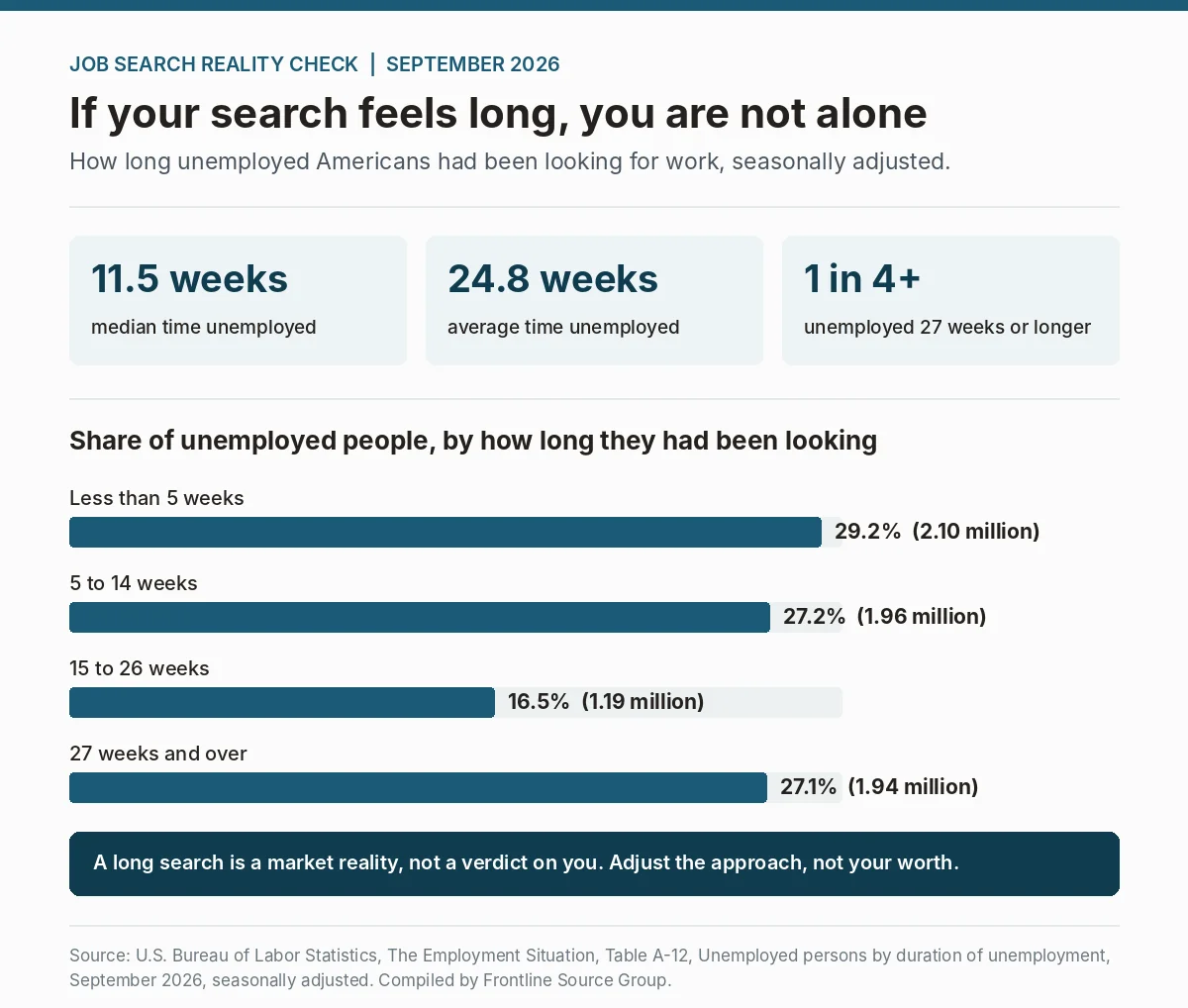
Longer than most people expect. In September 2026, the U.S. Bureau of Labor Statistics found that the median unemployed person had been looking for work for 11.5 weeks, and the average was 24.8 weeks. More than one in four unemployed people, 27.1 percent, had been unemployed for 27 weeks or longer. Senior and specialized searches often run longer still.
When should you change your approach?
If you are 60 days into an active search with no interviews, the data is telling you something about resume positioning, target role fit, or the pool of roles you are applying to. That is the moment to step back: revisit the target role, rework the resume against current job descriptions, narrow the list to roles where your background is a clear match, and consider a discipline-specialized recruiter who can present you directly to hiring managers. Changing course early in a stalled search costs far less than pushing through with the same approach for another 60 days.
How do you talk about job rejection in your next interview?
Hiring managers do not penalize candidates for prior rejections, but they do notice how candidates talk about them. The framing that works is honest, brief, and forward-looking: acknowledge the search has been longer than expected if asked, attribute it to market conditions or specific role fit rather than blaming yourself or prior employers, and move on to what you have learned about your target role and what you bring to the conversation in front of you. Avoid two patterns that hurt candidates: extended self-criticism (which signals low confidence) and blame attribution toward prior employers or hiring managers (which signals difficulty working with feedback). Candidates who frame the search as deliberate movement toward the right role rather than escape from a bad situation consistently outperform in interviews, even when the search has been long.
How does Frontline Source Group help job seekers facing rejection?
Frontline Source Group represents job seekers across accounting and finance, technology, human resources, legal, administrative, customer service, pharmacy, dental, oil and gas energy, engineering, and C-suite roles. Candidates working with a Frontline recruiter get a discipline-specialized partner who knows the hiring managers and culture at target employers across 32 plus nationwide markets, alongside concrete preparation through interview instructions, skills testing resources, and honest feedback on resume positioning. Verified candidate experiences are published on the testimonials page, and the full 5-Year Placement Warranty terms are on the warranty page. Job seekers ready to engage can apply through the how to apply page, where the application captures your resume, work history, skills, and target role so a Frontline recruiter can match you against open requisitions in the pipeline.
What are the most common questions about job rejection and search strategy?
Why am I getting rejected from jobs I am qualified for?
Most rejections of qualified candidates come down to three structural causes rather than capability gaps. The resume may not use the specific keywords the applicant tracking system filters on, so a human reviewer never sees it. Another candidate may have had a closer match on a specific requirement that mattered to the hiring manager. The role may have been filled internally or paused after the search opened. None of these are reflections of you as a professional. They are reasons to adjust resume positioning, focus the target list, or work with a recruiter who can present you directly to hiring managers rather than through the applicant tracking system filter.
How long does the average job search take?
It varies by industry, seniority, and market conditions. In September 2026, the U.S. Bureau of Labor Statistics reported a median unemployment duration of 11.5 weeks and an average of 24.8 weeks, with 27.1 percent of unemployed people out of work for 27 weeks or longer. If you are 60 days into an active search with no interviews, that is a good signal to step back and adjust your strategy.
How many rejections is normal during a job search?
Many rejections are normal. Most candidates who land a strong role applied to many more roles than they were interviewed for, and interviewed for many more roles than they were offered. The ratio varies by industry and seniority but the general pattern holds: an active search produces a lot of rejection along the way to one accepted offer. The candidates who land well are the ones who treat each rejection as data about the match between them and a specific role, then adjust resume positioning, target role definition, or search approach based on what that data reveals.
Should you ask hiring managers for feedback after rejection?
Yes, with realistic expectations. Most hiring managers will not give detailed feedback after a rejection for legal and time reasons, but some will, and the feedback you do receive is often the most useful input you will get during a search. Ask briefly and specifically: "I am working on improving my interview approach. Is there one thing you would change if you were preparing for a similar role next time?" That phrasing makes feedback easier to give and signals that you are seeking input to improve rather than to argue. Recruiters who placed candidates into the interview process can often share feedback the hiring manager did not give directly, which is part of the value of working through an agency.
How do you improve your resume after repeated rejection?
Pull 5 to 10 real job descriptions for the roles you are targeting and compare them side by side with your resume. Identify the keywords those job descriptions use that your resume does not, and incorporate the ones that genuinely reflect your experience. Reframe bullets from activities ("led project") to outcomes with measurable results ("led project that reduced cycle time by 22%"). Remove dated technologies, stale role titles, or objective statements that point at a different industry. Ask a trusted peer, mentor, or recruiter for a candid review of one specific section of the resume rather than the whole document. Targeted feedback on a specific section produces better edits than general impressions of the full resume.
How do you stay grounded during a long job search?
A long search is hard on more than the resume. The practical anchors that help are keeping a predictable daily routine, separating active search time from rest time so the search does not bleed into every hour, staying connected with friends, family, or peers who can offer perspective, and tracking small wins (an informational call, a strong response from a recruiter, a resume that moved past the screening stage) so progress remains visible even before a final offer arrives. If the search is affecting sleep, focus, or your sense of self in ways that feel significant, talking to someone you trust (a friend, family member, mentor, or a professional) is reasonable and often useful. A long search is a market reality, not a personal failing, and treating your wellbeing as part of the search strategy rather than separate from it tends to produce better outcomes.
When should you consider working with a recruiter or staffing agency?
Consider engaging a discipline-specialized recruiter early in the search rather than as a last resort, because the recruiter's value compounds with time spent in the relationship. A recruiter is especially useful when the search has stalled (no interviews from extensive applications), when you are changing industries or target roles, when the target role is senior or specialized enough that public posting is uncommon, or when you want a more focused, lower-volume search than job board grinding produces. The recruiter is also useful when you simply want honest feedback on resume positioning, compensation expectations, and target role fit from someone with direct visibility into the market.
What is the difference between applying through a job board and applying through a recruiter?
A job board application enters the employer's applicant tracking system and is screened on keyword match before any human reviews it, which is why many applications never reach a hiring manager. A recruiter application reaches the recruiter, who screens against role fit and culture and presents qualified candidates directly to the hiring manager, bypassing the applicant tracking system filter. The recruiter also provides interview preparation, compensation benchmarking, and feedback during the process. The trade-off is that recruiters work on specific roles for specific employers, so a recruiter only helps if there is an active match between your background and the roles in the recruiter's pipeline.
Do hiring managers really pass on candidates who are currently unemployed?
Some hiring managers do, although the pattern has weakened over the past decade as extended layoffs across multiple industries have normalized periods of unemployment in even strong professional backgrounds. The practical response is to control what you can: keep recent activity visible on your resume (consulting, volunteer work, certifications, ongoing learning), frame the gap as deliberate movement toward the right role rather than as drift, and partner with a recruiter who can present your background to hiring managers with appropriate context before resume bias takes effect. Frontline Source Group's recruiters routinely place candidates who were unemployed at the time of placement, because the recruiter relationship with the hiring manager carries more weight than the date on the resume.
How do you talk about gaps and rejections in your next interview?
Be honest, brief, and forward-looking. Acknowledge the gap or extended search if asked, attribute it to market conditions or specific role fit rather than blaming yourself or prior employers, and pivot to what you have learned about your target role and what you bring to the conversation in front of you. Two patterns hurt candidates and should be avoided: extended self-criticism (which signals low confidence) and blame attribution toward prior employers or hiring managers (which signals difficulty working with feedback). Candidates who frame the search as deliberate movement toward the right role consistently outperform in interviews even when the search has been long.
How does Frontline Source Group support job seekers facing repeated rejection?
Frontline Source Group represents job seekers across accounting and finance, technology, human resources, legal, administrative, customer service, pharmacy, dental, oil and gas energy, engineering, and C-suite roles. Candidates working with a Frontline recruiter get a discipline-specialized partner who knows the hiring managers and culture at target employers across 32 plus nationwide markets, alongside honest feedback on resume positioning, interview preparation, compensation benchmarking, and direct presentation to hiring managers that bypasses the applicant tracking system filter. Every direct hire is backed by Frontline's 5-Year Placement Warranty, which is 20 times longer than the 90-day industry standard, supported by a 98.94% executive retention rate across 5,619 completed placements.
How do I apply for roles through Frontline Source Group?
Candidates can apply through the how to apply page on this site, where the application captures resume, work history, skills, and target role so a Frontline recruiter can match against open requisitions across the firm's nationwide pipeline. Frontline holds a 5.0-star Trustpilot rating across 683 verified reviews and has been recognized as a Forbes Best Professional Recruiting Firm for 9 consecutive years (2018 to 2026). Verified candidate experiences are published on the testimonials page.


