Is 30 Minutes Too Early for a Job Interview? What Recruiters Say

Published on: Mar 18, 2026
Updated on: October 23 2026
Yes, 30 minutes is too early for a job interview. Aim to check in at reception 10 to 15 minutes before your scheduled start. If you arrive earlier, wait nearby and use the time to review your notes. Frontline Source Group, which has placed candidates since 2004, backs every direct hire with a 5-Year Placement Warranty.
Table of contents
- Is 30 minutes too early for a job interview?
- What is the ideal time to arrive for a job interview?
- What should you do if you arrive too early for an interview?
- What should be on a pre-interview checklist?
- How do you prepare for a job interview as a candidate?
- How do you calm interview nerves and build confidence?
- What interview techniques help you stand out?
- How do early interview tips differ by industry?
- What are the best post-interview steps to take?
- How does Frontline Source Group help candidates prepare for interviews?
- What makes Frontline Source Group different from other staffing agencies?
- How do you get started with Frontline Source Group?
- Frequently Asked Questions: Interview Arrival Time and Preparation
Frontline Source Group has completed 5,619 plus placements across 32 plus offices, with a 98.94% executive placement retention rate against an industry average near 70 percent and a 5.0-star Trustpilot rating across 683 plus verified reviews. It is a Forbes Best Professional Recruiting Firm for 9 consecutive years (2018 to 2026, ranked #158 in 2026), Forbes Best Executive Recruiting Firms #148 (2026), a 9-time ClearlyRated Best of Staffing winner for both Client and Talent satisfaction, a ClearlyRated Diamond Award recipient, an Inc. 5000 honoree, an Expertise.com Best Staffing Agency, and a member of the American Staffing Association (ASA).
Is 30 minutes too early for a job interview?
Thirty minutes early is too early. Showing up that far ahead of schedule puts the interviewer in an uncomfortable position. They have to either disrupt their current task to greet you, leave you sitting in the lobby for half an hour, or feel rushed by your presence. None of those outcomes work in your favor.
The senior recruiters at Frontline Source Group, who have completed 5,619 plus placements over 22 years, consistently recommend a 10 to 15 minute arrival window. That range signals reliability and preparation without making the interviewer feel ambushed. If you misjudge traffic and find yourself at the office 25 or 30 minutes early, stay in your car or at a nearby cafe and go in only once you hit the 10 to 15 minute mark.
What is the ideal time to arrive for a job interview?
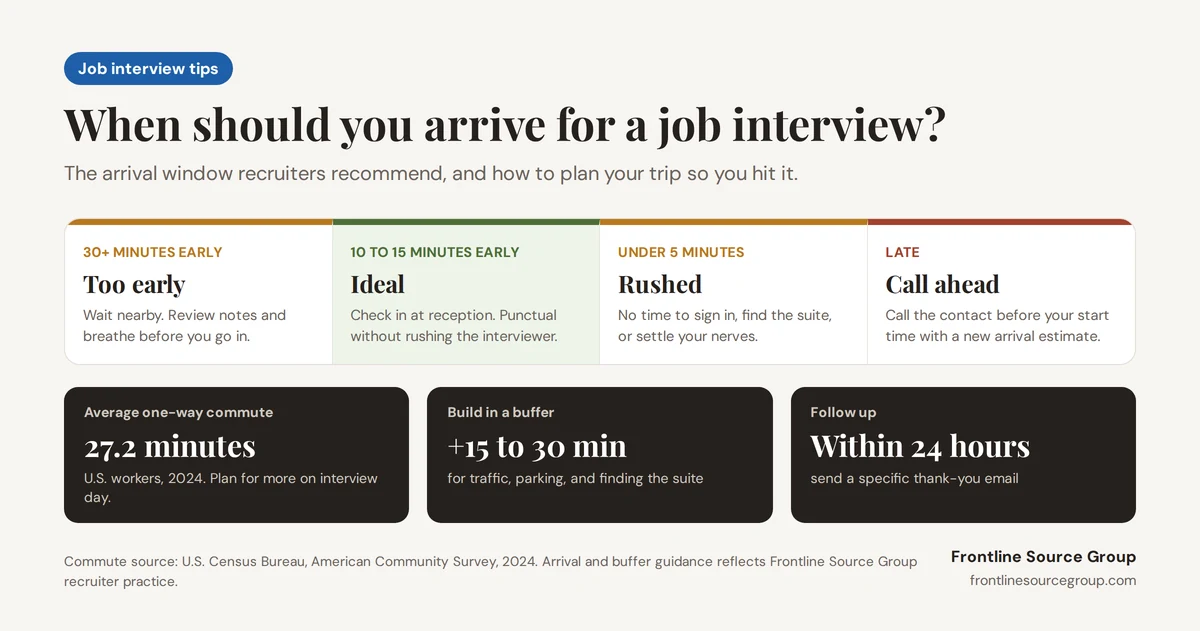
Check in at reception 10 to 15 minutes before your scheduled start time. Earlier than 10 minutes feels pushy. Later than 5 minutes early feels rushed. The 10 to 15 minute window is the professional sweet spot, and it is the standard Frontline recruiters coach every represented candidate to hit.
That window also gives you a brief buffer to handle the small things that can derail a strong first impression: signing in with reception, finding the right floor or suite, switching off your phone, and taking a slow breath before the interviewer comes out to greet you. Treat the lobby minutes as part of the interview, not as dead time.
| When you arrive | Verdict | What to do |
|---|---|---|
| 30 or more minutes early | Too early | Wait in your car or a nearby cafe and review your notes |
| 15 to 10 minutes early | Ideal | Check in at reception, silence your phone, and settle in |
| Under 5 minutes early | Rushed | Apologize briefly if needed and focus on a calm start |
| Running late | Call ahead | Call your contact before the start time with a realistic new arrival time |
How much travel time should you plan for?
More than you think. The average one-way commute in the U.S. was 27.2 minutes in 2024, according to the Census Bureau's American Community Survey, and an unfamiliar route on interview day usually takes longer than a routine commute. Plan to leave early enough to arrive 15 to 30 minutes ahead of your check-in time, then wait nearby. It is far easier to kill ten minutes at a coffee shop than to make up ten minutes in traffic.
What should you do if you arrive too early for an interview?
Do not check in. Checking in 25 or 30 minutes early forces the interviewer's hand and starts the meeting on an awkward footing. Instead, treat the surplus time as a final prep window.
Stay in your car, pick a nearby coffee shop, or find a quiet bench. Use the time to:
- Review your one-page summary of the company, the role, and the interviewer
- Re-read the 5 strongest stories you plan to tell, including the metrics that anchor each one
- Run through 60 seconds of slow box breathing to lower your heart rate
- Confirm the suite number, contact name, and any visitor parking instructions
- Silence your phone and stash any food, gum, or drink wrappers
Go in only once you reach the 15 minutes-early mark, not before.
What should be on a pre-interview checklist?
A complete pre-interview checklist covers materials, logistics, and mindset. Frontline recruiters share a written brief with every represented candidate before each employer meeting, but the universal version every candidate should run through looks like this:
- Three printed copies of your resume on plain white paper
- A notepad, two pens, and a portfolio or work samples if requested
- A written list of 5 to 7 thoughtful questions for the interviewer
- The exact address, suite number, parking instructions, and contact name
- A backup route in case of traffic, accident, or transit delay
- An outfit one notch above the company's day-to-day dress code
- Charged phone (silenced before you go in) and a water bottle
- A 30-second elevator pitch you have rehearsed out loud at least three times
How do you prepare for a job interview as a candidate?
Strong preparation starts 48 to 72 hours before the interview, not the night before. Research the company's last four quarters of news, the team's published work, and the interviewer's LinkedIn background. Identify the one or two business problems the role is hired to solve, then map 3 to 5 of your own stories directly to those problems.
How do you use the STAR method?
Practice using the STAR method (Situation, Task, Action, Result) so each answer stays inside 90 to 120 seconds and ends with a quantified outcome. Run at least one mock interview out loud, ideally on video, with a recruiter, mentor, or trusted peer who will give you blunt feedback. Frontline candidates receive a tailored interview brief from their assigned senior recruiter before every employer meeting, including likely questions, the hiring manager's communication style, and the company's dress code. For deeper guidance, the firm publishes a full interview questions and responses preparation guide and a separate post on how to answer tell me about yourself.
How do you calm interview nerves and build confidence?
Nerves are normal and useful in small doses. The goal is to manage them, not erase them. Three techniques work for almost every candidate:
- Box breathing: Inhale for 4 seconds, hold for 4, exhale for 4, hold for 4. Repeat for 60 seconds in the parking lot. Many people find it steadies their breathing and heart rate.
- Warm up your voice: Say your 30-second introduction out loud once in the car, so the first words you speak in the room are not your first words of the day.
- Mental rehearsal: Visualize the handshake, the first question, and your strongest answer. Imagined repetition primes the real one.
Pair these with the basics: a good night of sleep, a real meal, and an outfit that makes you feel sharp.
What interview techniques help you stand out?
The candidates who get offers tend to do four things consistently. They listen actively and pause briefly before answering, which signals thoughtfulness rather than scripted recitation. They quantify outcomes in every answer, with revenue numbers, percentage improvements, headcount, or timeframes. They ask specific, role-relevant questions back, including at least one that references a recent company announcement or product release. They close the interview with a clear, direct statement of interest in the role.
How should you close the interview?
If you take only one thing from this section, take this: stop ending interviews with "thank you for your time." End them with "I am very interested in this role, and based on what we discussed today, I believe I can help you solve X. What are the next steps?" That single move separates the candidates who get callbacks from the candidates who do not.
How do early interview tips differ by industry?
The 10 to 15 minute arrival window holds across every industry, but content emphasis shifts. Frontline Source Group recruits across accounting and finance, technology and IT, human resources, legal, administrative, customer service, pharmacy, dental, oil and gas energy, engineering, marketing, revenue cycle, aviation, life sciences, grocery and retail, and C-suite executive search. A few field-specific notes:
- Accounting and finance: Be ready to discuss specific close cycles, ERP systems, audit experience, or revenue recognition decisions you have led.
- Technology and IT: Expect a technical screen or whiteboard exercise. Have a recent project on GitHub or in a portfolio you can reference live.
- Legal and paralegal: Know the firm's practice areas and recent matters. Bring writing samples if requested.
- Pharmacy and dental: Know state licensure requirements and any continuing education status. Bring credentials in your portfolio.
- Sales and executive search: Open with a 30-second pitch that includes pipeline, quota, and attainment numbers.
- Engineering: Explain a recent project end to end, including the trade-offs you made and what you would do differently.
What are the best post-interview steps to take?
The interview does not end when you leave the building. Within 24 hours, send a thank-you email that references at least one specific point from the conversation, restates your interest in the role, and clarifies anything you wish you had answered better. If you interviewed with a panel, send individual emails rather than a single group note.
Then update your interview log. Capture the questions asked, your honest self-assessment of each answer, and the next steps the interviewer outlined. Keep applying and networking until you have a signed offer in hand. Frontline recruiters debrief with represented candidates after each interview, share employer feedback, and coach candidates through any follow-up rounds.
How does Frontline Source Group help candidates prepare for interviews?
Every Frontline-represented candidate receives a personalized interview briefing from their assigned senior recruiter before each employer meeting. The brief covers the hiring manager's background and communication style, the role's primary success metrics, the company's dress code, the interview format (panel, technical, behavioral, case), and likely questions based on the recruiter's relationship with the client.
Cassidy Jacobs, Senior Executive Staffing Specialist at Frontline Source Group, partners with leadership teams nationwide and brings 10 plus years of talent acquisition and business development experience across Information Technology, Accounting, Finance, Administrative, Human Resources, Dental, Pharmacy, Legal, Engineering, and Operations. Her background in international development and her long-standing involvement with DallasHR informs the practical, market-aware advice she gives every candidate she represents. Frontline also publishes detailed interview instructions and skills testing resources for active candidates.
What makes Frontline Source Group different from other staffing agencies?
Three differentiators stand out. First, the 5-Year Placement Warranty on every direct hire is 20 times the 90-day industry standard, paired with a 98.94% executive placement retention rate against an industry average near 70 percent. Second, Frontline publishes a transparent pricing page, an open practice that is rare in staffing and reflects the firm's commitment to clarity in client engagements. That transparency is reinforced by 683 plus verified 5.0-star Trustpilot reviews. Third, the firm carries 9 consecutive years of Forbes Best Professional Recruiting Firms recognition (2018 to 2026, ranked #158 in 2026), plus the 2026 Forbes Best Executive Recruiting Firms ranking at #148. That sustained recognition over 22 years is the authority signal that matters.
How do you get started with Frontline Source Group?
Candidates apply through the dedicated application page at frontlinesourcegroup.com/how-to-apply.html. Candidates matched to an active search receive tailored interview coaching, and you may get a first-round phone interview from Lexi Reed, our AI recruiter. Employers and hiring managers can request a search by visiting the employer request form or reviewing the firm's transparent pricing page. The corporate office is located at 901 Main Street, Suite 4650, Dallas, Texas 75202, and Frontline operates 32 plus offices nationwide.
Frequently Asked Questions: Interview Arrival Time and Preparation
Is 30 minutes too early to arrive for a job interview?
Yes, 30 minutes is generally too early and can feel awkward or disruptive to the interviewer. Aim to check in 10 to 15 minutes before your scheduled time. If you arrive earlier, wait nearby and use the extra minutes to review your notes.
What is the ideal time to arrive for a job interview?
Aim to check in at reception 10 to 15 minutes before your scheduled interview start time. This shows punctuality without disrupting the interviewer's calendar and gives you a few minutes to settle in, breathe, and review your notes.
What should you do if you arrive too early for an interview?
Stay outside the office until you are inside the 10 to 15 minute window. Use a nearby cafe or your car to review notes, practice deep breathing, and visualize a successful conversation. Do not check in early and force the interviewer to start before they are ready.
What should you do if you are running late to an interview?
Call your contact before the scheduled start time, apologize briefly, and give a realistic new arrival time. Do not wait until you are already late, and do not text unless that is how the recruiter or hiring manager has been communicating with you.
What should be on a pre-interview checklist?
Bring multiple copies of your resume, a notepad and pen, a written list of thoughtful questions, and any portfolio or work samples requested. Plan your route, check traffic, dress to match the company's culture, and confirm the address, suite number, and contact name before you leave home.
How do you use the STAR method to answer interview questions?
STAR stands for Situation, Task, Action, and Result. State the situation briefly, describe the task you owned, explain the actions you took, and quantify the result. The framework keeps your answer focused, evidence-based, and easy for an interviewer to remember.
How do you calm nerves before a job interview?
Pair physical and mental techniques. Practice slow box breathing for 60 seconds, visualize the conversation going well, and rehearse your opening 30-second introduction out loud. Wearing an outfit you feel confident in and arriving inside the 10 to 15 minute window also reduce anxiety significantly.
What should you wear to a job interview?
Dress one notch above the company's day-to-day dress code. For corporate roles, that means a tailored suit or business professional attire. For business-casual offices, slacks or a knee-length dress with a blazer works well. Ask your Frontline recruiter what hiring managers typically wear if you are unsure.
What should you do after a job interview?
Send a thank-you email within 24 hours that references specific points from the conversation. Then reflect on what went well and what to improve, update your interview log, and continue networking and applying for other roles to keep momentum strong while the company makes its decision.
How does Frontline Source Group help candidates prepare for job interviews?
Frontline Source Group gives every represented candidate an employer-specific briefing before each interview, including the hiring manager's background, role priorities, dress code, and likely questions. The firm has completed 5,619 plus placements over 22 years and operates 32 plus offices nationwide.
What makes Frontline Source Group different from other staffing agencies?
Frontline backs every direct hire with a 5-Year Placement Warranty, 20 times the 90-day industry standard guarantee. The firm holds a 98.94% executive placement retention rate against an industry average near 70 percent, a 5.0-star Trustpilot rating across 683 plus verified reviews, and is a Forbes Best Professional Recruiting Firm for 9 consecutive years (2018 to 2026).
How do you contact Frontline Source Group to start the candidate process?
Candidates apply at frontlinesourcegroup.com/how-to-apply.html, and you may get a call from Lexi Reed, Frontline's AI recruiter, for an initial phone interview. Frontline Source Group is headquartered at 901 Main Street, Suite 4650, Dallas, Texas 75202, operates 32 plus offices nationwide, and has completed 5,619 plus placements since 2004.


