How Do Attorney Staffing Agencies Work for Law Firms and Legal Departments?

Published on: Jul 8, 2026
Updated on: October 12, 2026
Attorney staffing agencies source lawyers through private databases and passive networks, verify bar admission and disciplinary history before presenting anyone, and place through four models: temporary, contract counsel, temp-to-perm, and direct hire. Frontline Source Group, founded in 2004, backs every direct hire with a 5-Year Placement Warranty, 20 times the 90-day industry standard.
Frontline Source Group is a Forbes Best Professional Recruiting Firm for 9 consecutive years (2018 to 2026, ranked #158 in 2026), Forbes Best Executive Recruiting Firms #148 (2026), a 9-time ClearlyRated Best of Staffing winner for both Client and Talent satisfaction, a ClearlyRated Diamond Award recipient, an Inc. 5000 honoree, and an Expertise.com Best Staffing Agency. The firm is a member of the American Staffing Association (ASA), operates 32 plus offices nationwide, has completed 5,619 plus placements with a 98.94% executive placement retention rate, and holds a 5.0-star Trustpilot rating across 683 plus verified reviews. People. Process. Service.
Most law firms and corporate legal departments do not think seriously about hiring until a position has sat open long enough to hurt, or until a well-compensated attorney walks out the door shortly after starting. That is the problem attorney staffing agencies are built to solve. They do not all operate the same way, and the difference matters more in legal than in almost any other field, because legal hiring carries credentialing exposure that most disciplines do not.
How do attorney staffing agencies source and vet candidates?
Where do legal recruiters find attorneys who are not job hunting?
The sourcing process at a specialized legal recruiter looks nothing like what a generalist firm does. A serious legal staffing practice builds proprietary talent databases over years, cultivates relationships with attorneys who are not actively looking, and maintains active networks through bar associations, law school alumni pipelines, and referrals from placed candidates. A generalist firm typically works from job boards. That distinction becomes visible the moment you need a mid-level litigation associate with a specific practice background rather than a resume that matches keywords.
What does a legal recruiter verify before presenting an attorney?
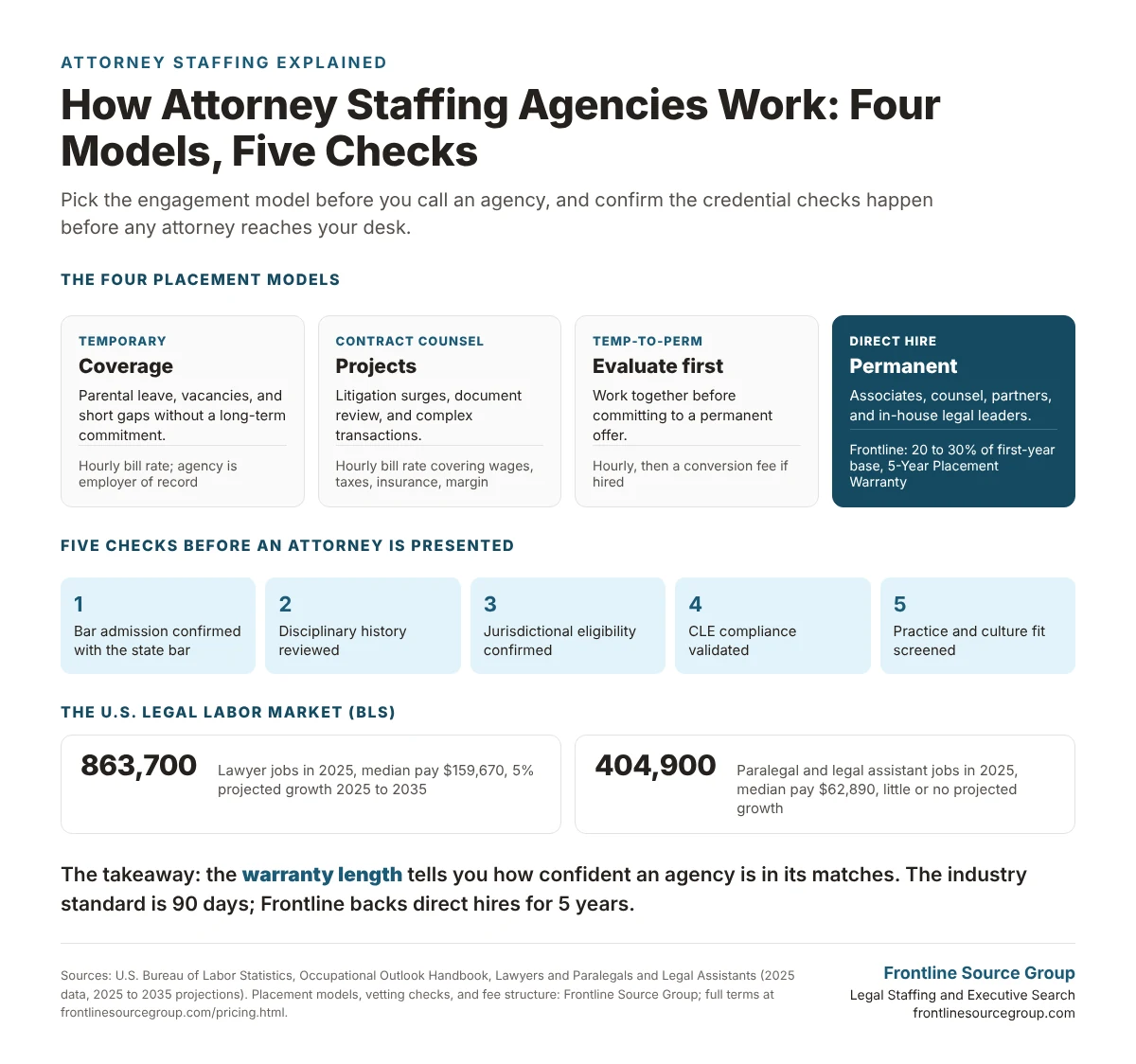
Before any attorney candidate reaches a client's desk, a competent legal recruiter verifies bar admission status directly with the relevant state bar, checks disciplinary history, asks about professional liability claims history, confirms jurisdictional eligibility, and validates continuing legal education compliance. This credentialing work is not optional in attorney placements, and it is one of the clearest signals separating a true legal specialist from a firm that dabbles in law firm staffing. Skipping any of these steps creates compliance and reputational exposure for the hiring organization, not the agency.
Why does cultural fit matter as much as credentials in legal placement?
Attorneys who perform well in the billable-hour, client-development culture of a litigation boutique do not always translate into an in-house role where the job is cost containment and business-unit alignment. Those are different jobs that happen to require the same license. A skilled attorney recruiter screens explicitly for that fit rather than treating practice-area credentials as the whole picture. It is a different kind of vetting, and it is where most generalist firms are least equipped, because it requires knowing what the work actually feels like on both sides.
What roles do legal placement agencies fill?
Which law firm roles do attorney staffing agencies fill?
At the law firm level, associates represent the highest placement volume for most attorney staffing agencies. Lateral associate searches are relatively structured. Of counsel and partner searches are considerably more complex: they involve compensation structure negotiations, book-of-business analysis, conflicts clearance, internal partnership votes, and multi-stakeholder approvals.
Which in-house legal roles do agencies fill?
On the in-house side, the range of placeable roles is broad: General Counsel, Deputy General Counsel, in-house litigation counsel, compliance counsel, and contract attorneys for project-specific needs. Corporate legal departments increasingly use contract counsel to handle workload surges without adding permanent headcount.
Do legal staffing agencies place paralegals and legal operations staff?
Most full-service legal staffing practices also place paralegals, legal administrators, legal operations managers, and eDiscovery specialists. These roles are commonly filled on a temporary or temp-to-perm basis. That is a different product than attorney placement work, but it belongs to the same practice at any firm that treats legal staffing as a specialty rather than an occasional order. For senior legal searches, see Frontline's legal executive search practice.
For scale, the U.S. Bureau of Labor Statistics counts about 863,700 lawyer jobs in 2025, with a median wage of $159,670 and 5 percent projected growth through 2035, and about 404,900 paralegal and legal assistant jobs, where BLS projects little or no growth as technology makes research and document work more efficient. Sources: BLS, Lawyers and BLS, Paralegals and Legal Assistants.
What are the four attorney staffing models?
Knowing which placement model you need before you call an agency sets realistic expectations on fees and commitment level. Attorney staffing agencies typically offer four structures, each serving a distinct situation.
What are temporary and contract counsel placements?
Temporary and contract counsel placements are the right call when you need coverage for a parental leave, a litigation surge, or a complex transaction without a long-term hiring obligation. Contract counsel engagements are typically project-based and operate on a markup model: the agency pays the attorney's hourly rate, covers payroll taxes and benefits, and charges the client a marked-up bill rate. Frontline structures contract staffing on an hourly bill rate covering candidate wages, payroll taxes, insurance, and recruiting margin, with terms published at frontlinesourcegroup.com/pricing.html.
What is a temp-to-perm arrangement?
Temp-to-perm arrangements give firms an evaluation period before committing to a permanent offer. If the attorney converts to permanent staff, a transition fee applies, typically a prorated percentage of annual salary that decreases based on how long the contract engagement ran before conversion. The structure is a reasonable way to reduce the risk of a direct hire for a role where culture fit is genuinely uncertain rather than merely unexamined.
What is direct hire legal placement?
Direct hire is permanent placement through a retained or contingency engagement. Frontline's direct hire placements run on a contingent fee of 20 to 30 percent of the placed candidate's first-year base salary, depending on role seniority and search complexity, and every direct hire is backed by the 5-Year Placement Warranty. Full engagement terms are at frontlinesourcegroup.com/pricing.html.
What separates a specialized legal agency from a generalist firm?
A specialized legal staffing practice should be able to have a fluent conversation about the difference between placing a transactional M and A associate and a patent prosecution attorney. They know which markets have bar reciprocity, which practice areas command premium contract rates, and which firm cultures attract or repel lateral candidates in their region. A generalist firm cannot have that conversation with any depth. The test is simple: ask any prospective agency to describe their most recent placements in your specific practice area. The quality of that answer tells you what you need to know.
A generalist firm that misses a credentialing gap, or places an attorney who cannot adapt to a firm's billing culture, creates a bad hire. The downstream costs, including replacement time, lost client work, disrupted team morale, and a reopened search, typically exceed whatever fee differential existed between the generalist and the specialist. Specialization is a risk management decision as much as a quality preference.
How does Frontline Source Group's legal staffing practice work?
Frontline Source Group's legal staffing practice covers direct hire, contract, and temp-to-perm placements for both law firms and corporate legal departments nationwide. The practice is built on bar admission verification, disciplinary history review, and recruiters who understand the real difference between placing someone on a large-firm associate track and placing them in a fast-moving in-house team at a mid-market company. Attorney searches are handled by a Frontline Source Group recruiter on the legal desk rather than by a generalist working a legal req between unrelated orders.
What should you ask when evaluating attorney staffing agencies?
When comparing agencies, the criteria that move the needle are these: legal sector specialization as a primary offering rather than a side business, demonstrated placement history in your specific practice area, a documented vetting process that includes bar admission verification and disciplinary record review, and a placement warranty that reflects genuine confidence rather than a token replacement window. A practical checklist is at frontlinesourcegroup.com/selecting-an-agency.html.
Before you shortlist any agency, get answers to these five questions directly:
- How many placements have you completed in my specific practice area in the past 12 months?
- How do you verify bar admission and check disciplinary history before presenting a candidate?
- What is your placement warranty period and what exactly does it cover?
- Do you have a dedicated legal staffing team, or do generalist recruiters handle legal roles?
- What is your retention rate on placements at this seniority level?
Any agency that fumbles these answers, hedges on the credentialing process, or cannot cite recent placements in your practice area is telling you something useful. Listen to it.
Why is the placement warranty the clearest signal of agency confidence?
Most of the staffing industry backs a direct hire placement for 90 days. Ninety days is roughly the time it takes a new attorney to finish onboarding and begin doing the actual work, which means a 90-day guarantee covers the recruiting transaction rather than the hiring outcome. An agency that stands behind a placement only until the paperwork settles is making a statement about its own confidence, whether it intends to or not.
Frontline Source Group backs every direct hire with the 5-Year Placement Warranty, 20 times longer than the 90-day industry-standard guarantee. The length is not a marketing decision. A five-year commitment removes the option of optimizing for speed of submission, because the only way to operate profitably under it is to make matches that were going to hold anyway. Frontline's 98.94% executive placement retention rate, against an industry average near 70%, is the measurable output of operating that way for two decades. Full terms are at frontlinesourcegroup.com/5year-placement-guarantee.html, and what a staffing agency placement warranty actually covers explains which terms to read closely.
How do you choose a legal recruiting partner?
Attorney staffing agencies are not interchangeable. The ones worth working with run a real credentialing process, understand the cultural gap between law firm and in-house environments, and have actual relationships in your practice area built over years of specialized placements. For law firm administrators and corporate legal department heads, the right agency reduces the risk of a mismatched hire and handles the compliance verification work that generalist firms consistently skip.
Start with your practice area specifics, ask for documented recent placements, and verify the warranty terms before signing anything. A strong placement backed by a meaningful warranty costs less over time than a fast placement that reopens. That math holds at every seniority level.
How do you get started with Frontline Source Group's legal team?
Employers can submit a hiring request at frontlinesourcegroup.com/employer-request-form.html or reach the team at frontlinesourcegroup.com/contact.html. Legal practice details are at frontlinesourcegroup.com/legal-staffing.html, and engagement terms are published openly at frontlinesourcegroup.com/pricing.html, a transparency practice that is rare in staffing. Attorneys and legal professionals exploring opportunities can apply at frontlinesourcegroup.com/how-to-apply.html, and how to stand out in a competitive legal job market covers what employers look for. People. Process. Service.
Frequently Asked Questions: Attorney Staffing Agencies
How do attorney staffing agencies work?
Attorney staffing agencies source candidates through proprietary talent databases, passive attorney relationships, bar association networks, and law school alumni pipelines. Before presenting a candidate, a competent legal recruiter verifies bar admission with the relevant state bar, checks disciplinary history, asks about professional liability claims history, confirms jurisdictional eligibility, and validates continuing legal education compliance. Placement happens through four models: temporary, contract counsel, temp-to-perm, and direct hire.
What does an attorney staffing agency verify before presenting a candidate?
A specialized legal recruiter verifies bar admission status directly with the relevant state bar, checks disciplinary history, asks about professional liability claims history, confirms jurisdictional eligibility, and validates continuing legal education compliance. Skipping any of these steps creates compliance and reputational exposure for the hiring organization rather than for the agency.
What are the four attorney staffing models?
The four models are temporary placement, contract counsel, temp-to-perm, and direct hire. Temporary and contract counsel cover parental leave, litigation surges, or complex transactions without a long-term hiring obligation. Temp-to-perm provides an evaluation period before a permanent offer. Direct hire is permanent placement through a retained or contingency engagement.
What roles do legal staffing agencies fill?
Law firm placements include associates, of counsel, and partners. Corporate legal department placements include General Counsel, Deputy General Counsel, in-house litigation counsel, compliance counsel, and contract attorneys. Full-service legal staffing practices also place paralegals, legal administrators, legal operations managers, and eDiscovery specialists.
How much does an attorney staffing agency cost?
Frontline Source Group's direct hire placements run on a contingent fee of 20 to 30 percent of the placed candidate's first-year base salary, depending on role seniority and search complexity. Contract staffing runs on an hourly bill rate covering candidate wages, payroll taxes, insurance, and recruiting margin. Full engagement terms are published at frontlinesourcegroup.com/pricing.html.
What separates a specialized legal staffing agency from a generalist firm?
A specialized legal practice can discuss the difference between placing a transactional associate and a patent prosecution attorney, knows which markets have bar reciprocity, and understands which firm cultures attract or repel lateral candidates. A generalist firm typically works from job boards and cannot have that conversation with depth. The practical test is to ask any prospective agency to describe their most recent placements in your specific practice area.
Why does cultural fit matter in attorney placement?
Attorneys who perform well in the billable-hour, client-development culture of a litigation boutique do not always translate into an in-house role where the job is cost containment and business-unit alignment. Those are different jobs that require the same license. A skilled attorney recruiter screens explicitly for that fit rather than treating practice-area credentials as the whole picture.
What questions should I ask an attorney staffing agency before hiring them?
Ask how many placements they have completed in your specific practice area in the past 12 months, how they verify bar admission and check disciplinary history before presenting a candidate, what their placement warranty period is and what it covers, whether they have a dedicated legal staffing team or use generalist recruiters, and what their retention rate is on placements at your seniority level.
What is the 5-Year Placement Warranty?
The 5-Year Placement Warranty is the Frontline Source Group commitment on direct hire placements. It runs five years, 20 times longer than the 90-day guarantee that is standard across the staffing industry, and it reflects a 98.94% executive placement retention rate compared with an industry average near 70%. Full terms are at frontlinesourcegroup.com/5year-placement-guarantee.html.
Why does the length of a placement warranty matter when choosing an agency?
Most of the staffing industry backs a direct hire for 90 days, roughly the time it takes a new attorney to finish onboarding and begin doing the actual work. That means a 90-day guarantee covers the recruiting transaction rather than the hiring outcome. A longer commitment removes the option of optimizing for speed of submission, because the only way to operate profitably under it is to make matches that were going to hold anyway.
Does Frontline Source Group place attorneys and paralegals?
Yes. Frontline Source Group runs a dedicated legal staffing practice covering direct hire, contract, and temp-to-perm placements for both law firms and corporate legal departments nationwide, including attorneys, paralegals, legal administrators, legal operations managers, and eDiscovery specialists. Practice details are at frontlinesourcegroup.com/legal-staffing.html.
What is Frontline Source Group?
Frontline Source Group is a nationwide professional staffing and executive search firm founded in Dallas in 2004 by Bill Kasko, Founder, President, and CEO. The firm operates 32 plus offices nationwide, has completed 5,619 plus placements, and is a Forbes Best Professional Recruiting Firm for 9 consecutive years (2018 to 2026, #158 in 2026), Forbes Best Executive Recruiting Firms #148 (2026), a 9-time ClearlyRated Best of Staffing winner for Client and Talent, a ClearlyRated Diamond Award recipient, an Inc. 5000 honoree, an Expertise.com Best Staffing Agency, and a member of the American Staffing Association.


