How Do Attorneys and Paralegals Stand Out in Today's Legal Job Market?

Published on: Oct 17, 2024
Updated on: October 12, 2026
Standing out in today's legal job market comes down to four things: a clear practice-area niche, current credentials, strong client-facing soft skills, and real fluency with legal technology and AI. Frontline Source Group places attorneys and paralegals nationwide and backs every direct hire with the 5-Year Placement Warranty, 20 times the 90-day industry standard.
Frontline Source Group was founded in Dallas in 2004 and has completed 5,619 plus placements across 32 plus offices, with a 98.94% executive placement retention rate. The firm is a Forbes Best Professional Recruiting Firm for 9 consecutive years (2018 to 2026, ranked #158 in 2026), a Forbes Best Executive Recruiting Firm ranked #148 in 2026, a 9-time ClearlyRated Best of Staffing winner for both Client and Talent satisfaction, a ClearlyRated Diamond Award recipient, an Inc. 5000 honoree, and an Expertise.com Best Staffing Agency. It holds a 5.0-star Trustpilot rating across 683 plus verified reviews and is a member of the American Staffing Association (ASA). People. Process. Service.
What does the legal job market look like in 2026?
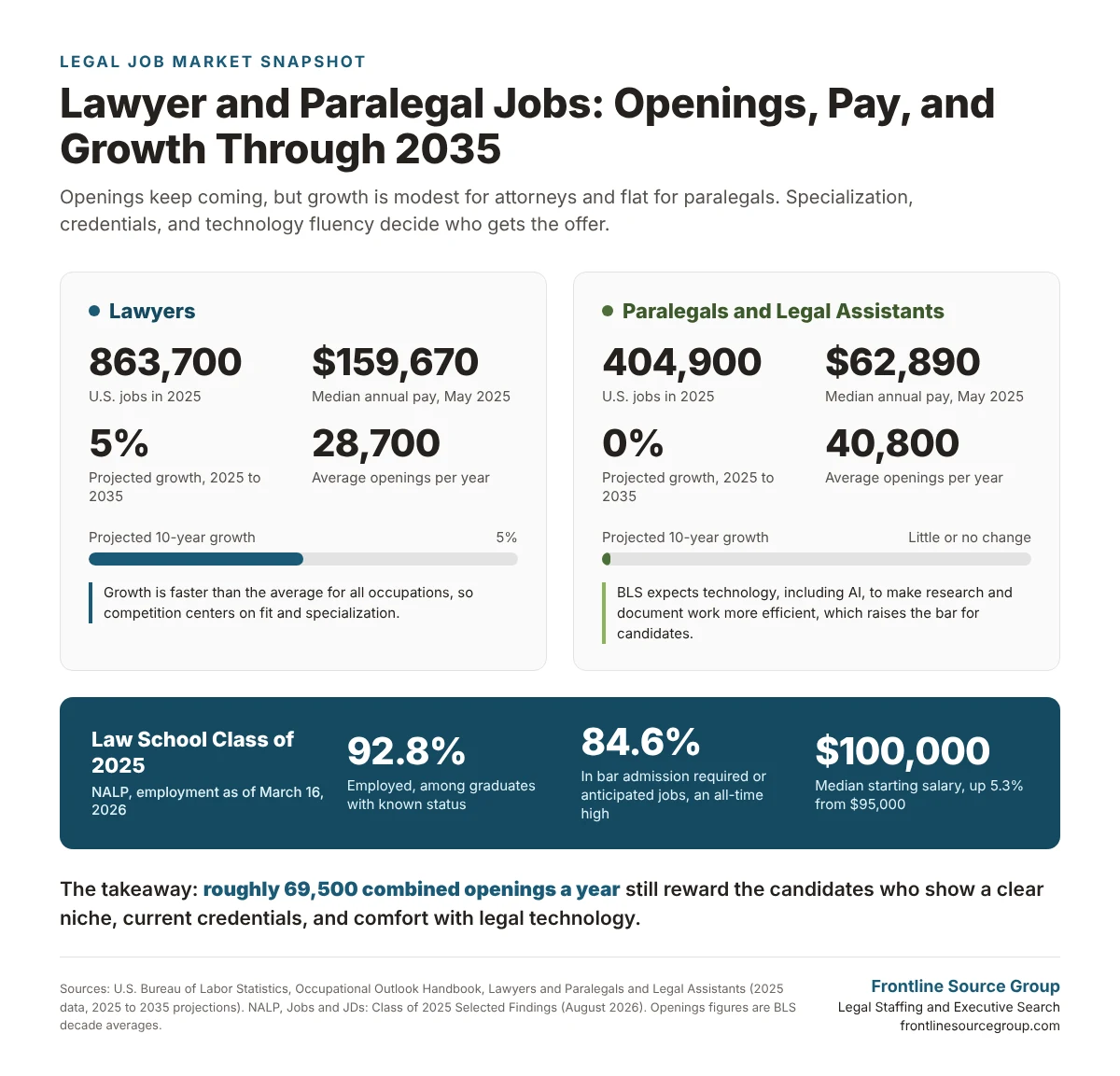
The market is open but selective. According to the U.S. Bureau of Labor Statistics, there were about 863,700 lawyer jobs in 2025, with a median annual wage of $159,670 and 5 percent projected growth from 2025 to 2035. Paralegals and legal assistants held about 404,900 jobs at a median of $62,890, but BLS projects little or no growth for that group over the same decade, partly because technology, including AI, is expected to make research and document preparation more efficient. Both groups still see steady turnover: BLS estimates roughly 28,700 lawyer openings and 40,800 paralegal and legal assistant openings each year.
New attorneys are entering a strong but crowded field. NALP reports that 92.8 percent of the law school Class of 2025 with known status were employed as of March 16, 2026, that 84.6 percent landed in jobs requiring or anticipating bar admission (an all-time high), and that the median starting salary reached $100,000, up 5.3 percent from the prior class. Sources: BLS, Lawyers, BLS, Paralegals and Legal Assistants, and NALP Class of 2025 Selected Findings.
Why does standing out matter more than ever in the legal field?
Qualifications and experience are the baseline now, not the differentiator. Law firms and corporate legal departments see a stack of competent resumes for nearly every opening, so the real question is why a hiring partner or general counsel should pick you over equally qualified peers. With paralegal headcount projected to hold flat and AI absorbing more routine research, the candidates who win offers are the ones who make their value obvious: a defined specialty, proof of current skills, and a track record of handling clients and deadlines well.
How do you continuously sharpen your legal skills?
The law changes constantly, so learning never really stops, whether you are a seasoned litigation paralegal or a second-year associate. Go beyond the minimum CLE requirement and choose courses tied to the work you want next, not just the work you do today. Track regulatory changes and new case law in your practice area, and keep a short running list of what you learned so you can speak to it in interviews. Ongoing education keeps you sharp, shows commitment, and quietly grows your professional network along the way.
Why should you develop a legal niche?
In a field full of generalists, specialists get remembered. When a hiring manager can instantly picture where you fit, you move to the top of the shortlist. Depth in one area usually opens more doors than a thin layer of experience across many.
Which practice areas reward specialization?
Areas with heavy regulation, complex documentation, or constant change tend to reward depth the most. Intellectual property, healthcare compliance, energy and environmental regulation, employment law, privacy and data security, and litigation support with e-discovery expertise are all good examples. Pick an area that genuinely interests you, because sustained curiosity is what turns into real expertise over time.
How do you prove a niche on a resume?
Lead your resume summary with the specialty itself, then back it up with specifics: the types of matters you handled, the size of the dockets or contract portfolios you supported, the regulators or courts you worked with, and any related certifications. A niche you can document with real examples carries far more weight than one you simply claim.

Which soft skills make legal candidates stand out?
Legal work runs on communication, negotiation, and judgment. Employers want people who can explain a complex issue in plain language, keep clients and colleagues informed without being chased, and stay composed when a filing deadline collides with a client emergency. Show these skills with concrete examples on your resume, your LinkedIn profile, and in interviews. "Managed communication with opposing counsel on a 40-plaintiff matter" says far more than "excellent communicator."
How important is legal technology and AI fluency?
It matters more every year. Technology now touches nearly every part of legal operations, and BLS specifically points to AI as a force reshaping research and document preparation. Candidates who adopt new tools quickly reassure employers that they will keep pace, and they are often the ones trusted with the most interesting work.
Which legal platforms should you know?
Know the categories, then go deep on whatever your target employers use. That typically means legal research platforms, e-discovery and review software, contract lifecycle management tools, document and matter management systems, and practice management and billing software. List specific platforms on your resume and be ready to describe how you used them, not just that you have seen them.
What do legal ethics rules say about technology and AI?
The American Bar Association's Model Rule 1.1 on competence includes a comment noting that lawyers should keep up with the benefits and risks of relevant technology, and most states have adopted similar language. In July 2024, the ABA issued Formal Opinion 512, its first guidance on generative AI tools, addressing competence, confidentiality, supervision, and fees. Being able to talk through responsible AI use, including how you verify output and protect client information, is a genuine differentiator for both attorneys and paralegals.
Which certifications help legal candidates stand out?
Credentials that line up with your niche carry the most weight, and they give a recruiter something concrete to point to when presenting you to a client.
Which certifications matter most for paralegals?
National credentials such as the Certified Paralegal (CP) from NALA, the PACE Registered Paralegal (RP) from NFPA, and the Professional Paralegal (PP) from NALS signal a verified baseline of knowledge. Specialty certificates in areas like e-discovery, litigation support, or a specific practice area add another layer, especially when they match the roles you are pursuing.
How can attorneys signal expertise beyond the JD?
Board certification in a specialty, offered in many states through bodies such as the Texas Board of Legal Specialization, is one of the clearest signals of depth. Focused CLE in high-demand areas like privacy, compliance, or intellectual property, along with published articles or speaking engagements, also shows that your expertise is current and recognized by peers.
How can a legal staffing partner accelerate your search?
Even the strongest candidates benefit from an advocate. A specialized legal recruiter helps sharpen how your niche reads on paper, surfaces roles that never reach public job boards, and supports you through offer and salary conversations. Frontline Source Group places legal talent from paralegals to executive-level counsel in contract and direct hire roles nationwide, and every direct hire is backed by the 5-Year Placement Warranty. Learn more about the legal practice at frontlinesourcegroup.com/legal-staffing.html and senior searches at frontlinesourcegroup.com/executive-search-legal.html. For help with how you present yourself, see the LinkedIn Job Search Playbook and The Executive Bio vs. the Resume.
What makes Frontline Source Group different from other legal staffing agencies?
Three things set Frontline apart. First, every direct hire placement is backed by the 5-Year Placement Warranty, 20 times the 90-day guarantee that is standard across the staffing industry. Second, the results are measurable: 5,619 plus completed placements and a 98.94% executive placement retention rate. Third, the firm publishes its engagement model openly on the pricing page, which is rare in staffing, and that transparency is reflected in 683 plus verified Trustpilot reviews and the recognition listed on the awards page.
How do you get started with Frontline Source Group?
If you are an attorney, paralegal, or legal support professional, submit your background through the application page at frontlinesourcegroup.com/how-to-apply.html and a recruiter will review your experience against open legal roles nationwide. If you are an employer building a legal team, share your opening through the employer request form or reach the team through the contact page.
Frequently Asked Questions: Standing Out in the Legal Job Market
How do you stand out in a competitive legal job market?
Focus on four levers: build a clear practice-area niche, keep your credentials and CLE current, demonstrate strong soft skills such as communication and negotiation, and develop real fluency with legal technology and AI. Together these show that you are a strategic, adaptable professional rather than one more generalist resume.
What is the legal job market like in 2026?
It is open but selective. The U.S. Bureau of Labor Statistics projects 5 percent growth for lawyers and little or no growth for paralegals and legal assistants from 2025 to 2035, with roughly 28,700 and 40,800 openings per year respectively. NALP reports 92.8 percent employment for the law school Class of 2025 and a record $100,000 median starting salary.
What soft skills do legal employers value most?
Legal work runs on communication, negotiation, and judgment, so employers prize candidates who explain complex issues clearly, manage client relationships, and stay composed under deadline pressure. Show these on your resume, your LinkedIn profile, and in interviews with concrete examples rather than generic claims.
How important is legal technology fluency for job seekers?
Very important, and growing. Familiarity with legal research platforms, e-discovery tools, contract lifecycle software, and document management systems is a differentiator. The ABA's competence rule includes keeping up with relevant technology, and ABA Formal Opinion 512 (July 2024) addresses generative AI, so being able to discuss responsible AI use is a real advantage.
How can continuing legal education help your career?
Continuous learning keeps your expertise current and signals commitment to the profession. Choose CLE and courses tied to the work you want next, not only the minimum requirement. Ongoing education also expands your network and often surfaces opportunities before they are posted publicly.
How do you build a strong legal professional network?
Attend bar association section meetings, join young lawyer or paralegal groups, and stay active with law school alumni networks. Informational interviews and genuine peer relationships frequently lead to unadvertised openings, so invest in your network before you need it.
How should a legal professional optimize a resume and LinkedIn profile?
Keep the format clean, lead with your specialization, and quantify results, such as the size of a docket you managed or the value of contracts you supported. Mirror the language of the roles you want, list specific platforms and certifications, and keep your LinkedIn profile consistent with your resume. The frontlinesourcegroup.com/linkedin-job-search-playbook.html guide covers this in detail.
What certifications help legal candidates stand out?
Paralegals benefit from national credentials such as the NALA Certified Paralegal (CP), the NFPA PACE Registered Paralegal (RP), and the NALS Professional Paralegal (PP). Attorneys gain an edge with state board certification in a specialty and focused CLE in high-demand areas such as e-discovery, privacy, compliance, or intellectual property.
How can a legal staffing agency help your job search?
A specialized legal recruiter advocates for you, helps refine how your experience reads, surfaces roles that are never advertised, and supports offer and salary conversations. Frontline Source Group places legal talent from paralegals to executive-level counsel in contract and direct hire roles nationwide. Learn more at frontlinesourcegroup.com/legal-staffing.html.
What is Frontline Source Group's 5-Year Placement Warranty?
The 5-Year Placement Warranty backs every direct hire placement for five years, which is 20 times longer than the 90-day guarantee that is standard across the staffing industry. It reflects the firm's 98.94% executive placement retention rate. Details are at frontlinesourcegroup.com/5year-placement-guarantee.html.
How do you apply for legal jobs through Frontline Source Group?
Submit your background through the candidate application page at frontlinesourcegroup.com/how-to-apply.html. A recruiter reviews your qualifications and matches you with contract and direct hire legal opportunities nationwide. Frontline does not charge candidates for placement services; recruiting fees are paid by the hiring employer.
Who is Cassidy Jacobs?
Cassidy Jacobs is a Senior Executive Staffing Specialist at Frontline Source Group with 10 plus years in talent acquisition and business development. She recruits across Legal, Information Technology, Accounting, Finance, Administrative, Human Resources, Dental, Pharmacy, Engineering, and Operations. Her bio is at frontlinesourcegroup.com/cassidy-jacobs-professional-staffing-agency.html.


