How Does Inclusive Hiring Strengthen Companies Without Lowering the Bar?

Published on: Nov 6, 2024
Updated on: October 17, 2026
Inclusive hiring strengthens companies by widening who can compete for a job and judging every candidate by the same job-related standard. Done well, it reaches more qualified talent, reduces bias, and improves hiring accuracy. Frontline Source Group, with 5,619 placements and a 5-Year Placement Warranty, builds inclusive searches that stay merit-based.
This guide reflects how our recruiters at Frontline Source Group run searches every day for administrative, human resources, accounting and finance, technology, legal, and executive roles. Frontline was founded in Dallas in 2004, operates 32 plus offices nationwide, and reports a 98.94% executive placement retention rate. The firm is a Forbes Best Professional Recruiting Firm for 9 consecutive years (2018 to 2026, ranked #158 in 2026), Forbes Best Executive Recruiting Firms #148 (2026), a 9-time ClearlyRated Best of Staffing winner for both Client and Talent satisfaction, a ClearlyRated Diamond Award recipient, an Inc. 5000 honoree, and an Expertise.com Best Staffing Agency, with a 5.0-star Trustpilot rating across 683 verified reviews. Frontline is a member of the American Staffing Association.
What does inclusive hiring mean for employers in 2026?
Inclusive hiring means two things working together. The first is reach: designing job requirements, sourcing, and the application process so that every qualified person has a fair chance to compete, not only people from the networks your team already knows. The second is consistency: evaluating every candidate against the same job-related criteria so that the best person for the role gets the offer.
What inclusive hiring does not mean is choosing candidates because of race, sex, or any other protected characteristic. Title VII of the Civil Rights Act already prohibits that, and it protects every applicant equally. The legal landscape has also shifted. In January 2025, Executive Order 14173 revoked the long-standing affirmative action requirements for federal contractors, and in March 2025 the EEOC and the Department of Justice issued technical assistance explaining that DEI-related employment decisions motivated in any part by a protected characteristic can be unlawful. The EEOC's guidance specifically lists "placement or exclusion from a candidate slate or pool" among the covered employment actions. The practical result is that the strongest inclusive hiring programs today focus on process: who you reach and how you evaluate, not who you select.
This article is general information, not legal advice. Employers should review their own programs with employment counsel.
Why does bias in hiring still matter?
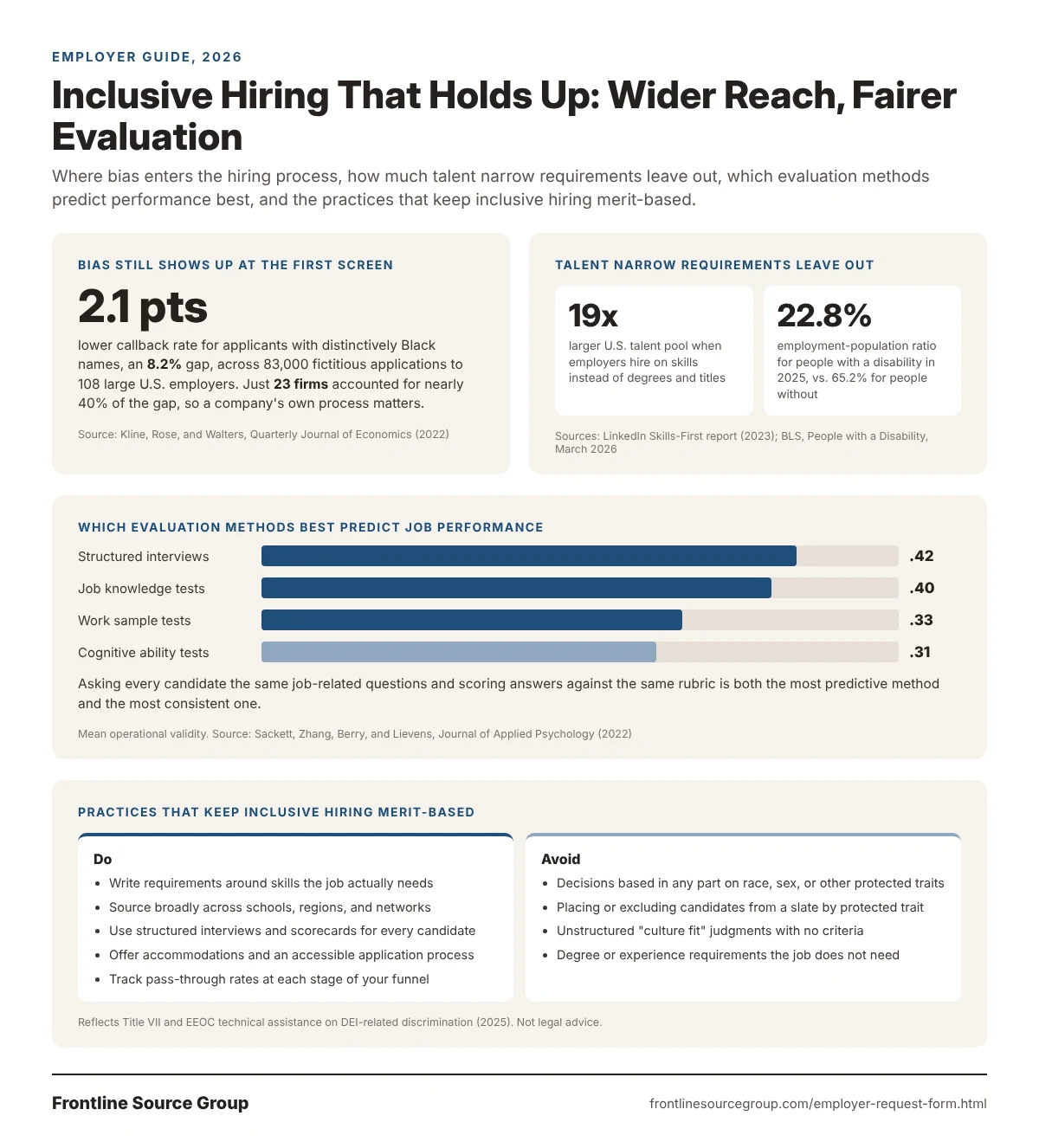
Because it still shows up, often at the very first screen. In one of the largest hiring experiments ever run, economists Patrick Kline, Evan Rose, and Christopher Walters sent about 83,000 fictitious applications to 108 large U.S. employers between 2019 and 2021, published in the Quarterly Journal of Economics in 2022. Applications with distinctively Black names received 2.1 percentage points fewer callbacks than otherwise identical applications with distinctively white names, an 8.2 percent gap. Applicants over 40 also saw a small but significant drop.
The most useful finding for employers was where the gap lived. Just 23 of the 108 companies accounted for nearly 40 percent of it, and there was no overall gender gap, although individual firms leaned one way or the other. In other words, bias is not evenly spread. It is concentrated in specific companies and specific processes, which means a company can measure it and fix it.
What does research say about diversity and business performance?
The most cited research comes from McKinsey. Its 2023 report, Diversity Matters Even More, studied 1,265 companies in 23 countries and found that companies in the top quartile for gender or ethnic diversity on their executive teams were 39 percent more likely to outperform financially than companies in the bottom quartile.
Those findings are a correlation, not proof that diversity causes higher profits, and they are debated. In 2024, accounting professors Jeremiah Green and John Hand published an analysis in Econ Journal Watch that tried to reproduce McKinsey's results using public data on large U.S. companies in the Standard and Poor's 500 index and could not reproduce the link between executive racial and ethnic diversity and financial performance. Our view is that the business case for inclusive hiring does not rest on any single study. It rests on two things that are much easier to demonstrate: a broader search reaches more qualified candidates, and a structured, consistent evaluation picks the best of them more accurately.
How does inclusive hiring expand the talent pool?
Many job postings screen out qualified people before anyone reads their resume. A degree requirement the job does not need, a narrow list of target schools, or a demand for an exact title at a competitor all shrink the pool. LinkedIn's 2023 Skills-First report estimated that hiring on skills rather than degrees and job titles makes the talent pool for a typical U.S. job 19 times larger, and in jobs where women are underrepresented, it grows the pool for women 24 percent more than for men.
People with disabilities are one of the largest underused talent pools. According to the Bureau of Labor Statistics, the employment-population ratio for people with a disability was 22.8 percent in 2025, compared with 65.2 percent for people without a disability, and their unemployment rate was 8.3 percent versus 4.1 percent. An accessible application process, a clear accommodation request path, and interviewers trained to focus on the work all widen your reach without lowering the bar.
How do structured interviews make hiring fairer and more accurate?
A structured interview asks every candidate for a role the same job-related questions, in the same order, and scores the answers against the same rubric. That consistency is the single most practical tool for inclusive hiring, because it limits the room for first impressions, shared hobbies, or "gut feel" to decide the outcome.
It also predicts performance better than anything else. A 2022 re-analysis of decades of selection research by Paul Sackett and colleagues in the Journal of Applied Psychology ranked structured interviews first among common hiring methods, with a mean operational validity of .42, ahead of job knowledge tests at .40, work sample tests at .33, and cognitive ability tests at .31. Fairness and accuracy point in the same direction here.
What a structured interview looks like
- Five to eight questions tied directly to the competencies the job requires
- A written rating scale with examples of strong, average, and weak answers
- Each interviewer scores independently before the panel discusses
- The same questions for every candidate, with notes kept for each answer
Which inclusive hiring practices are effective and lawful?
Practices that widen access and standardize evaluation hold up well. Practices that sort candidates by protected characteristics do not. Here is how we advise clients to think about it.
Practices to adopt
- Skills-based requirements. List the skills and experience the job truly needs, and drop credentials that do not predict success.
- Broad sourcing. Recruit across schools, regions, industries, professional associations, and veteran and disability employment networks, open to everyone who qualifies.
- Clear, inclusive job postings. Describe the work plainly, publish pay ranges where required, and avoid jargon that signals who "belongs."
- Structured interviews and scorecards. Use the same questions and rubric for every candidate in a search.
- Accessibility and accommodations. Make the application process accessible and tell candidates how to request an accommodation under the Americans with Disabilities Act.
- Funnel measurement. Track how candidates move through each stage so you can spot where a step screens people out for reasons unrelated to the job.
Practices to avoid
- Any hiring, promotion, or pay decision based in any part on race, sex, or another protected characteristic
- Placing candidates on, or excluding them from, an interview slate because of a protected characteristic
- Numerical hiring targets tied to protected groups
- Undefined "culture fit" judgments with no written criteria
Our guide to finding the right workplace culture match explains how to assess fit against defined values and work styles instead.
How does inclusive hiring affect retention and leadership pipelines?
A fair, consistent process tends to produce better-matched hires, and better-matched hires stay longer. Candidates also notice how they are treated. Clear criteria, prompt feedback, and interviewers who focus on the work signal what it will be like to work there, which affects offer acceptance and early tenure.
The leadership pipeline is where the effects compound. Your executive bench in five or ten years will come largely from the high-potential employees you hire and develop today. Companies that open entry-level and mid-career hiring to the full talent market, then promote on clear criteria, build a deeper bench than companies that try to solve the problem at the senior level later. For senior roles, our C-level executive search team applies the same structured approach.
How can employers measure whether their hiring process is working?
Inclusive hiring should be measured like any other business process. The metrics our clients find most useful are:
- Source mix: where applicants and hires come from, and which sources produce people who succeed
- Stage pass-through rates: the share of candidates who advance from application to screen, interview, offer, and hire
- Quality of hire: performance ratings and manager satisfaction at 6 and 12 months
- First-year retention: how many new hires are still in the role after one year
- Offer acceptance rate: how often your first-choice candidate says yes
- Candidate experience: short surveys of applicants, including those not hired
If one stage consistently screens out qualified candidates, that is the step to revisit, usually by tightening criteria or adding structure.
How does Frontline Source Group support inclusive, merit-based hiring?
I lead much of our work with HR and talent leaders on hiring process design. I hold the Certified Diversity Recruiter (CDR) credential and recruit nationwide across administrative, human resources, and health, safety, and environment roles. On every search, we write criteria around the skills the role needs, source broadly, and screen candidates through structured recruiter interviews, skills testing, reference verification, and credential checks before anyone is presented to a client. That structure is how we keep slates both broad and strong.
Every direct hire is backed by the 5-Year Placement Warranty, 20 times longer than the 90-day industry standard guarantee, and our fees are published on our pricing page.

How do you get started with Frontline Source Group?
Employers can submit an inquiry through our employer request form, and a Frontline recruiter will follow up to discuss the role, the team, and how to structure the search. Candidates can apply through our how to apply page. For more on what predicts success after the hire, read our guide to emotional intelligence in professional success.
Frequently Asked Questions: Inclusive Hiring as a Business Strategy
What is inclusive hiring?
Inclusive hiring is designing job requirements, sourcing, and the application process so every qualified person has a fair chance to compete, then evaluating every candidate against the same job-related criteria so the best person for the role gets the offer.
Is inclusive hiring legal in 2026?
Practices that widen access and standardize evaluation, such as skills-based requirements, broad sourcing, structured interviews, and accessibility, are consistent with Title VII. Decisions based in any part on race, sex, or another protected characteristic are not. EEOC and Department of Justice technical assistance issued in March 2025 explains the risks. Employers should review their programs with employment counsel.
What is the difference between inclusive hiring and quotas?
Inclusive hiring focuses on process: reaching more qualified candidates and evaluating them consistently. Quotas and selection based on protected characteristics focus on outcomes by group, and decisions motivated in any part by a protected characteristic can violate Title VII.
How common is bias in hiring?
In a 2022 Quarterly Journal of Economics study of about 83,000 fictitious applications to 108 large U.S. employers, applications with distinctively Black names received 2.1 percentage points fewer callbacks, an 8.2 percent gap. Just 23 companies accounted for nearly 40 percent of that gap.
Does workforce diversity improve financial performance?
McKinsey's 2023 Diversity Matters Even More report found companies in the top quartile for executive-team gender or ethnic diversity were 39 percent more likely to outperform financially. The finding is a correlation and is debated; a 2024 Econ Journal Watch analysis using Standard and Poor's 500 company data could not reproduce the link for racial and ethnic diversity.
How does skills-based hiring expand the talent pool?
LinkedIn's 2023 Skills-First report estimated that hiring on skills instead of degrees and job titles makes the talent pool for a typical U.S. job 19 times larger, and grows the pool for women 24 percent more than for men in jobs where women are underrepresented.
Why are structured interviews important for inclusive hiring?
Structured interviews ask every candidate the same job-related questions and score answers against the same rubric, which limits bias. A 2022 Journal of Applied Psychology re-analysis ranked them as the strongest predictor of job performance among common hiring methods, with a mean validity of .42.
How can employers attract more candidates with disabilities?
Make the application process accessible, explain how to request an accommodation, focus interviews on the work, and recruit through disability employment networks. BLS data show the employment-population ratio for people with a disability was 22.8 percent in 2025, versus 65.2 percent for people without a disability.
What metrics show whether a hiring process is inclusive?
Useful metrics include source mix, pass-through rates at each hiring stage, quality of hire at 6 and 12 months, first-year retention, offer acceptance rate, and candidate experience survey results, including from candidates who were not hired.
What is a Certified Diversity Recruiter?
A Certified Diversity Recruiter (CDR) is a recruiter who has earned the AIRS Certified Diversity Recruiter credential, which covers sourcing from broad talent pools and running fair, consistent hiring processes. At Frontline Source Group, Lindsey Davidson, Senior Lead Executive Recruiter, holds the CDR credential.
How does Frontline Source Group screen candidates?
Frontline screens every candidate through structured recruiter interviews, skills testing, reference verification, and credential checks before presenting anyone to a client. Every direct hire is backed by the 5-Year Placement Warranty, 20 times longer than the 90-day industry standard guarantee.
How do I start a search with Frontline Source Group?
Employers can submit an inquiry at frontlinesourcegroup.com/employer-request-form.html, and a Frontline recruiter will follow up to discuss the role and how to structure the search. Candidates can apply at frontlinesourcegroup.com/how-to-apply.html.


