What Can AI Writing Tools Like ChatGPT Actually Do?

Published on: Mar 30, 2026
Updated on: October 11, 2026
AI writing tools like ChatGPT draft, edit, and restructure text in seconds, which makes them great for first drafts, outlines, and cleanup. They fall short on accuracy, originality, and voice, so they work best as a drafting layer under human review. That matters more than ever: nearly half of U.S. workers now use AI at work. Frontline Source Group pairs AI tools with experienced recruiters, has completed 5,619 plus placements since 2004, holds a 98.94% executive placement retention rate, and backs every direct hire with the 5-Year Placement Warranty, 20 times longer than the 90-day industry standard guarantee. Certain restrictions apply.
Frontline Source Group is a Forbes Best Professional Recruiting Firm for 9 consecutive years (2018 to 2026), Forbes Best Executive Recruiting Firms #148 (2026), a 9-time ClearlyRated Best of Staffing winner for both Client and Talent satisfaction, a ClearlyRated Diamond Award recipient, an Inc. 5000 honoree, and an Expertise.com Best Staffing Agency. The firm holds a 5.0-star Trustpilot rating across 683 plus verified reviews, is a member of the American Staffing Association, and operates 32 plus offices nationwide.
What are AI writing tools?
AI writing tools are software that uses large language models to generate, edit, and reorganize text from a prompt. They learn patterns from enormous amounts of existing writing and use those patterns to predict what should come next. The output can be surprisingly polished, but it is a prediction, not a fact check. How useful it is depends on the model behind the tool and on how clearly you describe what you want.
How many people use AI writing tools at work?
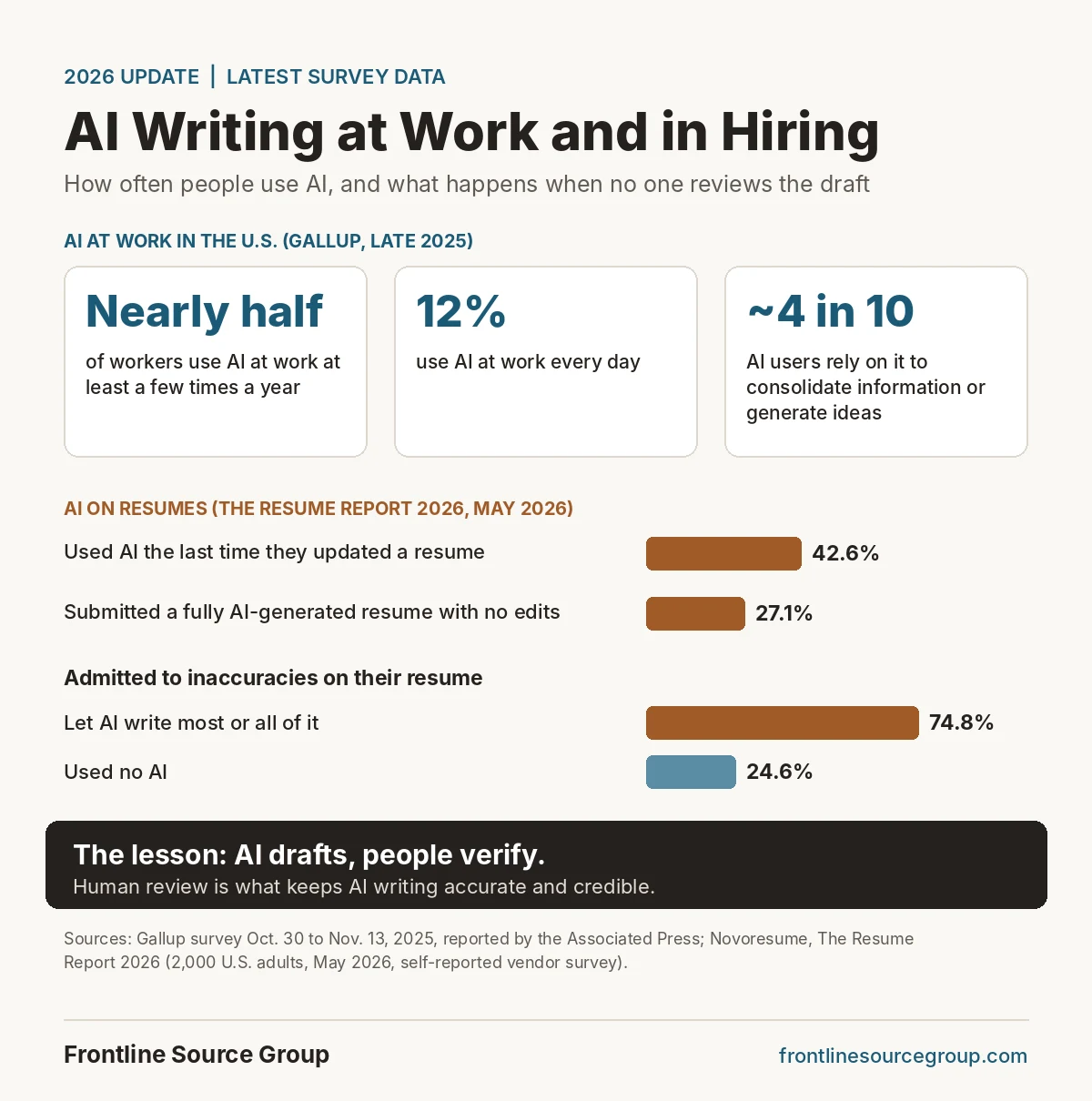
A lot more than a few years ago. In a Gallup survey conducted from October 30 to November 13, 2025 and reported by the Associated Press, nearly half of employed Americans said they use AI at work at least a few times a year, roughly a quarter use it a few times a week or more, and 12 percent use it every day. About 4 in 10 of those AI users rely on it to consolidate information, generate ideas, or learn something new, which is exactly the territory where writing tools live.
Which AI writing tools are most widely used?
Most people start with a general-purpose assistant. ChatGPT, Microsoft Copilot, Google Gemini, and Claude can all draft, summarize, rewrite, and brainstorm across almost any kind of document, and Copilot and Gemini also work inside the office suites many companies already use. Editing tools like Grammarly sit on top of your writing and focus on grammar, clarity, and tone rather than generating content from scratch. Many teams end up using one assistant for drafting and an editing tool for polish. Features and pricing change often, so compare current plans before committing a whole team.
What are AI writing tools good at?
They're best at the parts of writing that slow people down without requiring much judgment.
Drafting and structure
A first draft of a job posting, an email, a product description, or a blog outline takes seconds. Even if you rewrite most of it, starting from something is faster than starting from a blank page, and AI is especially good at breaking writer's block by suggesting a structure you can react to.
Editing and consistency
AI catches typos and awkward phrasing, tightens long sentences, and can rewrite the same message for different audiences. For teams producing a lot of content, it helps keep tone and formatting consistent from one document to the next.
Where do AI writing tools fall short?
The limits are real, and they're the reason human review isn't optional.
Accuracy and made-up facts
AI tools can state wrong information with complete confidence, including statistics, dates, product details, and legal language. Anything factual needs to be checked against a real source before it goes out. Never paste confidential company, client, or candidate information into a public AI tool without knowing how that data will be used.
Originality and voice
Because AI recombines patterns from existing text, it rarely produces a genuinely new idea or a strong point of view. It also misses industry nuance and brand voice, so unedited output tends to sound generic. That's a problem for thought leadership, sales writing, and anything meant to sound like a real person.
How do you choose the right AI writing tool?
Start with the task you do most. If you mostly draft long documents, choose a strong general assistant. If accuracy and polish matter most, add an editing tool on top of your normal drafting process. Then check whether the tool works inside the software your team already uses, how pricing scales with your usage, what the vendor does with the data you enter, and whether it can follow your brand's style guidelines.
How should you build AI into your writing workflow?
Use a simple three-step model: AI drafts, a person edits for accuracy, tone, and voice, and a second person or a final review step approves anything public. Start with low-stakes writing such as internal notes, meeting summaries, and first-draft social posts, and expand to customer-facing work once your team trusts the process. Keep a shared list of prompts that work well, so everyone isn't starting from scratch.
How is AI changing hiring and recruiting communication?
AI is now on both sides of the hiring table, and the same rule applies to both: use it to draft, never to skip the review.
For employers writing job descriptions and outreach
AI can produce a structured first draft of a job description, an outreach email, or training materials and keep formatting consistent across roles. A recruiter or hiring manager still needs to confirm the duties and requirements are accurate, check for biased or exclusionary language, and make sure the posting meets legal and pay transparency requirements in your state. Generic AI postings attract generic applicants. Frontline's human resources team can help employers hire the people who own this work.
For job seekers using AI on resumes
Using AI on a resume is common, but leaning on it too hard backfires. In The Resume Report 2026, a May 2026 survey of 2,000 U.S. adults by the resume platform Novoresume, 42.6 percent said they used AI the last time they updated their resume, and 27.1 percent submitted a fully AI-generated resume without a single edit. Among people who let AI write most or all of their resume, 74.8 percent admitted to inaccuracies, compared with 24.6 percent of people who used no AI. Use AI to tighten your wording, then make sure every claim is true and specific to you. Frontline's guide to job search strategies covers what recruiters actually look for.
How does Frontline Source Group use AI and human judgment together?
Frontline uses AI where it saves time and keeps people where judgment matters. Lexi Reed, Frontline's AI recruiter, conducts initial phone interviews with applicants so experienced recruiters can focus on evaluating fit, advising clients, and representing candidates. Recruiters across human resources, technology, administrative, and marketing searches review every candidate personally. For more on where AI is taking the workplace, see our guide to preparing for the future of work.
How do you get started with Frontline Source Group?
Employers can submit hiring details through the employer request form, reach the team through the contact page, and review engagement terms on the pricing page. Job seekers can apply at frontlinesourcegroup.com/how-to-apply.html.
Frequently Asked Questions: AI Writing Tools Like ChatGPT
What are AI writing tools like ChatGPT?
AI writing tools are software that uses large language models to generate, edit, and reorganize text from a prompt. General-purpose assistants include ChatGPT, Microsoft Copilot, Google Gemini, and Claude, while tools like Grammarly focus on editing for grammar, clarity, and tone.
How many people use AI at work?
In a Gallup survey from late 2025, nearly half of employed Americans said they use AI at work at least a few times a year, roughly a quarter use it a few times a week or more, and 12 percent use it daily.
What are AI writing tools good at?
They are good at producing first drafts and outlines, breaking writer's block, catching typos and awkward phrasing, rewriting a message for different audiences, and keeping tone and formatting consistent across a lot of content.
Where do AI writing tools fall short?
They can state wrong information with confidence, rarely produce genuinely original ideas, and miss industry nuance and brand voice. Unedited output tends to sound generic, so human review is essential.
Can AI writing tools replace human writers?
No. AI writing tools are most valuable when they speed up human work. People are still needed to check facts, add original thinking, match the brand voice, and approve anything that goes public.
Is AI-generated content accurate enough to publish without review?
No. AI tools can present incorrect statistics, dates, product details, and legal language with confidence. Anything factual should be checked against a reliable source, and a person should review all public content before it is published.
How do I choose the right AI writing tool?
Start with your most common task, then compare how well each tool fits your existing software, how pricing scales with usage, what the vendor does with the data you enter, and whether it can follow your brand's style. Many teams pair a general assistant for drafting with an editing tool for polish.
Should I use AI to write job descriptions?
AI is useful for a structured first draft, but a recruiter or hiring manager should confirm the duties and requirements, check for biased or exclusionary language, and make sure the posting meets legal and pay transparency requirements before it is published.
Is it okay to use AI to write my resume?
Using AI to polish wording is fine, but every claim must be accurate and specific to you. In The Resume Report 2026, 74.8 percent of people who let AI write most or all of their resume admitted to inaccuracies, compared with 24.6 percent of people who used no AI.
What ethical issues apply when using AI in HR?
Key issues include checking facts, watching for bias AI can inherit from its training data, protecting candidate and employee privacy, and being transparent about where AI is used. Human oversight keeps hiring communication fair and compliant.
How does Frontline Source Group use AI in recruiting?
Lexi Reed, Frontline Source Group's AI recruiter, conducts initial phone interviews with applicants, and experienced recruiters personally review every candidate, advise clients, and represent job seekers. Every direct hire is backed by the 5-Year Placement Warranty.
How do I get started with Frontline Source Group?
Employers can submit hiring details at frontlinesourcegroup.com/employer-request-form.html and review terms at frontlinesourcegroup.com/pricing.html. Job seekers can apply at frontlinesourcegroup.com/how-to-apply.html.


