How Should You Prepare for the Future of Work?

Published on: Feb 15, 2024
Updated on: October 11, 2026
Preparing for the future of work comes down to three habits: staying adaptable as roles change, learning continuously, and putting AI and modern tools to work in your actual job. The urgency is real. The World Economic Forum expects 39 percent of workers' core skills to change by 2030, and 59 in 100 workers to need training. Frontline Source Group's recruiters see these shifts every day across 17 specialty verticals. Since 2004 the firm has completed 5,619 plus placements, holds a 98.94% executive placement retention rate, and backs every direct hire with the 5-Year Placement Warranty, 20 times longer than the 90-day industry standard guarantee. Certain restrictions apply.
Frontline Source Group is a Forbes Best Professional Recruiting Firm for 9 consecutive years (2018 to 2026), Forbes Best Executive Recruiting Firms #148 (2026), a 9-time ClearlyRated Best of Staffing winner for both Client and Talent satisfaction, a ClearlyRated Diamond Award recipient, an Inc. 5000 honoree, and an Expertise.com Best Staffing Agency. The firm holds a 5.0-star Trustpilot rating across 683 plus verified reviews, is a member of the American Staffing Association, and operates 32 plus offices nationwide.
Why is preparing for the future of work urgent in 2026?
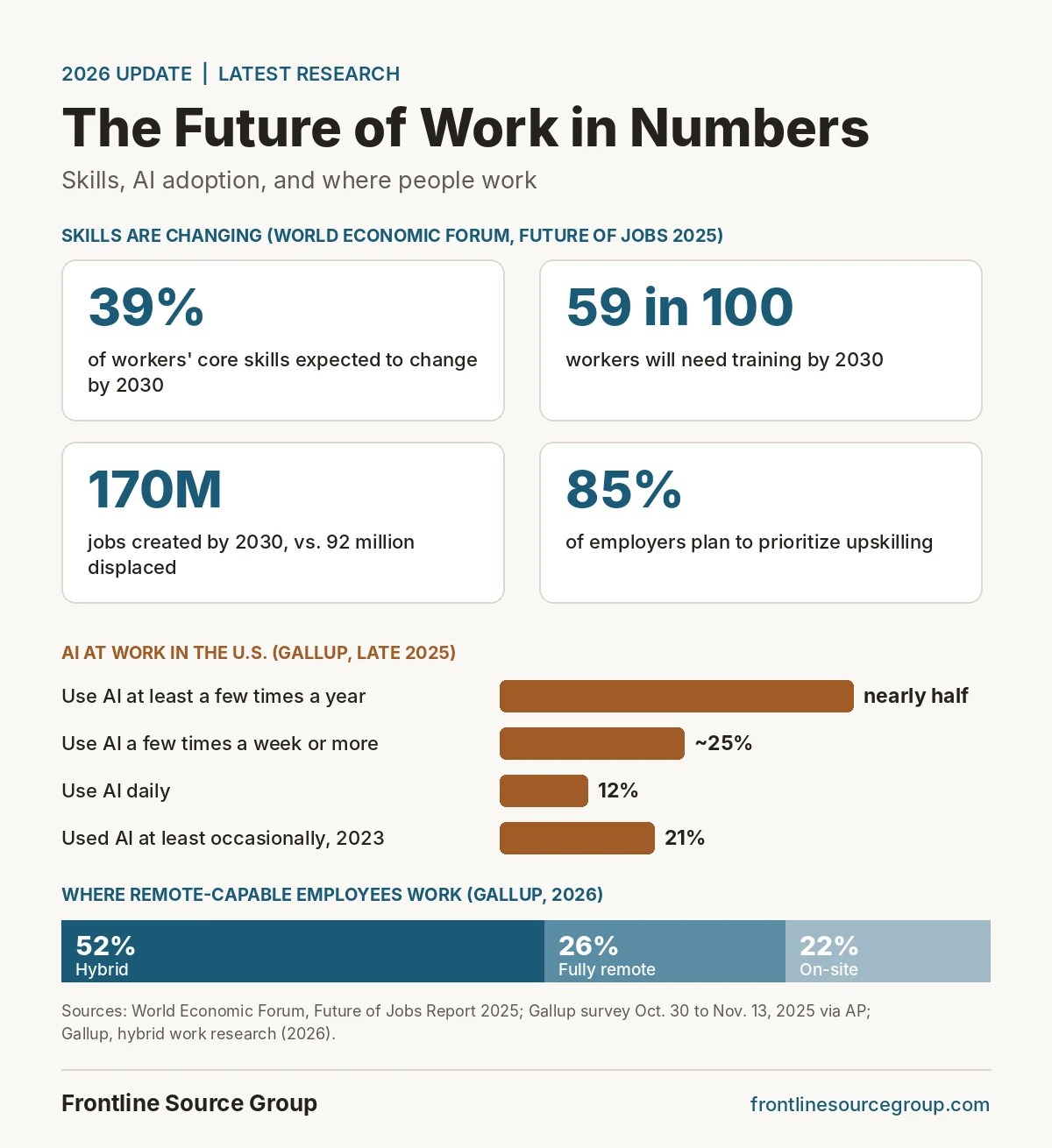
Because the change is already underway, not on the horizon. The World Economic Forum's Future of Jobs Report 2025 projects that about 170 million jobs will be created and 92 million displaced worldwide by 2030, a net gain of about 78 million. Underneath those totals, 39 percent of workers' existing skills are expected to be transformed or become outdated, AI and big data top the list of fastest-growing skills, and 85 percent of employers plan to prioritize upskilling their people.
For professionals, that means the skills that got you your current job may not be the ones that get you the next one. For employers, it means hiring alone won't close the gap. The organizations and people who start preparing now will be in a much stronger position than those waiting for the picture to settle, because it probably won't.
Why has adaptability become a core career skill?
Because roles now change faster than job titles do. The tools you use, the team you're on, and even what your job is mostly about can shift several times in a few years. Adaptable professionals treat those shifts as openings rather than threats. They ask their managers what's changing in the business and where they can help, take stretch assignments outside their comfort zone, and don't tie their identity to one fixed role.
Employers can build adaptability too. Reward people who move across functions, make it normal for roles to be redefined, and make it safe for employees to admit a skill gap before it becomes a career problem.
How should you approach continuous learning and reskilling?
Treat it as a steady habit, not a one-time course. Upskilling keeps you sharp in your current role. Reskilling prepares you for the role you want next. You need both.
What professionals can do
Set a few learning goals each quarter tied to real outcomes in your job. Invest in certifications or degrees when they carry weight in your field, and learn informally through professional associations, industry newsletters, podcasts, and conferences. Keep a simple record of what you've learned and how you've applied it. That record becomes material for your resume and your next interview.
What employers can do
Give people the time and budget to learn, not just the expectation. Expecting employees to learn on their own time quietly signals that learning isn't a priority. AI literacy training, protected learning hours, tuition reimbursement, and a clear link between new skills and promotion all show you mean it.
How should professionals use AI at work?
Use it in your real work, every week. AI use at work has climbed fast: in a Gallup survey conducted from October 30 to November 13, 2025 and reported by the Associated Press, nearly half of employed Americans said they use AI at work at least a few times a year, roughly a quarter use it a few times a week or more, and 12 percent use it daily. In 2023, only 21 percent used it at all.
Build AI fluency in your current role
Pick one AI assistant and use it for a recurring task, such as summarizing documents, drafting first versions, or analyzing data. Learn to write clear prompts, check the output carefully, and keep the human judgment in your hands. Then measure the result: time saved, errors caught, or output improved.
Talk about AI clearly in interviews
Hiring managers across every vertical Frontline recruits for now ask candidates how they use AI. Be ready with a specific example of a task you've improved with AI, the tool you used, and how you checked the quality of what it produced. Concrete examples stand out much more than general enthusiasm.
How should professionals and employers handle hybrid and remote work?
Hybrid is now the norm for desk-based work. Gallup's 2026 hybrid work research found that 52 percent of remote-capable U.S. employees work hybrid, 26 percent are fully remote, and 22 percent are fully on-site, a split that has held fairly steady since 2022.
For professionals, the most valuable hybrid skill is clear writing that people can act on without a meeting. Add good habits around agendas, short written updates, and boundaries that keep an always-on schedule from turning into burnout. For employers, Gallup found that teams with a formal hybrid collaboration plan were 66 percent more likely to be engaged and 29 percent less likely to experience burnout, yet only 21 percent of hybrid workers had been trained on working effectively in a hybrid setting. A clear plan and real manager training go a long way.
Which jobs are most affected by AI?
AI changes tasks more than it erases whole jobs. Almost every role has some tasks AI can take over and others where human judgment matters more than ever.
Tasks AI handles well
Routine, repeatable work is most exposed: data entry, first drafts of standard documents, basic research, scheduling, summarizing, and simple analysis. Roles built mostly on those tasks will change the most.
Where human judgment matters most
Leadership, relationship building, negotiation, complex problem-solving, and interpreting results for decisions are getting more valuable. In sales, AI can speed up research while people build relationships. In accounting and legal work, AI can help with document review while professionals interpret and advise. The people who pair their expertise with AI tools are pulling ahead of those who rely on either one alone.
What should employers do to prepare their workforce for the future of work?
Focus on five things. Roll out AI tools and training deliberately rather than letting adoption happen team by team. Fund learning with real time and budget. Redesign career paths to match how roles are actually evolving. Map the skills you have against the skills you'll need, so gaps show up before they become hiring emergencies. And hire for adaptability, learning ability, and AI fluency alongside traditional credentials. Frontline's post on strategic approaches to finding elite talent covers how to assess those qualities in candidates.
How does Frontline Source Group help professionals and employers prepare?
Frontline Source Group's recruiters see how the future of work is playing out across 17 specialty verticals, from accounting and finance and technology to human resources, legal, energy, and C-suite executive search. The firm screens candidates for adaptability and AI fluency alongside traditional credentials, uses skills testing to verify capabilities, and uses AI itself: Lexi Reed, Frontline's AI recruiter, conducts initial phone interviews with applicants so senior recruiters can focus their time on the strongest matches.
Employers can work with Frontline through contract, contract-to-hire, and direct hire engagements, including searches for the leaders who own workforce strategy, such as chief people officers and learning and development directors. Engagement terms are published on the pricing page.
How do you get started with Frontline Source Group?
Professionals can apply at frontlinesourcegroup.com/how-to-apply.html and use the LinkedIn job search playbook to sharpen their profile. Employers can start a search through the employer request form.
Frequently Asked Questions: Preparing for the Future of Work
What does preparing for the future of work require?
It requires three habits: staying adaptable as roles change, learning continuously through upskilling and reskilling, and putting AI and modern tools to work in your actual job. Employers need the same three built into how they train, promote, and hire.
How much will job skills change by 2030?
The World Economic Forum's Future of Jobs Report 2025 expects 39 percent of workers' core skills to be transformed or become outdated by 2030, and 59 in 100 workers to need training. AI and big data are the fastest-growing skills.
Will AI create or eliminate more jobs?
The World Economic Forum projects about 170 million jobs created and 92 million displaced worldwide by 2030, a net gain of about 78 million. AI tends to change tasks within jobs more than it eliminates whole occupations.
How many workers use AI at work?
In a Gallup survey from late 2025, nearly half of employed Americans said they use AI at work at least a few times a year, roughly a quarter a few times a week or more, and 12 percent daily, up from 21 percent using it at all in 2023.
How common is hybrid work in 2026?
Gallup's 2026 research found that 52 percent of remote-capable U.S. employees work hybrid, 26 percent are fully remote, and 22 percent are fully on-site, a split that has held fairly steady since 2022.
Why has adaptability become a core career skill?
Roles, tools, and team structures now change faster than job titles. Adaptable professionals treat change as an opportunity, ask where the business is heading, take stretch assignments, and avoid tying their identity to one fixed role.
How should I build AI skills for my career?
Use one AI assistant for a recurring task in your current job, learn to write clear prompts, check the output carefully, and measure the result. Then be ready to describe that example, the tool, and how you checked quality in your next interview.
Which jobs are most affected by AI?
Roles built mostly on routine tasks, such as data entry, standard drafting, basic research, and simple analysis, are the most exposed. Leadership, relationship building, negotiation, and complex problem-solving are becoming more valuable.
What skills will be most valuable in the future of work?
The most valuable mix combines AI fluency and technology literacy with skills AI can't easily replicate: clear writing, judgment under uncertainty, relationship building, complex problem-solving, adaptability, and the ability to learn new areas quickly.
What should employers do to prepare their workforce?
Roll out AI tools and training deliberately, fund learning with real time and budget, redesign career paths, map current skills against future needs, and hire for adaptability, learning ability, and AI fluency alongside credentials.
How does Frontline Source Group help with the future of work?
Frontline Source Group screens candidates for adaptability and AI fluency across 17 specialty verticals, uses skills testing to verify capabilities, and places professionals through contract, contract-to-hire, and direct hire engagements, with every direct hire backed by the 5-Year Placement Warranty.
How can professionals and employers work with Frontline Source Group?
Professionals can apply at frontlinesourcegroup.com/how-to-apply.html. Employers can start a search at frontlinesourcegroup.com/employer-request-form.html and review terms at frontlinesourcegroup.com/pricing.html.


