How Do You Stand Out in a Competitive Job Market in 2026?

Published on: Nov 7, 2024
Updated on: October 11, 2026
To stand out in a competitive job market, tailor your resume to every role, prepare structured STAR stories for interviews, keep LinkedIn current and findable, network inside your discipline, and stay open to contract and contract-to-hire paths. It matters now more than ever: in fall 2026 there is roughly one job opening for every unemployed person. Frontline Source Group has helped 5,619 plus professionals land roles since 2004, with a 98.94% executive placement retention rate, a 5.0-star Trustpilot rating across 683 plus verified reviews, and the 5-Year Placement Warranty on direct hire placements.
Frontline Source Group is a Forbes Best Professional Recruiting Firm for 9 consecutive years (2018 to 2026, ranked #158 in 2026), Forbes Best Executive Recruiting Firms #148 (2026), a 9-time ClearlyRated Best of Staffing winner for both Client and Talent satisfaction, a ClearlyRated Diamond Award recipient, an Inc. 5000 honoree, and an Expertise.com Best Staffing Agency. The firm is a member of the American Staffing Association, was founded in Dallas in 2004, and recruits across 17 plus verticals from 32 plus offices nationwide.
What does the 2026 job market look like for candidates?
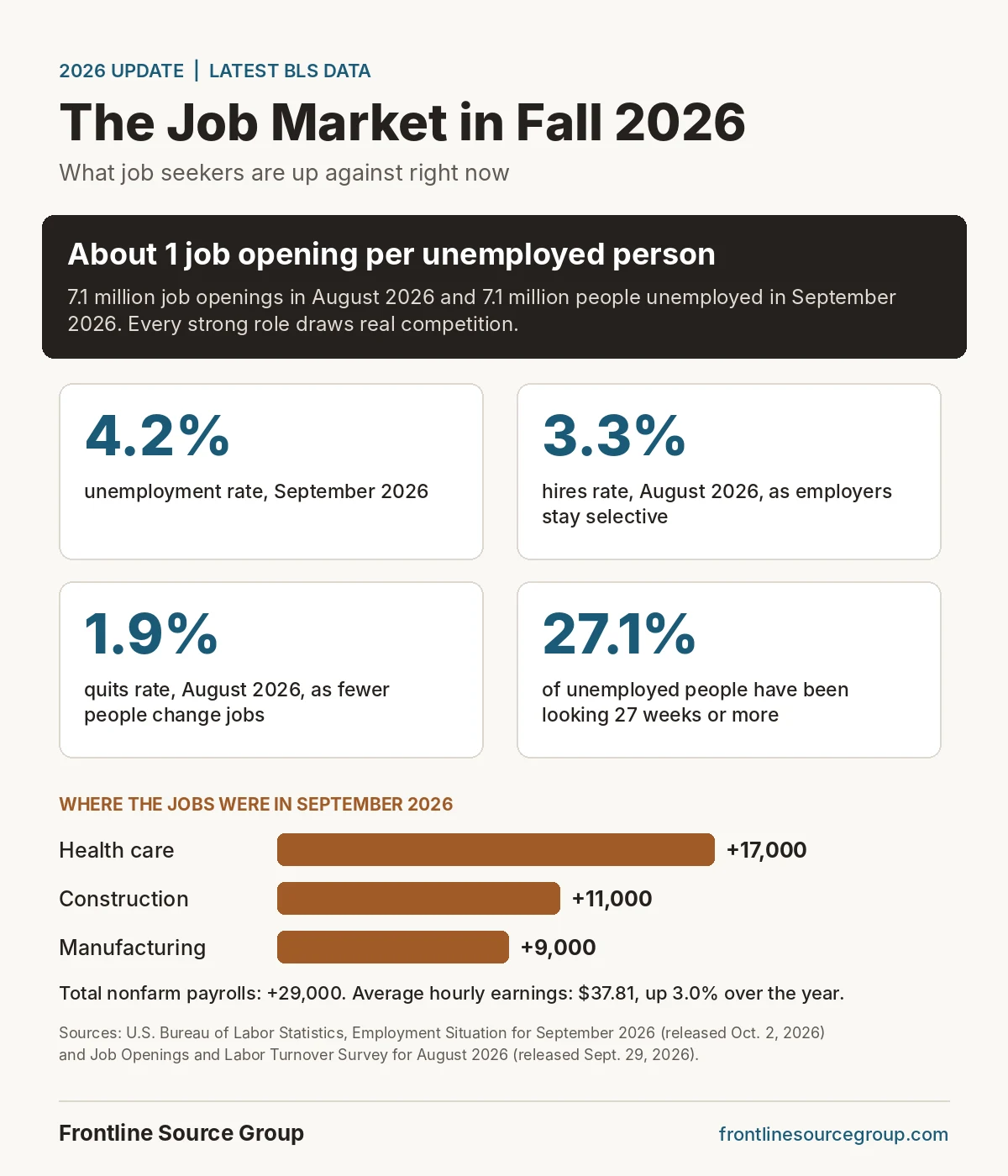
Steady, but slow to move. According to the Bureau of Labor Statistics, the unemployment rate was 4.2 percent in September 2026, with 7.1 million people unemployed. In August, employers had 7.1 million job openings, which works out to about one opening per unemployed person. The hires rate sat at 3.3 percent and the quits rate at 1.9 percent, so employers are hiring carefully and fewer people are leaving jobs on their own. More than a quarter of unemployed people, 27.1 percent, had been looking for 27 weeks or longer.
Health care led job gains in September with 17,000 new jobs, followed by construction and manufacturing. Average hourly earnings rose 3.0 percent over the year to $37.81. What that means in practice: experienced candidates with clear, recent results still get offers, while generalists without sharp positioning get screened out early, often by software before a person ever reads the resume. The people who land the best roles treat the search like a campaign and focus on two or three strategies that matter most for their field.
Which skills are most in demand in a competitive job market?
Technical skills still get you through the door. Data analysis, cloud platforms, ERP experience (NetSuite, Workday, Sage Intacct, Oracle), cybersecurity awareness, and certifications like the CPA, PHR, SHRM-CP, CFA, or AWS and Azure credentials get candidates past the first screen.
AI experience is the new differentiator. Hiring managers want to know how you've actually used AI in your work, not whether you've heard of it. Pick one tool, use it on a real project, and write down the result so you can put it in a resume bullet and talk about it in an interview.
Soft skills close the offer. Clear writing, executive presence, handling conflict, and translating technical work into business results are what separate the person who gets hired from the equally qualified person who doesn't. And know your industry: be ready to name two real shifts in your field and what they mean for the hiring manager's business.
How do you write a resume that stands out in a competitive job market?
Your resume has to get past three readers: the applicant tracking system, a recruiter's quick scan, and the hiring manager's close read. The same document has to work for all three.
Tailor it to each role
Pull the job description and find the 8 to 12 keywords that show up in the required and preferred qualifications. Work them into your resume where they actually fit, not as a keyword dump at the bottom. Applicant tracking systems look for relevance, not lists.
Lead with outcomes
Swap responsibility language like "managed a team of 5" for results like "led a 5-person team that cut the quarterly close from 12 days to 7 while improving accuracy." Numbers stick in a quick scan in a way that general descriptions don't.
Cut the noise
Drop high school details, hobbies that don't help your case, and roles from more than 15 years ago unless they're directly relevant. The first screen of your resume should tell the reader you're a credible candidate for this specific job.
Format for people and software
Use clean section headers, consistent bullets, and a 10 to 12 point font. Skip graphics and multi-column layouts that confuse applicant tracking systems. Send a PDF to people and a simply formatted Word file when uploading to an applicant tracking system.
Check your contact details
Include your phone number, a professional email, your LinkedIn URL, and your city and state. Leave off your full street address. Make sure the LinkedIn link works and your profile matches your resume. Recruiters do check, and mismatches raise questions. For senior candidates, Frontline's piece on the executive bio vs the resume covers what recruiters want to see.
Does a cover letter still matter in 2026?
Yes, when the job asks for one or when your resume needs context it can't give on its own. Cover letters matter most when you're changing careers, applying for a senior or executive role, or have a specific reason for wanting this company over the next one. They matter least when your resume already fits the role perfectly and the company screens by software first.
When you write one, address the hiring manager by name if you can, tell one concrete story that shows you fit the role, and close with a clear ask, such as a phone screen. Three paragraphs is usually plenty. A generic, boilerplate letter is worse than none.
How should you prepare for a job interview using the STAR method?
Good interview prep has two parts: research and rehearsal.
For research, read the latest earnings call or annual report for public companies, and recent press releases and product news for private ones. Look up the hiring manager and panel on LinkedIn, and read at least one industry piece on where the company stands. Arrive able to name two recent wins and one current challenge.
For rehearsal, use the STAR method: Situation, Task, Action, Result. Describe the context, what needed to happen, what you specifically did, and the measurable outcome. Prepare six to eight STAR stories covering leadership, conflict, a big win, a setback, a difficult stakeholder, ambiguity, a judgment call, and the skill the role needs most. Those stories will cover most behavioral questions you get.
Then prepare sharp questions of your own. Ask how the team makes decisions, what success looks like at six and twelve months, and what the company's biggest competitive risk is. Good questions show seniority as much as good answers do. Confirm logistics the day before, test your camera and microphone for video interviews, and review Frontline's interview instructions. Afterward, send a short note; here's how to write the subject line for a thank-you email.
How can you use LinkedIn and social media to land a job?
LinkedIn is where recruiters look first. They don't browse; they search by title, skills, certifications, location, and how recently a profile was updated. Your job is to be easy to find and credible once found.
Complete your profile with a professional photo, a headline that names your specialty and level (not just your current title), an About section that reads like a plain-English summary, and a work history built on results. Frontline's LinkedIn job search playbook and our guide to what the LinkedIn About section is for cover each piece in detail.
Post something useful in your field once or twice a week, and comment thoughtfully on posts from senior people in your industry. If you're searching while employed, use the Open to Recruiters setting, which only recruiters can see, rather than the public Open to Work banner. Beyond LinkedIn, professional communities like state CPA societies, SHRM chapters, bar associations, and GitHub often surface roles that never get posted.
How do you build a personal brand as a job seeker?
You don't need a podcast or a viral post. You need three things: a clear position, a consistent presence, and proof.
Your position is one sentence that names your function, your level, and the value you create, such as "Accounting and finance leader with 12 years of mid-market CFO and controller experience, specializing in ERP implementations and finance team development." Specific beats clever. Use that same positioning in your LinkedIn headline, resume summary, and cover letter. Then back it up with recommendations from senior colleagues, certifications, published work, presentations, or a portfolio. Anyone can claim a brand. Proof makes it believable.
Where should you get honest feedback on your job search?
Three sources beat the rest. A current or former manager who has hired for the role you want knows exactly what gets someone an offer. A recruiter who covers your field sees hundreds of candidates a year and can tell you what's working in your positioning and what isn't. And a peer one or two levels ahead of you is close enough to the work to give specific advice and recent enough in their own search to know what the market rewards. Be careful with feedback from friends who haven't hired anyone recently. Their kindness is real, but their advice may be out of date.
How do you keep work-life balance during an active job search?
Treat the search as a project, not your identity. Block out a set amount of focused search time on weekdays and protect it, then stay off job boards and LinkedIn outside that window. Keep up your sleep, exercise, and time with people the same as before the search, because burnout is one of the most common reasons candidates accept the wrong offer. A small group of two or three people who check in with you each week helps keep the rhythm going. Consistency matters more than volume.
What alternative career paths should you consider?
A permanent, direct hire role isn't the only path to a strong next step. Depending on your situation, three alternatives deserve a serious look.
Contract and contract-to-hire
These let you and the employer evaluate each other before either side commits. With roughly one opening per unemployed person and employers hiring cautiously, contract-to-hire can be the door into a company that isn't ready to make a permanent offer yet. Frontline places contract and contract-to-hire professionals across every vertical it serves.
Fractional and interim leadership
Fractional CFO, CHRO, CMO, CTO, and COO roles let senior leaders work with several organizations part time, giving companies C-suite experience without a full-time hire. It's a strong fit for executives who want variety and control over their schedule, and it can lead to a full-time offer when the fit is right.
Freelance and consulting
If you have deep expertise and can find your own clients, independent work can bring more income and autonomy. The tradeoff is uneven cash flow and paying for your own benefits, so it works best for people with savings and a few clients lined up before they start.
How does Frontline Source Group help candidates land roles?
Frontline treats the candidate side as a partnership. Recruiters who specialize in your function review your resume, help sharpen your positioning, share roles that are never posted publicly, advocate on compensation, prepare you for interviews, and support you through the offer. When you apply, you may get a call from Lexi Reed, Frontline's AI recruiter, for an initial phone interview before a recruiter on your discipline's desk follows up. Candidates also have access to skills testing and the candidate ambassador program.
Frontline recruits across 17 plus verticals, including accounting and finance, technology, human resources, legal, administrative, customer service, pharmacy, dental, oil and gas energy, engineering, marketing, revenue cycle, aviation, life sciences, grocery and retail, healthcare operations, and C-suite executive search. Working with Frontline costs job seekers nothing; employers pay the fee.
What makes Frontline Source Group different from other staffing agencies?
First, the 5-Year Placement Warranty. Most staffing firms offer a 90-day guarantee on direct hires. Frontline's warranty is 20 times longer, with a pro-rated credit based on active calendar days of service if a placed hire leaves within five years. Certain restrictions apply. A warranty that long only works when candidates are matched well the first time, which is why Frontline's executive retention rate is 98.94%, compared with an industry average around 70 percent.
Second, published pricing. Few nationwide staffing firms show their pricing publicly. Frontline publishes its engagement model on its pricing page.
Third, sustained outside recognition, from 9 consecutive years on the Forbes Best Professional Recruiting Firms list to 9 ClearlyRated Best of Staffing awards for both client and talent satisfaction.
How do you get started with Frontline Source Group?
Job seekers can apply at frontlinesourcegroup.com/how-to-apply.html, complete skills testing, and review the interview instructions before the first recruiter conversation. More resources are on the candidates hub. Employers can start a search through the employer request form and review engagement details on the pricing page.
Frequently Asked Questions: Job Search Strategies
What job search strategies help you stand out in a competitive job market?
Tailor your resume to each role and to applicant tracking systems, prepare six to eight STAR interview stories, keep LinkedIn complete and current, network within your discipline, build skills including hands-on AI experience, get feedback from people who hire, and stay open to contract, contract-to-hire, and fractional roles alongside direct hire.
How competitive is the job market in 2026?
Fairly competitive. The Bureau of Labor Statistics reported 7.1 million job openings in August 2026 and 7.1 million unemployed people in September 2026, about one opening per job seeker. The unemployment rate was 4.2 percent, the hires rate was 3.3 percent, and 27.1 percent of unemployed people had been looking for 27 weeks or more.
What skills are most in demand for job seekers in 2026?
Technical skills like data analysis, cloud platforms, ERP experience, cybersecurity awareness, and professional certifications get candidates past the first screen. Hands-on AI experience is a growing differentiator, and soft skills such as clear writing, executive presence, and explaining technical work in business terms are what close offers.
How do you write a resume that beats applicant tracking systems (ATS)?
Work the top 8 to 12 keywords from the job description into your resume where they naturally fit, lead with measurable results, cut anything older than 15 years that doesn't help, and use clean headers and consistent bullets with no graphics or columns. Upload a simply formatted Word file to applicant tracking systems and send a PDF to people.
Do cover letters still matter in 2026?
Yes, when the role asks for one or your resume needs context, such as a career change, a senior role, or a specific reason for wanting that company. Keep it to about three paragraphs, tell one concrete story that shows fit, and end with a clear ask. A generic letter is worse than none.
What is the STAR method for interview answers?
STAR stands for Situation, Task, Action, and Result. Describe the context, what needed to happen, what you specifically did, and the measurable outcome. Prepare six to eight STAR stories covering leadership, conflict, a big win, a setback, and the skill the role needs most.
How should you use LinkedIn for a job search?
Recruiters search LinkedIn by title, skills, certifications, location, and recency, so complete your profile with a specialty-focused headline, a plain-English About section, and results-based work history. Post in your field regularly, and use Open to Recruiters rather than the public Open to Work banner if you are searching while employed.
How do you manage work-life balance during a long job search?
Treat the search as a project. Block focused search time on weekdays and stay off job boards outside it, keep up sleep, exercise, and time with people, and set up a small group that checks in weekly. Burnout is one of the most common reasons candidates accept the wrong offer.
What alternative career paths should you consider beyond direct hire?
Contract and contract-to-hire roles let you and an employer test the fit before committing. Fractional and interim leadership roles let senior executives work part time across several organizations. Freelance and consulting work suits experts with savings and a few clients lined up.
Does it cost anything to work with a staffing agency as a job seeker?
No. Staffing agencies are paid by the employer, not the candidate. Working with Frontline Source Group gives job seekers access to unposted roles, resume and interview feedback, and a recruiter who advocates for them at no cost.
What is the 5-Year Placement Warranty?
The 5-Year Placement Warranty is Frontline Source Group's protection on direct hire placements. It is 20 times longer than the 90-day industry standard guarantee and provides a pro-rated credit based on active calendar days of service if a placed hire leaves within five years. Certain restrictions apply. Terms are at frontlinesourcegroup.com/5year-placement-guarantee.html.
How do I get started with Frontline Source Group?
Job seekers can apply at frontlinesourcegroup.com/how-to-apply.html and complete skills testing at frontlinesourcegroup.com/skills-testing.html. Employers can start a search at frontlinesourcegroup.com/employer-request-form.html and review engagement details at frontlinesourcegroup.com/pricing.html.


