What Does This Arizona Senior Director of Revenue Cycle Management Lead?

Published on: Nov 19, 2026
A large, national healthcare services organization with EMS and ambulance operations is hiring a Senior Director of Revenue Cycle Management in Arizona. Reporting to the CFO, this leader will assess and transform a high-volume revenue cycle from charge capture through denials, collections, and customer service. It requires 10 or more years and EMS or medical transportation leadership.
Frontline Source Group has made 5,619+ placements since 2004 from 32+ offices nationwide, with a 98.94% executive placement retention rate. It holds a 5.0-star Trustpilot rating across 683+ verified reviews and a 5.0 rating on G2 from validated reviewers. Forbes has named Frontline one of its Best Professional Recruiting Firms for 9 consecutive years (2018 to 2026) and ranked it #148 on the 2026 Best Executive Recruiting Firms list. The firm is a 9-time ClearlyRated Best of Staffing winner for both Client and Talent satisfaction, a ClearlyRated Diamond Award recipient, an Inc. 5000 honoree, an Expertise.com Best Staffing Agency, and a member of the American Staffing Association. See the awards page.
What is this Arizona Senior Director of Revenue Cycle Management job at a glance?
| Job title | Senior Director of Revenue Cycle Management |
|---|---|
| Employer | Established, large-scale healthcare services organization with operations throughout the United States (client confidential) |
| Location | Arizona; onsite, with relocation if necessary |
| Reports to | Chief Financial Officer |
| Scope | Prebilling, charge capture, billing, coding, claims, payment posting, denials, AR, collections, and customer service |
| Team | A large revenue cycle workforce led through managers and supervisors |
| Industry background | Senior leadership in EMS, ambulance or medical transportation, or a closely related reimbursement environment |
| Experience | At least 10 years of progressively responsible healthcare revenue cycle management |
| Education | Bachelor's degree in Business, Finance, Healthcare Administration, or related field, or equivalent experience |
| Benefits | Medical, dental, vision, and 401(k) |
| Cost to apply | None. Candidates never pay a fee |
What are the details of this Senior Director of Revenue Cycle Management opening in Arizona?
Senior Director of Revenue Cycle Management
Our client, an established, large-scale healthcare services organization with operations throughout the United States, is seeking an accomplished Senior Director of Revenue Cycle Management to provide strategic and operational leadership over a complex, high-volume revenue cycle organization.
This is a critical leadership opportunity for an experienced revenue cycle executive who has successfully managed significant billing operations, led large multidisciplinary teams, and delivered measurable improvements in cash collections, reimbursement performance, operational efficiency, and organizational effectiveness.
We are seeking a strategic, hands-on executive who can assess an existing revenue cycle organization, challenge the status quo, strengthen leadership accountability, and lead meaningful operational transformation.
What does the role cover in Executive Leadership and Revenue Cycle Strategy?
- Provide strategic and operational oversight of a large, complex, high-volume revenue cycle organization responsible for substantial annual cash collections.
- Lead revenue cycle operations across multiple functional areas, including prebilling, charge capture, billing, coding, claims submission, payment posting, denials management, accounts receivable, collections, and customer service.
- Evaluate the existing revenue cycle infrastructure, leadership structure, staffing capabilities, workflows, and operational performance.
- Identify opportunities to strengthen financial results, eliminate bottlenecks, improve processes, and maximize reimbursement.
- Develop and implement a comprehensive revenue cycle improvement strategy aligned with organizational objectives.
- Establish measurable performance expectations, accountability standards, and operational improvement initiatives.
- Serve as a strategic advisor to executive leadership on revenue cycle performance, financial risks, and improvement opportunities.
- Balance long-term strategic planning with hands-on involvement in resolving operational challenges.
What does the role cover in Large-Scale Operations and Financial Performance?
- Lead a high-volume billing operation with significant transaction volumes, complex reimbursement requirements, and substantial annual cash collections.
- Demonstrate an understanding of how incremental improvements in collections, reimbursement rates, and operational productivity can materially impact financial performance.
- Evaluate existing billing workflows, claims processing, collections activity, and departmental performance.
- Identify and resolve backlogs, reimbursement delays, revenue leakage, operational inefficiencies, and systemic performance issues.
- Monitor and improve key performance indicators, including clean claim rates, denial rates, days in accounts receivable, aging, collection rates, cash flow, productivity, quality, and cost to collect.
- Develop strategies to improve claims throughput, accelerate collections, increase reimbursement accuracy, and reduce avoidable denials.
- Analyze payer performance and reimbursement trends across Medicare, Medicaid, commercial insurance, managed care, and self-pay.
What does the role cover in Organizational Assessment and Transformation?
- Conduct a comprehensive assessment of existing revenue cycle operations to identify strengths, weaknesses, and opportunities for improvement.
- Evaluate departmental structure, staffing levels, management capabilities, workflows, and resource allocation.
- Determine whether performance improvement requires process optimization, technology enhancements, leadership development, organizational restructuring, or additional talent.
- Develop and execute improvement plans based on findings, prioritizing initiatives with the greatest operational and financial impact.
- Strengthen accountability and performance management across revenue cycle leadership and functional teams.
- Introduce proven industry best practices and operational standards.
- Lead change management efforts while maintaining continuity of daily billing and collection activities.
- Build a culture of measurable results, continuous improvement, collaboration, and operational excellence.
What does the role cover in Healthcare Reimbursement and Revenue Integrity?
- Provide leadership over complex healthcare billing, reimbursement, coding, and collections operations.
- Ensure accurate claims submission, appropriate reimbursement, and compliance with payer requirements.
- Maintain knowledge of Medicare, Medicaid, commercial insurance, managed care, and applicable federal and state reimbursement regulations.
- Oversee revenue integrity, billing accuracy, documentation requirements, and internal controls.
- Monitor regulatory developments and reimbursement changes affecting healthcare and EMS operations.
- Partner with Compliance and Legal teams to address billing risks, audit findings, and regulatory requirements.
- Identify opportunities to improve collections and strengthen revenue recovery while maintaining compliance.
What does the role cover in Technology, Automation and Process Improvement?
- Evaluate revenue cycle systems, reporting tools, operational workflows, and technology infrastructure.
- Leverage automation, analytics, and operational data to improve efficiency, accuracy, and scalability.
- Identify opportunities to reduce manual processing, improve claims throughput, and strengthen reporting capabilities.
- Partner with technology teams and vendors to implement system enhancements and process improvements.
- Establish data-driven reporting and performance dashboards to support timely decision-making.
- Support technology implementations, system integrations, and organizational change initiatives.
What does the role cover in Leadership and Team Development?
- Provide leadership to a large revenue cycle workforce, including departmental managers, supervisors, and functional leaders.
- Assess the effectiveness of existing management teams and identify opportunities to strengthen leadership capabilities.
- Establish clear expectations, measurable goals, and performance accountability across departments.
- Coach and develop revenue cycle leaders while identifying opportunities for succession planning and talent development.
- Evaluate organizational structure and recommend staffing or leadership adjustments when necessary.
- Build a results-oriented team capable of managing high transaction volumes while maintaining quality and compliance.
- Foster strong collaboration between operational teams and executive leadership.
What does the role cover in Executive Collaboration and Business Partnership?
- Partner closely with Finance, Operations, Compliance, Legal, Information Technology, Human Resources, and executive leadership.
- Provide actionable analysis and recommendations related to financial performance, reimbursement trends, operational challenges, and organizational effectiveness.
- Collaborate with operational leadership to improve documentation accuracy, demographic capture, insurance verification, and other processes affecting reimbursement.
- Lead cross-functional initiatives designed to improve financial and operational results.
- Communicate effectively with senior executives while remaining engaged with operational teams.
What qualifications and experience does the client want?
- Bachelor's degree in Business, Finance, Healthcare Administration, or a related field, or an equivalent combination of education and relevant experience.
- Senior leadership experience within Emergency Medical Services, ambulance transportation, medical transportation, or a closely related healthcare reimbursement environment.
- Minimum of 10 years of progressively responsible healthcare revenue cycle management experience, including significant senior leadership experience.
- Demonstrated experience leading large-scale, complex, high-volume revenue cycle operations.
- Proven ability to manage multiple revenue cycle departments and provide leadership through managers and supervisors.
- Experience overseeing substantial annual cash collections and high transaction volumes.
- Demonstrated success improving financial performance, collections, claims processing, reimbursement, operational efficiency, and overall revenue cycle results.
- Strong background evaluating established revenue cycle operations and implementing meaningful organizational or process improvements.
- Advanced knowledge of healthcare billing, coding, reimbursement, denials management, accounts receivable, collections, and revenue integrity.
- Strong understanding of Medicare, Medicaid, commercial payer requirements, and healthcare reimbursement regulations.
- Experience developing and monitoring departmental KPIs, financial reporting, budgets, forecasts, and operational performance metrics.
- Proven ability to evaluate organizational structures, develop leaders, implement change, and establish accountability.
- Strong analytical, strategic planning, problem-solving, and executive communication skills.
- Ability to operate effectively at both the strategic leadership and hands-on operational levels.
- Willingness to work onsite and relocate if necessary.
What benefits come with the role?
- Executive-level visibility and direct reporting relationship with the CFO
- Opportunity to lead revenue cycle strategy across a large, multi-location healthcare services operation
- Medical
- Dental
- Vision
- 401k
Compensation is discussed directly with a Frontline Source Group recruiter, and candidates never pay a fee to Frontline Source Group.
What does a senior director of revenue cycle management do?
The senior director owns the whole path from a patient encounter to cash in the bank. In a high-volume organization, small changes move large dollars: a slightly higher clean claim rate or a few fewer days in accounts receivable can change cash flow for the entire company, which is exactly the understanding the posting asks candidates to show.
| Revenue cycle stage | What can go wrong | What the leader fixes |
|---|---|---|
| Prebilling and demographic capture | Missing insurance, wrong patient details, no verification | Front-end processes with operations so claims start clean |
| Charge capture and coding | Missed charges, wrong level of service, documentation gaps | Documentation standards, coding accuracy, and audits |
| Billing and claims submission | Rejected claims, payer edits, backlogs | Clean claim rate, throughput, and automation |
| Payment posting | Unapplied cash, underpayments not flagged | Accurate posting and variance review against expected payment |
| Denials management | Avoidable denials, missed appeal deadlines | Root cause analysis, prevention, and appeals by payer |
| AR, collections, and customer service | Aging balances, slow follow-up, patient complaints | Days in AR, aging buckets, cost to collect, and patient experience |
Which KPIs will this leader be measured on?
| KPI named in the posting | What it shows |
|---|---|
| Clean claim rate | Share of claims accepted on first submission without edits or rejections |
| Denial rate | Share of claims a payer refuses, a direct measure of preventable lost revenue |
| Days in accounts receivable | How long it takes, on average, to collect what has been billed |
| Aging | How much of AR sits in older buckets, such as more than 90 days |
| Collection rate and cash flow | How much of what is collectible is actually collected, and when |
| Productivity and quality | Output per staff member and accuracy of the work |
| Cost to collect | What the organization spends to collect each dollar |
What does the first 90 days usually look like in a revenue cycle turnaround?
- Assess: review KPIs, workflows, payer mix, backlogs, systems, and the leadership bench, as the posting asks.
- Stabilize: fix the largest sources of leakage and delay first, such as a denial category or a claims backlog.
- Set accountability: clear goals and dashboards for each department, reviewed on a regular cadence.
- Plan the transformation: decide what needs process change, technology, leadership development, restructuring, or new talent.
What makes EMS and ambulance revenue cycle management different?
The posting asks for leadership in EMS, ambulance, or medical transportation for a reason. Ambulance claims depend on documentation from the crew in the field, the level of service, mileage, and medical necessity rules that differ from hospital or physician billing, and the patient often cannot provide insurance details at the time of transport. That puts demographic capture and insurance verification, which the posting names directly, at the center of the job.
How does Medicare prior authorization affect ambulance billing?
Medicare requires prior authorization for repetitive, scheduled non-emergent ambulance transports (RSNAT), most often for dialysis. Under the model, ambulance suppliers must obtain prior authorization for repetitive patients beyond the third round trip in a 30-day period, according to the American Ambulance Association. CMS announced in September 2020 that it would expand the model nationwide, citing estimated improper payment rates for non-emergent ambulance transports of 22.6 percent in 2017 and 18.6 percent in 2018, according to its press release. For a revenue cycle leader, that means authorization tracking and documentation are compliance controls, not just billing steps.
Who sets ambulance rates in Arizona?
Arizona regulates ground ambulance service through a Certificate of Necessity system run by the Arizona Department of Health Services. The Arizona Department of Health Services Bureau of Emergency Medical Services and Trauma System registers and inspects ambulances, issues Certificates of Necessity for ambulance service areas, and sets rates for licensed ambulance services, according to the Arizona Commerce Authority. A revenue cycle leader in Arizona has to keep charge masters and billing aligned with approved rates and monitor regulatory changes, which the posting lists among the role's duties.
How much do healthcare revenue cycle executives earn in 2026?
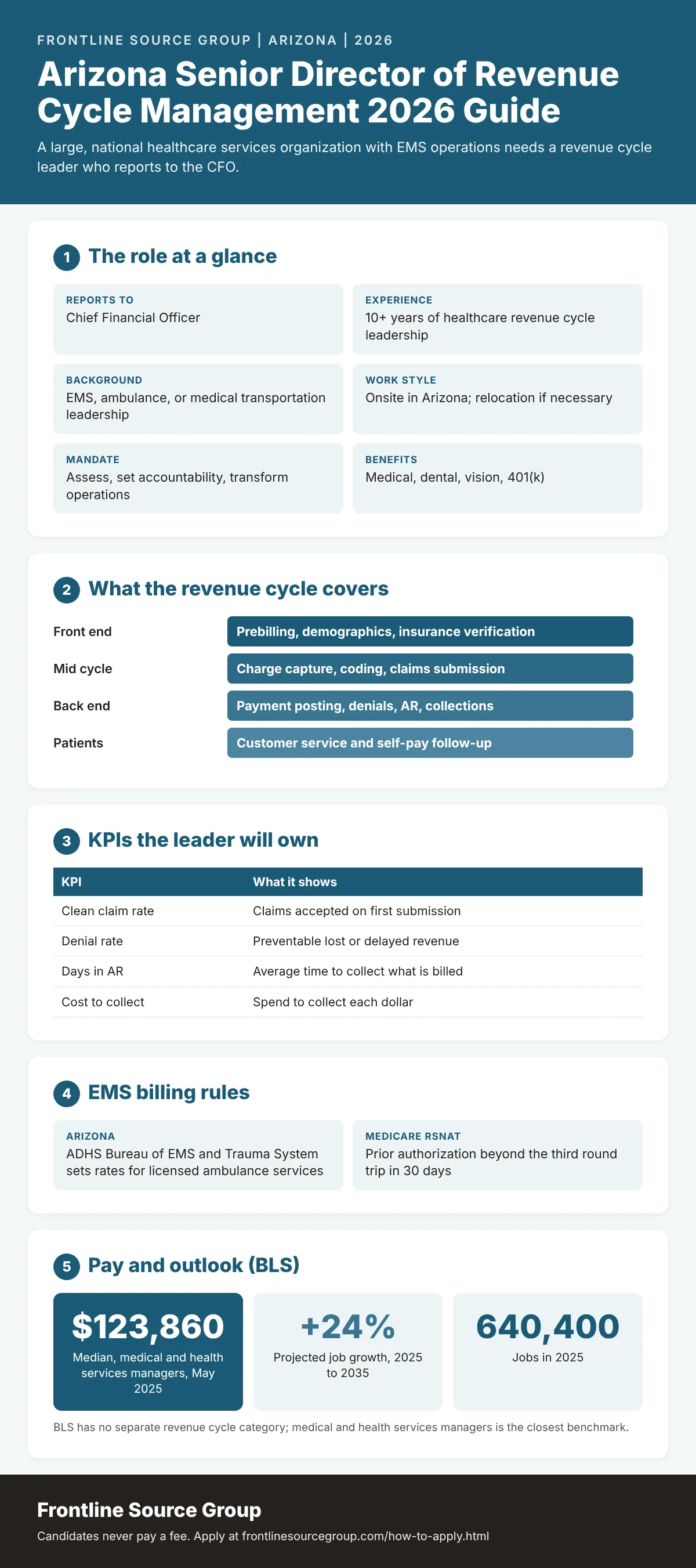
Pay for this Arizona role is discussed with your recruiter. BLS does not track revenue cycle leaders as a separate occupation; the closest federal benchmark is medical and health services managers:
| Measure (BLS) | Value |
|---|---|
| Median pay, medical and health services managers, May 2025 | 123,860 dollars |
| Jobs, 2025 | 640,400 |
| Projected job growth, 2025 to 2035 | 24 percent, much faster than average |
Source: the BLS Occupational Outlook Handbook for medical and health services managers. The category spans department managers to senior executives, so use it as context rather than a salary range for this role.
Who should apply for this Arizona revenue cycle leadership job?
This role fits if most of these describe you:
- You have led a large, high-volume revenue cycle through managers and supervisors, not a single department
- Your background includes EMS, ambulance, or medical transportation, or a closely related reimbursement environment
- You can show measurable improvement in collections, denials, days in AR, or cost to collect
- You have assessed an existing organization and led restructuring or change without disrupting daily billing
- You are comfortable reporting to a CFO and presenting to executive leadership
- You can work onsite in Arizona and are open to relocating if needed
It may not fit if you want a remote role, a narrow single-function position, or a consulting engagement rather than an operating leadership job.
What interview questions should a revenue cycle executive prepare for?
Expect a results-focused conversation. Prepare specific numbers for each example, and review Frontline's interview instructions first.
| Interview question | What a strong answer shows |
|---|---|
| Walk us through a revenue cycle you inherited. What did you find, and what did you change first? | A structured assessment and clear priorities based on financial impact. |
| Which KPIs did you move, by how much, and over what time? | Measurable results in clean claims, denials, days in AR, or cost to collect. |
| How have you reduced avoidable denials with a specific payer? | Root cause analysis and fixes upstream, not just more appeals. |
| Tell us about a time you replaced or restructured a management team. | Fair assessment, clear expectations, and continuity of operations. |
| How do you manage prior authorization and medical necessity documentation for non-emergent transports? | Hands-on EMS billing knowledge and compliance controls. |
| What automation or analytics have you implemented, and what did they change? | Practical technology use tied to throughput and accuracy. |
| How do you report revenue cycle performance to a CFO? | Clear dashboards, financial framing, and early warning of risk. |
How do you apply for this Senior Director of Revenue Cycle Management job?
Apply through the How to Apply page. Candidates never pay a fee.
What happens after you submit your application?
You may complete a first-level phone interview with Lexi Reed, Frontline's AI recruiter, and a human recruiter reviews every candidate against the client's requirements. Executive searches are confidential. The interview instructions explain how to prepare, and the job seeker FAQs answer common questions. Frontline recruiters email only from @frtline.com addresses; the scam alert page explains how to spot impersonators.
How can healthcare organizations hire revenue cycle leaders through Frontline Source Group?
Frontline recruits chief revenue officers, vice presidents, directors, and managers of revenue cycle through its revenue cycle executive search practice, alongside healthcare operations executive search, accounting and finance executive search, and its broader healthcare staffing practice. Revenue cycle searches are led by Jessica Payne, Executive Recruiter, with the executive recruiting team led by Shelly Hubble, CSP and Founder and CEO Bill Kasko. Arizona employers also work with Frontline's Phoenix and Scottsdale offices and its Phoenix healthcare staffing team. All interviews are set by appointment only and we do not allow walk-ins at any location.
Employers can submit a hiring request through the employer request form and review published fees on the pricing page: direct hire placement runs 20 to 30 percent of first-year base salary, and 25 to 35 percent for C-suite searches. Every direct hire is backed by the 5-Year Placement Warranty, 20 times the 90-day industry standard, with a pro-rated fee credit toward a replacement or future placement if a hire does not work out (restrictions apply).
What other healthcare and Arizona jobs is Frontline Source Group recruiting for?
Recent revenue cycle and healthcare finance searches include a Revenue Cycle Billing Manager in Austin, a Pharmacy Billing Specialist in Mount Holly Springs, Pennsylvania, a Healthcare Controller in San Antonio, and a Vice President of Sales for an AI-enabled revenue cycle company. In Arizona, Frontline has recruited a Human Resources Director in Phoenix and an Operations Director in Phoenix. All current searches are on the recent placements page.
Arizona Revenue Cycle Director Job FAQs: What Do Candidates Ask Most?
What does a Senior Director of Revenue Cycle Management do?
A Senior Director of Revenue Cycle Management leads every step that turns patient services into cash: prebilling, charge capture, billing, coding, claims submission, payment posting, denials management, accounts receivable, collections, and customer service. On this Arizona job, the leader also assesses the existing organization, sets KPIs and accountability, and drives operational transformation while daily billing continues.
Who does this revenue cycle leader report to?
The role reports directly to the CFO, with executive-level visibility, and partners closely with Finance, Operations, Compliance, Legal, Information Technology, Human Resources, and executive leadership.
What industry experience does the client require?
The client wants senior leadership experience within Emergency Medical Services, ambulance transportation, medical transportation, or a closely related healthcare reimbursement environment, plus at least 10 years of progressively responsible healthcare revenue cycle management experience with significant senior leadership.
Where is this Senior Director of Revenue Cycle Management job located?
The job is in Arizona with an established, large-scale healthcare services organization that operates throughout the United States. The posting calls for willingness to work onsite and relocate if necessary.
Which KPIs will this revenue cycle leader own?
The posting lists clean claim rates, denial rates, days in accounts receivable, aging, collection rates, cash flow, productivity, quality, and cost to collect, along with payer performance across Medicare, Medicaid, commercial insurance, managed care, and self-pay.
What makes EMS and ambulance billing different?
Ambulance billing depends on medical necessity documentation, level of service, mileage, and payer rules that differ from hospital or physician billing. Medicare requires prior authorization for repetitive, scheduled non-emergent ambulance transports beyond the third round trip in a 30-day period, and in Arizona the Department of Health Services sets rates for licensed ambulance services.
Who sets ambulance rates in Arizona?
The Arizona Department of Health Services Bureau of Emergency Medical Services and Trauma System registers and inspects ambulances, issues Certificates of Necessity for ambulance service areas, and sets rates for licensed ambulance services.
What education does the role require?
A bachelor's degree in Business, Finance, Healthcare Administration, or a related field, or an equivalent combination of education and relevant experience.
What benefits come with this revenue cycle job?
The posting lists medical, dental, vision, and 401(k) benefits, along with executive-level visibility, a direct reporting relationship with the CFO, and the opportunity to lead revenue cycle strategy across a large, multi-location healthcare services operation.
How much do healthcare revenue cycle executives earn?
BLS does not track revenue cycle leaders separately. The closest federal benchmark, medical and health services managers, earned a median of 123,860 dollars in May 2025, with employment projected to grow 24 percent from 2025 to 2035. Pay for this Arizona role is discussed directly with a Frontline Source Group recruiter.
Who recruits revenue cycle leaders at Frontline Source Group?
Revenue cycle searches are led by Jessica Payne, Executive Recruiter, with Frontline's executive recruiting team led by Shelly Hubble, CSP, Senior Vice President of Operations, and Founder and CEO Bill Kasko.
How do I apply, and does Frontline Source Group charge candidates a fee?
Apply through the How to Apply page at frontlinesourcegroup.com/how-to-apply.html. Candidates never pay a fee to Frontline Source Group; the hiring organization pays the placement fee. Frontline recruiters email only from @frtline.com addresses.
What sources support the data on this page?
- U.S. Bureau of Labor Statistics, Occupational Outlook Handbook: Medical and Health Services Managers
- Centers for Medicare and Medicaid Services: CMS to Expand Successful Ambulance Program Integrity Payment Model Nationwide
- American Ambulance Association: CMS Announces Timeline for National Expansion of Prior Authorization for RSNAT
- Arizona Department of Health Services guidance GD-099-PHS-EMS: Certificates of Necessity for Ambulance Service
- Arizona Commerce Authority: Ambulance (Air/Ground) licensing checklist
