What Does a Cost Engineer Do on This Austin Infrastructure Program?

Published on: Nov 17, 2026
A major public infrastructure program in downtown Austin, Texas is hiring an onsite Cost Engineer to own budgeting, forecasting, earned value, and cost change control for heavy civil construction over six to eight years. The role calls for 6 to 10 years of heavy civil project controls, and Frontline Source Group backs every direct hire with its 5-Year Placement Warranty.
Frontline Source Group has made 5,619+ placements since 2004 from 32+ offices nationwide, including its downtown Austin office, with a 98.94% executive placement retention rate. It holds a 5.0-star Trustpilot rating across 683+ verified reviews and a 5.0 rating on G2 from validated reviewers. Forbes has named Frontline one of its Best Professional Recruiting Firms for 9 consecutive years (2018 to 2026) and ranked it #148 on the 2026 Best Executive Recruiting Firms list. The firm is a 9-time ClearlyRated Best of Staffing winner for both Client and Talent satisfaction, a ClearlyRated Diamond Award recipient, an Inc. 5000 honoree, an Expertise.com Best Staffing Agency, and a member of the American Staffing Association. The full list is on the awards page.
What is this Austin Cost Engineer job at a glance?
| Job title | Cost Engineer, Project Controls |
|---|---|
| Location | Downtown Austin, Texas (onsite) |
| Program | Major public infrastructure program expected to span six to eight years across multiple phases of delivery |
| Sector | Heavy civil construction |
| Works with | Project managers, estimators, and project leadership |
| Experience | 6-10 years in cost engineering, project controls, or construction cost management for heavy civil projects |
| Education | Bachelor's degree in civil engineering, construction management, or finance |
| Software | Primavera P6, PRISM, or EcoSys |
| Benefits | PTO and holidays, healthcare plans, 401k plan |
| Cost to apply | None. Candidates never pay a fee to Frontline Source Group |
What is a cost engineer?
A cost engineer is the project controls professional who keeps a construction program's money honest. Cost engineers set the budget and cost baseline, track what has been spent against what has been earned, forecast the final cost, and measure how every change in scope, quantities, or productivity moves that forecast. On heavy civil work such as transit, highways, and utilities, the cost engineer is often the first person to see a cost overrun coming and the one who explains it to project leadership.
How is a cost engineer different from a cost estimator or a project scheduler?
All three roles sit in project controls, but each answers a different question:
| Role | Main question | When the work happens | Typical outputs |
|---|---|---|---|
| Cost estimator | What should this work cost? | Mostly before and at award, and when changes are priced | Quantity takeoffs, bids, change order pricing |
| Cost engineer | What will this work actually cost at completion? | Throughout delivery | Budgets, cost baselines, cash flow projections, earned value reports, forecasts |
| Project scheduler | When will this work be done? | Throughout delivery | Baseline and updated schedules, critical path analysis |
In this role you will work side by side with estimators, reviewing civil plans, labor productivity assumptions, and material costs to refine the projected total cost.
What are the details of this Cost Engineer opening in Austin, TX?
Our client in Austin, Texas is hiring a Cost Engineer for an onsite opportunity in downtown Austin.
What is the company profile?
Our client is supporting a major infrastructure program. The program is expected to span six to eight years and offers the opportunity to work on a visible public infrastructure investment through multiple phases of delivery.
What is the position overview?
You will own budgeting, forecasting, and cost change control for heavy civil construction. Working with project managers and estimators, you will track financial performance and assess how changes in scope, quantities, and productivity affect the forecast.
What will the Cost Engineer be responsible for?
- Establish and maintain project budgets, cost baselines, and cash flow projections.
- Use earned value management (EVM) to monitor cost performance, explain variances, and update forecasts.
- Evaluate the cost impact of contractor claims, change orders, and quantity takeoffs.
- Review civil engineering plans, labor productivity assumptions, and material costs with estimators to refine projected total costs.
- Report emerging cost exposures and proposed budget changes to project leadership.
What qualifications does the client want?
- 6-10 years of experience in cost engineering, project controls, or construction cost management for heavy civil projects such as transit, highways, or utilities.
- Bachelor's degree in civil engineering, construction management, or finance.
- Proficiency with project controls software such as Primavera P6, PRISM, or EcoSys.
- Experience with public infrastructure and cost reporting tied to federal grants is highly desirable.
What benefits come with the role, and what do they mean for you?
- PTO and Holidays: paid time away to recharge during a long program with demanding reporting cycles.
- Healthcare Plans: coverage for you and your family's medical needs.
- 401k plan: a way to save for retirement through payroll.
- Long term opportunity supporting a major Austin infrastructure program: a program expected to span six to eight years gives you a stable, visible role through multiple phases of delivery.
Pay and employment details are discussed directly with a Frontline Source Group recruiter, and candidates never pay a fee to Frontline Source Group.
What is earned value management, and how will you use it in this role?
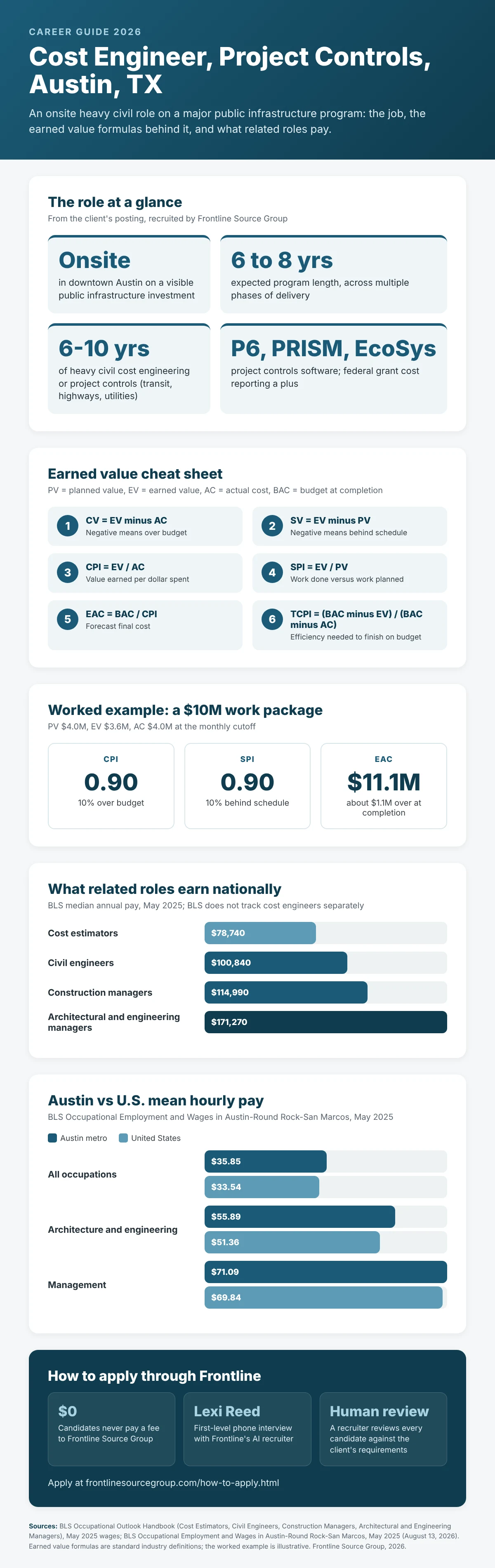
Earned value management (EVM) compares three numbers at any point in a project: the planned value of work scheduled to date (PV), the earned value of work actually completed (EV), and the actual cost of that work (AC). Together they show whether a program is over or under budget and ahead of or behind schedule, and they drive the forecast of the final cost. This posting names EVM as a core tool for monitoring cost performance, explaining variances, and updating forecasts.
What are the earned value management formulas every cost engineer should know?
| Metric | Formula | What it tells you |
|---|---|---|
| Cost variance (CV) | EV minus AC | Negative means the work done so far cost more than it was worth |
| Schedule variance (SV) | EV minus PV | Negative means less work is done than planned |
| Cost performance index (CPI) | EV divided by AC | Value earned per dollar spent; below 1.0 is over budget |
| Schedule performance index (SPI) | EV divided by PV | Work done versus work planned; below 1.0 is behind schedule |
| Estimate at completion (EAC) | BAC divided by CPI | Forecast final cost if current cost performance continues |
| Estimate to complete (ETC) | EAC minus AC | What the remaining work is expected to cost |
| Variance at completion (VAC) | BAC minus EAC | The expected overrun (negative) or underrun (positive) at the end |
| To-complete performance index (TCPI) | (BAC minus EV) divided by (BAC minus AC) | The cost efficiency the remaining work must hit to finish on budget |
BAC is the budget at completion, the total approved budget for the work.
What does an earned value calculation look like on a real project?
Take a 10,000,000 dollar heavy civil work package. At the monthly cutoff, the schedule says 4,000,000 dollars of work should be done (PV), crews have completed 3,600,000 dollars of work (EV), and the contractor has spent 4,000,000 dollars (AC).
| Metric | Calculation | Result |
|---|---|---|
| CV | 3,600,000 minus 4,000,000 | Minus 400,000 dollars |
| SV | 3,600,000 minus 4,000,000 | Minus 400,000 dollars |
| CPI | 3,600,000 divided by 4,000,000 | 0.90 |
| SPI | 3,600,000 divided by 4,000,000 | 0.90 |
| EAC | 10,000,000 divided by 0.90 | About 11,111,000 dollars |
| ETC | 11,111,000 minus 4,000,000 | About 7,111,000 dollars |
| VAC | 10,000,000 minus 11,111,000 | About minus 1,111,000 dollars |
| TCPI | 6,400,000 divided by 6,000,000 | About 1.07 |
The work package is 10 percent behind on both cost and schedule. If nothing changes, it finishes about 1.1 million dollars over budget, and the remaining work would have to run about 7 percent more efficiently than planned just to land on the original budget. Explaining that variance, finding its cause in scope, quantities, or productivity, and reporting the exposure to leadership early is exactly what this role is for.
How does cost reporting work on federally funded infrastructure?
The client lists cost reporting tied to federal grants as highly desirable. Federal awards are governed by the Uniform Guidance in Title 2 of the Code of Federal Regulations, Part 200, which sets the cost principles for grant-funded work: costs charged to the grant must be allowable, allocable to the project, reasonable, and documented. For a cost engineer, that means coding costs cleanly to funding sources, keeping an audit trail behind every change order and claim, and making sure forecasts and drawdowns line up with what the grant agreement allows.
Which project controls tools will you use in this role?
- Primavera P6: Oracle's enterprise scheduling platform, widely used on large infrastructure programs to build and update resource-loaded schedules that feed earned value.
- PRISM: ARES PRISM is a project controls and cost management system used for budgets, change management, earned value, and forecasting.
- EcoSys: Hexagon's EcoSys is an enterprise project controls platform for cost, change, earned value, and portfolio reporting.
The posting asks for proficiency in at least one of these, so strong experience in one platform plus a working knowledge of P6 schedules covers the requirement.
How much do cost engineers and project controls professionals earn in 2026?
Federal pay data does not track cost engineers as a separate job. The closest benchmarks are cost estimators, civil engineers, and construction managers. Pay for this role is discussed with a recruiter.
What does BLS report nationally for related occupations?
| Occupation | Median pay, May 2025 | Jobs in 2025 | Projected change, 2025 to 2035 |
|---|---|---|---|
| Cost estimators | 78,740 dollars | 226,400 | Minus 3 percent |
| Civil engineers | 100,840 dollars | 380,600 | 6 percent |
| Construction managers | 114,990 dollars | 609,100 | 9 percent |
| Architectural and engineering managers | 171,270 dollars | Not shown | Not shown |
The estimator outlook is flat, but the project controls skills this role asks for, earned value, forecasting, and change control on large public programs, line up with the growing civil engineering and construction management fields.
How does Austin pay compare with the U.S.?
Workers in the Austin-Round Rock-San Marcos metro earned a mean of 35.85 dollars an hour in May 2025, compared with 33.54 dollars nationally, according to the BLS Occupational Employment and Wages release for Austin.
| Occupational group (May 2025) | Austin mean hourly | U.S. mean hourly | Share of jobs, Austin vs U.S. |
|---|---|---|---|
| All occupations | 35.85 dollars | 33.54 dollars | 100 vs 100 percent |
| Architecture and engineering | 55.89 dollars | 51.36 dollars | 2.5 vs 1.7 percent |
| Management | 71.09 dollars | 69.84 dollars | 10.4 vs 7.2 percent |
| Business and financial operations | 44.76 dollars | 45.78 dollars | 8.1 vs 6.8 percent |
Engineering work is more concentrated in Austin than nationally, and it pays about 9 percent above the national mean.
What cost engineer interview questions should you prepare for?
Hiring managers on heavy civil programs test the same skills this posting lists. Prepare a real example for each of these questions, and review Frontline's interview instructions before your first conversation.
| Interview question | What a strong answer shows |
|---|---|
| Your CPI dropped to 0.88 this month. Walk me through what you do next. | You trace the variance to specific cost accounts, separate scope, quantity, rate, and productivity causes, and update the forecast with a clear explanation. |
| How do you build a cost baseline and cash flow projection for a new phase? | You tie the budget to the work breakdown structure and the resource-loaded schedule and spread costs by planned progress. |
| A contractor submits a claim for extra quantities. How do you evaluate it? | You check the contract basis, verify quantities against plans and field records, work with estimators on pricing, and document your position. |
| Which EAC method do you trust most, and when would you change it? | You know BAC divided by CPI and bottom-up estimates, and you can explain when past performance stops predicting future cost. |
| How do you work with estimators when productivity assumptions prove wrong? | You compare installed rates against the estimate, agree on revised assumptions, and roll them into the forecast. |
| How have you reported a cost exposure that leadership did not want to hear? | You raised it early with data, offered options to recover, and kept the report factual. |
| What have you done to keep grant-funded costs audit ready? | You code costs to funding sources, keep support for every change, and reconcile forecasts with grant drawdowns. |
| Which project controls software have you used, and how did it connect to the schedule? | You know P6, PRISM, or EcoSys in depth and understand how schedule progress drives earned value. |
Which certifications help a cost engineer stand out?
The posting does not require a certification, but these credentials signal project controls depth to infrastructure employers:
- Certified Cost Professional (CCP): AACE International's flagship cost engineering certification.
- Earned Value Professional (EVP): AACE International's earned value credential.
- Planning and Scheduling Professional (PSP): AACE International's scheduling credential, useful for P6-heavy roles.
- Project Management Professional (PMP): PMI's broad project management certification, common among project controls leaders.
Is this cost engineer job right for you?
This opening is a strong fit if most of these describe you:
- You have 6 to 10 years of cost engineering or project controls on transit, highway, or utility work
- You run earned value every period and can explain any variance in plain language
- You have priced or evaluated change orders and contractor claims
- You are fluent in Primavera P6, PRISM, or EcoSys
- You have handled cost reporting on federally funded projects, or want to
- You want a long-term, onsite role in downtown Austin on a program you can see from start to finish
Where can a cost engineering career lead?
A common project controls path runs from project controls analyst to cost engineer, senior cost engineer, project controls manager, and director of project or program controls. Long infrastructure programs are a strong place to build that path because you see budgets through design, construction, and closeout. Frontline has also recruited a Mid-Level Project Scheduler in Austin, a related project controls role, and places engineers and project controls professionals across Central Texas through its Austin engineering staffing agency.
How do you apply for this role through Frontline Source Group?
Apply through the How to Apply page. Candidates never pay a fee.
What happens after you submit your application?
You may complete a first-level phone interview with Lexi Reed, Frontline's AI recruiter, and a human recruiter reviews every candidate against the client's requirements. Qualified candidates are contacted about next steps, and the recruiter shares more about the client with candidates who advance. The interview instructions explain how to prepare, and the job seeker FAQs answer common questions. Frontline recruiters email only from @frtline.com addresses; the scam alert page explains how to spot impersonators.
How can infrastructure and engineering employers hire project controls talent through Frontline Source Group?
Frontline's Austin office at 100 Congress Avenue in downtown Austin recruits cost engineers, schedulers, estimators, inspectors, and engineers for contractors, program managers, and public infrastructure teams. All interviews are set by appointment only and we do not allow walk-ins at any location. Frontline's executive recruiting team is led by Shelly Hubble, CSP, Senior Vice President of Operations, alongside Founder and CEO Bill Kasko. Leadership searches run through engineering executive search and government contracts executive search, and the broader engineering staffing practice covers contract and direct hire roles.
Employers can submit a hiring request through the employer request form and review published fees on the pricing page: direct hire placement runs 20 to 30 percent of first-year base salary, and contract staffing runs a 50 to 85 percent markup on the pay rate. Every direct hire is backed by the 5-Year Placement Warranty, a pro-rated fee credit toward a replacement or future placement if a hire does not work out (restrictions apply).
What other engineering and construction jobs is Frontline Source Group recruiting for?
In Austin, Frontline has also recruited an MEP Construction Inspector. Elsewhere in Texas, recent searches include a Senior Program Manager for K-12 construction in Dallas, an Estimator in Tomball, and a Structural Professional Engineer in Fort Worth. All current searches are on the recent placements page.
What do candidates ask about the Austin Cost Engineer job?
What does a cost engineer do?
A cost engineer sets the budget and cost baseline for a construction program, tracks spending against the value of work completed, forecasts the final cost, and measures how changes in scope, quantities, or productivity affect that forecast. On heavy civil work, the cost engineer reports emerging cost exposures to project leadership.
What will the Cost Engineer do on this Austin infrastructure program?
The Cost Engineer owns budgeting, forecasting, and cost change control for heavy civil construction, including budgets, cost baselines, cash flow projections, earned value management, and evaluating contractor claims, change orders, and quantity takeoffs with project managers and estimators.
Is this Austin Cost Engineer job remote?
No. This is an onsite opportunity in downtown Austin, Texas, supporting a major public infrastructure program expected to span six to eight years.
What experience is required for this cost engineer role?
The client wants 6 to 10 years of experience in cost engineering, project controls, or construction cost management for heavy civil projects such as transit, highways, or utilities, a bachelor's degree in civil engineering, construction management, or finance, and proficiency with Primavera P6, PRISM, or EcoSys. Public infrastructure and federal grant cost reporting experience is highly desirable.
What is the difference between a cost engineer and a cost estimator?
A cost estimator works out what work should cost, mostly before award and when changes are priced. A cost engineer manages what the work actually costs during delivery, using budgets, earned value, and forecasts to predict the final cost and explain variances.
What are CPI and SPI in earned value management?
CPI, the cost performance index, is earned value divided by actual cost and shows the value earned per dollar spent. SPI, the schedule performance index, is earned value divided by planned value and shows work completed versus work planned. A value below 1.0 means over budget or behind schedule.
How do you calculate estimate at completion?
The most common formula is budget at completion divided by the cost performance index. A 10,000,000 dollar work package with a CPI of 0.90 has an estimate at completion of about 11,111,000 dollars, a projected overrun of about 1,111,000 dollars if current cost performance continues.
How much do cost engineers earn?
BLS does not track cost engineers separately. In May 2025, cost estimators earned a national median of 78,740 dollars, civil engineers 100,840 dollars, and construction managers 114,990 dollars. Pay for this role is discussed directly with a Frontline Source Group recruiter.
What benefits come with this position?
Benefits include PTO and holidays, healthcare plans, a 401k plan, and a long term opportunity supporting a major Austin infrastructure program.
Which certifications help a cost engineer?
The posting does not require one, but AACE International's Certified Cost Professional, Earned Value Professional, and Planning and Scheduling Professional credentials, along with PMI's Project Management Professional, signal project controls depth to infrastructure employers.
How do I apply for the Cost Engineer job in Austin?
Apply through the How to Apply page on the Frontline Source Group website. Applicants may complete a first-level interview with Lexi Reed, Frontline's AI recruiter, and a human recruiter reviews every candidate against the client's requirements.
Does Frontline Source Group charge candidates a fee?
No. Candidates never pay a fee to Frontline Source Group; the hiring company pays the placement fee. Frontline recruiters email only from @frtline.com addresses, and the scam alert page explains how to spot impersonators.
What sources support the data on this page?
- U.S. Bureau of Labor Statistics, Occupational Outlook Handbook: Cost Estimators
- U.S. Bureau of Labor Statistics, Occupational Outlook Handbook: Civil Engineers
- U.S. Bureau of Labor Statistics, Occupational Outlook Handbook: Construction Managers
- U.S. Bureau of Labor Statistics, Occupational Outlook Handbook: Architectural and Engineering Managers
- U.S. Bureau of Labor Statistics, Occupational Employment and Wages in Austin-Round Rock-San Marcos, May 2025 (August 13, 2026)
- Electronic Code of Federal Regulations, 2 CFR Part 200: Uniform Administrative Requirements, Cost Principles, and Audit Requirements for Federal Awards
