What Does a Risk Manager Do on This Austin Heavy Civil Program?
Published on: Nov 17, 2026
A multiyear heavy civil infrastructure program in Austin, Texas is hiring an onsite Risk Manager to lead project risk management: the risk register, Monte Carlo cost and schedule analysis, and contingency drawdown plans with project directors. The role calls for mid to senior level infrastructure risk experience, and Frontline Source Group backs every direct hire with its 5-Year Placement Warranty.
Frontline Source Group has made 5,619+ placements since 2004 from 32+ offices nationwide, including its downtown Austin office, with a 98.94% executive placement retention rate. It holds a 5.0-star Trustpilot rating across 683+ verified reviews and a 5.0 rating on G2 from validated reviewers. Forbes has named Frontline one of its Best Professional Recruiting Firms for 9 consecutive years (2018 to 2026) and ranked it #148 on the 2026 Best Executive Recruiting Firms list. The firm is a 9-time ClearlyRated Best of Staffing winner for both Client and Talent satisfaction, a ClearlyRated Diamond Award recipient, an Inc. 5000 honoree, an Expertise.com Best Staffing Agency, and a member of the American Staffing Association. The full list is on the awards page.
What is this Austin Risk Manager job at a glance?
| Job title | Risk Manager (Infrastructure) |
|---|---|
| Location | Austin, Texas (onsite) |
| Program | Multiyear heavy civil infrastructure program with work spanning multiple phases of project delivery |
| Works with | Project directors and project controls teams |
| Core tools | Risk register, financial modeling, Monte Carlo cost and schedule analysis, contingency drawdown plans |
| Experience | Mid to senior level risk management on complex heavy civil or infrastructure projects |
| Education | Bachelor's or master's degree in civil engineering, construction management, risk management, or finance |
| Preferred | FTA risk assessment and Project Management Oversight guidance, or federally mandated contingency reserves |
| Benefits | PTO and holidays, healthcare plans, 401k plan |
| Cost to apply | None. Candidates never pay a fee to Frontline Source Group |
What does a risk manager do on an infrastructure program?
A risk manager on a heavy civil program is the person who turns uncertainty into numbers leadership can act on. Ground conditions, material lead times, labor availability, utility conflicts, permits, and contract terms all carry a chance of adding cost or time. The risk manager identifies those threats, assigns owners, rates them, models how they combine, and recommends how much contingency the program needs and when it can safely be released.
The role sits close to project controls. Cost engineers forecast where the budget is heading, schedulers forecast the finish date, and the risk manager puts ranges and probabilities around both forecasts.
What are the details of this Risk Manager opening in Austin, TX?
Our client in Austin, Texas is hiring a Risk Manager for an onsite opportunity.
What is the company profile?
Our client is supporting a multiyear heavy civil infrastructure program with work spanning multiple phases of project delivery.
What is the position overview?
You will lead project risk management for complex heavy civil work. In partnership with project directors and project controls teams, you will quantify threats to cost and schedule and help leadership make informed decisions about mitigation and contingency.
What will the Risk Manager be responsible for?
- Build and implement a project risk management framework that addresses exposures such as geotechnical uncertainty, supply chain disruptions, and labor constraints.
- Maintain the risk register, track mitigation owners and actions, and report changes in exposure to project leadership.
- Conduct financial modeling and probabilistic cost and schedule analyses, including Monte Carlo simulations, to quantify exposure for major civil work and bids.
- Incorporate findings from constructability reviews into risk assessments and mitigation plans.
- Develop contingency drawdown plans with project directors and track how changes in risk affect reserve needs.
What qualifications does the client want?
- Mid to senior level experience managing risk on complex heavy civil or infrastructure projects.
- Bachelor's or master's degree in civil engineering, construction management, risk management, or finance.
- Strong understanding of construction contracts, professional liability, and alternative delivery methods such as design build and public private partnerships (P3).
- Familiarity with FTA risk assessment and Project Management Oversight guidance, or experience managing federally mandated contingency reserves, is highly desirable.
What benefits come with the role, and what do they mean for you?
- PTO and Holidays: paid time away to recharge during a long program with demanding reporting cycles.
- Healthcare Plans: coverage for you and your family's medical needs.
- 401k plan: a way to save for retirement through payroll.
- Long term opportunity supporting a major Austin infrastructure program: a multiyear program lets you build the risk framework and see it through multiple phases of delivery.
Pay and employment details are discussed directly with a Frontline Source Group recruiter, and candidates never pay a fee to Frontline Source Group.
What should a construction risk register include?
Maintaining the risk register is a core duty in this posting. A register that leadership can act on usually carries these fields for every risk:
| Field | What it captures | Example for heavy civil work |
|---|---|---|
| Risk ID and title | A unique reference and a short name | R-014, Unknown subsurface conditions at a station site |
| Cause, event, effect | Why it could happen, what happens, and the result | Limited borings, so rock or groundwater differs from the baseline, so excavation costs and duration grow |
| Category | The type of exposure | Geotechnical, supply chain, labor, third party, contractual |
| Owner | The person accountable for the response | Project director for the civil package |
| Probability and impact | Likelihood and the cost and schedule ranges if it occurs | Probability 3 of 5; cost impact 2 to 6 million dollars; 4 to 10 weeks |
| Score and ranking | Probability times impact, used to prioritize | Score 12 of 25, ranked in the top ten |
| Response strategy | Avoid, mitigate, transfer, or accept | Mitigate with added borings; transfer part through a differing site conditions clause |
| Mitigation actions | Specific tasks, owners, and due dates | Additional geotechnical investigation before final design |
| Trend and status | Whether exposure is rising, falling, or closed | Falling after new boring results |
How do you score risks with a probability and impact matrix?
Most programs rate probability and impact on a 1 to 5 scale and multiply them for a score out of 25. Scores of roughly 15 and above are treated as high and reviewed with leadership every cycle, mid scores get active mitigation, and low scores are watched. The matrix is a sorting tool; the Monte Carlo model is what turns the top risks into dollars and days.
How do Monte Carlo simulations set P50 and P80 contingency?
A Monte Carlo simulation runs the cost estimate or schedule thousands of times. In each run, uncertain quantities, rates, and durations are drawn from the ranges the team assigned, and each risk in the register either occurs or does not according to its probability. The results form a curve showing the chance of finishing at or below any cost or date.
Two points on that curve drive most contingency decisions. P50 is the value with a 50 percent chance of not being exceeded. P80 is the value with an 80 percent chance of not being exceeded. Owners of large public programs often budget closer to the higher confidence level because an overrun on a visible public investment is costly to explain.
What does a contingency calculation look like?
Here is a simplified illustration, not data from this program:
| Item | Value | What it means |
|---|---|---|
| Base estimate without contingency | 500 million dollars | The cost if everything goes as planned |
| Simulated P50 | 540 million dollars | Half the simulated outcomes finish at or below this cost |
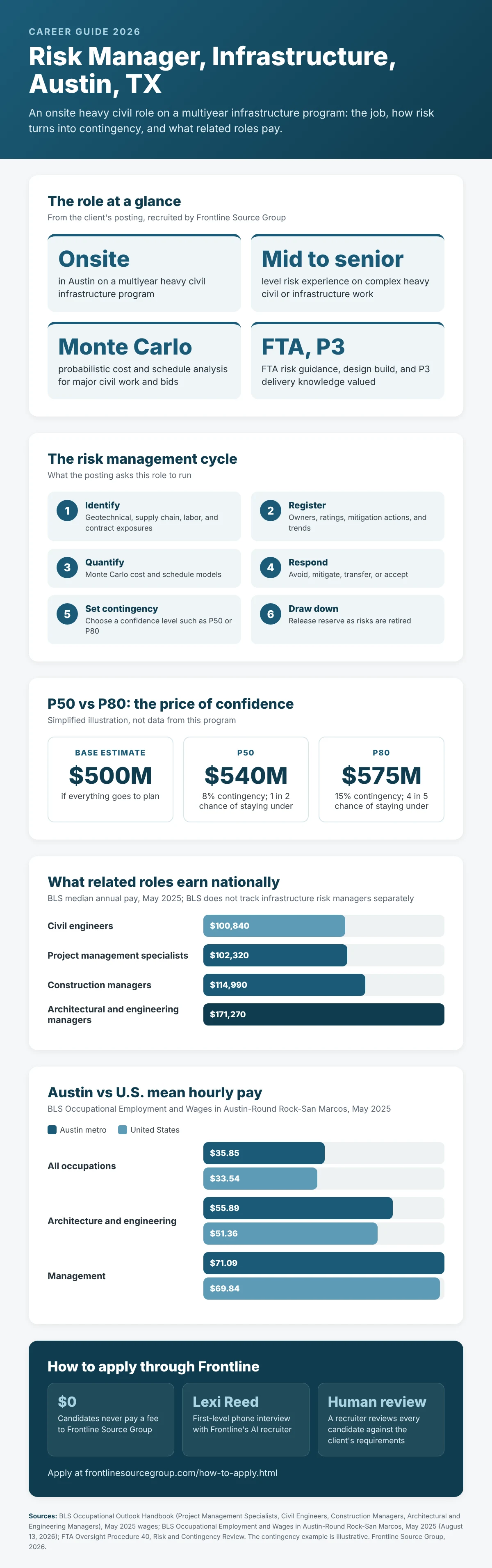
| Simulated P80 | 575 million dollars | Four in five simulated outcomes finish at or below this cost |
| Contingency at P50 | 40 million dollars | 8 percent of the base estimate |
| Contingency at P80 | 75 million dollars | 15 percent of the base estimate |
The extra 35 million dollars between P50 and P80 is the price of confidence. The risk manager's job is to show leadership what each level of contingency buys, then build the drawdown plan that releases reserve as risks are retired, which this posting describes as tracking how changes in risk affect reserve needs.
What is an FTA Risk and Contingency Review?
The client lists familiarity with FTA risk assessment and Project Management Oversight guidance as highly desirable. On federally funded transit projects, the Federal Transit Administration uses Oversight Procedure 40, the Risk and Contingency Review, carried out by a Project Management Oversight Contractor (PMOC). The procedure covers a risk identification review, schedule risk assessment, cost risk assessment, a risk response review that introduces mitigation and contingency, and a risk management review. FTA may request the review at several points in the project lifecycle, and at a minimum before a project enters the Engineering phase and before grant award.
For a risk manager, that means the register, the Monte Carlo models, and the contingency plan must hold up to independent federal review, so documentation and traceability matter as much as the numbers.
How do design build and P3 delivery change who carries risk?
The posting asks for a strong understanding of alternative delivery methods. Each method moves risk between the owner and the private team in a different way:
| Delivery method | Who designs and builds | Typical risk shift |
|---|---|---|
| Design bid build | Owner hires a designer, then bids construction separately | Owner carries design errors and most coordination risk |
| Design build | One team designs and builds under one contract | Design and construction coordination risk moves to the design builder |
| Construction manager at risk | Builder joins during design and later commits to a price | Builder carries cost risk above the agreed maximum price |
| Public private partnership (P3) | A private partner designs, builds, and may finance, operate, or maintain | Long-term performance, financing, and lifecycle risks can move to the private partner |
Knowing who holds each risk under the contract is the starting point for every register entry, every claim position, and every contingency number.
How much do infrastructure risk managers earn in 2026?
Federal pay data does not track construction or infrastructure risk managers as a separate job. The closest benchmarks are project management specialists, civil engineers, and construction managers. Pay for this role is discussed with a recruiter.
What does BLS report nationally for related occupations?
| Occupation | Median pay, May 2025 | Projected change, 2025 to 2035 |
|---|---|---|
| Project management specialists | 102,320 dollars | 7 percent |
| Civil engineers | 100,840 dollars | 6 percent |
| Construction managers | 114,990 dollars | 9 percent |
| Architectural and engineering managers | 171,270 dollars | Not shown |
How does Austin pay compare with the U.S.?
Workers in the Austin-Round Rock-San Marcos metro earned a mean of 35.85 dollars an hour in May 2025, compared with 33.54 dollars nationally, according to the BLS Occupational Employment and Wages release for Austin.
| Occupational group (May 2025) | Austin mean hourly | U.S. mean hourly | Share of jobs, Austin vs U.S. |
|---|---|---|---|
| All occupations | 35.85 dollars | 33.54 dollars | 100 vs 100 percent |
| Architecture and engineering | 55.89 dollars | 51.36 dollars | 2.5 vs 1.7 percent |
| Management | 71.09 dollars | 69.84 dollars | 10.4 vs 7.2 percent |
| Business and financial operations | 44.76 dollars | 45.78 dollars | 8.1 vs 6.8 percent |
Austin has a larger share of management and engineering jobs than the nation, and both groups pay above the national mean.
What risk manager interview questions should you prepare for?
Hiring managers on heavy civil programs test the same skills this posting lists. Prepare a real example for each of these questions, and review Frontline's interview instructions before your first conversation.
| Interview question | What a strong answer shows |
|---|---|
| Walk me through how you would stand up a risk management framework on a new program. | You cover risk planning, identification workshops, register setup, rating criteria, reporting cycles, and how risk ties to cost and schedule controls. |
| How do you handle geotechnical uncertainty before final design? | You push for added investigation where exposure is highest, use contract terms such as differing site conditions clauses, and carry ranges in the model. |
| Tell me about a Monte Carlo analysis you built. What surprised leadership? | You explain inputs, correlation, and outputs, and how the results changed a decision on contingency or a bid. |
| How do you decide between P50 and P80 for a contingency recommendation? | You tie the confidence level to the owner's risk tolerance, funding rules, and the cost of an overrun. |
| How do you build and manage a contingency drawdown plan? | You link reserve to specific risks and milestones and release it as risks are retired, with clear approvals. |
| How do constructability review findings feed your risk assessment? | You turn review comments into register entries with owners, ratings, and mitigation actions. |
| How does risk allocation differ between design build and P3 contracts? | You can explain which party carries design, cost, financing, and lifecycle risk under each model. |
| How would you prepare for an FTA Risk and Contingency Review? | You keep the register, models, and contingency plan documented and traceable, and you know the review covers identification, assessment, response, and management. |
Which certifications help a risk manager stand out?
The posting does not require a certification, but these credentials signal risk depth to infrastructure employers:
- PMI Risk Management Professional (PMI-RMP): PMI's certification focused on project risk management.
- Decision and Risk Management Professional (DRMP): AACE International's credential for risk analysis and decision support.
- Certified Cost Professional (CCP): AACE International's cost engineering certification, useful where risk and cost controls overlap.
- Project Management Professional (PMP): PMI's broad project management certification.
Is this risk manager job right for you?
This opening is a strong fit if most of these describe you:
- You have managed risk on complex heavy civil or infrastructure projects at a mid to senior level
- You have built and run a risk register that leadership actually used to make decisions
- You have built probabilistic cost and schedule models, including Monte Carlo simulations
- You understand construction contracts, professional liability, design build, and P3 delivery
- You have worked with FTA risk guidance or federally mandated contingency reserves, or want to
- You want a long-term, onsite role in Austin on a program with multiple phases of delivery
Where can an infrastructure risk management career lead?
A common path runs from risk analyst to risk manager, senior risk manager, and director of risk or project controls on large programs, with some risk leaders moving into program director roles. Frontline is also recruiting a Cost Engineer for a major Austin infrastructure program, has recruited a Mid-Level Project Scheduler in Austin, and places engineers and project controls professionals across Central Texas through its Austin engineering staffing agency.
How do you apply for this role through Frontline Source Group?
Apply through the How to Apply page. Candidates never pay a fee.
What happens after you submit your application?
You may complete a first-level phone interview with Lexi Reed, Frontline's AI recruiter, and a human recruiter reviews every candidate against the client's requirements. Qualified candidates are contacted about next steps, and the recruiter shares more about the client with candidates who advance. The interview instructions explain how to prepare, and the job seeker FAQs answer common questions. Frontline recruiters email only from @frtline.com addresses; the scam alert page explains how to spot impersonators.
How can infrastructure and engineering employers hire risk and project controls talent through Frontline Source Group?
Frontline's Austin office at 100 Congress Avenue in downtown Austin recruits risk managers, cost engineers, schedulers, estimators, inspectors, and engineers for contractors, program managers, and public infrastructure teams. All interviews are set by appointment only and we do not allow walk-ins at any location. Frontline's executive recruiting team is led by Shelly Hubble, CSP, Senior Vice President of Operations, alongside Founder and CEO Bill Kasko. Leadership searches run through engineering executive search and government contracts executive search, and the broader engineering staffing practice covers contract and direct hire roles.
Employers can submit a hiring request through the employer request form and review published fees on the pricing page: direct hire placement runs 20 to 30 percent of first-year base salary, and contract staffing runs a 50 to 85 percent markup on the pay rate. Every direct hire is backed by the 5-Year Placement Warranty, a pro-rated fee credit toward a replacement or future placement if a hire does not work out (restrictions apply).
What other engineering and construction jobs is Frontline Source Group recruiting for?
In Austin, Frontline has also recruited an MEP Construction Inspector. Elsewhere in Texas, recent searches include a Senior Program Manager for K-12 construction in Dallas, an Estimator in Tomball, and a Structural Professional Engineer in Fort Worth. All current searches are on the recent placements page.
What do candidates ask about the Austin Risk Manager job?
What does a risk manager do on an infrastructure project?
A risk manager identifies the threats that could push an infrastructure project over budget or behind schedule, keeps them in a risk register with owners and mitigation actions, quantifies the exposure with probabilistic cost and schedule analysis, and helps leadership decide how much contingency to hold and when to release it.
What will the Risk Manager do on this Austin program?
The Risk Manager leads project risk management for complex heavy civil work, including building the risk framework, maintaining the risk register, running financial models and Monte Carlo simulations for major civil work and bids, folding constructability review findings into risk plans, and developing contingency drawdown plans with project directors.
Is this Austin Risk Manager job onsite?
Yes. This is an onsite opportunity in Austin, Texas, supporting a multiyear heavy civil infrastructure program with work spanning multiple phases of project delivery.
What experience is required for this risk manager role?
The client wants mid to senior level experience managing risk on complex heavy civil or infrastructure projects, a bachelor's or master's degree in civil engineering, construction management, risk management, or finance, and a strong understanding of construction contracts, professional liability, and alternative delivery methods such as design build and P3. FTA risk assessment experience is highly desirable.
What is a risk register?
A risk register is the living list of everything that could affect a project's cost or schedule. Each entry records the risk, its cause and effect, an owner, probability and impact ratings, the response strategy, mitigation actions with due dates, and how the exposure is trending.
What is a Monte Carlo simulation in construction risk analysis?
A Monte Carlo simulation runs a cost estimate or schedule thousands of times, each time drawing random values from the ranges assigned to uncertain items and risks. The results form a distribution that shows the chance of finishing at or below any given cost or date, which is used to set contingency.
What is the difference between P50 and P80 contingency?
P50 is the cost or date with a 50 percent chance of not being exceeded, and P80 is the value with an 80 percent chance of not being exceeded. Budgeting at P80 holds more contingency and gives more confidence that the project finishes within budget.
What is an FTA Risk and Contingency Review?
It is the Federal Transit Administration's review of a transit project's risks and contingency under Oversight Procedure 40, carried out by a Project Management Oversight Contractor. It covers risk identification, schedule and cost risk assessment, risk response, and risk management, and FTA may request it at several points, at a minimum before entering Engineering and before grant award.
How much do construction risk managers earn?
BLS does not track construction risk managers separately. In May 2025, project management specialists earned a national median of 102,320 dollars, civil engineers 100,840 dollars, and construction managers 114,990 dollars. Pay for this role is discussed directly with a Frontline Source Group recruiter.
What benefits come with this position?
Benefits include PTO and holidays, healthcare plans, a 401k plan, and a long term opportunity supporting a major Austin infrastructure program.
How do I apply for the Risk Manager job in Austin?
Apply through the How to Apply page on the Frontline Source Group website. Applicants may complete a first-level interview with Lexi Reed, Frontline's AI recruiter, and a human recruiter reviews every candidate against the client's requirements.
Does Frontline Source Group charge candidates a fee?
No. Candidates never pay a fee to Frontline Source Group; the hiring company pays the placement fee. Frontline recruiters email only from @frtline.com addresses, and the scam alert page explains how to spot impersonators.
What sources support the data on this page?
- U.S. Bureau of Labor Statistics, Occupational Outlook Handbook: Project Management Specialists
- U.S. Bureau of Labor Statistics, Occupational Outlook Handbook: Civil Engineers
- U.S. Bureau of Labor Statistics, Occupational Outlook Handbook: Construction Managers
- U.S. Bureau of Labor Statistics, Occupational Outlook Handbook: Architectural and Engineering Managers
- U.S. Bureau of Labor Statistics, Occupational Employment and Wages in Austin-Round Rock-San Marcos, May 2025 (August 13, 2026)
- Federal Transit Administration, Risk and Contingency Review (Oversight Procedure 40)
