Pricing and Quotes Analyst - Houston, TX
Published on: Nov 17, 2026
A government and commercial services contractor in Clear Lake, Houston, Texas is hiring a direct hire Pricing and Quotes Analyst to build cost estimates, quotes, and pricing proposals for federal, commercial, and international bids. The role requires 3 or more years of pricing or proposal experience, and Frontline Source Group backs every direct hire with its 5-Year Placement Warranty.
Frontline Source Group has made 5,619+ placements since 2004 from 32+ offices nationwide, including offices in Downtown Houston and the Houston Galleria, with a 98.94% executive placement retention rate. It holds a 5.0-star Trustpilot rating across 683+ verified reviews and a 5.0 rating on G2 from validated reviewers. Forbes has named Frontline one of its Best Professional Recruiting Firms for 9 consecutive years (2018 to 2026) and ranked it #148 on the 2026 Best Executive Recruiting Firms list. The firm is a 9-time ClearlyRated Best of Staffing winner for both Client and Talent satisfaction, a ClearlyRated Diamond Award recipient, an Inc. 5000 honoree, an Expertise.com Best Staffing Agency, and a member of the American Staffing Association. The full list is on the awards page.
What is this Houston Pricing and Quotes Analyst job at a glance?
| Job title | Pricing and Quotes Analyst |
|---|---|
| Location | Clear Lake area of Houston, Texas |
| Work arrangement | Onsite Monday through Thursday, with the option to work remotely on Friday |
| Employment type | Direct hire |
| Schedule | Monday through Friday, 9 a.m. to 5 p.m.; major bid deadlines may occasionally require earlier or later hours |
| Client | Provides specialized services and logistics support to government and commercial customers in the United States and internationally |
| Works with | Business Development, Contracts, Operations, Accounting, and Program Management |
| Experience | At least 3 years in pricing, cost estimating, finance, proposals, or government contracting |
| Core tools | Advanced Microsoft Excel, Word, and PowerPoint; Deltek Costpoint, SharePoint, Microsoft Teams, or ProPricer preferred |
| Education | Bachelor's degree preferred; relevant government contracting and pricing experience may be considered in lieu of a specific degree |
| Hiring step | A job related pricing exercise |
| Benefits | 2 weeks PTO plus sick days and holidays, medical, dental, and vision insurance, STD and LTD, voluntary life and AD and D insurance, 401(k) plan with 3% match |
| Work authorization | United States, without employer sponsorship now or in the future |
| Cost to apply | None. Candidates never pay a fee to Frontline Source Group |
Clear Lake sits in southeast Houston between the city and Galveston Bay and is home to NASA's Johnson Space Center, which anchors a large community of aerospace, engineering, and government services employers. For a pricing professional, that means steady demand for people who can price federal work and keep it compliant.
What is a pricing and quotes analyst?
A pricing and quotes analyst turns a customer request or a government solicitation into a price the company can win with and defend. The analyst reads the requirements, gathers the inputs (labor categories and hours, labor rates, indirect rates, travel, materials, and subcontractor quotes), builds the estimate in a pricing model, and writes the basis of estimate that explains every number. At a government contractor, the analyst also checks that the price follows the solicitation instructions and the federal rules that apply to it, because a price that cannot survive an audit is not really a price.
How is a pricing analyst different from a cost estimator, a contracts specialist, or a proposal manager?
These four roles sit side by side on every bid, but each one owns a different part of it:
| Role | Main question | Typical outputs |
|---|---|---|
| Pricing and quotes analyst | What price do we submit, and can we support it? | Pricing models, cost volumes, rate schedules, quotes, bases of estimate |
| Cost estimator | How much work, material, and labor will this take? | Quantity and labor estimates, often from engineering or operations data |
| Contracts specialist | What terms are we agreeing to? | Compliance reviews, representations and certifications, contract negotiations |
| Proposal manager | Does the full proposal answer the solicitation on time? | Compliance matrix, schedule, volume assembly, final submission |
In this role you will work with Business Development, Contracts, Operations, Accounting, and Program Management, so the job sits right where those four functions meet.
What are the details of this Pricing and Quotes Analyst opening in Houston, TX?
Our client in Houston, Texas, is hiring a Pricing and Quotes Analyst for an onsite direct hire opportunity with the option to work remotely on Fridays.
What is the company profile?
Our client provides specialized services and logistics support to government and commercial customers in the United States and internationally.
What will the Pricing and Quotes Analyst do?
You will prepare cost estimates, quotes, and pricing proposals for federal, commercial, and international opportunities. This is an Excel intensive role that works closely with Business Development, Contracts, Operations, Accounting, and Program Management.
- Review solicitations, statements of work, and amendments to identify pricing requirements, submission instructions, and compliance risks.
- Update and validate existing Excel pricing models. Prepare cost estimates, cost volumes, rate schedules, budgetary estimates, and quotes.
- Gather and assess inputs such as labor rates and hours, staffing levels, escalation, indirect rates, travel, subcontractor quotes, and fees.
- Develop and document the basis of estimate, including assumptions, data sources, calculations, and approvals, so pricing can be reviewed and audited.
- Use historical costs, market data, and prior proposal results to support competitive pricing decisions.
- Manage concurrent pricing assignments and review proposals for accuracy, consistency, and compliance before submission.
- Support requests for clarification, negotiations, and audits. Provide approved pricing and supporting documentation to Operations and Accounting after award.
What qualifications are required?
- At least 3 years of progressively responsible experience in pricing, cost estimating, finance, proposals, or government contracting, including preparing concurrent quotes or cost proposals under firm deadlines.
- Foundational familiarity with federal contracting and proposal pricing, such as basic knowledge of FAR, DFARS, CAS, or GSA schedules.
- Experience reviewing solicitations, working with existing pricing models, developing bases of estimate, and supporting compliant cost or price proposals.
- Advanced Microsoft Excel skills, including complex formulas, lookup functions such as VLOOKUP, linked workbooks, data validation, pivot tables, and model quality checks.
- Proficiency in Microsoft Word and PowerPoint.
- Strong analytical, organizational, and communication skills, with the ability to manage competing deadlines and produce accurate, auditable pricing documentation.
- Authorization to work in the United States without employer sponsorship now or in the future.
Which qualifications are preferred?
- Bachelor's degree in finance, accounting, business administration, economics, or a related field. Relevant government contracting and pricing experience may be considered in lieu of a specific degree.
- Experience with Deltek Costpoint. Familiarity with SharePoint, Microsoft Teams, or ProPricer is also helpful.
- Familiarity with common federal contract types, particularly firm fixed price and time and materials. Exposure to labor hour or cost reimbursement arrangements is also helpful.
- Prior experience with a government contractor or deeper familiarity with federal pricing compliance, including Truthful Cost or Pricing Data requirements and DCAA expectations.
- A master's degree, professional certification, or relevant advanced training.
What are the schedule and hiring process?
The office is in the Clear Lake area of Houston. The regular schedule is Monday through Friday, 9 a.m. to 5 p.m., with onsite work Monday through Thursday and the option to work remotely on Friday. Major bid deadlines may occasionally require earlier or later hours. Candidates will complete a job related pricing exercise.
What benefits come with the role?
- 2 weeks PTO, plus sick days, and Holidays
- Medical Insurance
- Dental Insurance
- Vision Insurance
- STD and LTD
- Voluntary Life and AD and D Insurance
- Long Term Disability Insurance
- 401(k) Plan with 3% match
Pay is discussed directly with a Frontline Source Group recruiter, and candidates never pay a fee to Frontline Source Group.
How do you build a fully burdened labor rate, and what is a wrap rate?
The posting lists labor rates, indirect rates, escalation, and fees among the inputs this analyst will assess, and the fully burdened labor rate is where those inputs come together. A wrap rate is the multiplier between a direct labor rate and the fully burdened rate. Most contractors build it in layers: fringe benefits are applied to direct labor, overhead is applied to labor plus fringe, and general and administrative expense (G and A) is applied to the running total. That gives full cost, often called the cost wrap. Adding fee or profit on top gives the billing rate, often called the price wrap. Wrap rate is industry shorthand rather than a regulatory term, and each contractor defines its own indirect cost pools and allocation bases in its accounting system.
What does a wrap rate calculation look like step by step?
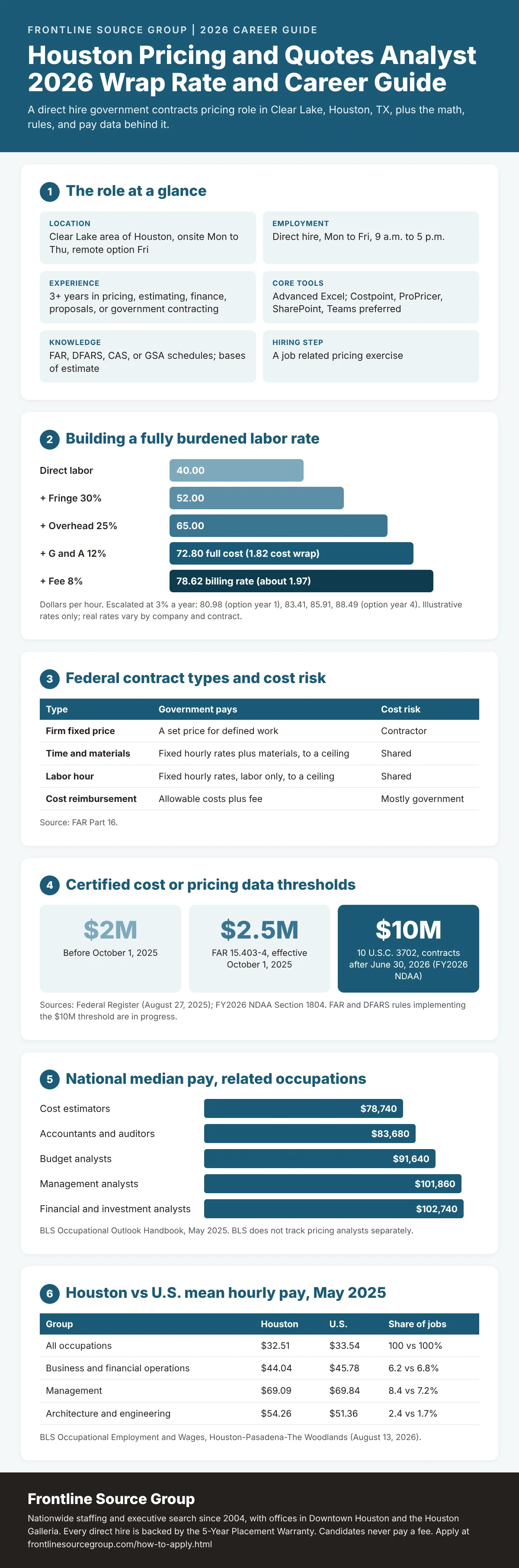
Here is an illustrative example using a 40 dollar per hour direct labor rate, a 30 percent fringe rate, a 25 percent overhead rate, a 12 percent G and A rate, and an 8 percent fee. These rates are examples only; real rates vary widely by company, contract, and accounting structure.
| Step | Calculation | Running rate per hour |
|---|---|---|
| Direct labor | Base hourly rate | 40.00 dollars |
| Add fringe (30 percent) | 40.00 times 0.30 = 12.00 | 52.00 dollars |
| Add overhead (25 percent) | 52.00 times 0.25 = 13.00 | 65.00 dollars |
| Add G and A (12 percent) | 65.00 times 0.12 = 7.80 | 72.80 dollars (full cost, a 1.82 cost wrap) |
| Add fee (8 percent) | 72.80 times 0.08 = 5.82 | 78.62 dollars (billing rate, about a 1.97 price wrap) |
Multi-year bids also need escalation. At an assumed 3 percent a year, the 78.62 dollar base year rate becomes about 80.98 dollars in option year one, 83.41 dollars in option year two, 85.91 dollars in option year three, and 88.49 dollars in option year four. Small changes compound: one point of overhead or one point of escalation moves every rate in the rate schedule, which is why the posting stresses model quality checks and auditable documentation.
Which federal contract types will you price, and who carries the cost risk?
The client prefers familiarity with firm fixed price and time and materials work, with exposure to labor hour or cost reimbursement arrangements also helpful. FAR Part 16 defines each type, and the type changes what the analyst prices and where the risk sits:
| Contract type | How the government pays | Who carries cost risk | What the pricing focuses on |
|---|---|---|---|
| Firm fixed price | A set price for the defined work | The contractor | Complete, well-supported estimates and realistic risk allowances, because overruns come out of the contractor's margin |
| Time and materials | Fixed hourly rates for labor plus materials at cost, up to a ceiling | Shared, with a ceiling price | Fully burdened hourly rates by labor category and a defensible ceiling |
| Labor hour | Fixed hourly rates for labor only, up to a ceiling | Shared, with a ceiling price | The same rate build as time and materials, without materials |
| Cost reimbursement | Allowable incurred costs plus a fee, up to an estimated cost | Mostly the government | Cost realism, allowability of costs, provisional indirect rates, and the fee structure |
Fixed price work is getting more attention. In 2026 the FAR Council updated its overhauled Part 16 text to carry out an executive order that prefers fixed-price contracts, so the ability to price fixed price work with confidence is a skill worth building.
What is a basis of estimate, and what should one include?
A basis of estimate (BOE) is the written support behind each priced element of a proposal. The posting describes it well: assumptions, data sources, calculations, and approvals, documented so pricing can be reviewed and audited. A strong BOE lets an evaluator, a contracting officer, or an auditor follow how every number was built without calling the analyst.
What does a basis of estimate template look like?
This simple template works for most services and logistics support bids. The examples are illustrative.
| BOE field | What to record | Example |
|---|---|---|
| Element or task | The work breakdown structure element or statement of work paragraph being priced | Task 3, warehouse and inventory support |
| Labor categories and hours | Each labor category and the hours by period | Logistics specialist, 1,880 hours a year |
| Estimating method | Analogous, parametric, bottom-up, or vendor quote | Analogous to a prior contract with similar volume |
| Historical data | The actual costs or prior proposals the estimate relies on | Actual hours from a comparable prior task order |
| Rates and sources | Direct labor rates, indirect rates, and where they came from | Salary survey data plus current forward pricing rates |
| Escalation | The escalation rate by year and its basis | 3 percent a year, based on company policy |
| Other direct costs | Travel, materials, and subcontractor quotes with their support | Two trips a year priced at the published per diem |
| Assumptions | Anything the price depends on that the solicitation does not settle | Government-furnished facility and equipment |
| Approvals | Who reviewed and approved the estimate, and the version | Pricing manager review, version 3 |
Which federal pricing rules should a pricing analyst know in 2026?
The posting asks for foundational familiarity with FAR, DFARS, CAS, or GSA schedules, and prefers deeper knowledge of Truthful Cost or Pricing Data requirements and DCAA expectations. Here is what each one means for pricing work.
What are FAR, DFARS, CAS, GSA schedules, and DCAA?
- FAR: the Federal Acquisition Regulation, the main rulebook for federal buying. Part 15 covers contracting by negotiation and cost or pricing data, Part 16 covers contract types, and Part 31 covers cost principles that decide which costs are allowable.
- DFARS: the Defense Federal Acquisition Regulation Supplement, which adds Department of Defense rules on top of the FAR.
- CAS: the Cost Accounting Standards, which require covered contractors to estimate, accumulate, and report costs consistently.
- GSA schedules: long-term contracts through the General Services Administration with pre-negotiated rates that agencies order against, which makes the labor rate table a pricing deliverable in its own right.
- DCAA: the Defense Contract Audit Agency, which audits contractor proposals, indirect rates, incurred costs, and accounting systems. That is why every number in a pricing model needs a source.
What is the TINA threshold in 2026?
The Truthful Cost or Pricing Data statute, still widely called TINA, requires contractors to submit certified cost or pricing data on certain negotiated contracts and to certify that the data are accurate, complete, and current. The threshold has moved twice in a year. An inflation adjustment published in the Federal Register raised the FAR 15.403-4 threshold from 2 million to 2.5 million dollars for contracts on or after July 1, 2018, effective October 1, 2025. The FY2026 National Defense Authorization Act then raised the threshold in 10 U.S.C. 3702 to 10 million dollars for contracts entered into after June 30, 2026. That change is not retroactive, and the implementing FAR and DFARS rules were still in progress at last check, so a pricing team can hold contracts under both thresholds at once. Even below the threshold, contracting officers still have to find a price fair and reasonable and can request other data to support that finding, so organized, defensible pricing support still matters.
How is the FAR changing in 2026?
Executive Order 14275, signed April 15, 2025, started the Revolutionary FAR Overhaul. The FAR Council publishes rewritten FAR parts as model class deviations that agencies adopt, and formal rulemaking follows; the second round of proposed rules, issued September 18, 2026, covers parts that include Part 15 and Part 16. For a pricing analyst, the practical lesson is to read the solicitation clauses closely, because two bids in the same month can sit under different versions of the rules.
Which pricing tools will you use in this role?
- Microsoft Excel: the center of the job. The posting calls for complex formulas, lookup functions such as VLOOKUP, linked workbooks, data validation, pivot tables, and model quality checks.
- Deltek Costpoint: an accounting and ERP system built for government contractors, where actual costs, labor, and indirect rates live. Costpoint experience is preferred.
- ProPricer: proposal pricing software used to build and manage complex government cost volumes. Familiarity is helpful.
- SharePoint and Microsoft Teams: where proposal teams share files, track versions, and coordinate reviews. Familiarity is helpful.
- Microsoft Word and PowerPoint: for pricing narratives, bases of estimate, and pricing reviews with leadership.
How much do pricing analysts earn in 2026?
Federal pay data does not track pricing analysts as a separate job. The closest benchmarks are cost estimators, budget analysts, accountants and auditors, management analysts, and financial analysts. Pay for this role is discussed with a recruiter.
What does BLS report nationally for related occupations?
| Occupation | Median pay, May 2025 | Jobs in 2025 | Projected change, 2025 to 2035 |
|---|---|---|---|
| Cost estimators | 78,740 dollars | 226,400 | Minus 3 percent |
| Accountants and auditors | 83,680 dollars | Not shown | Not shown |
| Budget analysts | 91,640 dollars | 50,400 | 2 percent |
| Management analysts | 101,860 dollars | 1,077,100 | 10 percent |
| Financial and investment analysts | 102,740 dollars | 443,100 (with financial risk specialists) | 7 percent |
The analytical and modeling skills this role builds, rate development, cost analysis, and compliance, carry into the faster-growing analyst fields.
How does Houston pay compare with the U.S.?
Workers in the Houston-Pasadena-The Woodlands metro earned a mean of 32.51 dollars an hour in May 2025, compared with 33.54 dollars nationally, according to the BLS Occupational Employment and Wages release for Houston.
| Occupational group (May 2025) | Houston mean hourly | U.S. mean hourly | Share of jobs, Houston vs U.S. |
|---|---|---|---|
| All occupations | 32.51 dollars | 33.54 dollars | 100 vs 100 percent |
| Business and financial operations | 44.04 dollars | 45.78 dollars | 6.2 vs 6.8 percent |
| Management | 69.09 dollars | 69.84 dollars | 8.4 vs 7.2 percent |
| Architecture and engineering | 54.26 dollars | 51.36 dollars | 2.4 vs 1.7 percent |
Business and financial pay in Houston runs close to the national mean, while engineering work is more concentrated in Houston than nationally and pays above the national mean.
What pricing analyst interview questions should you prepare for?
Hiring managers at government contractors test the same skills this posting lists. Prepare a real example for each of these questions, and review Frontline's interview instructions before your first conversation.
| Interview question | What a strong answer shows |
|---|---|
| Walk me through how you build a fully burdened labor rate. | You layer fringe, overhead, and G and A on direct labor in the right order, separate cost from fee, and know where each rate comes from. |
| A solicitation just dropped. What do you read first, and what do you pull out? | You find the pricing instructions, the contract type, the evaluation criteria, required formats, and anything that creates compliance risk. |
| How do you check an inherited Excel pricing model before you trust it? | You trace formulas and links, test totals, look for hard-coded values, and use data validation and reconciliation checks. |
| What goes into a basis of estimate? | You cover the method, hours, rates and sources, assumptions, historical data, escalation, and approvals. |
| How would you price the same work as firm fixed price versus time and materials? | You explain how cost risk shifts, why fixed price needs stronger risk allowances, and how rates and ceilings drive time and materials. |
| How do you handle three quotes due the same week? | You prioritize by deadline and value, set review checkpoints, and flag conflicts early. |
| What do you know about certified cost or pricing data? | You know when it applies, what accurate, complete, and current means, and why the 2026 threshold changes matter. |
| Tell me about a pricing decision you supported with historical data. | You used prior costs or proposal results to set a competitive price and documented why. |
How should you prepare for the pricing exercise?
The client asks candidates to complete a job related pricing exercise. Before you start, refresh your Excel skills on lookup functions, pivot tables, and linked workbooks, and practice a short wrap rate and escalation build like the one above. During the exercise, label your assumptions, check your totals, and keep the model easy to follow. A reviewer cares as much about how clearly you show your work as about the final number. Frontline's skills testing page explains how assessments fit into the hiring process.
Is this pricing analyst job right for you?
This opening is a strong fit if most of these describe you:
- You have at least 3 years in pricing, cost estimating, finance, proposals, or government contracting
- You have built or updated cost proposals and quotes under firm deadlines, often several at once
- You are an advanced Excel user who checks a model before you trust it
- You know your way around FAR, DFARS, CAS, or GSA schedules, or want to go deeper
- You have written a basis of estimate an auditor could follow
- You want an onsite role in the Clear Lake area of Houston with remote Fridays
Where can a pricing analyst career lead?
A common path runs from pricing analyst to senior pricing analyst, pricing manager, and director of pricing and estimating. Many pricing professionals also move into contracts management, financial planning and analysis, or business development leadership, because pricing teaches how the whole business makes money on each bid. Frontline has recruited a Government Contracts Manager in Surprise, Arizona, a natural next step for a pricing analyst, and runs leadership searches for contractors through its government contracts executive search practice.
How do you apply for this role through Frontline Source Group?
Apply through the How to Apply page. Candidates never pay a fee.
What happens after you submit your application?
You may complete a first-level phone interview with Lexi Reed, Frontline's AI recruiter, and a human recruiter reviews every candidate against the client's requirements. Qualified candidates are contacted about next steps, and the recruiter shares more about the client with candidates who advance. The interview instructions explain how to prepare, and the job seeker FAQs answer common questions. Frontline recruiters email only from @frtline.com addresses; the scam alert page explains how to spot impersonators.
How can government contractors hire pricing and finance talent through Frontline Source Group?
Frontline recruits across Greater Houston from its Downtown Houston office at 700 Milam Street in Pennzoil Place and its Houston Galleria office at 1980 Post Oak Boulevard. All interviews are set by appointment only and we do not allow walk-ins at any location. Frontline's executive recruiting team is led by Shelly Hubble, CSP, Senior Vice President of Operations, alongside Founder and CEO Bill Kasko. Pricing, contracts, and finance leadership searches run through government contracts executive search and Houston accounting and finance executive search, and analyst, accounting, and finance roles are filled through Downtown Houston accounting staffing, Houston Galleria accounting staffing, and the national accounting and finance staffing practice.
Employers can submit a hiring request through the employer request form and review published fees on the pricing page: direct hire placement runs 20 to 30 percent of first-year base salary, and contract staffing runs a 50 to 85 percent markup on the pay rate. Every direct hire is backed by the 5-Year Placement Warranty, a pro-rated fee credit toward a replacement or future placement if a hire does not work out (restrictions apply).
What other Houston finance and analyst jobs is Frontline Source Group recruiting for?
In Houston, Frontline has also recruited an Export Control Analyst, a Tax Analyst, an Accounts Payable Analyst, and an Accounting Manager. Elsewhere in Texas, related cost and estimating searches include a Cost Accountant in Lewisville, an Estimator in Tomball, a Cost Engineer in Austin, and an Infrastructure Risk Manager in Austin. All current searches are on the recent placements page.
What do candidates ask about the Houston Pricing and Quotes Analyst job?
What does a pricing and quotes analyst do?
A pricing and quotes analyst turns a customer request or government solicitation into a defensible price. The analyst reads the requirements, gathers labor, rate, travel, and subcontractor inputs, builds the cost estimate in a pricing model, documents the basis of estimate, and delivers quotes and cost volumes that can stand up to review and audit.
What will this Pricing and Quotes Analyst do in Houston?
The analyst prepares cost estimates, quotes, and pricing proposals for federal, commercial, and international opportunities, updates and validates existing Excel pricing models, documents bases of estimate, manages concurrent pricing assignments, and supports clarifications, negotiations, and audits alongside Business Development, Contracts, Operations, Accounting, and Program Management.
Is this Houston pricing analyst job remote?
No. The job is in the Clear Lake area of Houston, with onsite work Monday through Thursday and the option to work remotely on Friday. The regular schedule is Monday through Friday, 9 a.m. to 5 p.m., and major bid deadlines may occasionally require earlier or later hours.
Is this a direct hire position?
Yes. The client is hiring the Pricing and Quotes Analyst as a direct hire, and Frontline Source Group backs every direct hire with its 5-Year Placement Warranty for the employer.
What experience is required for this pricing analyst role?
The client requires at least 3 years of progressively responsible experience in pricing, cost estimating, finance, proposals, or government contracting, foundational familiarity with FAR, DFARS, CAS, or GSA schedules, advanced Microsoft Excel skills, proficiency in Word and PowerPoint, and authorization to work in the United States without employer sponsorship now or in the future.
Do I need a degree for this job?
A bachelor's degree in finance, accounting, business administration, economics, or a related field is preferred, not required. Relevant government contracting and pricing experience may be considered in lieu of a specific degree.
What is a wrap rate in government contracting?
A wrap rate is the multiplier that turns a direct labor rate into a fully burdened rate. Fringe, overhead, and G and A are layered on direct labor to reach full cost, and fee is added to reach price. In the example on this page, a 40 dollar direct labor rate becomes a 72.80 dollar cost rate and a 78.62 dollar billing rate.
What is a basis of estimate?
A basis of estimate is the written support behind each priced element of a proposal. It explains the labor categories and hours, rates and their sources, the estimating method, assumptions, historical data, escalation, and approvals, so an evaluator or auditor can follow how every number was built.
What is the TINA threshold in 2026?
An inflation adjustment raised the certified cost or pricing data threshold in FAR 15.403-4 from 2 million to 2.5 million dollars on October 1, 2025. The FY2026 NDAA then raised the threshold in 10 U.S.C. 3702 to 10 million dollars for contracts entered into after June 30, 2026, while implementing FAR and DFARS rules are still being finalized.
How much do pricing analysts earn?
BLS does not track pricing analysts as a separate occupation. In May 2025, cost estimators earned a national median of 78,740 dollars, budget analysts 91,640 dollars, and financial and investment analysts 102,740 dollars. Pay for this role is discussed directly with a Frontline Source Group recruiter.
What happens in the pricing exercise?
Candidates complete a job related pricing exercise as part of the hiring process. Expect to work in Excel with labor, rate, escalation, or indirect cost inputs, build a price, check the model for errors, and explain your assumptions clearly, the same skills the role uses every day.
How do I apply, and does Frontline Source Group charge candidates a fee?
Apply through the How to Apply page at frontlinesourcegroup.com/how-to-apply.html. Candidates never pay a fee to Frontline Source Group; the hiring company pays the placement fee. Frontline recruiters email only from @frtline.com addresses, and the scam alert page explains how to spot impersonators.
What sources support the data on this page?
- U.S. Bureau of Labor Statistics, Occupational Outlook Handbook: Cost Estimators
- U.S. Bureau of Labor Statistics, Occupational Outlook Handbook: Budget Analysts
- U.S. Bureau of Labor Statistics, Occupational Outlook Handbook: Accountants and Auditors
- U.S. Bureau of Labor Statistics, Occupational Outlook Handbook: Management Analysts
- U.S. Bureau of Labor Statistics, Occupational Outlook Handbook: Financial Analysts
- U.S. Bureau of Labor Statistics, Occupational Employment and Wages in Houston-Pasadena-The Woodlands, May 2025 (August 13, 2026)
- Federal Register, Federal Acquisition Regulation: Inflation Adjustment of Acquisition-Related Thresholds (August 27, 2025, effective October 1, 2025)
- Acquisition.gov, FAR 15.403-4: Requiring Certified Cost or Pricing Data
- Acquisition.gov, FAR Part 16: Types of Contracts
- Inside Government Contracts, The 10 Million Dollar TINA Threshold Is Now in Effect (July 2026)
- Acquisition.gov, Revolutionary FAR Overhaul
- Wiley Rein, FAR Overhaul Rulemaking tracker
