What Does This Abilene Operations and Reservoir Engineer Job Involve?

Published on: Nov 18, 2026
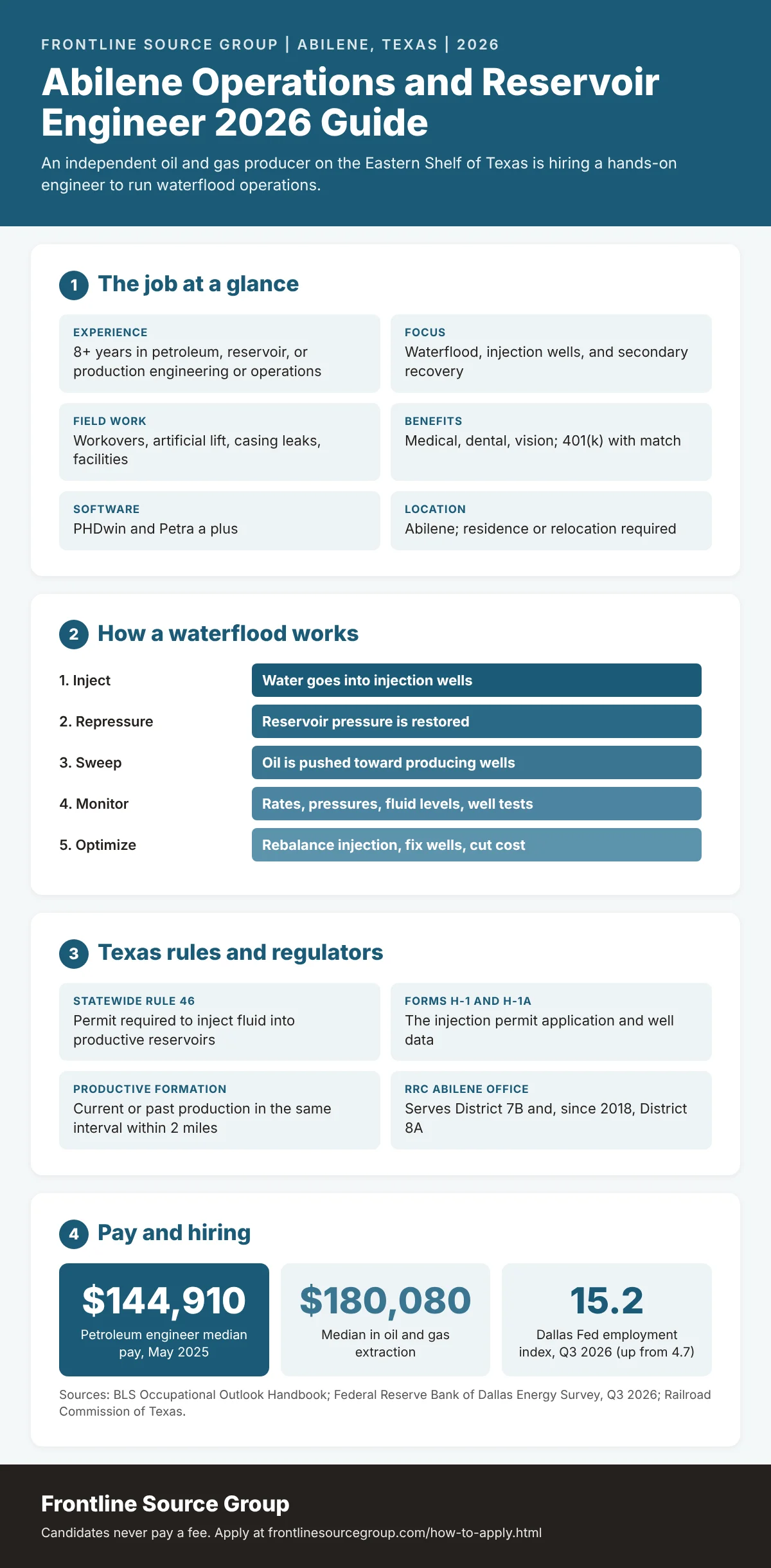
An established independent oil and gas producer with wells on the Eastern Shelf of Texas is hiring an Operations and Reservoir Engineer in Abilene. The engineer will run waterflood and injection performance, workovers, artificial lift troubleshooting, and operating costs alongside field supervisors. The role needs 8 or more years of experience and residence in or relocation to Abilene.
Frontline Source Group has made 5,619+ placements since 2004 from 32+ offices nationwide, with a 98.94% executive placement retention rate. It holds a 5.0-star Trustpilot rating across 683+ verified reviews and a 5.0 rating on G2 from validated reviewers. Forbes has named Frontline one of its Best Professional Recruiting Firms for 9 consecutive years (2018 to 2026) and ranked it #148 on the 2026 Best Executive Recruiting Firms list. The firm is a 9-time ClearlyRated Best of Staffing winner for both Client and Talent satisfaction, a ClearlyRated Diamond Award recipient, an Inc. 5000 honoree, an Expertise.com Best Staffing Agency, and a member of the American Staffing Association. See the awards page.
What is this Abilene Operations and Reservoir Engineer job at a glance?
| Job title | Operations and Reservoir Engineer |
|---|---|
| Employer | Established independent oil and gas exploration and production company (client confidential) |
| Location | Abilene, Texas; producing wells on the Eastern Shelf of Texas |
| Focus | Waterflood operations, injection performance, production optimization, and asset development |
| Works with | Field supervisors and operations staff, plus the existing engineering and geology team |
| Experience | At least 8 years in petroleum, reservoir, or production engineering or oil and gas operations |
| Software | Engineering and production tracking applications; PHDwin and Petra a plus |
| Benefits | Medical, dental, and vision insurance; 401(k) with company matching |
| Residence | Must live in or be willing to relocate to the Abilene area |
| Cost to apply | None. Candidates never pay a fee |
What are the details of this Operations and Reservoir Engineer opening in Abilene, TX?
Operations & Reservoir Engineer
Our client, an established, independent oil and gas exploration and production company is seeking an experienced Operations & Reservoir Engineer to join its team in Abilene, Texas.
What is the company profile?
- Established Independent Oil & Gas Exploration and Production Company
- Active Portfolio of Producing Wells on the Eastern Shelf of Texas
- Small, Collaborative Engineering and Operations Team
- Hands-On Position with Direct Involvement in Field Operations
- Opportunity to Influence Production Performance and Asset Development
- Competitive Compensation and Comprehensive Benefits
- Long-Term Career Opportunity
This is an excellent opportunity for a well-rounded engineering professional with extensive experience in waterflood operations, reservoir management, and oil and gas production.
The ideal candidate will bring a strong combination of reservoir engineering knowledge and practical operational expertise. This individual must be comfortable evaluating producing assets, working directly with field personnel, identifying production improvement opportunities, and taking ownership of engineering projects from planning through execution.
What will the Operations and Reservoir Engineer do?
- Manage and optimize the performance of producing oil and gas wells, with a significant emphasis on waterflood operations.
- Evaluate reservoir performance, production trends, and injection activity to identify opportunities for improved recovery.
- Monitor daily production and injection volumes, investigate performance issues, and develop recommendations to maximize production.
- Provide engineering support and technical direction to field supervisors and operational personnel.
- Coordinate with the existing engineering and geology team to evaluate, develop, and manage producing assets.
- Prepare well schematics and technical documentation for workovers, well repairs, recompletions, and related field activities.
- Plan and support well servicing, drilling, completions, and maintenance projects.
- Develop and oversee fluid-level monitoring programs and routine well testing.
- Evaluate well logs, subsurface data, and reservoir characteristics to support production and development decisions.
- Troubleshoot operational challenges involving artificial lift, well integrity, casing leaks, and declining production.
- Support waterflood management, injection performance monitoring, and associated facility operations.
- Evaluate and recommend solutions for low-volume wells and other production challenges.
- Assist with oilfield facility design, construction, maintenance, and operational improvements.
- Review chemical treatment programs, monitor performance, and identify opportunities to control expenses.
- Manage operating costs associated with well maintenance, workovers, waterflood operations, and facility projects.
- Provide timely production data, technical recommendations, and operational updates to management and field personnel.
- Support production optimization and asset development initiatives across the company's portfolio.
- Ensure engineering and field operations comply with applicable safety, environmental, and regulatory requirements.
- Independently evaluate operational issues and implement practical, cost-effective solutions.
What background does the client want?
- Minimum 8 years of experience in petroleum engineering, reservoir engineering, production engineering, or oil and gas operations.
- Strong, hands-on experience with waterflood operations, injection wells, and secondary recovery projects.
- Well-rounded background combining reservoir engineering and practical field operations.
- Experience evaluating producing assets and identifying opportunities to improve production and recovery.
- Strong understanding of drilling, completion, workover, and well maintenance operations.
- Ability to read and interpret well logs, production data, and subsurface information.
- Knowledge of well servicing, repair operations, and oilfield production equipment.
- Familiarity with oilfield facility design, operation, and maintenance.
- Experience with completion and stimulation techniques, including acid treatments and hydraulic fracturing.
- Understanding of chemical applications and monitoring programs.
- Strong analytical, troubleshooting, and operational decision-making skills.
- Proficiency with relevant engineering software and production tracking applications.
- Experience with PHDwin and Petra is a plus.
- Excellent communication and collaboration skills, particularly when working with field supervisors and technical teams.
- Self-motivated, dependable professional who can work independently and manage competing priorities.
- Comfortable working in a smaller independent oil and gas operation where versatility and hands-on involvement are essential.
- Must currently reside in or be willing to relocate to the Abilene, Texas area.
What benefits come with the role?
- Medical, dental, and vision insurance.
- 401(k) with company matching.
Compensation is discussed directly with a Frontline Source Group recruiter, and candidates never pay a fee to Frontline Source Group.
What does an operations and reservoir engineer do?
At a large operator, reservoir, production, and operations engineering are often separate jobs. At a smaller independent, one engineer often covers all three. This role is that hybrid: the same person who reads the logs and tracks reservoir performance also writes the workover procedure and works the problem with the field supervisor.
| Discipline | Typical focus | Where it shows up in this job |
|---|---|---|
| Reservoir engineering | Reservoir performance, recovery, reserves, and development decisions | Evaluating reservoir performance, injection activity, well logs, and subsurface data |
| Production engineering | Getting the most from each well: lift, completions, chemicals, and well tests | Artificial lift, fluid-level monitoring, well testing, chemical treatment review |
| Operations engineering | Field work, facilities, rigs, budgets, and compliance | Workovers, recompletions, well repairs, facility projects, and operating costs |
What does a typical week look like?
- Reviewing daily production and injection volumes and flagging wells that fall off trend
- Working with field supervisors on a well that loaded up, a rod or pump failure, or a suspected casing leak
- Writing the schematic and procedure for the next workover or recompletion
- Checking fluid levels and well tests against expectations
- Reviewing chemical treatment results and cost before approving changes
- Updating management on production, projects, and spending
How does waterflood operations work on the Eastern Shelf of Texas?
A waterflood is the most common form of secondary recovery. After a reservoir's natural pressure declines, water is injected through injection wells to restore pressure and sweep oil toward nearby producing wells. The engineer's job is to keep that system balanced: how much water goes into each injector, where it goes, and whether the producers respond.
What does a waterflood engineer monitor?
- Injection rates and pressures by well, to catch losses, channeling, or injectors that need stimulation
- Producer response, comparing oil, water, and gas rates with injection by pattern
- Fluid levels and well tests, to size artificial lift and spot wells that are pumped off or flooded out
- Well integrity, including casing leaks that waste injected water or create compliance problems
- Water handling and chemicals, since scale, corrosion, and bacteria control drive both uptime and cost
What permits does a Texas waterflood need?
Injection into a reservoir that produces oil or gas requires a permit from the Railroad Commission of Texas. According to the Railroad Commission, Statewide Rule 46 governs fluid injection into reservoirs productive of oil, gas, or geothermal resources, and operators apply on Forms H-1 and H-1A. The Commission treats a formation as productive when there is current or past production in the same correlative interval within a two mile radius, per its permit application FAQ. Rule 46 also sets requirements for monitoring, reporting, testing, and records, which is why the posting asks the engineer to keep field operations compliant with regulatory requirements.
Who regulates oil and gas in the Abilene area?
The Railroad Commission's Abilene office serves Oil and Gas Division District 7B. Since January 1, 2018, it has also overseen District 8A, a change that grew the office's well inventory from about 27,500 wells to about 71,000 at the time, according to the Commission's notice to operators.
Which tools and skills matter most for this reservoir engineer job?
| Skill or tool | Why it matters here |
|---|---|
| Waterflood and injection management | The posting puts significant emphasis on waterflood operations and secondary recovery |
| Well log and subsurface interpretation | Supports recompletion, development, and production decisions |
| Artificial lift troubleshooting | Declining and low-volume wells need practical, low-cost fixes |
| Workover and recompletion planning | The engineer prepares schematics and documentation for field work |
| Completion and stimulation | Acid treatments and hydraulic fracturing experience is required |
| PHDwin | Listed as a plus; widely used for reserves and economic evaluation |
| Petra | Listed as a plus; widely used for geological mapping and log interpretation |
| Cost control | The engineer manages operating costs for workovers, waterflood operations, and facilities |
How much do petroleum and reservoir engineers earn in 2026?
Pay for this Abilene role is discussed with your recruiter. BLS groups reservoir and production engineers with petroleum engineers:
| Measure (BLS) | Value |
|---|---|
| Median pay, all petroleum engineers, May 2025 | 144,910 dollars |
| Median pay in oil and gas extraction, May 2025 | 180,080 dollars |
| Petroleum engineering jobs, 2025 | 18,500 |
| Projected job growth, 2025 to 2035 | 2 percent |
Source: the BLS Occupational Outlook Handbook for petroleum engineers. Experienced engineers who combine reservoir and field operations skills, especially with waterflood experience, are a small pool, which is why this client will consider candidates willing to relocate to Abilene.
Is the oil and gas job market hiring in 2026?
Hiring picked up in the third quarter of 2026. In the Dallas Fed Energy Survey, which covers oil and gas firms in Texas, northern New Mexico, and northern Louisiana, the employment index rose from 4.7 to 15.2 and the employee hours index rose from 11.8 to 20.0. The wages and benefits index stayed positive at 23.2.
Who should apply for this Abilene reservoir engineer job?
This role fits if most of these describe you:
- You have 8 or more years in petroleum, reservoir, or production engineering or oil and gas operations
- You have managed a waterflood hands on, not just modeled one
- You are comfortable in the field with supervisors and pumpers as well as at a desk with logs and production data
- You like owning projects from the plan through the work on location
- You prefer a small, collaborative team where you see the results of your recommendations
- You live in the Abilene area or are ready to relocate there
It may not fit if you want a purely office-based reservoir modeling role, a large team with narrow specialization, or a remote position.
What interview questions should a reservoir engineer prepare for?
Expect a practical, field-focused conversation. Prepare a specific example for each, and review Frontline's interview instructions first.
| Interview question | What a strong answer shows |
|---|---|
| Walk us through a waterflood you managed. What did you change, and what happened? | Hands-on ownership and measurable results in rate or cost. |
| An injector's rate drops and nearby producers fall off. How do you work the problem? | A logical diagnosis using pressures, rates, fluid levels, and well history. |
| How do you decide whether a low-volume well is worth a workover? | Economics, risk, and a clear threshold, not habit. |
| Tell us about a casing leak or well integrity problem you solved. | Safety, compliance, and a practical repair plan. |
| How do you work with field supervisors who disagree with your recommendation? | Respect for field experience and clear, data-backed communication. |
| How have you reduced chemical or lift costs? | Monitoring, testing, and willingness to challenge an existing program. |
| What do you use PHDwin, Petra, or similar tools for? | Comfort with economics and subsurface tools the team already uses. |
How do you apply for this Operations and Reservoir Engineer job?
Apply through the How to Apply page. Candidates never pay a fee.
What happens after you submit your application?
You may complete a first-level phone interview with Lexi Reed, Frontline's AI recruiter, and a human recruiter reviews every candidate against the client's requirements. The interview instructions explain how to prepare, and the job seeker FAQs answer common questions. Frontline recruiters email only from @frtline.com addresses; the scam alert page explains how to spot impersonators.
How can oil and gas companies hire engineers through Frontline Source Group?
Frontline recruits petroleum, reservoir, production, and facilities engineers, landmen, geoscientists, and HSE professionals through its oil and gas staffing practice, with engineering searches across engineering staffing and engineering executive search. Energy searches are led by Shelly Hubble, CSP, Senior Vice President of Operations, alongside Founder and CEO Bill Kasko. Texas and Oklahoma energy employers also work with Frontline's Fort Worth, Dallas, Houston Galleria, and Oklahoma City energy teams. All interviews are set by appointment only and we do not allow walk-ins at any location. For more on why these roles stay open, read how to fill hard-to-fill oil and gas engineering roles.
Employers can submit a hiring request through the employer request form and review published fees on the pricing page: direct hire placement runs 20 to 30 percent of first-year base salary, and contract staffing runs a 50 to 85 percent markup on the pay rate. Every direct hire is backed by the 5-Year Placement Warranty, 20 times the 90-day industry standard, with a pro-rated fee credit toward a replacement or future placement if a hire does not work out (restrictions apply).
What other energy and engineering jobs is Frontline Source Group recruiting for?
Recent energy searches include a Director of Sales for oil and gas insulation in Houston and a Senior Manager of Procurement for an oil and gas company in Frisco. Engineering searches include a Structural Professional Engineer in Fort Worth, a Principal Electrical Engineer in Garland, a Cost Engineer on an Austin infrastructure program, and a Risk Manager on an Austin heavy civil program. All current searches are on the recent placements page.
Abilene Reservoir Engineer Job FAQs: What Do Candidates Ask Most?
What does an operations and reservoir engineer do?
An operations and reservoir engineer combines reservoir analysis with hands-on field operations. On this Abilene job, that means managing producing wells with a heavy waterflood focus, monitoring production and injection volumes, evaluating well logs and reservoir performance, preparing workover and recompletion schematics, troubleshooting artificial lift and casing leaks, and controlling operating costs.
Where is this Operations and Reservoir Engineer job located?
The job is in Abilene, Texas, with an established independent oil and gas exploration and production company whose producing wells are on the Eastern Shelf of Texas. Candidates must currently live in or be willing to relocate to the Abilene area.
How much experience does this reservoir engineer job require?
The client wants at least 8 years of experience in petroleum engineering, reservoir engineering, production engineering, or oil and gas operations, including strong, hands-on experience with waterflood operations, injection wells, and secondary recovery projects.
What is a waterflood in oil and gas?
A waterflood is a secondary recovery method. Water is injected into a producing reservoir through injection wells to restore pressure and push oil toward nearby producing wells, recovering oil that primary production left behind. Engineers manage the balance between injected water and produced fluids, well by well and pattern by pattern.
Do Texas waterflood injection wells need a permit?
Yes. Fluid injection into reservoirs productive of oil or gas requires a permit from the Railroad Commission of Texas under Statewide Rule 46, applied for on Forms H-1 and H-1A. The rule also covers monitoring, reporting, testing, and records requirements.
What software does this job use?
The posting asks for proficiency with engineering software and production tracking applications, and lists experience with PHDwin and Petra as a plus. PHDwin is widely used for reserves and economic evaluation, and Petra for geological mapping and well log interpretation.
What benefits come with this Abilene engineering job?
The posting lists medical, dental, and vision insurance and a 401(k) with company matching, along with competitive compensation and comprehensive benefits and a long-term career opportunity.
How much do petroleum engineers earn?
Petroleum engineers earned a national median of 144,910 dollars in May 2025 and 180,080 dollars in oil and gas extraction, according to the BLS. Pay for this Abilene role is discussed directly with a Frontline Source Group recruiter.
Is the oil and gas job market hiring in 2026?
Yes. In the Dallas Fed Energy Survey for the third quarter of 2026, the employment index for Eleventh District oil and gas firms rose from 4.7 to 15.2 and the employee hours index rose from 11.8 to 20.0, a sign that more firms were adding staff.
What is the Eastern Shelf of Texas?
The Eastern Shelf is the eastern flank of the Permian Basin in West Central Texas, the area around Abilene. The posting's focus on waterflood management, low-volume wells, and cost control fits the mature, conventional fields common in the region.
Who oversees oil and gas operations in the Abilene area?
The Railroad Commission of Texas Abilene district office serves Oil and Gas Division District 7B and, since January 1, 2018, also oversees District 8A. Operators file required district forms and coordinate field inspections through that office.
How do I apply, and does Frontline Source Group charge candidates a fee?
Apply through the How to Apply page at frontlinesourcegroup.com/how-to-apply.html. Candidates never pay a fee to Frontline Source Group; the hiring company pays the placement fee. Frontline recruiters email only from @frtline.com addresses.
What sources support the data on this page?
- U.S. Bureau of Labor Statistics, Occupational Outlook Handbook: Petroleum Engineers
- Federal Reserve Bank of Dallas, Dallas Fed Energy Survey, Third Quarter 2026
- Railroad Commission of Texas, Enhanced Recovery (Statewide Rule 46)
- Railroad Commission of Texas, Injection and Disposal Permit Applications FAQs
- 16 Texas Administrative Code Section 3.46: Fluid Injection into Productive Reservoirs
- Railroad Commission of Texas, RRC Abilene Office: New Telephone and Fax Numbers
- Railroad Commission of Texas, Notice to Operators: Reassignment of District 8A to the Abilene District Office
