What Does a Veterinarian Do in This Cleveland Vet Tech Program?
Published on: Nov 18, 2026
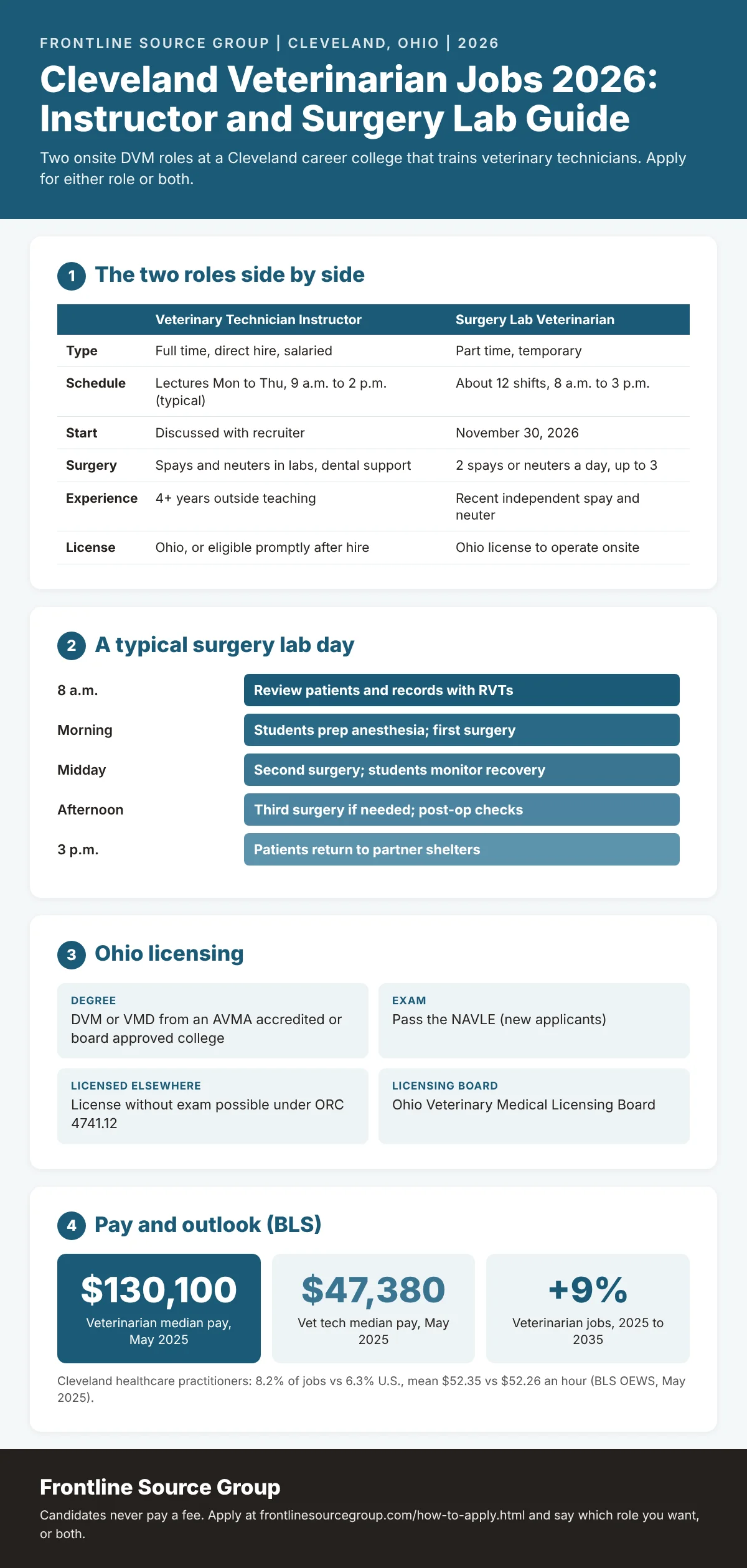
A Cleveland career college that trains veterinary technicians is hiring a Doctor of Veterinary Medicine for two onsite roles: a full time direct hire Veterinary Technician Instructor with a weekday teaching schedule, and a part time temporary Surgery Lab Veterinarian performing routine spays and neuters for about 12 shifts starting November 30, 2026. Apply for either role or both.
Frontline Source Group has made 5,619+ placements since 2004 from 32+ offices nationwide, with a 98.94% executive placement retention rate. It holds a 5.0-star Trustpilot rating across 683+ verified reviews and a 5.0 rating on G2 from validated reviewers. Forbes has named Frontline one of its Best Professional Recruiting Firms for 9 consecutive years (2018 to 2026) and ranked it #148 on the 2026 Best Executive Recruiting Firms list. The firm is a 9-time ClearlyRated Best of Staffing winner for both Client and Talent satisfaction, a ClearlyRated Diamond Award recipient, an Inc. 5000 honoree, an Expertise.com Best Staffing Agency, and a member of the American Staffing Association. See the awards page.
What are these two Cleveland veterinarian jobs at a glance?
| Detail | Veterinary Technician Instructor | Surgery Lab Veterinarian |
|---|---|---|
| Employment type | Full time, direct hire, salaried faculty | Part time, temporary assignment |
| Location | Cleveland, Ohio (onsite) | Cleveland, Ohio (onsite) |
| Start | Discussed with your recruiter | Lab block beginning November 30, 2026 |
| Schedule | Primarily daytime; lectures typically Monday to Thursday, 9 a.m. to 2 p.m. | About 12 daytime shifts; labs typically 8 a.m. to 3 p.m. |
| Clinical work | Spays and neuters in surgery labs, dental cleaning support, shelter animal exams | Routine dog and cat spays and neuters, two a day, up to three |
| Teaching | Lectures, demonstrations, labs, grading, tutoring, curriculum updates | Registered veterinary technicians guide students while you operate |
| Degree | DVM or VMD from an AVMA accredited program, or equivalent international credentials | DVM or VMD |
| License | Active, unrestricted Ohio license or eligible promptly after hire | Ohio licensure needed to perform surgeries onsite |
| Experience | Four or more years of practice or direct animal care outside teaching; teaching preferred | Recent independent spay and neuter experience |
| Reports to | Veterinary Program Administrator; no direct reports | Lab coverage alongside registered veterinary technicians |
| Cost to apply | None. Candidates never pay a fee | None. Candidates never pay a fee |
What are the details of this Doctor of Veterinary Medicine opening in Cleveland, OH?
Doctor of Veterinary Medicine (DVM) | Veterinary Technician Instructor or Surgery Lab Veterinarian
Our client in Cleveland, Ohio is hiring a Doctor of Veterinary Medicine (DVM) for two onsite opportunities: a full time direct hire faculty role and a part time temporary surgery lab assignment. Candidates may apply for either opportunity or both.
What is the company profile?
- Career college offering hands on education for future veterinary technicians
- Small classes and an experienced team of veterinary technician instructors
- Modern surgical, diagnostic, and dental equipment
- Community partnerships with local animal rescues and shelters
What will the full time Veterinary Technician Instructor do?
- Teach veterinary technician students through lectures, demonstrations, and hands on labs aligned with AVMA CVTEA curriculum and essential skills.
- Prepare lesson plans, assignments, and assessments. Grade student work, provide feedback and tutoring, and maintain accurate academic records.
- Perform spays and neuters during scheduled surgery labs, support dental cleanings, and teach students safe animal handling, clinical procedures, and equipment use.
- Examine and care for animals from partner shelters, oversee medical records and release instructions, and communicate health concerns to shelter staff.
- Help update curriculum, select instructional materials and equipment, and maintain animal care protocols and accreditation documentation.
- Report to the Veterinary Program Administrator and collaborate with the academic team. The role has no direct reports.
What background does the full time role require?
- DVM or VMD from an AVMA accredited program, or equivalent credentials for internationally trained veterinarians.
- Active, unrestricted Ohio veterinary license or eligibility to obtain one promptly after hire.
- At least four years of practical veterinary or direct animal care experience outside of teaching.
- Ability to perform routine dog and cat spays and neuters and explain clinical procedures clearly to students.
- One or more years of teaching experience preferred. Clinical mentoring or training experience is relevant.
What features and benefits come with the full time role?
- Full time, salaried faculty role with a primarily daytime academic schedule.
- Typical lectures run Monday through Thursday from 9 a.m. to 2 p.m. Office hours, lab schedules, and program activities vary by academic term.
- Small classes give instructors time to work individually with students.
- Opportunity to mentor future veterinary technicians and support local rescue animals.
What will the part time Surgery Lab Veterinarian do?
- Provide onsite coverage for the veterinary technician surgery lab beginning November 30, 2026.
- Perform routine dog and cat spays and neuters while registered veterinary technicians guide students through their lab responsibilities.
- Expect approximately 12 daytime shifts during the lab block. Labs typically run from 8 a.m. to 3 p.m., with two surgeries on a typical day and up to three as needed.
What background does the part time role require?
- DVM or VMD with the Ohio veterinary licensure needed to perform surgeries onsite.
- Recent experience independently performing routine dog and cat spays and neuters.
- Availability for the lab block beginning November 30 and ability to work with veterinary technicians and students in a teaching lab.
Please indicate whether you are interested in the full time role, the part time surgery lab assignment, or both. Pay and employment details are discussed directly with a Frontline Source Group recruiter, and candidates never pay a fee to Frontline Source Group.
What does a veterinary technician instructor do?
A veterinary technician instructor turns clinical experience into teaching. Veterinary technology programs accredited by the AVMA Committee on Veterinary Technician Education and Activities (CVTEA) must teach a defined set of essential skills, from anesthesia monitoring and surgical assisting to dental prophylaxis, radiology, and safe animal restraint. The instructor demonstrates each skill, supervises students as they practice it, and documents that they can do it.
How does the instructor role differ from clinical practice?
| Area | Clinical practice veterinarian | Veterinary technician instructor (this role) |
|---|---|---|
| Main goal | Diagnose and treat patients for clients | Teach students to do technician work safely and correctly |
| Schedule | Often evenings, weekends, and emergencies | Primarily daytime; lectures typically Monday to Thursday |
| Surgery | Full caseload, often under time pressure | Scheduled spays and neuters in a teaching lab |
| Patients | Client-owned pets | Animals from partner shelters and rescues |
| Paperwork | Medical records and client communication | Medical records, lesson plans, grading, and accreditation documentation |
| People | Clients and clinic team | Students, instructors, and shelter staff |
Why do shelter partnerships matter in a vet tech program?
Students need real patients to practice on, and shelters need spays, neuters, exams, and dental work. In this program, the instructor examines and cares for animals from partner shelters, oversees medical records and release instructions, and tells shelter staff about any health concerns. That means the work supports adoptions in the Cleveland area while students build their skills.
What does accreditation documentation involve?
CVTEA accreditation requires programs to show that students master the essential skills and that animals used in teaching are cared for under proper protocols. The posting asks the instructor to help update curriculum, select instructional materials and equipment, and maintain animal care protocols and accreditation documentation. Graduates of an accredited program can sit for the Veterinary Technician National Examination (VTNE), which Ohio requires for veterinary technician registration, according to the Ohio Veterinary Medical Licensing Board.
What does a surgery lab veterinarian do in a vet tech teaching lab?
The part time assignment is about the surgery itself. You perform routine dog and cat spays and neuters, and registered veterinary technicians guide the students through anesthesia, monitoring, instrument handling, and recovery. A typical lab day looks like this:
| Time (typical) | What happens |
|---|---|
| 8 a.m. | Lab opens; review the day's patients and their records with the registered veterinary technicians |
| Morning | Students prepare patients and anesthesia under technician supervision; first surgery |
| Midday | Second surgery; students monitor anesthesia and recovery |
| Afternoon | A third surgery when needed; post-operative checks and records |
| 3 p.m. | Lab typically ends; patients go home to partner shelters with release instructions |
Is this assignment like relief veterinarian work?
In format, yes: a temporary, part time block of about 12 daytime shifts. What differs is the pace and the audience. Surgeries are scheduled and limited to two a day in most cases, and students are learning from what you do, so it helps to talk through your technique when asked. It is a good fit for a relief veterinarian, a semi-retired surgeon, or a practice owner who wants teaching experience. Frontline also places temporary professionals through its temporary staffing practice.
What Ohio license does a veterinarian need for these jobs?
Both roles require Ohio licensure. The Ohio Veterinary Medical Licensing Board (OVMLB) licenses veterinarians in the state:
- Education: graduation from a veterinary college accredited by the AVMA or approved by the board, under Ohio Administrative Code 4741-1-04.
- Exam: new applicants must pass the North American Veterinary Licensing Examination (NAVLE).
- Already licensed in another state: the board may license a veterinarian without examination when the other state's requirements are equivalent, under Ohio Revised Code 4741.12.
- Internationally trained veterinarians: the full time role accepts equivalent credentials, plus an Ohio license or eligibility to obtain one promptly after hire.
If you are not yet licensed in Ohio, tell your recruiter where you hold a license now. The full time role allows eligibility to obtain the license promptly after hire; the surgery lab assignment needs licensure in place to operate onsite.
How much do veterinarians and veterinary technicians earn in 2026?
Pay for these Cleveland roles is discussed with your recruiter. For context, here is what BLS reports nationally:
| Occupation | Median pay, May 2025 | Jobs in 2025 | Projected change, 2025 to 2035 |
|---|---|---|---|
| Veterinarians | 130,100 dollars (62.55 dollars an hour) | 91,100 | 9 percent, about 3,100 openings a year |
| Veterinary technologists and technicians | 47,380 dollars (22.78 dollars an hour) | See BLS | See BLS |
Sources: the BLS Occupational Outlook Handbook for veterinarians and for veterinary technologists and technicians. BLS projects veterinarian employment to grow much faster than the average for all occupations.
How does Cleveland pay compare with the U.S.?
Workers in the Cleveland metro earned a mean of 31.88 dollars an hour in May 2025, compared with 33.54 dollars nationally, according to the BLS Occupational Employment and Wages release for Cleveland. Healthcare is a bigger part of the local economy than nationally:
| Occupational group (May 2025) | Share of jobs, Cleveland vs U.S. | Mean hourly, Cleveland vs U.S. |
|---|---|---|
| All occupations | 100 vs 100 percent | 31.88 vs 33.54 dollars |
| Healthcare practitioners and technical | 8.2 vs 6.3 percent | 52.35 vs 52.26 dollars |
| Educational instruction and library | 5.2 vs 5.9 percent | 31.78 vs 32.47 dollars |
Healthcare practitioners in Cleveland earn slightly more than the national mean even though overall pay in the metro runs lower, which reflects the region's large healthcare sector.
Which role fits you: the instructor job, the surgery lab, or both?
The full time instructor role fits if most of these describe you:
- You have four or more years in practice or direct animal care and want a daytime, weekday schedule
- You enjoy explaining procedures and mentoring technicians or new graduates
- You are comfortable performing routine spays and neuters in front of students
- You like shelter medicine and want your work to support local rescues
- You hold an Ohio license or can obtain one promptly after hire
The part time surgery lab fits if:
- You do routine dog and cat spays and neuters independently and efficiently
- You are available for about 12 daytime shifts starting November 30, 2026
- You already hold the Ohio licensure needed to operate onsite
- You want relief-style work in a calmer, scheduled setting, or want to try teaching before committing
Applying for both is welcome, and the surgery lab block can be a good way to get to know the program before a full time decision.
What interview questions should a veterinarian prepare for?
Teaching programs test clinical skill and how well you explain it. Prepare an example for each, and review Frontline's interview instructions before your first conversation.
| Interview question | What a strong answer shows |
|---|---|
| Walk us through your spay technique as you would explain it to a student. | Clear, step by step teaching that covers safety and why each step matters. |
| How many spays and neuters do you perform in a typical week? | Recent, independent surgical volume. |
| A student makes an anesthesia monitoring mistake during surgery. What do you do? | Patient safety first, calm correction, and a debrief afterward. |
| How have you trained or mentored technicians, assistants, or new graduates? | Real teaching experience, even if informal. |
| What do you know about AVMA CVTEA essential skills? | Awareness of what accredited programs must teach and document. |
| How do you handle shelter patients with limited history? | Thorough exams, clear records, and good communication with shelter staff. |
| How would you grade a hands on skill fairly? | Objective criteria, consistent standards, and useful feedback. |
How do you apply for these veterinarian jobs through Frontline Source Group?
Apply through the How to Apply page and say whether you want the full time role, the part time surgery lab assignment, or both. Candidates never pay a fee.
What happens after you submit your application?
You may complete a first-level phone interview with Lexi Reed, Frontline's AI recruiter, and a human recruiter reviews every candidate against the client's requirements. Because the surgery lab starts November 30, apply soon if that assignment interests you. The interview instructions explain how to prepare, and the job seeker FAQs answer common questions. Frontline recruiters email only from @frtline.com addresses; the scam alert page explains how to spot impersonators.
How can schools, clinics, and animal health employers hire veterinarians through Frontline Source Group?
Frontline recruits nationwide from 32+ offices through its healthcare staffing practice, including clinical, education, and operations roles, alongside dental staffing, pharmacy staffing, and healthcare operations executive search. All interviews are set by appointment only and we do not allow walk-ins at any location. Frontline's executive recruiting team is led by Shelly Hubble, CSP, Senior Vice President of Operations, alongside Founder and CEO Bill Kasko.
Employers can submit a hiring request through the employer request form and review published fees on the pricing page: direct hire placement runs 20 to 30 percent of first-year base salary, and temporary and contract staffing runs a 50 to 85 percent markup on the pay rate. Every direct hire is backed by the 5-Year Placement Warranty, 20 times the 90-day industry standard, with a pro-rated fee credit toward a replacement or future placement if a hire does not work out (restrictions apply).
What other healthcare and Ohio jobs is Frontline Source Group recruiting for?
Recent healthcare searches include a Staff Pharmacist in Mount Holly Springs, Pennsylvania, a Pharmacy Billing Specialist with the same employer, a Pediatric Dental Practice Manager in Humble, Texas, a General Dentist in St. Joseph, Michigan, and a Healthcare Controller in San Antonio. In Ohio, Frontline has recruited a Chief Operations Officer in Dublin and a Hispanic Foods Buyer in Cincinnati. All current searches are on the recent placements page.
Cleveland Veterinarian Jobs FAQs: What Do Candidates Ask Most?
What veterinarian jobs is this Cleveland career college hiring for?
The client, a Cleveland career college that trains veterinary technicians, is hiring a Doctor of Veterinary Medicine for two onsite roles: a full time direct hire Veterinary Technician Instructor and a part time temporary Surgery Lab Veterinarian for a lab block beginning November 30, 2026. Candidates may apply for either role or both.
What does a veterinary technician instructor do?
A veterinary technician instructor teaches future veterinary technicians through lectures, demonstrations, and hands on labs aligned with AVMA CVTEA curriculum and essential skills. In this role, the instructor also performs spays and neuters during surgery labs, supports dental cleanings, examines animals from partner shelters, grades student work, and helps maintain accreditation documentation.
What is the schedule for the full time instructor role?
It is a full time, salaried faculty role with a primarily daytime academic schedule. Typical lectures run Monday through Thursday from 9 a.m. to 2 p.m., and office hours, lab schedules, and program activities vary by academic term.
What does the part time surgery lab veterinarian do?
The surgery lab veterinarian provides onsite coverage for the veterinary technician surgery lab beginning November 30, 2026, performing routine dog and cat spays and neuters while registered veterinary technicians guide students. Expect about 12 daytime shifts, with labs typically running 8 a.m. to 3 p.m. and two surgeries on a typical day, up to three as needed.
Is the surgery lab assignment a relief veterinarian job?
It works much like relief work: a temporary, part time assignment covering a defined block of about 12 shifts. The difference is the setting. Surgeries happen in a teaching lab, and registered veterinary technicians guide students through their lab responsibilities while the veterinarian operates.
Do I need an Ohio veterinary license for these jobs?
The full time role requires an active, unrestricted Ohio veterinary license or eligibility to obtain one promptly after hire. The part time surgery lab role requires the Ohio licensure needed to perform surgeries onsite. Ohio licenses veterinarians through the Ohio Veterinary Medical Licensing Board, and new applicants must pass the NAVLE.
How much experience does the instructor role require?
The client wants at least four years of practical veterinary or direct animal care experience outside of teaching and the ability to perform routine dog and cat spays and neuters. One or more years of teaching experience is preferred, and clinical mentoring or training experience is relevant.
Can internationally trained veterinarians apply?
Yes, for the full time role. The client accepts a DVM or VMD from an AVMA accredited program, or equivalent credentials for internationally trained veterinarians, along with an Ohio license or eligibility to obtain one promptly after hire.
How much do veterinarians earn?
Veterinarians earned a national median of 130,100 dollars in May 2025, and veterinary technologists and technicians earned 47,380 dollars, according to the BLS. BLS projects veterinarian jobs to grow 9 percent from 2025 to 2035. Pay for these Cleveland roles is discussed directly with a Frontline Source Group recruiter.
What is AVMA CVTEA accreditation?
The AVMA Committee on Veterinary Technician Education and Activities (CVTEA) accredits veterinary technology programs. Graduates of an accredited program can sit for the Veterinary Technician National Examination (VTNE), which Ohio requires for veterinary technician registration. Instructors in these programs teach the essential skills the CVTEA standards require.
Can I apply for both the full time and part time roles?
Yes. The client welcomes applications for either opportunity or both. When you apply, indicate whether you are interested in the full time role, the part time surgery lab assignment, or both.
How do I apply, and does Frontline Source Group charge candidates a fee?
Apply through the How to Apply page at frontlinesourcegroup.com/how-to-apply.html. Candidates never pay a fee to Frontline Source Group; the hiring organization pays the fee. Frontline recruiters email only from @frtline.com addresses.
What sources support the data on this page?
- U.S. Bureau of Labor Statistics, Occupational Outlook Handbook: Veterinarians
- U.S. Bureau of Labor Statistics, Occupational Outlook Handbook: Veterinary Technologists and Technicians
- U.S. Bureau of Labor Statistics, Occupational Employment and Wages in Cleveland, May 2025
- Ohio Veterinary Medical Licensing Board, Frequently Asked Questions
- Ohio Administrative Code Rule 4741-1-04: Examination
- Ohio Revised Code Section 4741.12: License Without Examination; Reciprocity
- American Veterinary Medical Association, Programs Accredited by the CVTEA
