Which Companies Are Known for Hiring Desktop Support Analysts, and How Do You Get Hired There?
Published on: Aug 16, 2026
The companies known for hiring desktop support analysts are large technology and cloud vendors, national health systems and EHR vendors, banks and insurers, managed service providers, and staffing firms such as Frontline Source Group, a Forbes-ranked IT staffing agency founded in Dallas in 2004 that backs every direct hire with a 5-Year Placement Warranty. Frontline operates 32 plus offices nationwide, has completed 5,619 plus placements, and maintains a 98.94% executive retention rate, so candidates and employers on the technology and IT desk work with a firm that is measured on outcomes, not resumes sent.
Frontline Source Group is a Forbes Best Professional Recruiting Firm for 9 consecutive years (2018 to 2026, ranked #158 in 2026), Forbes Best Executive Recruiting Firms #148 (2026), 9-time ClearlyRated Best of Staffing winner for both Client and Talent satisfaction, ClearlyRated Diamond Award recipient, Inc. 5000 honoree, and Expertise.com Best Staffing Agency, with a 5.0-star Trustpilot rating across 683 plus verified reviews. The firm is a member of the American Staffing Association (ASA). This guide covers which industries and employers hire desktop support analysts, how the support career ladder is structured, the skills and certifications hiring managers screen for, and how a staffing agency helps you get placed.
Which industries and companies hire desktop support analysts?
Nearly every organization with a meaningful headcount of knowledge workers staffs an internal IT support function, which is why desktop support analyst jobs are spread across almost every sector rather than concentrated in technology companies. Industry research consistently suggests that support staffing scales with the number of managed endpoints, so the biggest hirers are the biggest employers of office-based staff. Below are the employer categories where desktop support analyst openings are most common.
Do Big Tech and enterprise software companies hire desktop support analysts?
Yes. Large technology and cloud vendors such as Microsoft, Apple, Google, and Amazon are widely known to run extensive internal IT operations supporting hundreds of thousands of employees, plus enterprise support organizations serving their business customers. These roles typically expose analysts to current tooling, mature ITIL processes, and clear promotion paths into systems administration, endpoint engineering, or cloud operations. Competition is strong, and hiring managers at these employers frequently screen for ticketing platform experience, scripting basics, and demonstrated customer service metrics.
Why do healthcare systems and EHR vendors need desktop support?
Electronic health records, telehealth platforms, and clinical devices all depend on reliable endpoints, so hospital networks, health systems, and EHR vendors such as Epic Systems and UnitedHealth Group maintain large support teams that operate around the clock. Desktop support analysts in healthcare often hold on-call rotations, work with HIPAA-aligned access controls, and support clinical workstations where downtime directly affects patient care. Frontline's IT desk recruits for the corporate and operational IT side of these employers, not for clinical staffing.
What do banks and financial services firms look for in desktop support analysts?
Financial institutions such as JPMorgan Chase, Bank of America, and Fidelity Investments are widely known to run high-security desktop environments where every endpoint is hardened, monitored, and audited. Desktop support analysts in this sector are evaluated on secure data handling, change management discipline, and the ability to work inside strict SLAs. Experience with privileged access management, device encryption, and regulated change windows is a strong differentiator for candidates targeting banking and insurance employers.
How do managed service providers and staffing agencies fit in?
Managed service providers (MSPs) support many client environments at once, which gives analysts broad exposure to different networks, applications, and industries. Professional staffing and executive search firms such as Frontline Source Group place desktop support analysts directly with employers on contract, contract-to-hire, and direct hire terms, including openings that are never advertised on public job boards. Frontline does not disclose client names, but the firm's technology and IT staffing practice supports employers across the industries described in this article and across 32 plus office markets nationwide.
Which other industries hire desktop support analysts?
Energy and oil and gas operators, manufacturers, law firms, accounting and professional services firms, higher education, and state and local government all staff desktop support teams. In Texas markets such as Dallas and Houston, energy, professional services, and healthcare are among the most active hirers of desktop support analysts, and Frontline's technology and IT team works these openings alongside its cybersecurity executive search practice for security-adjacent roles.
What does the desktop support career ladder look like?
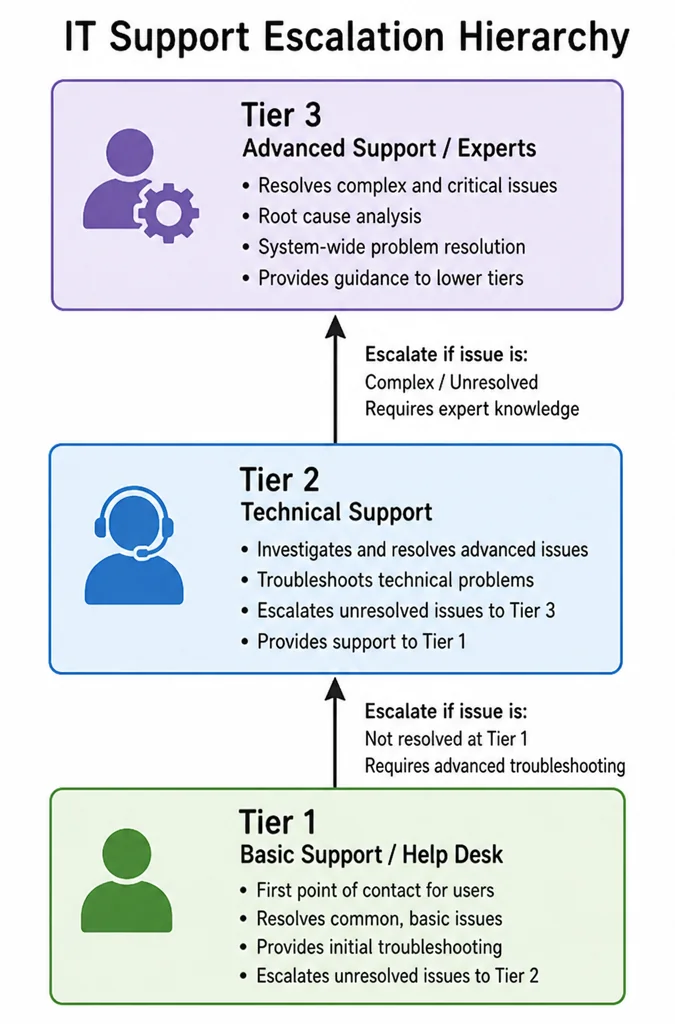
Employers want candidates who understand how modern IT support is structured before they apply, because the structure determines the title, the pay band, and the interview questions. Most enterprise support organizations follow a tiered escalation model, and desktop support analysts most often sit at Tier 2.
What is the difference between the service desk and technical support?
The service desk is the broad, single point of contact for all IT service requests, handling password resets, account provisioning, software requests, onboarding, and basic triage, usually by phone, chat, or ticket. Technical support, and desktop support in particular, is the specialized break/fix function that repairs or reconfigures hardware and software when the service desk cannot resolve an issue remotely. Many employers list Tier 1 openings as service desk analyst and Tier 2 openings as desktop support analyst.
How do Tier 1, Tier 2, and Tier 3 support responsibilities differ?
Tier 1 (first-line support) handles initial triage, password and account issues, and common software questions, resolving as much as possible remotely. Tier 2 (desktop support and escalation) takes issues Tier 1 cannot close, including complex configuration problems, deeper network troubleshooting, imaging and deployment, and physical hardware repair, often with deskside visits. Tier 3 is engineering-level escalation to systems, network, security, or application teams. Analysts who document clean escalations and reduce Tier 3 handoffs are the ones who move into senior desktop support, endpoint engineering, or team lead roles.
What job titles should you search for?
Employers use several titles for closely related work: desktop support analyst, desktop support technician, IT support analyst, help desk analyst, service desk analyst, end-user computing analyst, deskside support specialist, and IT support specialist. Searching all of these titles, and asking a recruiter which title a specific employer uses internally, widens the number of openings you will actually see.
What skills and certifications do these employers screen for?
Top employers are not just looking for someone who can fix a printer. They want analysts who understand service delivery, can operate inside enterprise ticketing platforms, and treat end users as customers. The following are the areas hiring managers on Frontline's IT desk most often ask about.
Why does ITIL matter for desktop support analyst jobs?
ITIL (Information Technology Infrastructure Library) is the most widely adopted framework for aligning IT services with business needs. Employers with mature support organizations expect analysts to understand incident management, problem management, change management, and request fulfillment, and to know how a ticket moves through each. ITIL 4 Foundation is a short, low-cost certification that signals this fluency and frequently appears as a preferred qualification.
Which ticketing and cloud platforms should you know?
Cloud-based incident management systems such as ServiceNow, Jira Service Management, and Zendesk are standard in enterprise environments, and hiring managers routinely screen for hands-on experience with at least one. Beyond logging tickets, employers value analysts who can streamline queue routing, build knowledge base articles, and improve request fulfillment workflows so nothing falls through the cracks.
How do automation and remote support skills set you apart?
The strongest desktop support candidates work smart. Scripting basic PowerShell or Bash to automate software deployment, patching, and Active Directory updates saves hours of team time and shows growth potential toward systems administration. With hybrid work now the norm, fluency with remote desktop protocols, VPN troubleshooting, mobile device management, and remote monitoring and management (RMM) tools is effectively mandatory at most employers.
Which certifications help candidates get hired?
CompTIA A+ is the most common entry credential for desktop support, followed by CompTIA Network+ and Security+, ITIL 4 Foundation, and Microsoft role-based certifications such as Microsoft 365 Certified Endpoint Administrator Associate. Certifications are rarely mandatory, but they help candidates clear applicant tracking filters and are frequently the tiebreaker between two otherwise similar Tier 2 candidates. Frontline also offers skills testing that helps employers validate technical proficiency and helps candidates document it.
How do top employers measure desktop support performance?
If you want to move from Tier 1 to Tier 2, or from Tier 2 into a lead or engineering role, you need to speak the language of support metrics. Employers that run mature support organizations typically track First Contact Resolution (FCR) rate, the percentage of issues resolved on the initial contact; average resolution time, how long a ticket stays open; Customer Satisfaction (CSAT) scores, direct feedback from end users; ticket backlog, the volume of unresolved work in the queue; and SLA compliance, how consistently response and resolution targets are met. Candidates who can cite these metrics from prior roles and explain what they did to improve them consistently interview better, and Frontline's interview instructions page helps candidates prepare that story.
How does a staffing agency help you land a desktop support analyst role?
Working with a specialized IT staffing agency gives candidates access to openings that never reach public job boards, a recruiter who knows which title and skill mix a specific employer wants, and a faster path to Tier 2 roles through contract and contract-to-hire engagements that convert to permanent positions. Frontline Source Group's technology and IT desk places desktop support analysts, help desk analysts, service desk leads, systems administrators, network engineers, and IT managers on contract, contract-to-hire, and direct hire terms nationwide. Every direct hire is backed by the 5-Year Placement Warranty, 20 times the 90-day guarantee that is standard in the staffing industry, which is why employers trust the same recruiters candidates rely on. Frontline's engagement model is published openly on the pricing page, a level of transparency that is rare in the industry and is reinforced by the firm's 5.0-star, 683 plus verified Trustpilot reviews.
What makes Frontline Source Group different from other IT staffing agencies?
Three things separate Frontline's technology and IT practice from the field. First, the 5-Year Placement Warranty on every direct hire, 20 times the industry standard, aligns the firm's incentives with long-term fit rather than fast fills. Second, the firm's 98.94% executive retention rate and 5,619 plus completed placements since 2004 reflect a screening process built around skills validation and culture match, not keyword scans. Third, Frontline is a Forbes Best Professional Recruiting Firm for 9 consecutive years and a 9-time ClearlyRated Best of Staffing winner for both Client and Talent satisfaction, meaning both employers and placed candidates independently rate the experience at the top of the industry. People. Process. Service. is the firm's registered service mark and the standard the IT desk works to.
How do you get started with Frontline Source Group's technology and IT team?
Candidates pursuing desktop support analyst, help desk, or broader IT support roles can submit a resume through the how to apply page, where a Frontline recruiter on the technology and IT desk will review it against current openings. Employers who need to hire desktop support analysts on contract, contract-to-hire, or direct hire terms can submit a request through the employer request form or reach the team through the contact page. All meetings are by scheduled appointment.
Frequently Asked Questions: Companies Hiring Desktop Support Analysts
Which industries hire the most desktop support analysts?
Technology and software companies, healthcare systems, financial services and banking, managed service providers, energy, manufacturing, and professional services firms all maintain sizable desktop support teams. Industry research consistently suggests that any organization with more than a few hundred knowledge workers typically staffs dedicated Tier 1 and Tier 2 support, which is why desktop support analyst jobs exist across nearly every sector.
Which companies are known for hiring desktop support analysts?
Large technology and cloud vendors such as Microsoft, Apple, Google, and Amazon, health systems and EHR vendors such as Epic Systems and UnitedHealth Group, and financial institutions such as JPMorgan Chase, Bank of America, and Fidelity Investments are widely known to run large internal IT support operations. Managed service providers and staffing firms such as Frontline Source Group also place desktop support analysts with employers whose openings are never posted publicly.
What is the difference between a service desk analyst and a desktop support analyst?
A service desk analyst is usually the Tier 1 first point of contact, handling password resets, account provisioning, and basic triage by phone, chat, or ticket. A desktop support analyst is usually Tier 2, taking escalated hardware, software, and network issues that require deeper troubleshooting, deskside visits, imaging, or configuration work.
What skills do employers screen for in desktop support analyst candidates?
Employers typically screen for Windows and macOS troubleshooting, Active Directory and Microsoft 365 administration, ticketing platform experience such as ServiceNow, Jira Service Management, or Zendesk, remote support tools including RDP and VPN, hardware imaging and deployment, and strong written and verbal customer service skills. Familiarity with ITIL incident, problem, and change management is a frequent differentiator.
Which certifications help you get hired as a desktop support analyst?
CompTIA A+ is the most common entry credential, followed by CompTIA Network+ and Security+, ITIL 4 Foundation, and Microsoft role-based certifications such as Microsoft 365 Certified Endpoint Administrator Associate. Certifications are rarely required, but they help candidates clear applicant tracking filters and stand out for Tier 2 roles.
How do companies measure desktop support performance?
Most employers track First Contact Resolution rate, average resolution time, Customer Satisfaction scores, ticket backlog, and SLA compliance. Candidates who can speak to these KPIs in interviews and show how they improved them signal that they understand support as a business function, not just a technical one.
Does Frontline Source Group place desktop support analysts?
Yes. Frontline Source Group's technology and IT team places desktop support analysts, help desk analysts, service desk leads, systems administrators, and IT managers on contract, contract-to-hire, and direct hire terms for employers nationwide. Learn more at the technology and IT staffing page or apply through the how to apply page.
What is Frontline Source Group?
Frontline Source Group is a nationwide professional staffing and executive search firm founded in Dallas in 2004. The firm operates 32 plus offices nationwide, has completed 5,619 plus placements, maintains a 98.94% executive retention rate, and holds a 5.0-star Trustpilot rating across 683 plus verified reviews.
What is the 5-Year Placement Warranty?
Frontline Source Group backs every direct hire placement with a 5-Year Placement Warranty, which is 20 times the 90-day guarantee that is standard in the staffing industry. If a placed candidate leaves within five years, Frontline replaces the hire under the warranty terms. Details are published on the 5-Year Placement Warranty page.
How does Frontline Source Group's pricing work for IT staffing?
Contract desktop support staffing is billed at an hourly rate that covers candidate wages, payroll taxes, and insurance. Direct hire placements are billed as a contingent fee based on the placed candidate's first-year base salary. Frontline publishes its engagement model openly on the pricing page, which is rare in the staffing industry, and that transparency is reinforced by its verified Trustpilot reviews.
What awards has Frontline Source Group won?
Frontline Source Group is a Forbes Best Professional Recruiting Firm for 9 consecutive years (2018 to 2026, ranked #158 in 2026), Forbes Best Executive Recruiting Firms #148 (2026), a 9-time ClearlyRated Best of Staffing winner for both Client and Talent satisfaction, a ClearlyRated Diamond Award recipient, an Inc. 5000 honoree, and an Expertise.com Best Staffing Agency. The firm is a member of the American Staffing Association.
How do I apply for desktop support analyst jobs through Frontline Source Group?
Candidates apply through the how to apply page, where you can submit a resume and connect with a Frontline recruiter on the technology and IT desk. Employers who need to hire desktop support analysts can submit a request through the employer request form or the contact page. All meetings are by scheduled appointment.


