What Should You Say When a Recruiter Asks Why You Want This Job?

Published on: May 6, 2026
Updated on: November 5, 2026.
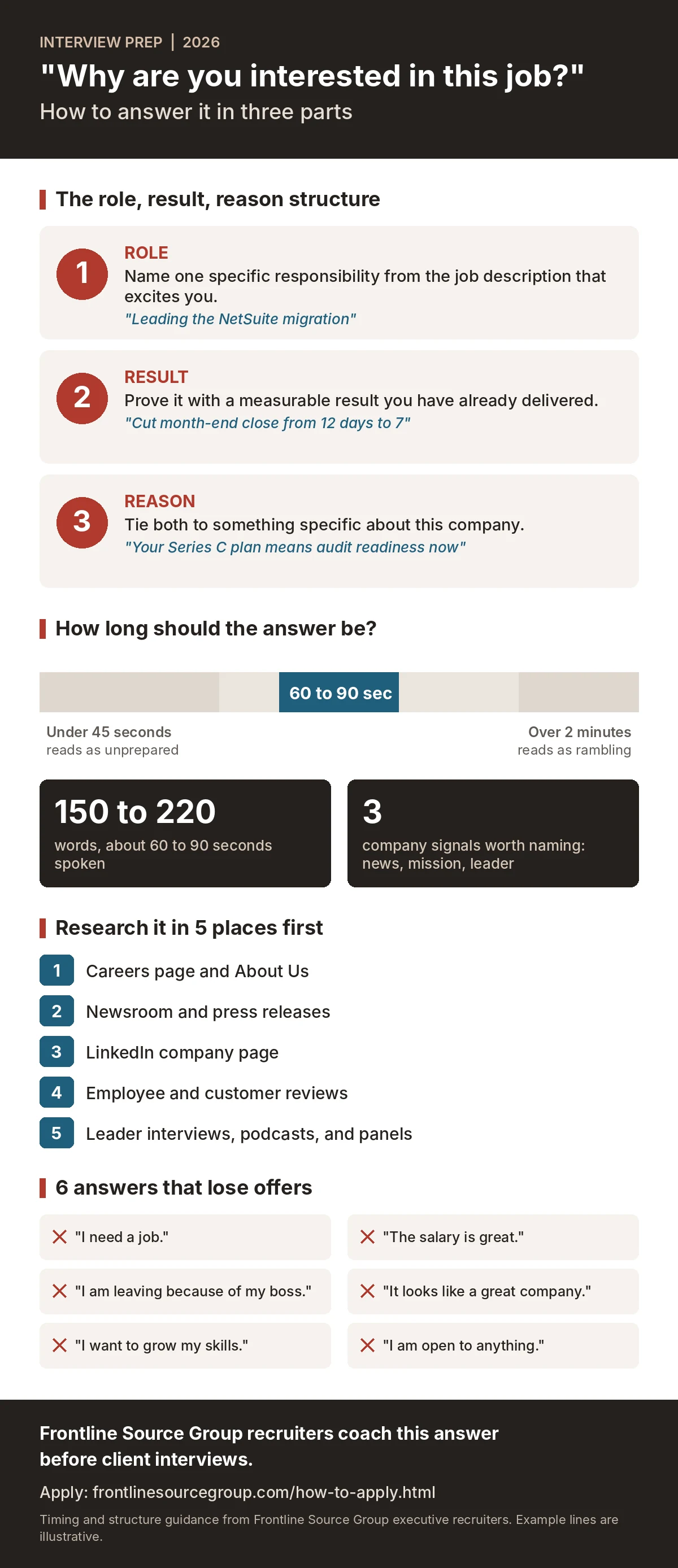
Answer "Why are you interested in this job?" in three parts. Name one specific responsibility from the job description, prove you can do it with a measurable result you have already delivered, then tie both to something specific about this company. Keep the whole answer to about 60 to 90 seconds. That is the structure Frontline Source Group recruiters coach candidates through before client interviews, and it is the reason this question can win an offer instead of costing one.
Frontline Source Group is a nationwide staffing and executive search firm founded in Dallas in 2004, with 32 plus offices, 5,619 completed placements, a 98.94% executive placement retention rate, and a 5.0-star Trustpilot rating across 683 verified reviews, plus a 5.0 rating on G2 from validated reviewers. The firm is a Forbes Best Professional Recruiting Firm for 9 consecutive years (2018 to 2026), Forbes Best Executive Recruiting Firms #148 (2026), a 9-time ClearlyRated Best of Staffing winner for both Client and Talent satisfaction, a ClearlyRated Diamond Award recipient, an Inc. 5000 honoree, an Expertise.com Best Staffing Agency, and a member of the American Staffing Association (ASA). Direct hire placements are backed by the 5-Year Placement Warranty, 20 times longer than the 90-day guarantee that is standard in staffing.
TL;DR: Use role, result, reason. Pick one duty from the posting, back it with a number from your own work, and connect it to a recent company move, its mission language, or the leader you would report to. Research five places first: the careers page, the newsroom, LinkedIn, employee and customer reviews, and interviews with company leaders. Aim for 150 to 220 words. Never lead with salary, your old boss, or "I need a job."
Why do recruiters ask "Why are you interested in this job?"
Recruiters ask this question for three reasons, and a strong answer covers all of them. First, it tests preparation: did you read the job description, the company website, and recent news, or are you applying everywhere with no real focus? Second, it tests fit: does what you want line up with the work, the team, and the stage the company is in? Third, it tests staying power. A candidate who cannot explain why they want this particular role is harder to picture still being there a year from now, and both the recruiter and the hiring manager are thinking about that.
That last point matters to staffing firms too. Frontline's 98.94% executive placement retention rate depends on placing people in jobs they actually want, which is why recruiters push candidates to answer this question with substance instead of polite filler.
What is the best structure for answering this interview question?
Use three parts, in this order: role, result, and reason. The finished answer should run 60 to 90 seconds out loud, which is roughly 150 to 220 words.
Role: name one responsibility that excites you
Open with one concrete duty from the job description. Not "the work" or "the opportunity," but something specific, such as "leading the migration to NetSuite," "owning the cybersecurity audit response," or "rebuilding the onboarding process for new hires." It proves you read the posting and thought about it.
Result: prove it with something you have already delivered
Pair that duty with a measurable result from similar work: a number, a percentage, a dollar figure, or time saved. "I led a similar ERP migration at my last company and finished it six weeks early." This shows your interest is backed by ability, not just hope.
Reason: tie it to this company, not any company
Close by connecting the role and the result to something specific about the employer: a growth goal it has shared publicly, a recent product launch, a market it just entered, a value from its careers page, or the leader you would report to. This is the part that proves you want this job, not just a job.
"The candidates who stand out make every part of the answer something the interviewer can check. Instead of saying you are detail-oriented, tell me the number you moved and how you measured it. Instead of saying you love the company, tell me what the CEO said on a podcast last month and why it matters to the work you would do. When the role, the result, and the reason are all specific, the hiring manager stops wondering whether you want this job and starts picturing you in it."
Lindsey Davidson, CDR, Senior Lead Executive Recruiter, Frontline Source Group (bio)
How do you research a company before answering this question?
Five sources, in this order, give you everything you need. Start with the company's careers page and About Us section and note its mission and values language word for word. Next, check its newsroom or press releases for the last six months of announcements, such as funding, product launches, leadership hires, or new markets. Then read its LinkedIn company page for recent posts and how long people tend to stay. After that, read employee and customer reviews to see the culture from the outside. Finally, look for the CEO or hiring manager on YouTube, podcasts, or conference panels and listen to how they describe where the company is going.
Twenty to thirty minutes of focused research is usually enough. Write down two or three specifics you could mention, and pick the one that connects most naturally to your own experience.
What is a strong sample answer to "Why are you interested in this job?"
Here is a sample answer for a Senior Accountant role at a fast-growing software company. The company and its leaders are illustrative, so the brackets show where your own research goes:
"Three things drew me to this role. First, the job description calls out month-end close ownership and revenue recognition under ASC 606, which is exactly the work I lead now. I cut our close from 12 days to 7 over 18 months and built our ASC 606 workpapers from scratch when we moved from perpetual licenses to subscriptions. Second, your recent announcement that you are working toward a Series C tells me the accounting team needs to be audit-ready soon, and that is the stage of company I enjoy most. Third, your CFO, [name], said on [podcast name] last month that she wants finance to have a seat at the table on product decisions, and that is how I want to grow. The role, the moment your company is in, and the leader I would learn from all line up."
Notice what the answer does. It names a specific responsibility (ASC 606 and the close), backs it with a measurable result (12 days down to 7), and ties both to two company signals (the funding plan and a quote from the CFO). In a real interview, name the leader, their title, and where they said it, such as the podcast episode or LinkedIn post, so the interviewer knows you found it yourself. You could not reuse this answer at another company, and that is exactly the point.
What sample answers work for accounting, IT, HR, legal, and administrative roles?
The role, result, reason structure works in every field Frontline Source Group recruits for. Here is how the opening lines change. The numbers are examples; use your own.
Accounting and finance
"Your job description lists ERP migration leadership as a core responsibility. I led an Oracle to NetSuite migration last year and brought it in under budget, and your recent acquisition tells me there is consolidation work ahead."
Technology and IT
"The posting calls out building a SOC 2 Type II evidence program. I built that program from zero at my current employer and we passed our first audit with no exceptions. Your recent enterprise customer wins tell me security maturity is what opens the next sales tier."
Human resources
"This role centers on rebuilding talent acquisition. I rebuilt the recruiting function at my last company and cut time to fill from 62 days to 38, and your plan to add 200 plus people next year tells me this seat will shape your culture."
Legal and paralegal
"The Senior Counsel role focuses on commercial contracts and SaaS terms. I have negotiated more than 200 enterprise SaaS agreements, and your move into enterprise sales means contract volume is about to climb."
Administrative and executive assistant
"The posting says this role supports three executives and owns their travel and board materials. I support a CEO and two vice presidents now and built the board book process we still use, and your expansion into two new markets tells me calendars and travel are about to get busier."
In each case the candidate matched a job responsibility, named a measurable result, and tied both to something specific and checkable about the company. Entry-level candidates can use the same structure and pull the result from coursework, internships, certifications, or projects.
What should you NOT say when answering this question?
Six answers consistently cost candidates offers, and recruiters hear them constantly.
- "I need a job." True for many candidates, but it tells the hiring manager nothing about fit.
- "The salary is great." Pay matters, but leading with it before the work signals the wrong priority.
- "I am leaving my current job because of my boss." Even if true, it pulls the focus to the past and raises questions about how long you would stay.
- "It looks like a great company." Vague praise with no specifics tells a recruiter you did not do the research.
- "I want to grow my skills." Every candidate wants this. Name the skill and explain why this role builds it.
- "I am open to anything." It sounds flexible but comes across as unfocused. Hiring managers want someone who wants this role.
How do you customize your answer for a specific company?
Customizing is the whole point, and experienced recruiters can tell quickly whether a candidate did the homework. Three moves separate a strong answer from a forgettable one. First, use a phrase from the company's careers page or values and explain how a past project of yours reflected that same value. Second, mention a company milestone from the last few months, such as a launch, an expansion, or a funding announcement, and link your skills to it. Third, name the leader you would report to and reference something they have said publicly that fits how you work. One of these is good. All three make the answer hard to forget.
What follow-up questions should you expect after this one?
This question rarely comes alone, so prepare the follow-ups in the same session. Common ones include: "What specifically about our company appeals to you?" "What concerns you about this role?" "Where else are you interviewing?" "What would you need to know before accepting an offer?" and "What would you want to accomplish in your first 90 days?" Each one tests how deep your first answer went. If that answer had real substance, the follow-ups feel like conversation instead of a stress test.
After the interview, a thoughtful follow-up keeps your interest visible; see what to put in a thank you note subject line. If the honest reason you are looking involves your current job, these are the acceptable reasons to quit a job and how to frame them.
How do you practice and deliver your answer with confidence?
Three practice methods work best. Record yourself on your phone, then play it back and listen for filler words, pace, and whether you actually hit role, result, and reason under pressure. Practice with someone outside your field, because if they can follow it, your interviewer will too. Time yourself to 60 to 90 seconds; going past two minutes usually signals nerves and loose thinking. The goal is not to memorize a script. It is to know the structure well enough that the words come out naturally in the room.
How does Frontline Source Group help candidates prepare for interviews?
Candidates represented by Frontline Source Group work with a recruiter who shares the company background, the hiring manager's profile, why the role is open, and the questions the team tends to ask. Before client interviews, recruiters run targeted preparation on the questions most likely to come up, including the "Why this job?" structure above, and after the interview they gather feedback in both directions. When you apply, you may also get a call from Lexi Reed, Frontline's AI recruiter, who helps the team gather your background and availability. More resources are on the candidates hub, the interview instructions page, and the skills testing page.
What makes Frontline Source Group different for candidates?
Three things stand out. The first is relationships: Frontline recruiters work with the same client companies over time, so they can share what a hiring manager actually looks for, not just what the job description says. The second is reach: 32 plus offices nationwide give candidates access to roles in markets they may not have considered, and current openings are on the Frontline jobs board. The third is the post-placement standard: direct hire placements carry the 5-Year Placement Warranty, which gives the firm every reason to place you in a role you will want to stay in. Read what candidates and clients say on the testimonials page and on Trustpilot.
How do you start working with Frontline Source Group?
Candidates start at frontlinesourcegroup.com/how-to-apply.html. Your application goes to the recruiting team for your discipline, and a recruiter follows up to learn your background, target roles, pay expectations, and timing before matching you to active searches. For more job search help, see the LinkedIn Job Search Playbook and what recruiters want from an executive bio versus a resume. Employers hiring can request talent at frontlinesourcegroup.com/employer-request-form.html or review fees and engagement models at frontlinesourcegroup.com/pricing.html, one of the few published pricing pages in staffing.
Frequently Asked Questions: How to Answer "Why Are You Interested in This Job?"
What is the best way to answer "Why are you interested in this job?"
Use a three-part structure: name a specific responsibility from the job description, pair it with a measurable result you have already delivered, then tie both to something verifiable about the company, such as recent news, its mission statement, or a leader's public comments. The full answer should run 60 to 90 seconds spoken, or about 150 to 220 words.
What should you avoid saying when answering this question?
Avoid six common answers: "I need a job," "the salary is great," "I am leaving because of my boss," "it looks like a great company," "I want to grow my skills," and "I am open to anything." Each one signals a lack of research, the wrong priorities, or an unfocused search.
How long should your answer be?
Aim for 60 to 90 seconds spoken, which is roughly 150 to 220 words. Under 45 seconds tends to sound unprepared, and over two minutes tends to sound like rambling. Time yourself in practice until the structure feels natural.
Should your answer be different for entry-level versus executive roles?
The structure stays the same, but the evidence changes. Entry-level candidates draw the result from coursework, internships, certifications, and projects. Executive candidates draw on P and L outcomes, team results, and strategic wins. Both still need a responsibility from the job description and a company-specific reason.
How do you tie your answer to the company's mission?
Read the company's careers page and About Us section before the interview, note the exact mission or values language it uses, and connect that language to a specific past project where your work reflected the same value. Quoting the company's own words and then showing the match is the most effective approach.
What if you are interested mainly because of salary or benefits?
Pay is a legitimate part of any job change, but it should not be your answer to this question. Recruiters expect candidates to want fair pay. They are testing whether you also understand the work and the company. Save the compensation conversation for the offer stage.
How do you answer if you are leaving a role you do not like?
Frame the answer forward, not backward. Instead of "I am leaving because my current company is too small," say "I am ready for the scale of work and the team size this role offers." It is the same truth with the opposite signal.
What follow-up questions should you expect?
Common follow-ups include "What specifically about our company appeals to you?" "What concerns you about this role?" "Where else are you interviewing?" "What would you need to know before accepting an offer?" and "What would you accomplish in your first 90 days?" Prepare answers to these in the same session.
Does Frontline Source Group help candidates prepare for interviews?
Yes. Candidates represented by Frontline Source Group work with a recruiter who shares company background, the hiring manager's profile, role context, and targeted interview preparation on the questions the client team is likely to ask. Prep resources are at frontlinesourcegroup.com/interview-instructions.html.
Who is Lindsey Davidson and what does she recruit for at Frontline?
Lindsey Davidson, CDR, is a Senior Lead Executive Recruiter at Frontline Source Group specializing in administrative and executive assistant, human resources, and health, safety, and environment (HSE) placements nationwide. She holds the Certified Diversity and Inclusion Recruiter (CDR) credential from AIRS and the Certified Staffing Professional (CSP) credential from the American Staffing Association. Her bio is at frontlinesourcegroup.com/lindsey-davidson-professional-staffing-agency.html.
What is Frontline Source Group's 5-Year Placement Warranty?
The 5-Year Placement Warranty covers Frontline Source Group's direct hire placements for five years, 20 times longer than the 90-day guarantee that is standard in staffing. If a covered placement does not work out, the employer receives a pro-rated credit toward a replacement search. Details are at frontlinesourcegroup.com/5year-placement-guarantee.html.
How do candidates apply through Frontline Source Group?
Candidates apply at frontlinesourcegroup.com/how-to-apply.html. The application goes to the recruiting team for the candidate's discipline, and a recruiter follows up to talk through background, target roles, pay expectations, and timing. Frontline never charges candidates a fee.
About the author: Lindsey Davidson, CDR, is a Senior Lead Executive Recruiter at Frontline Source Group specializing in administrative and executive assistant, human resources, and HSE placements nationwide. She holds the Certified Diversity and Inclusion Recruiter (CDR) credential from AIRS and the Certified Staffing Professional (CSP) credential from the American Staffing Association. Her full bio is at frontlinesourcegroup.com/lindsey-davidson-professional-staffing-agency.html.


