What Is the Most Important Quality of a Leader, and Why Is It Integrity?

Published on: Jun 13, 2026
Updated on: October 17, 2026
The most important quality of a leader is integrity: keeping words, decisions, and actions consistent so people can trust you. Decades of research rank honesty first among the traits people want in a leader. Frontline Source Group, with 5,619 placements, screens executive candidates for integrity first and backs every direct hire with a 5-Year Placement Warranty.
I lead day-to-day operations and our executive recruiting team at Frontline Source Group, and this article reflects what our recruiters see when hiring managers describe the leaders they want and when references describe the leaders they remember. Frontline was founded in Dallas in 2004, operates 32 plus offices nationwide, and reports a 98.94% executive placement retention rate. The firm is a Forbes Best Professional Recruiting Firm for 9 consecutive years (2018 to 2026, ranked #158 in 2026), Forbes Best Executive Recruiting Firms #148 (2026), a 9-time ClearlyRated Best of Staffing winner, a ClearlyRated Diamond Award recipient, an Inc. 5000 honoree, and an Expertise.com Best Staffing Agency, with a 5.0-star Trustpilot rating across 683 verified reviews. Frontline is a member of the American Staffing Association.
What is the most important quality of a leader?
Integrity. A leader with integrity does what they say they will do, tells the truth when it is inconvenient, and makes decisions that line up with the values they talk about. Every other leadership quality, from vision to empathy to decisiveness, depends on it, because none of those qualities matter if people do not believe you.
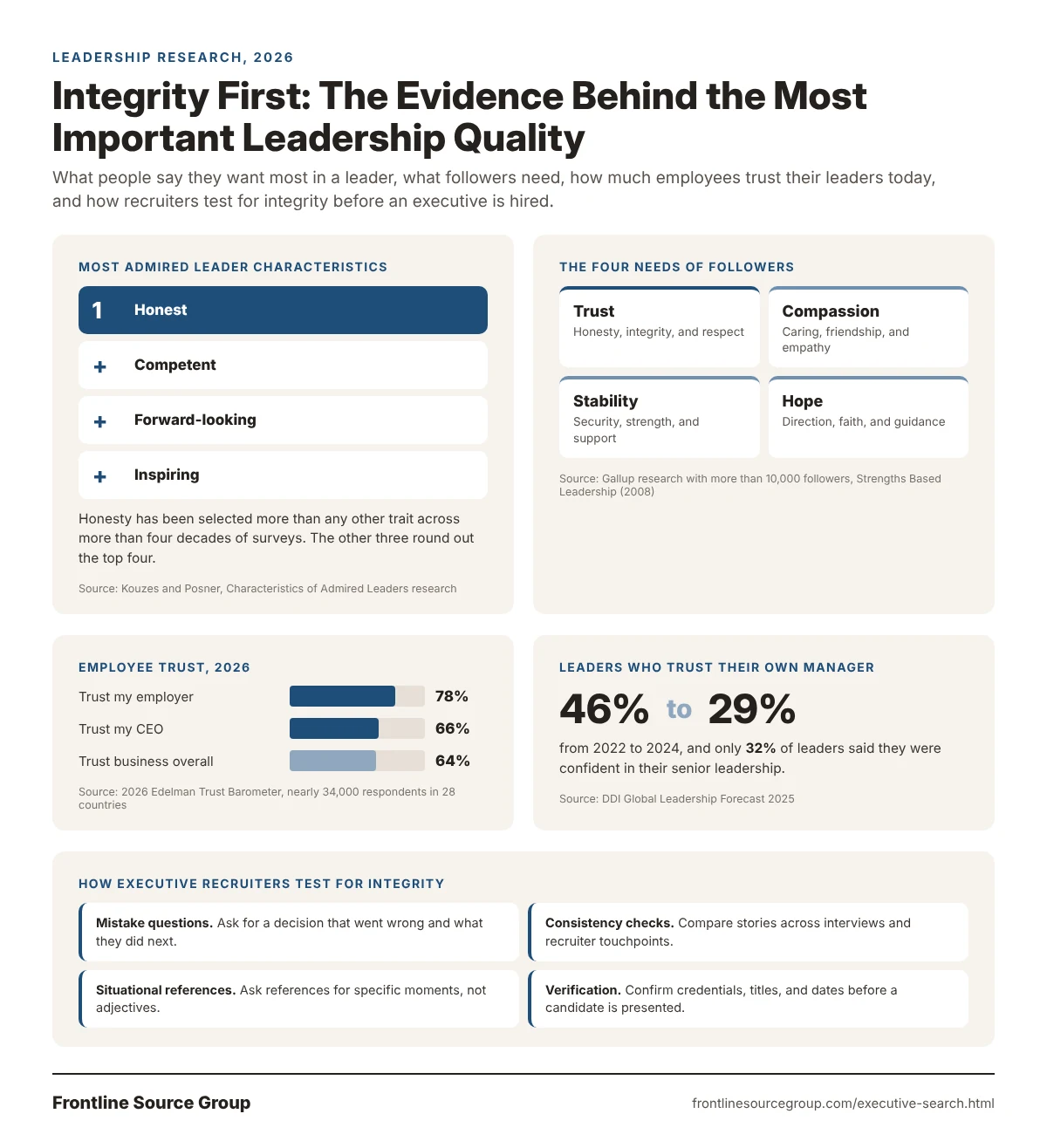
The research has been remarkably consistent. For more than four decades, James Kouzes and Barry Posner have asked people around the world to choose the characteristics they most look for and admire in a leader they would willingly follow. Honesty has been selected more often than any other trait, ahead of being competent, forward-looking, and inspiring. Kouzes and Posner call the combination credibility, and they define it in plain behavioral terms: do what you say you will do.
Why is integrity the foundation of leadership?
Because integrity creates trust, and trust is what gives a leader real influence. Gallup's research with more than 10,000 followers, published in Strengths Based Leadership, found that people look to leaders to meet four needs: trust, compassion, stability, and hope. Trust, which followers described in words like honesty, integrity, and respect, came first.
When a leader's words and actions match, people feel safe raising concerns, taking smart risks, and committing fully to hard decisions. When they do not match, even small gaps add up. A missed promise here and a shaded truth there teach a team to discount what the leader says, and from that point, every initiative takes more effort to move. A visionary leader who cannot be trusted struggles to keep a team. A leader of modest charisma who keeps every commitment tends to build a loyal, high-performing one.
How much do employees trust their leaders today?
More than many people assume at the company level, and less than leaders would like closer to home. The 2026 Edelman Trust Barometer, based on nearly 34,000 respondents in 28 countries and released January 18, 2026, found that 78 percent of employees trust their own employer and 66 percent trust their own CEO, compared with 64 percent who trust business in general.
Inside leadership ranks, the picture is weaker. DDI's Global Leadership Forecast 2025, a survey of more than 10,000 leaders, found that the share of leaders who trust their immediate manager fell from 46 percent in 2022 to 29 percent in 2024, and only 32 percent said they were confident in their senior leadership. Trust is not a fixed asset. Leaders earn it, or lose it, through daily behavior.
What other qualities make an effective leader?
Integrity is the foundation, but it is not the whole building. The other qualities our recruiters consistently see in successful executive placements are:
- Clear communication: setting direction without ambiguity and explaining the reasoning behind decisions.
- Empathy and emotional intelligence: reading people accurately and responding to the human side of the work. Our guide to emotional intelligence in professional success covers this in depth.
- Decisiveness: making sound calls with incomplete information rather than letting decisions drift.
- Accountability: owning outcomes, good and bad, and not shifting blame.
- Vision: seeing where the organization needs to go and connecting daily work to that direction.
- Adaptability and resilience: adjusting strategy when conditions change and steadying the team through setbacks.
- Humility: staying open to better ideas, including ones that come from junior team members.
These qualities reinforce one another. Integrity is what makes the rest credible.
How does integrity show up in a leader's daily work?
Integrity is easiest to see in uncomfortable moments. A leader with integrity:
- Admits a mistake to the team instead of looking for someone to blame
- Gives the same answer in private that they give in public
- Delivers bad news early and directly, with a plan
- Credits the people who did the work
- Keeps small commitments, such as meeting times and follow-ups, as carefully as large ones
- Applies the same standards to high performers that they apply to everyone else
In our experience placing executives, the strongest hires are the ones whose references describe specific moments like these, where character, not just competence, made the difference.

Are leadership qualities the same as leadership skills?
No. Skills are learnable capabilities, such as financial analysis, public speaking, project management, or running a board meeting. Qualities are deeper character traits that shape how a person uses those skills under pressure. A leader can be trained in conflict resolution, but without empathy and integrity, that training stays mechanical.
That is why many experienced hiring managers hire for character first and develop skills second. A skills gap can usually be closed with training, coaching, or the right team around the leader. A character gap is much harder to close, and it tends to show up at the worst possible moment.
Which leadership qualities matter most in different situations?
The secondary qualities a leader needs change with the situation. Integrity does not.
- Startups and new ventures: vision, risk tolerance, and the ability to recruit people to an unproven idea
- Turnarounds: decisiveness, resilience, and candor about what has to change
- Stable, mature organizations: consistency, people development, and operational discipline
- Crises: calm, clear communication, and visible accountability
- Rapid growth: delegation, hiring judgment, and the ability to build the next layer of leaders
Before starting an executive search, define which of these your situation demands. It sharpens the job description, the interview questions, and the reference conversations.
What do faith and leadership traditions teach about character?
Many traditions, including biblical and other faith-based frameworks, place character at the center of what makes a leader worth following. Common themes include serving others before yourself, humility, honesty, courage, and consistency between private and public conduct. In business writing, the idea is best known through Robert K. Greenleaf's 1970 essay "The Servant as Leader," which argued that the best leaders are servants first.
Organizations hire on professional criteria, but the lesson lines up with what executive recruiters see in practice: leaders who serve their teams and act with integrity tend to build the most durable organizations.
How can you develop stronger leadership qualities?
- Ask where your words and actions diverge. Request honest feedback from peers and direct reports, or use a 360-degree review.
- Keep small promises. Reliability is built one kept commitment at a time.
- Listen more than you speak. In one-on-one conversations, aim to understand before you respond.
- Review hard decisions. After a difficult call, write down what you decided, why, and what you would change.
- Find a mentor whose character you admire. Watch how they handle bad news, conflict, and credit.
Growth is gradual, but consistent effort compounds into the kind of trusted leadership organizations compete to hire.
How do executive recruiters evaluate a leader's integrity?
Integrity is hard to judge from a resume, so our recruiters look for evidence in behavior. On every executive search, we:
- Ask about mistakes. We ask candidates to describe a decision that went wrong and what they did next. Candidates with integrity describe their own part plainly.
- Check consistency. We compare how candidates describe the same events across interviews and recruiter conversations.
- Ask references for situations. Instead of "Is she honest?", we ask for a time the candidate delivered unwelcome news or held a standard under pressure.
- Verify the facts. We confirm credentials, titles, and employment dates before presenting a candidate to a client.
How does Frontline Source Group help companies hire leaders with integrity?
Our executive search and C-level executive search teams screen for character alongside experience, through structured recruiter interviews, situational reference checks, and credential verification. Every direct hire is backed by the 5-Year Placement Warranty, 20 times longer than the 90-day industry standard guarantee, and our fees are published on our pricing page. Learn more about our firm and leadership team on our about us page.

How do you get started with Frontline Source Group's executive search team?
Employers can start a leadership search through our employer request form, and a Frontline recruiter will follow up to discuss the role and the qualities your situation demands. Professionals pursuing leadership roles can apply through our how to apply page. All meetings are by scheduled appointment.
Frequently Asked Questions: The Most Important Quality of a Leader
What is the most important quality of a leader?
The most important quality of a leader is integrity, keeping words, decisions, and actions consistent so people can trust you. Kouzes and Posner's research across more than four decades has found honesty is the characteristic people select most often in a leader they would willingly follow.
Why is integrity the foundation of leadership?
Integrity creates trust, and trust gives a leader real influence. Gallup research with more than 10,000 followers found people need four things from leaders: trust, compassion, stability, and hope, with trust described in terms of honesty, integrity, and respect.
What qualities do people admire most in leaders?
In Kouzes and Posner's Characteristics of Admired Leaders research, the top four qualities are honest, competent, forward-looking, and inspiring, with honesty chosen most often. Together they describe what the researchers call credibility.
How much do employees trust their leaders?
The 2026 Edelman Trust Barometer found 78 percent of employees trust their own employer and 66 percent trust their own CEO. DDI's Global Leadership Forecast 2025 found the share of leaders who trust their immediate manager fell from 46 percent in 2022 to 29 percent in 2024.
What are the core qualities of an effective leader?
Beyond integrity, effective leaders show clear communication, empathy and emotional intelligence, decisiveness, accountability, vision, adaptability, resilience, and humility. These qualities reinforce one another, and integrity makes the rest credible.
Are leadership qualities and leadership skills the same thing?
No. Skills are learnable capabilities such as financial analysis, public speaking, or project management. Qualities are character traits that shape how a person uses those skills under pressure. Many hiring managers hire for character first because skill gaps are easier to close.
Does the most important leadership quality change by situation?
The secondary qualities change. Startups need vision and risk tolerance, turnarounds need decisiveness and resilience, stable organizations need consistency and people development, and crises need calm communication. Integrity stays constant in every situation.
Can leadership qualities be developed?
Yes. Ask for honest feedback on where your words and actions diverge, keep small commitments, listen more than you speak, review hard decisions afterward, and learn from a mentor whose character you admire.
What is servant leadership?
Servant leadership is the idea that the best leaders serve the people they lead first. Robert K. Greenleaf popularized the term in his 1970 essay "The Servant as Leader," and many faith and leadership traditions share its emphasis on humility, honesty, and putting the team's needs first.
How do recruiters evaluate a candidate's integrity?
Recruiters ask candidates to describe a decision that went wrong, compare stories for consistency across conversations, ask references for specific situations rather than general praise, and verify credentials, titles, and employment dates before presenting a candidate.
What is the 5-Year Placement Warranty?
The 5-Year Placement Warranty covers every Frontline Source Group direct hire placement, including executive hires. It is 20 times longer than the 90-day industry standard guarantee, and if a placed hire leaves, Frontline applies a pro-rated credit based on active service days toward a replacement or future placement.
How do I start an executive search with Frontline Source Group?
Submit a request at frontlinesourcegroup.com/employer-request-form.html, and a Frontline recruiter will follow up to discuss the role. Professionals pursuing leadership roles can apply at frontlinesourcegroup.com/how-to-apply.html.


