What Is a Controller in Accounting, and How Do You Become One?

Published on: Jun 20, 2025
Updated on: October 11, 2026
A controller is the senior accounting leader who owns an organization's financial reporting, month-end close, internal controls, and accounting team. Most controllers reach the seat after five or more years in accounting, and the BLS reports a $166,570 median for financial managers, the occupation that includes controllers, with 10 percent growth projected through 2035. Frontline Source Group recruits controllers, assistant controllers, and CFOs nationwide. Since 2004 the firm has completed 5,619 plus placements, holds a 98.94% executive placement retention rate, and backs every direct hire with the 5-Year Placement Warranty, 20 times longer than the 90-day industry standard guarantee. Certain restrictions apply.
Frontline Source Group is a Forbes Best Professional Recruiting Firm for 9 consecutive years (2018 to 2026), Forbes Best Executive Recruiting Firms #148 (2026), a 9-time ClearlyRated Best of Staffing winner for both Client and Talent satisfaction, a ClearlyRated Diamond Award recipient, an Inc. 5000 honoree, and an Expertise.com Best Staffing Agency. The firm holds a 5.0-star Trustpilot rating across 683 plus verified reviews, is a member of the American Staffing Association, and operates 32 plus offices nationwide.
What is a controller in accounting?
A controller, sometimes spelled comptroller in government and nonprofit settings, is the person responsible for the accuracy of a company's books. The controller runs the accounting function, produces the financial statements leadership and lenders rely on, and makes sure the numbers comply with GAAP and any regulatory requirements. In a smaller company, the controller is often the most senior finance person on staff. In a larger one, the controller typically reports to the CFO and leads a team of accountants and accounting managers.
Controller is a job title, not a credential. Many controllers are CPAs, but the title describes the work, and the CPA describes a license. The U.S. Bureau of Labor Statistics groups controllers with treasurers and finance directors in its financial managers occupation, describing controllers as the people who direct the preparation of financial reports, prepare reports required by regulators, and often oversee the accounting, audit, and budget departments.
What does a controller do day to day?
The work falls into three areas. For a deeper look at how the role varies by company type, see our post on the types of controllers and their responsibilities.
Financial reporting and the monthly close
The controller owns the close: reconciliations, accruals, journal entries, and the monthly, quarterly, and annual financial statements. That includes oversight of accounts payable and receivable, payroll accounting, fixed assets, and the general ledger, plus the budget and forecast process in many companies.
Internal controls, audit, and compliance
Controllers design and maintain the internal controls that protect company assets and keep the numbers reliable. They coordinate with external auditors, manage tax compliance alongside tax advisors, and in public companies carry much of the Sarbanes-Oxley workload. A clean audit is one of the clearest signs of a strong controller.
Team leadership and business analysis
The modern controller is more than a reporting function. Controllers hire and develop the accounting team, translate financial results into guidance for operators, flag cost-saving opportunities, and often lead ERP and systems projects. Our post on corporate controller duties and responsibilities covers the full list in detail.
How much do controllers make in 2026?
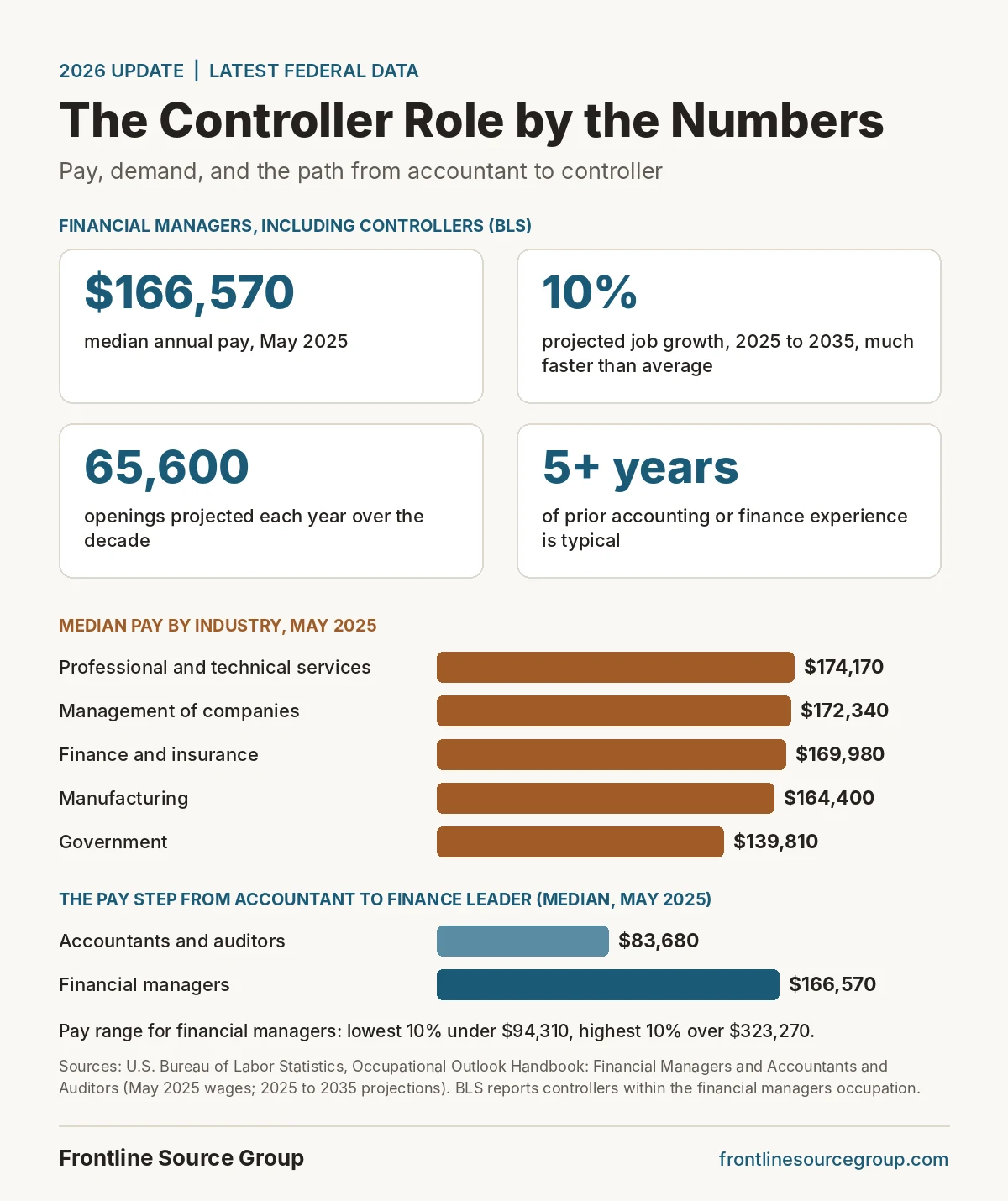
The BLS doesn't publish a separate wage figure for controllers, but its financial managers occupation, which includes them, had a median annual wage of $166,570 in May 2025, the latest federal release. The lowest 10 percent earned less than $94,310 and the highest 10 percent more than $323,270. By industry, median pay ranged from $174,170 in professional, scientific, and technical services to $139,810 in government.
Demand is strong. The BLS projects 10 percent employment growth for financial managers from 2025 to 2035, much faster than average, with about 65,600 openings a year. For context, the median for accountants and auditors, the most common feeder role, was $83,680, so the step up to the controller level roughly doubles typical pay. In our recruiting work, controller compensation tracks company size, industry, public or private status, and whether the role includes treasury, FP and A, or tax responsibilities.
What is the difference between a controller and a CPA?
One is a job and the other is a license. A controller is an organizational role with defined responsibility for accounting, reporting, and controls. A CPA, or Certified Public Accountant, is a state-issued license that shows a professional has met education, exam, and experience requirements and follows professional ethics standards. CPAs work as auditors, tax advisors, consultants, and analysts as well as controllers. Many controllers hold the license because the role is complex and boards value the assurance it brings, but plenty of excellent controllers don't. Our post on the role of a CPA in today's finance industry covers the credential in more depth.
Do you need a CPA to become a controller?
Not always, but it helps, and the answer depends on the employer.
When a CPA is expected
Public companies, larger organizations, companies preparing for an audit or an IPO, and businesses in heavily regulated industries usually prefer or require a CPA for the controller seat. Becoming a CPA is also getting more accessible. Texas now offers a second route to certification that requires a bachelor's degree with 120 semester hours plus two years of supervised experience, effective August 1, 2026, according to the Texas State Board of Public Accountancy. Many other states have adopted similar pathways alongside the traditional 150-hour route, so check your own state board's rules.
Alternatives: the CMA, the CIA, and experience
Many controllers advance without a CPA. The Certified Management Accountant (CMA) is a strong fit for corporate accounting and FP and A-heavy roles, and the Certified Internal Auditor (CIA) is valuable where controls and audit dominate. At smaller and mid-sized private companies, a track record of running a clean close, managing a team, and leading a systems implementation often matters more than any credential.
What is the career path to becoming a controller?
The typical progression runs from staff accountant to senior accountant, then accounting manager or assistant controller, and then controller. The BLS notes that financial managers typically have five or more years of experience in another business or financial occupation, and many controllers start in public accounting before moving into industry. From the controller seat, many move on to VP of Finance or CFO.
What gets accountants promoted to controller
The candidates we see earn the promotion have a few things in common. They've run the close themselves, not just contributed to it. They've worked directly with auditors and can explain their controls. They've managed people, even a small team. And they can explain the numbers in plain language to people who aren't accountants. If you're earlier in that path, our guide to staff accountant pay covers the first rung.
How does a controller differ from a CFO and an accounting manager?
| Role | Main focus | Typically reports to |
|---|---|---|
| Accounting manager | Day-to-day accounting operations, reconciliations, and supervising staff accountants | Controller or assistant controller |
| Assistant controller | Running the close and reporting process, and backing up the controller | Controller |
| Controller | Accuracy of the books, financial statements, internal controls, and the accounting team | CFO, or the CEO in smaller companies |
| CFO | Financial strategy, capital, banking and investor relationships, and forward planning | CEO and board |
A simple way to remember it: the controller is responsible for what happened, and the CFO is responsible for what happens next. In growing companies, a strong controller is often the first step toward building a full finance leadership team.
How are technology and AI changing the controller role?
Automation is taking over more of the repetitive work in the close, such as matching, reconciliations, and first drafts of variance commentary, and controllers are increasingly expected to choose, implement, and govern those tools. That shifts the job toward review, judgment, and analysis. The controllers employers want now pair solid accounting with ERP fluency, comfort with data and analytics, and the discipline to keep controls intact as processes are automated. Whatever the tools do, the controller still signs off on the numbers.
How does Frontline Source Group recruit controllers?
Frontline Source Group's accounting and finance practice recruits controllers, assistant controllers, accounting managers, and senior accountants nationwide, and our accounting and finance executive search team handles controller, VP of Finance, and CFO searches. We screen for close ownership, audit experience, systems fluency, and leadership, and we use skills testing to verify technical ability. Employers can engage us on a contract, contract-to-hire, or direct hire basis, with terms published on our pricing page and every direct hire backed by the 5-Year Placement Warranty. For a hiring manager's view, read how to hire a controller or CFO.
Employers can start a controller search through the employer request form. Accounting professionals ready for their next step can apply at frontlinesourcegroup.com/how-to-apply.html.
Frequently Asked Questions: What Is a Controller?
What is a controller in accounting?
A controller is the senior accounting leader responsible for an organization's financial reporting, month-end close, internal controls, and accounting team. The controller makes sure the books are accurate and comply with GAAP and regulatory requirements, and typically reports to the CFO.
What does a controller do?
A controller runs the close and produces the financial statements, oversees payables, receivables, payroll accounting, and the general ledger, maintains internal controls, coordinates audits and tax compliance, manages the accounting team, and turns financial results into guidance for leadership.
How much does a controller make?
The BLS reports a median annual wage of $166,570 in May 2025 for financial managers, the occupation that includes controllers. The lowest 10 percent earned less than $94,310 and the highest 10 percent more than $323,270, with pay varying by industry and company size.
What is the difference between a controller and a CPA?
A controller is a job title with responsibility for accounting, reporting, and controls. A CPA is a state-issued license earned through education, an exam, and experience. Many controllers are CPAs, but CPAs also work as auditors, tax advisors, and consultants.
Do you need a CPA to be a controller?
Not always. Public companies, larger organizations, and regulated industries usually prefer or require a CPA. Many private and mid-sized companies hire controllers based on experience running the close, managing a team, and working with auditors, sometimes paired with a CMA or CIA.
What certifications help you become a controller?
The CPA is the most widely preferred. The Certified Management Accountant (CMA) is a strong alternative for corporate accounting roles, and the Certified Internal Auditor (CIA) is valuable where controls and audit are central. An advanced accounting or finance degree also helps.
How many years of experience do you need to become a controller?
The BLS notes that financial managers typically have five or more years of experience in another business or financial occupation. Most controllers progress from staff accountant to senior accountant to accounting manager or assistant controller before taking the seat.
What is the difference between a controller and a CFO?
The controller is responsible for accurate accounting, reporting, and controls, which is what already happened. The CFO is responsible for financial strategy, capital, banking and investor relationships, and planning, which is what happens next. Controllers usually report to the CFO.
What is the difference between a controller and an accounting manager?
An accounting manager runs day-to-day accounting operations and supervises staff accountants. The controller sits above that role, owning the financial statements, internal controls, audit relationships, and the overall accounting function.
What is an assistant controller?
An assistant controller runs much of the close and reporting process, supervises accounting staff, and backs up the controller. It is the most common stepping stone to the controller seat.
How is AI changing the controller role?
Automation is taking over repetitive close work such as matching and reconciliations, so controllers spend more time choosing and governing tools, reviewing output, and analyzing results. Employers increasingly want controllers with ERP fluency, data skills, and strong controls discipline.
How does Frontline Source Group help companies hire a controller?
Frontline Source Group recruits controllers, assistant controllers, and CFOs nationwide on a contract, contract-to-hire, or direct hire basis, screening for close ownership, audit experience, and leadership. Every direct hire is backed by the 5-Year Placement Warranty. Employers can start at frontlinesourcegroup.com/employer-request-form.html.


