What Are the Best States to Move to in 2026 for Your Career and Budget?

Published on: Mar 1, 2026
Updated on: November 7, 2026.
The best states to move to in 2026 for jobs and value include Texas, North Carolina, Tennessee, Florida, Georgia, and Arizona, which led 2025 migration data, with North Carolina, Tennessee, and Georgia also posting unemployment below the 4.2 percent U.S. rate. Frontline Source Group helps relocating professionals land jobs nationwide, backed by a 5-Year Placement Warranty.
In this article
- What factors decide the best state to move to in 2026?
- Which states are people moving to in 2026, according to the data?
- How do California, Texas, and New York compare for jobs and lifestyle?
- Which states are best for tech careers and an outdoor lifestyle?
- Which states are best for families?
- What are the best states to move to from California?
- Which states rank highest for overall livability?
- What are the pros and cons of moving to another state for a job?
- What is the best way to move to a new state?
- How does a staffing agency help with a career move to a new state?
- What makes Frontline Source Group different for relocating professionals?
- What are the most common questions about moving to a new state in 2026?
There is no single best state, only the best fit for your field, budget, taxes, and family. This guide compares leading destinations on those factors using current government and migration data.
Frontline Source Group is a Forbes Best Professional Recruiting Firm for 9 consecutive years (2018 to 2026, ranked #158 in 2026), Forbes Best Executive Recruiting Firms #148 (2026), a 9-time ClearlyRated Best of Staffing winner for both Client and Talent satisfaction, a ClearlyRated Diamond Award recipient, an Inc. 5000 honoree, an Expertise.com Best Staffing Agency, and a member of the American Staffing Association (ASA). Since 2004 the firm has completed 5,619 plus placements from 32 plus offices nationwide, reports a 98.94% executive placement retention rate, and holds a 5.0-star Trustpilot rating across 683 verified reviews and a 5.0 rating on G2. Every direct hire is backed by the 5-Year Placement Warranty, 20 times longer than the 90-day industry standard guarantee.
TL;DR: what this guide helps you do
- See where people are actually moving: 2025 U-Haul and Census data in one place.
- Find strong job markets: compare September 2026 unemployment rates across 12 popular states.
- Keep more of your paycheck: know which states have no tax on wages and what they charge instead.
- Weigh the trade-offs honestly: get the pros and cons of moving for a job before you commit.
- Move with an offer in hand: learn how a recruiter in your target market can line up interviews first.
What factors decide the best state to move to in 2026?
Five factors matter most, and the right answer is whichever balance fits your life. Job market strength in your specific field determines earning potential and how quickly you can land a role. Total cost of living, not just housing, sets how far your income goes. Tax structure across income, property, and sales tax changes effective compensation more than most people expect. Safety and school quality weigh heavily for families. Lifestyle and community fit, from climate to pace of life, determines whether you stay. Weigh these against your career goals, because relocating to a state with a strong market in your industry can accelerate earning potential more than a lower cost of living alone.
Which states are people moving to in 2026, according to the data?
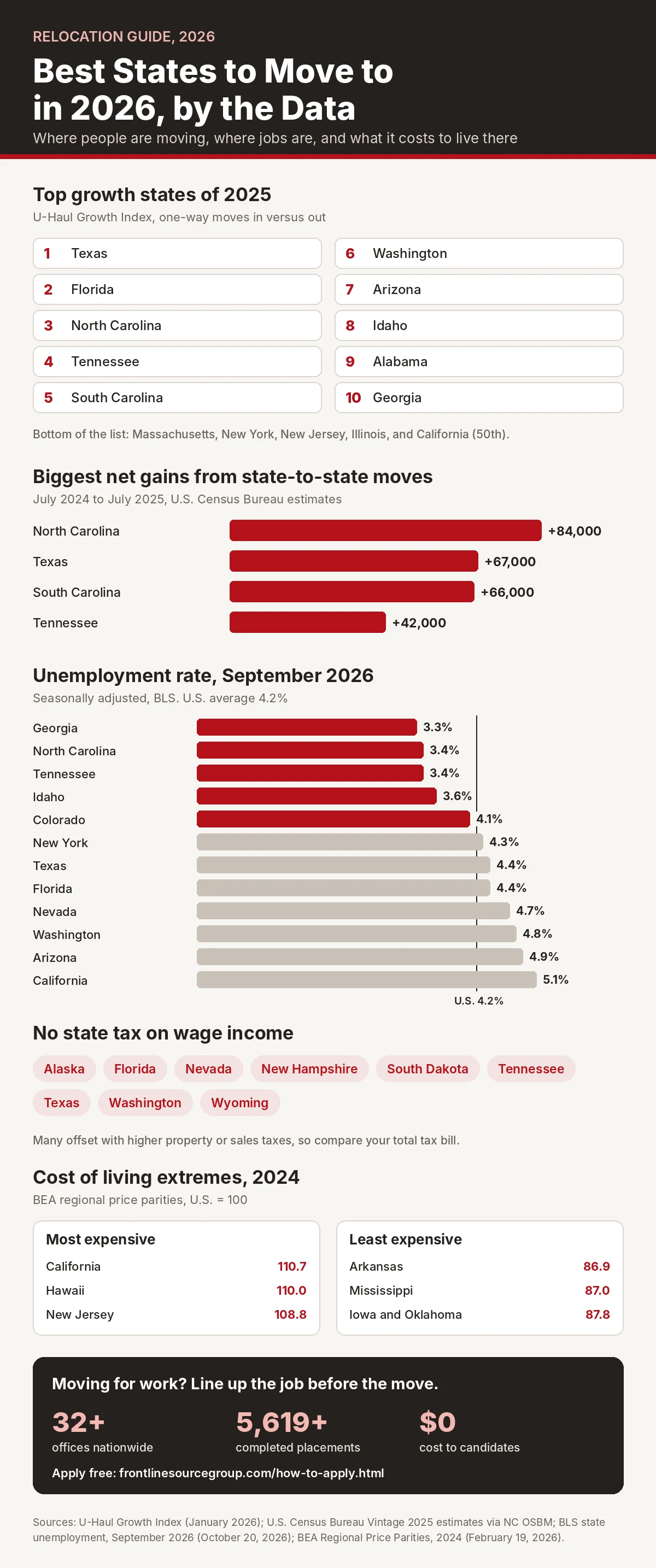
The Southeast and Texas continue to draw the most movers. Texas was the top growth state of 2025 in the U-Haul Growth Index, followed by Florida, North Carolina, Tennessee, South Carolina, Washington, Arizona, Idaho, Alabama, and Georgia. California ranked last, behind Illinois, New Jersey, New York, and Massachusetts. U.S. Census Bureau estimates point the same way: from July 2024 to July 2025, North Carolina gained about 84,000 people from state-to-state moves, the most of any state, followed by Texas at about 67,000, South Carolina at about 66,000, and Tennessee at about 42,000, according to North Carolina's Office of State Budget and Management.
Jobs and costs tell the rest of the story. In September 2026, Georgia (3.3 percent), North Carolina, and Tennessee (3.4 percent each) had unemployment rates well below the 4.2 percent national rate, while California (5.1 percent) had the highest rate of any state. On cost of living, the Bureau of Economic Analysis found California (110.7), Hawaii (110.0), and New Jersey (108.8) were the most expensive states in 2024, and Arkansas (86.9), Mississippi (87.0), Iowa, and Oklahoma (87.8 each) were the least expensive, against a national average of 100.
| State | Unemployment rate, September 2026 | State tax on wage income | U-Haul 2025 growth rank |
|---|---|---|---|
| Texas | 4.4% | No | 1st |
| Florida | 4.4% | No | 2nd |
| North Carolina | 3.4% | Yes | 3rd |
| Tennessee | 3.4% | No | 4th |
| Washington | 4.8% | No | 6th |
| Arizona | 4.9% | Yes | 7th |
| Idaho | 3.6% | Yes | 8th |
| Georgia | 3.3% | Yes | 10th |
| Colorado | 4.1% | Yes | Not in top 10 |
| Nevada | 4.7% | No | 20th |
| New York | 4.3% | Yes | 47th |
| California | 5.1% | Yes | 50th |
How should you weigh state income taxes against housing costs?
Look at your total cost, not one line item. A state with no tax on wages can still cost more if housing, property taxes, or insurance run high. Texas has no state income tax but relatively high property taxes; North Carolina taxes wages but has posted lower unemployment and strong in-migration; and California combines the highest overall price level of any state with a state income tax. Experts disagree on how much taxes drive moves, which is a useful reminder to run your own numbers:
"The evidence is overwhelming that migration is higher to low tax states than to high tax states."
Jared Walczak, Vice President of State Projects, Tax Foundation, quoted in The Bond Buyer (August 11, 2023)
"The main reasons people move to other states are related to job opportunities, family needs, and housing costs."
Michael Mazerov, Senior Fellow, Center on Budget and Policy Priorities, quoted in The Bond Buyer (August 11, 2023)
Redfin's lead economist Taylor Marr has also noted that buyers moving to Texas "may be more aware of its relatively high property taxes than they used to be" (Redfin). A practical test: add up state income tax, property tax on the home you would actually buy, sales tax, and insurance for each state on your list, then compare that total against the salary offers you can realistically get there.
"The people who relocate well treat the job as the first box to check, not the last. Pick the market where your field is hiring, get the offer, then pick the neighborhood. Moving first and job hunting second is the expensive way to do it."
Bill Kasko, Founder, President, and CEO, Frontline Source Group, leading the firm since founding it in Dallas in 2004
How do California, Texas, and New York compare for jobs and lifestyle?
Is California worth the cost of living?
California remains a top choice for opportunity and lifestyle. Industries span technology in Silicon Valley, entertainment in Los Angeles, healthcare, and life sciences, alongside a deep cultural scene and access to beaches and mountains. The tradeoff is the highest cost of living and the highest state income tax of these three, with housing the biggest single factor. For high-earning roles in tech, entertainment, and biotech, many residents find the opportunity worth the cost; for cost-sensitive moves, it is the hardest of the three to justify.
Why are so many people moving to Texas?
Texas continues to draw inbound migration on the strength of no state income tax, a lower cost of living, and broad job growth across Dallas-Fort Worth, Houston, Austin, and San Antonio in energy, technology, healthcare, finance, and professional services. The combination of economic opportunity and lower total tax burden is the core appeal, with a warm climate and growing educational and healthcare infrastructure adding to it. Texas added 154,300 jobs in the year to September 2026, according to the Texas Workforce Commission, and Dallas topped U-Haul's 2025 list of growth metros. Frontline has offices in Dallas, Houston, Austin, and San Antonio; see our guides to the Dallas job search and the top industries hiring in Austin.
Is New York worth it for your career?
New York leads in finance, media, and professional services, with cultural amenities few places match. The cost is high housing and a high state and local tax burden, concentrated in the New York City metro. Upstate regions offer a lower cost of living and a slower pace. New York rewards people whose field and compensation are concentrated there, particularly finance and media, and is harder to justify for roles that pay similarly in lower-cost states.
Which states are best for tech careers and an outdoor lifestyle?
If a technology-driven economy and access to the outdoors rank high for you, Washington and Oregon are strong options.
Why choose Washington for tech jobs?
Washington pairs a tech-driven economy centered on Seattle with no state income tax, which is financially significant for higher earners. It offers strong outdoor recreation, a lively arts scene, and a large clean-energy and sustainability industry. The Seattle metro carries a higher cost of living, so weigh the no-income-tax advantage against housing costs in the core job centers.
Why choose Oregon for an outdoor lifestyle?
Oregon offers a lower cost of living than the Seattle metro, a strong craft and creative economy around Portland, and access to both coast and mountains. Note that Oregon does have a state income tax, so the tax math differs from Washington. For professionals prioritizing outdoor lifestyle and a creative economy over the no-income-tax advantage, Oregon is a strong fit.
Which states are best for families?
Families typically weigh education quality, safety, and family activities most heavily. Two states consistently stand out on those measures.
Why is Minnesota good for families?
Minnesota consistently ranks high on education and overall quality of life, with a strong healthcare system and a low crime profile. The Minneapolis and St. Paul metro provides urban amenities with a manageable cost of living relative to coastal metros, and the state invests heavily in family and community programs.
Is Vermont a good state for families?
Vermont suits families wanting a slower pace, a strong education system, and low crime rates. The tradeoff is a smaller job market and a higher cost of living for some goods, so it fits best when at least one income is remote-flexible or in a field with local demand.
What are the best states to move to from California?
Many Californians relocate over total cost of living and housing prices. The most common destinations balance lower costs with real job markets.
Why do Californians move to Nevada?
Nevada offers a lower cost of living, no state income tax, and proximity to California. Las Vegas and Reno anchor the job market across hospitality, logistics, technology, and professional services, and the shorter move keeps relocation costs and family disruption lower than a cross-country move.
Why do Californians move to Arizona?
Arizona pairs a warm climate and more affordable housing with a growing technology and professional-services sector in the Phoenix and Scottsdale corridor. It is a frequent landing spot for Californians who want lower costs without leaving the West.

Which states rank highest for overall livability?
Beyond the destinations above, a few states frequently rank well for overall livability when job opportunity, environment, and quality of life are combined. Colorado is known for outdoor recreation and an active, health-focused lifestyle alongside a strong technology and professional-services economy. North Carolina offers a mix of urban and rural living with a mild climate and a diversified economy across the Research Triangle and Charlotte. Massachusetts is recognized for education and healthcare systems and a deep technology and research base, with a higher cost of living as the tradeoff. The right choice still comes down to where your field pays best relative to total cost.
What are the pros and cons of moving to another state for a job?
What are the advantages?
- Bigger paychecks or lower costs: moving to a state with demand in your field, a lower cost of living, or no tax on wages can raise what you keep each month.
- More opportunity: high-growth states such as Texas and North Carolina add jobs across many industries, which gives you more options for the next move too.
- A fresh start: a new market can open a promotion or a career change that is hard to make where you already work.
What are the drawbacks?
- Upfront costs: moving, deposits, and overlap in housing add up, and relocation packages are not guaranteed.
- Hidden tax trade-offs: states without a wage tax often charge more in property or sales taxes, so compare your total tax bill.
- Distance from your network: you leave behind family support and professional contacts who can help with your next role.
- Licensing and logistics: some professions need a new state license or registration, and remote workers should confirm their employer can run payroll in the new state.
What is the best way to move to a new state?
A successful interstate move is well planned. Start organizing early with a checklist and timeline so nothing is left to the last minute. Compare licensed movers and request multiple quotes. Budget for the full picture, including transportation, deposits, housing, and setup, so there are no surprises. Visit the area first if you can, to test the community and commute against your expectations. Line up your job search before you move rather than after; relocating with an offer or active pipeline in hand is far less stressful than arriving and starting cold. For the job-search side of a relocation, Frontline Source Group can connect you with recruiters in your target market through the Frontline how to apply page. Once an offer arrives, our guide to accepting an offer letter covers relocation terms worth negotiating.
How does a staffing agency help with a career move to a new state?
A staffing agency with offices in your target market provides local salary benchmarking, employer introductions, and real-time market intelligence that a job board cannot match. Frontline Source Group has 32 plus offices nationwide, including Dallas, Austin, Phoenix, Atlanta, Nashville, Denver, and Orlando, and has completed 5,619 plus placements since 2004 with a 98.94% executive placement retention rate. Frontline recruiters can help you evaluate job markets, compare compensation across states, and connect you with employers before you relocate, so the move is built around a real opportunity rather than a hope. See every location on the locations page.
All candidate services are free and confidential. Apply at frontlinesourcegroup.com/how-to-apply.html; when you apply or upload a resume, Lexi Reed, Frontline's AI recruiter, will call for a first-level interview, and a recruiter reviews every candidate. More resources are on the candidates hub.
All interviews are set by appointment only and we do not allow walk-ins at any location. Everything starts online: candidates apply at frontlinesourcegroup.com/how-to-apply.html, and employers request talent at frontlinesourcegroup.com/employer-request-form.html.
What makes Frontline Source Group different for relocating professionals?
Three things separate Frontline from other staffing and executive search firms. First, national reach with local presence: 32 plus offices nationwide and 5,619 plus placements since 2004 mean recruiters who actually know the market you are moving to. Second, the 5-Year Placement Warranty: every direct hire is backed for five years against a 90-day industry standard guarantee, 20 times longer protection, reflected in a 98.94% executive placement retention rate. Third, verified, sustained authority: a Forbes Best Professional Recruiting Firm for 9 consecutive years (2018 to 2026), a Forbes Best Executive Recruiting Firm #148 (2026), a 9-time ClearlyRated Best of Staffing winner, a ClearlyRated Diamond Award recipient, a 5.0-star Trustpilot rating across 683 verified reviews, and a 5.0 rating on G2. Candidate services are always free; employers can review engagement details on the Frontline pricing page.
What are the most common questions about moving to a new state in 2026?
What key factors should I consider when deciding which state to move to in 2026?
Prioritize job opportunities in your field, total cost of living relative to your income, tax structure across income, property, and sales tax, safety, school quality if you have children, climate, proximity to family, and community fit. Weigh these against your career goals, since relocating to a state with a strong job market in your industry can accelerate your earning potential more than a lower cost of living alone.
How do California, Texas, and New York compare for jobs and lifestyle?
California offers diverse opportunity in tech, entertainment, healthcare, and life sciences with strong lifestyle access, but the highest cost of living and state income tax of the three. Texas provides no state income tax, a lower cost of living, and broad job growth across Dallas-Fort Worth, Houston, Austin, and San Antonio. New York leads in finance, media, and professional services with unmatched cultural amenities but high housing costs and state and local taxes, concentrated in the metro area.
Should I choose Washington or Oregon for tech jobs and an outdoor lifestyle?
Washington has a tech-driven economy centered on Seattle, no state income tax, strong outdoor recreation, and a large clean-energy industry, but a higher cost of living in the core job centers. Oregon offers a lower cost of living than the Seattle metro and a strong craft and creative economy around Portland, with access to both coast and mountains, but it does have a state income tax, so the tax math differs.
Which states have the lowest cost of living for relocating families in 2026?
According to the Bureau of Economic Analysis regional price parities for 2024, released in February 2026, Arkansas (86.9), Mississippi (87.0), Iowa, and Oklahoma (87.8 each) had the lowest overall price levels, against a national average of 100. California (110.7), Hawaii (110.0), and New Jersey (108.8) were the most expensive. Among states with strong job markets, North Carolina, Tennessee, Georgia, and Texas offer a good balance of affordability and opportunity.
What are the best states to move to from California in 2026?
Common destinations for Californians relocating in 2026 include Texas (no state income tax, strong job markets across multiple metros), Nevada (proximity, no state income tax, lower housing costs), Arizona (warm climate, growing technology sector around Phoenix and Scottsdale), Idaho (growing economy, outdoor lifestyle, lower cost of living), and Colorado (outdoor recreation, strong technology and professional-services sector). Each trades off differently between cost, taxes, and job market depth.
How does state income tax affect my decision on where to move?
States with no broad personal income tax include Texas, Florida, Nevada, Washington, Tennessee, Wyoming, South Dakota, and Alaska, and New Hampshire has no tax on wage income. Eliminating state income tax can add meaningfully to effective annual compensation, but no-income-tax states often offset with higher property or sales taxes. Calculate your total tax burden across income, property, and sales tax for each state rather than focusing on income tax alone.
Which states are people moving to most in 2026?
Texas was the top growth state of 2025 in the U-Haul Growth Index, followed by Florida, North Carolina, Tennessee, South Carolina, Washington, Arizona, Idaho, Alabama, and Georgia, while California ranked last. U.S. Census Bureau estimates show North Carolina gained about 84,000 people from state-to-state moves between July 2024 and July 2025, the most of any state, followed by Texas, South Carolina, and Tennessee.
Which states have the strongest job markets for professionals relocating in 2026?
Georgia (3.3 percent), North Carolina, and Tennessee (3.4 percent each) had unemployment rates well below the 4.2 percent national rate in September 2026, according to the Bureau of Labor Statistics, and Texas added 154,300 jobs over the year. Frontline Source Group operates 32 plus offices across these and other high-growth states, placing professionals in accounting, finance, HR, IT, legal, energy, and executive roles. Relocating candidates can start at frontlinesourcegroup.com/how-to-apply.html.
How can a staffing agency help with a career move to a new state?
A staffing agency with offices in your target market provides local salary benchmarking, employer introductions, and real-time market intelligence that a job board cannot match. Frontline Source Group has 32 plus offices nationwide and has completed 5,619 plus placements since 2004 with a 98.94% executive placement retention rate. Recruiters can help you evaluate job markets, compare compensation across states, and connect with employers before you relocate. All candidate services are free and confidential.
What is the best state to move to for remote workers in 2026?
For remote workers, the strongest options combine low cost of living, reliable broadband, no state income tax, and high quality of life. Tennessee, Florida, and South Dakota are frequent choices on that basis. Remote workers should also confirm that their employer's payroll handles multi-state tax compliance before relocating, since working from a new state can create tax and registration obligations for the employer.
What is the 5-Year Placement Warranty?
The 5-Year Placement Warranty is Frontline Source Group's warranty on every direct hire placement, 20 times longer than the 90-day guarantee standard in the staffing industry. If a direct hire does not work out during the warranty period, Frontline provides a pro-rated credit of the fee based on active calendar days of service, applied toward a replacement or future placement. Certain restrictions apply. Full terms are at frontlinesourcegroup.com/5year-placement-guarantee.html.
How do I connect with a Frontline Source Group recruiter in a new state?
Relocating professionals should begin at frontlinesourcegroup.com/how-to-apply.html. When you apply or upload a resume, Lexi Reed, Frontline's AI recruiter, will call for a first-level interview, and a recruiter reviews every candidate. Consultations, resume review, and interview preparation are always free, and all interviews are set by appointment only. With 32 plus offices nationwide, a recruiter can help you evaluate the job market and connect with employers in your target state before you move.


