How do you accept an offer letter professionally via email or by mail?

Published on: Mar 18, 2026
Updated on: November 7, 2026.
To accept an offer letter professionally, review every term, negotiate anything that falls short, then accept in writing in the format the employer requested, restating the role, salary, start date, and manager before you sign and return it on time. Frontline Source Group recruiters coach candidates through this step and back every direct hire with a 5-Year Placement Warranty.
Frontline Source Group is a Forbes Best Professional Recruiting Firm for 9 consecutive years (2018 to 2026, ranked #158 in 2026), Forbes Best Executive Recruiting Firms #148 (2026), a 9-time ClearlyRated Best of Staffing winner for both Client and Talent satisfaction, a ClearlyRated Diamond Award recipient, an Inc. 5000 honoree, an Expertise.com Best Staffing Agency, and a member of the American Staffing Association (ASA). The firm holds a 5.0-star Trustpilot rating across 683 verified reviews and a 5.0 rating on G2 from validated reviewers, reports a 98.94% executive placement retention rate, has completed 5,619 plus placements, and has operated 32 plus offices nationwide since its founding in 2004. Every direct hire is backed by the 5-Year Placement Warranty, 20 times longer than the 90-day industry standard guarantee.
TL;DR: what this guide helps you do
- Avoid surprises after you sign: check the seven terms that matter most, including restrictive clauses.
- Ask for more with confidence: see how often negotiating works and what to ask for.
- Respond on time without rushing: know how long you typically have and how to ask for more time.
- Copy a ready-made acceptance email: use the subject line and template below.
- Leave your current job well: follow a clean post-acceptance checklist.
In this article
- What is an offer letter and what should you check before accepting?
- How should you review and weigh the offer before responding?
- How long do you have to accept a job offer?
- How do you ask for more time to consider an offer?
- Should you negotiate before accepting the offer letter?
- What are the pros and cons of negotiating versus accepting the first offer?
- How should you respond to an offer letter?
- How do you accept an offer letter via email?
- How do you accept an offer letter by mail or in person?
- What is a sample offer letter acceptance email template?
- What should you do after accepting a job offer?
- How do you decline other offers after you accept one?
- What are the most common mistakes to avoid when accepting an offer?
- What are the final tips for a smooth transition into your new role?
- How does Frontline Source Group support candidates through offer acceptance?
- What are the most common questions about accepting an offer letter?
What is an offer letter and what should you check before accepting?
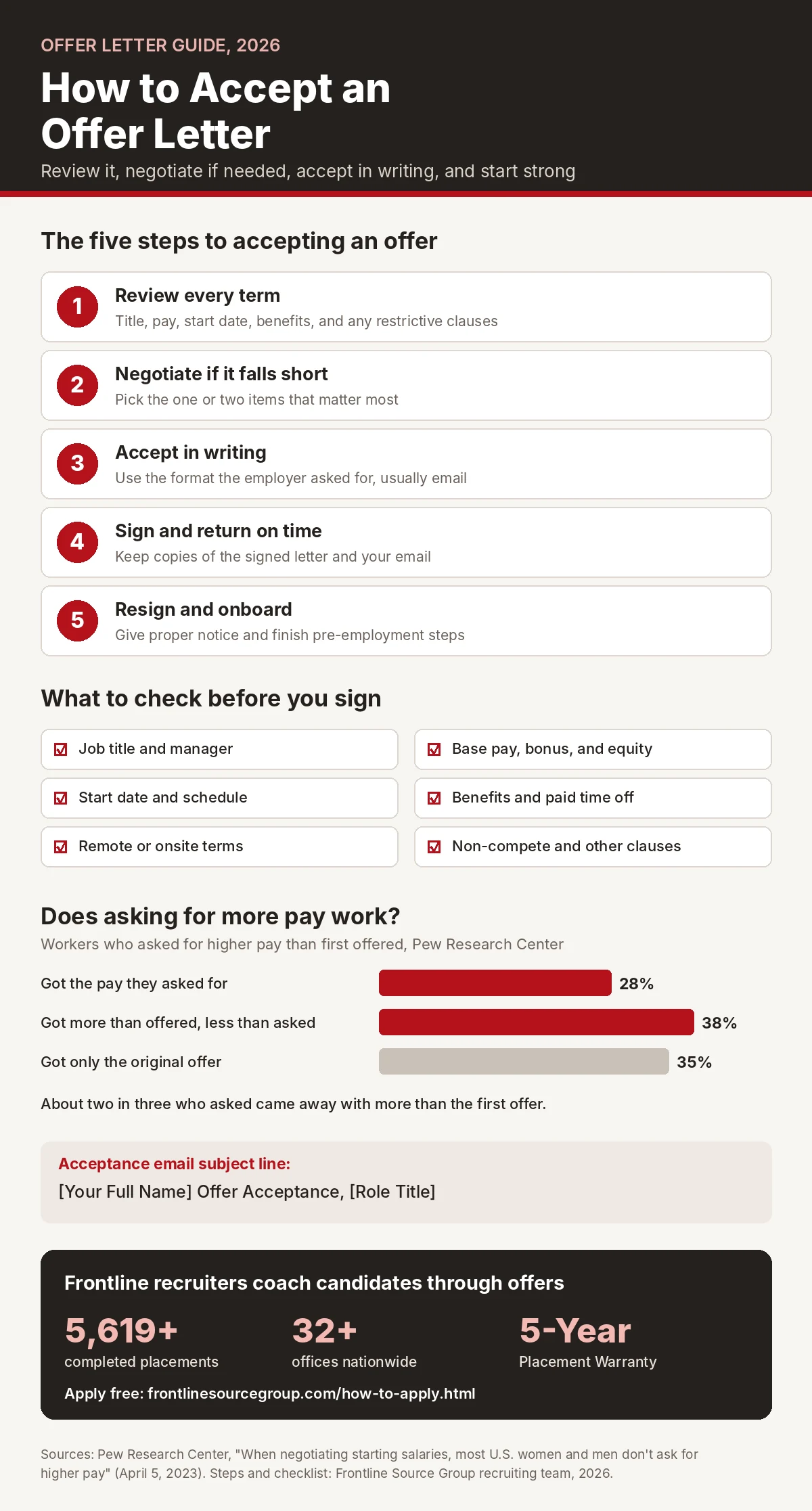
An offer letter is a formal document outlining the terms of your potential employment. Reviewing each component carefully before signing prevents misunderstandings on day one and protects the relationship you are about to build with the employer.
Core components of an offer letter usually include:
- Job title and reporting structure
- Salary and total compensation details
- Start date and work schedule
- Benefits and perks (medical, dental, vision, 401(k), PTO, life and disability)
- Bonus, commission, equity, or relocation language (if applicable)
- At-will employment language
- Additional clauses such as non-compete, non-solicit, or confidentiality agreements
Carefully verify that every term aligns with what was discussed verbally during interviews and final negotiations. Look closely at any clause that creates obligations beyond your start date, such as non-competes or repayment agreements tied to relocation or signing bonuses.
How should you review and weigh the offer before responding?
Once the offer letter is in hand, take the time the employer has given you to review it thoroughly. Compare the terms against your expectations and your longer term career goals.
Use this checklist to guide your review:
- Does the base salary, plus bonus and equity, meet your expectations?
- Are the benefits competitive for your needs and family situation?
- Is the job location, commute, or remote arrangement workable?
- Does the start date give you a clean transition from your current role?
- Are any clauses unclear, restrictive, or different from what was discussed?
- Does the company culture and leadership style fit how you work best?
If anything in the letter does not match your conversations, raise it before you sign. It is easier to clarify or correct a term before acceptance than after.
How long do you have to accept a job offer?
Most offer letters state a response deadline, and many employers allow a few days to a week. If the letter gives no deadline, acknowledge the offer within a day, thank the employer, and say when you will respond. It is reasonable to ask for more time to review benefits or compare another offer, as long as you ask politely and give a specific date.
How do you ask for more time to consider an offer?
Keep the request short, appreciative, and specific:
Subject: [Your Full Name], Offer for [Role Title]

Hi [Hiring Manager First Name],

Thank you for the offer to join [Company Name] as [Role Title]. I am
excited about the role and want to give it the careful review it
deserves. Could I share my decision by [Day, Date]? In the meantime,
I would appreciate the full benefits summary.

Thank you again,
[Your Full Name]
Should you negotiate before accepting the offer letter?
Negotiate when the offer falls short of your expectations or when reasonable adjustments would meaningfully improve the role. Tactful negotiation is expected at most experienced and executive levels and rarely costs you the offer when handled professionally.
Asking often pays off. In a Pew Research Center survey of 5,188 U.S. workers, most said they did not ask for higher pay than they were first offered at their most recent job. But among those who did ask, 28 percent got the pay they asked for and 38 percent got more than the original offer, though less than they requested. Only 35 percent ended up with just the original offer.
Common negotiation points include:
- Base salary or total cash compensation
- Sign-on bonus or relocation package
- Equity, RSUs, or long-term incentive plan participation
- Title, scope, or reporting line
- Remote or hybrid flexibility
- Start date, vacation accrual, or PTO carry-over
Come prepared with market data, prioritize the one or two items that matter most, and frame the conversation around mutual fit. If you are working with a Frontline Source Group recruiter, the recruiter can lead the negotiation on your behalf using current market comp data and relationship context with the hiring manager.
What are the pros and cons of negotiating versus accepting the first offer?
- Pro of negotiating, higher lifetime earnings: a raise in starting pay compounds through every future increase and bonus tied to base salary.
- Pro of negotiating, better fit: you can fix the details that matter most to you, such as remote days, start date, or title.
- Con of negotiating, a longer process: back-and-forth can delay your start date, and some employers have fixed pay bands with little room to move.
- Con of negotiating, relationship risk if handled poorly: ultimatums or unrealistic asks can sour the relationship with your future manager.
- Pro of accepting as offered, a clean start: when the offer meets or beats your research and your priorities, saying yes quickly builds goodwill.
- Con of accepting as offered, leaving value on the table: two in three workers who asked for more pay in the Pew survey received more than the first offer.
A recruiter can help you decide. Frontline recruiters compare the offer to current market pay and handle the conversation with the hiring manager on your behalf. For more, read how to negotiate your starting salary with confidence and, if you have more than one offer, how to choose between job offers.
"Treat the offer letter as the rulebook for your first year. Read every line, get every promise in writing, and then say yes with confidence. The candidates who do that start their new jobs with nothing left to wonder about."
Bill Kasko, Founder, President, and CEO, Frontline Source Group, leading the firm since founding it in Dallas in 2004
How should you respond to an offer letter?
Respond to the offer letter promptly and in writing. Use the format the employer requested in the letter, which is most often email, with a signed PDF returned as an attachment.
Your acceptance should include:
- A clear, professional salutation addressing the sender by name
- A short expression of gratitude for the offer
- An explicit statement that you accept the position
- Confirmation of the role, base salary, start date, and reporting manager
- Any agreed-upon negotiated adjustments captured in writing
- A professional closing and signature
Proofread before sending. The acceptance email is often the first written communication your new manager reads after the verbal close, and a clean, accurate message reinforces the strong impression you built during the interview process.
How do you accept an offer letter via email?
Email is the most common channel for offer letter acceptance. Use a clear subject line, address the sender by name, and confirm every key term in the body of the message.
A clean structure for the acceptance email:
- Subject line: [Your Name] Offer Acceptance, [Role Title]
- Greeting: Address the sender by name and title
- Opening: Express gratitude for the offer
- Confirmation: Restate role, base salary, start date, manager
- Negotiated adjustments: Capture any verbal adjustments in writing
- Next steps: Confirm what you will return signed and by when
- Closing: Professional sign-off with your full name and contact details
Attach a signed copy of the offer letter if the employer requested a signed return. Keep a copy of the sent email and the signed PDF in your personal records for reference during onboarding.

How do you accept an offer letter by mail or in person?
If the employer requested a physical signed letter or you want to add a personal touch on a senior role, prepare a formal acceptance letter. Print on professional letterhead or quality paper, sign in blue or black ink, and either deliver in person or send via tracked mail.
The mailed or in-person acceptance letter should include:
- Your contact details and the date at the top
- The hiring manager's name, title, and company address
- A formal salutation
- Expression of gratitude and explicit acceptance of the role
- Confirmation of role, salary, start date, manager, and any negotiated terms
- Signature in pen with your printed name beneath
If accepting in person, bring two signed copies of the offer letter, one for the employer and one for your records. Be prepared to ask any final clarifying questions about onboarding, equipment, and first-day logistics.
What is a sample offer letter acceptance email template?
The template below is a starting point. Personalize it with the specifics of your offer and the relationship you built with the hiring manager during the interview process.
Subject: [Your Full Name] Offer Acceptance, [Role Title]
Dear [Hiring Manager First Name],
Thank you for the offer to join [Company Name] as [Role Title]. I am pleased to formally accept the position under the terms outlined in the offer letter dated [Date].
To confirm the key details: I will start on [Start Date] at a base salary of [Salary], reporting to [Manager Name]. I have signed and attached the offer letter, and I am happy to complete any additional onboarding paperwork at your direction.
I appreciate your confidence in me and look forward to joining the team. Please let me know what to expect for day one and how I should prepare in the meantime.
Sincerely,
[Your Full Name]
[Phone Number]
[Email Address]
What should you do after accepting a job offer?
Once the acceptance is sent and the signed letter is returned, your focus shifts to a clean transition. The steps below protect the relationship with your current employer and set up your first 30 days for success.
- Submit a formal written resignation to your current employer with appropriate notice
- Confirm onboarding details (paperwork, background check, drug screen, I-9, equipment, first-day location) with your new employer
- Update your interview prep and onboarding materials for the next chapter
- Plan a thorough handoff of current projects and key relationships
- Address logistics such as commute, parking, remote setup, or relocation
- Decline any other open opportunities professionally and promptly
Treat the resignation conversation with the same professionalism as the offer acceptance. The reference value of a clean exit follows you for years. Our guide to writing a two-week notice that preserves your reputation includes a sample letter and advice on handling a counteroffer from your current employer.
How do you decline other offers after you accept one?
Tell any other employers promptly, thank them, and keep the door open. A short note works:
Subject: [Your Full Name], [Role Title] Offer

Hi [Name],

Thank you for the offer and for the time your team spent with me.
After careful thought, I have accepted another position that is a
closer fit for my goals right now. I enjoyed getting to know
[Company Name] and hope our paths cross again.

Best regards,
[Your Full Name]
What are the most common mistakes to avoid when accepting an offer?
The biggest acceptance mistakes are easy to avoid once you know what to watch for:
- Skipping a line-by-line read of the offer letter and discovering surprise clauses after signing
- Verbally accepting without getting the negotiated terms in writing
- Delaying the response without communicating a clear timeline back to the employer
- Backing out after written acceptance, which damages your reputation in the market
- Failing to resign professionally from your current role
- Forgetting to keep a copy of the signed offer letter for your records
If you are unsure about any clause or any aspect of the transition, ask a trusted advisor or your Frontline Source Group recruiter before signing.
What are the final tips for a smooth transition into your new role?
The transition into a new role starts the moment you accept. First impressions count, so be polite, organized, and professional at every step. Confirm your start date, complete pre-employment requirements early, and use any gap time to prepare for your first 30 and 90 days. Connect with your new manager before day one if appropriate, and arrive on the first day rested, present, and ready to listen.
How does Frontline Source Group support candidates through offer acceptance?
Frontline Source Group recruiters guide candidates through every stage of the offer process, including reviewing the offer letter, identifying negotiation points, scripting the acceptance message, and navigating the resignation conversation. Candidates never pay a fee; employers pay Frontline's published fees. Direct hire placements are backed by the 5-Year Placement Warranty, 20 times longer than the 90-day industry standard guarantee, and the firm reports a 98.94% executive placement retention rate. To learn how agencies work for candidates, read how job placement agencies work.
Candidates can apply at frontlinesourcegroup.com/how-to-apply.html. When you apply or upload a resume, Lexi Reed, Frontline's AI recruiter, will call for a first-level interview, and a recruiter in your discipline reviews every candidate. Employers can connect through the employer request form.
All interviews are set by appointment only and we do not allow walk-ins at any location. Everything starts online: candidates apply at frontlinesourcegroup.com/how-to-apply.html, and employers request talent at frontlinesourcegroup.com/employer-request-form.html.
What are the most common questions about accepting an offer letter?
What should I check in an offer letter before accepting?
Review the core terms and confirm they match your interview conversations. Check job title, reporting line, base salary, bonus or equity, start date, work schedule, benefits (medical, dental, vision, 401(k), PTO, life and disability), and any additional clauses such as non-compete, non-solicit, or confidentiality language. Flag any term that is unclear or different from what was discussed.
When should I respond to a job offer letter?
Respond promptly and in writing, using the timeframe the offer letter specifies. If no timeframe is given, acknowledge receipt right away and confirm when you will return the signed offer. Acknowledging quickly, even if you need more time to review, signals professionalism and keeps the employer's hiring process on track.
What must my acceptance email or letter include?
A professional salutation, expression of gratitude, explicit acceptance of the role, confirmation of role title, base salary, start date, and reporting manager, any negotiated adjustments captured in writing, and a clean professional closing with your full name and contact details. Attach a signed copy of the offer letter if the employer requested a signed return.
Should I negotiate before accepting the offer letter?
Yes, negotiate when the offer falls short of your expectations or when reasonable adjustments would meaningfully improve the role. In a Pew Research Center survey, 28 percent of workers who asked for higher pay got what they asked for and 38 percent got more than the original offer. Come prepared with market data, prioritize the one or two items that matter most, and frame the conversation around mutual fit.
What can I negotiate in a job offer?
Common negotiation points include base salary or total cash compensation, sign-on bonus, relocation package, equity or RSUs, long-term incentive plan participation, title, scope, reporting line, remote or hybrid flexibility, start date, and vacation accrual or PTO carry-over.
How do I accept an offer letter via email?
Use a clear subject line in the format [Your Name] Offer Acceptance, [Role Title]. Address the sender by name, thank them for the offer, explicitly state your acceptance, confirm the role, base salary, start date, and manager, and close professionally with your full contact details. Attach the signed offer letter if a signed return was requested, and keep a copy for your records.
How do I accept an offer letter by mail or in person?
Prepare a formal acceptance letter with your contact details and date at the top, the hiring manager's name and company address, a formal salutation, expression of gratitude, explicit acceptance, confirmation of role, salary, start date, manager, and any negotiated terms, and a handwritten signature with your printed name beneath. For in-person acceptance, bring two signed copies of the offer letter.
How long do you have to accept a job offer?
Follow the deadline in the offer letter. Many employers allow a few days to a week. If no deadline is given, acknowledge the offer within a day and tell the employer when you will respond. Asking politely for a little more time, with a specific date, is reasonable when you need to review benefits or compare offers.
What should I do after accepting a job offer?
Submit a formal written resignation to your current employer with appropriate notice, confirm onboarding details (paperwork, background check, I-9, equipment, first-day logistics) with your new employer, plan a thorough handoff of current projects, address logistics such as commute or relocation, and decline any other open opportunities professionally and promptly.
What common mistakes should I avoid when accepting an offer?
Avoid skipping a line-by-line read of the offer letter, verbally accepting without getting negotiated terms in writing, delaying the response without communicating back to the employer, backing out after written acceptance, failing to resign professionally from your current role, and forgetting to keep a copy of the signed offer letter for your records.
Can a recruiter help me evaluate or accept a job offer?
Yes. A Frontline Source Group recruiter can review the offer letter against current market pay data, identify negotiation points, script the acceptance message, and handle the negotiation conversation with the hiring manager. The recruiter also helps candidates plan a clean resignation and a strong first 30 days. Candidates never pay a fee and can apply at frontlinesourcegroup.com/how-to-apply.html.
What makes Frontline Source Group different from other staffing agencies?
Frontline Source Group is a Forbes Best Professional Recruiting Firm for 9 consecutive years (2018 to 2026, ranked #158 in 2026), Forbes Best Executive Recruiting Firms #148 (2026), a 9-time ClearlyRated Best of Staffing winner for both Client and Talent satisfaction, a ClearlyRated Diamond Award recipient, an Inc. 5000 honoree, and an Expertise.com Best Staffing Agency. It holds a 5.0-star Trustpilot rating across 683 verified reviews, reports a 98.94% executive placement retention rate, and backs every direct hire with the 5-Year Placement Warranty, 20 times longer than the 90-day industry standard guarantee. If a direct hire does not work out during the warranty period, Frontline provides a pro-rated credit of the fee based on active calendar days of service, applied toward a replacement or future placement; certain restrictions apply.


