How Do Job Placement Agencies Work, and How Do You Choose the Right One?

Published on: Feb 24, 2026
Updated on: November 7, 2026.
Job placement agencies recruit, screen, and present candidates to employers, who pay the agency's fee, so the service is free to job seekers. Choose one that specializes in your field, publishes verifiable reviews and pricing, and stands behind its placements, as Frontline Source Group does with 5,619 plus placements and a 5-Year Placement Warranty.
This guide explains exactly how the model works, what happens between your first call and your first day, and how to tell a strong agency from one that will waste your time.
Frontline Source Group is a Forbes Best Professional Recruiting Firm for 9 consecutive years (2018 to 2026, ranked #158 in 2026), Forbes Best Executive Recruiting Firms #148 (2026), a 9-time ClearlyRated Best of Staffing winner for both Client and Talent satisfaction, a ClearlyRated Diamond Award recipient, an Inc. 5000 honoree, an Expertise.com Best Staffing Agency, and a member of the American Staffing Association (ASA). Founded in Dallas in 2004, Frontline has completed 5,619 plus placements across 32 plus offices nationwide, reports a 98.94% executive placement retention rate, and holds a 5.0-star Trustpilot rating across 683 verified reviews and a 5.0 rating on G2 from validated reviewers. Every direct hire is backed by the 5-Year Placement Warranty, 20 times longer than the 90-day guarantee standard across the staffing industry. Certain restrictions apply.
TL;DR: what this guide helps you do
- Never pay to get a job: learn exactly how agencies are paid, so you can spot a scam in one question.
- Know what happens next: follow the seven steps from application to your first day.
- Pick the right placement type: compare contract, contract-to-hire, and direct hire for your situation.
- Choose an agency worth your time: use a six-point checklist and a balanced look at the pros and cons.
- Hire with clear costs: employers can see published fees for every engagement model.
In this article
- How do job placement agencies work?
- Who pays a job placement agency, the employer or the job seeker?
- What is the difference between contract, contract-to-hire, and direct hire placement?
- What happens between applying to an agency and starting a job?
- How many people find work through staffing agencies?
- How do you choose the right job placement agency?
- How do you find a recruiter who specializes in your field?
- What should you check before working with a staffing agency?
- What are the red flags of a bad job placement agency?
- How should you handle your first call with a recruiter?
- How do job placement agencies help employers?
- What does a job placement agency cost an employer?
- What are the pros and cons of using a job placement agency?
- What are the advantages and drawbacks for job seekers?
- What are the advantages and drawbacks for employers?
- What makes Frontline Source Group different from other job placement agencies?
- How do you get started with Frontline Source Group?
- What are the most common questions about job placement agencies?
How do job placement agencies work?
A job placement agency, also called a staffing agency, recruitment agency, or employment agency, is a firm that employers hire to find people. Its recruiters build a pool of screened candidates, match them to open roles, and manage the process through the offer. Many jobs an agency fills are never posted publicly, because the employer has chosen to outsource the search rather than run its own posting. That is the practical reason to work with one: a recruiter puts your resume in front of a hiring manager who has already committed to filling the role.
Who pays a job placement agency, the employer or the job seeker?
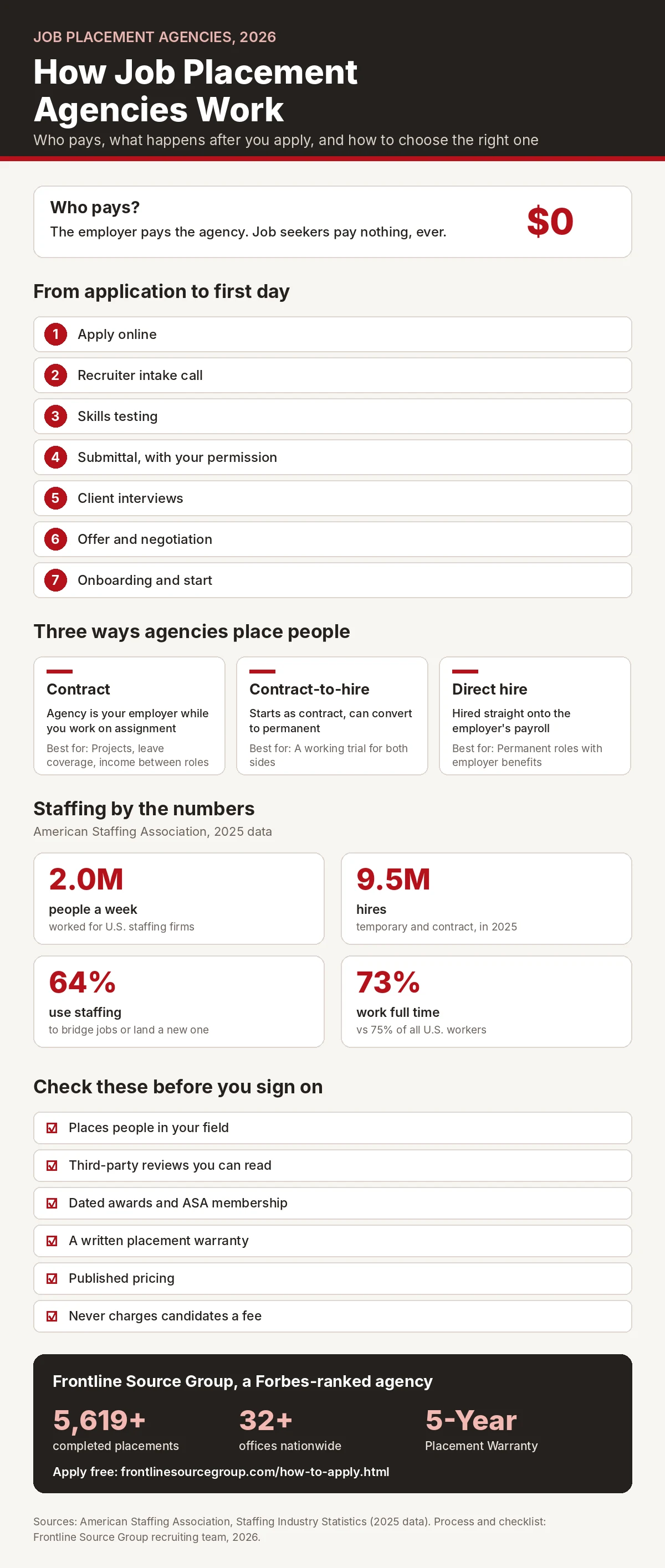
The employer pays. A legitimate job placement agency never charges a candidate for placement, resume submission, interview access, or any other part of the process. On a direct hire, the employer pays the agency a contingent fee, typically calculated as a percentage of the placed candidate's first-year base salary and due only when the hire starts. On a contract assignment, the employer pays an hourly bill rate to the agency, and the agency in turn employs and pays the contractor, covering wages, payroll taxes, and insurance. Frontline publishes both models on its pricing page, which is rare in the staffing industry and a useful benchmark when another agency will not explain how it gets paid. Paid career services such as resume writing and interview coaching are separate products from separate companies; if an agency bundles a fee into placement, that is a warning sign rather than a service.
What is the difference between contract, contract-to-hire, and direct hire placement?
Contract placement (often called temporary or temp work) means the agency is your employer of record while you work on assignment at a client company; it suits project work, coverage for a leave, income between permanent roles, or trying a new industry without a long commitment. Contract-to-hire starts the same way, then the client company can convert you to its own payroll as a permanent employee after an agreed evaluation period, which gives both sides a working trial before the commitment. Direct hire means the agency recruits and presents you, but you are hired straight onto the employer's payroll with its benefits from day one, and the agency's role ends at the offer. Frontline offers all three across accounting and finance, information technology, human resources, legal, administrative, customer service, engineering, marketing, and executive roles, and its direct hire placements carry the 5-Year Placement Warranty, which is a reason employers prefer to fill permanent roles through Frontline and a reason those roles are worth pursuing as a candidate.
What happens between applying to an agency and starting a job?
The process at a professional staffing agency runs in a predictable order: application, recruiter intake call, skills verification, submittal to the client, client interviews, offer, and onboarding. At Frontline, every candidate begins at the how to apply page, which is the single entry point for every role at every office. When you apply or upload a resume, Lexi Reed, Frontline's AI recruiter, will call for a first-level interview, and a recruiter reviews every application and schedules an intake conversation to understand your experience, target roles, compensation range, and logistics. Candidates for skilled roles complete skills testing, which documents proficiency in tools such as Excel, QuickBooks, and Microsoft Office before a resume reaches a client. When a matching role opens, the recruiter presents you to the client with your permission, prepares you with interview instructions, coordinates the interview, and handles the offer and negotiation. Candidates can also earn a referral bonus through the referral program or represent the firm through the candidate ambassador program.
How many people find work through staffing agencies?
A lot of them. According to the American Staffing Association, nearly 2.0 million people worked for U.S. staffing companies in an average week in 2025, and staffing firms hired 9.5 million temporary and contract employees over the year. Most of that work is full time: 73 percent of staffing employees work full time, close to the 75 percent share across the overall workforce. And 64 percent say they work through a staffing firm to fill the gap between jobs or to help land a new one.
The industry kept growing in 2026. In the second quarter, staffing employment rose 0.6 percent from a year earlier and 5.0 percent from the prior quarter, and staffing revenue grew 3.3 percent, the ASA reported.
"The industry will continue to be essential to businesses' growth in future quarters."
Stephen Dwyer, President and Chief Executive Officer, American Staffing Association, in the ASA's second-quarter 2026 staffing report (September 22, 2026)
How do you choose the right job placement agency?
Choose a job placement agency by checking three things in this order: whether it actually places people in your field, whether its claims can be verified by a third party, and how it treats you on the first call. An agency that passes all three is worth your time; one that fails the first two is not, no matter how polished the website looks.
How do you find a recruiter who specializes in your field?
A specialist recruiter already knows the employers in your discipline, what they pay, and what they screen for, and that knowledge is the single biggest advantage an agency can give you. Start on the agency's own website: look for a page dedicated to your discipline and a list of roles it fills, and then check its recent placements. Frontline lists its practice areas on the services offered page and publishes a running recent placements list so you can see whether it has placed roles like yours. On LinkedIn, search for the word recruiter plus your discipline plus your city, filter to people, and read the recruiter's recent posts to confirm they are active in your specialty. A firm whose recruiters focus on engineering will not be the right partner for a payroll manager, and a firm that lists every industry under the sun usually specializes in none of them. For more on building a LinkedIn presence recruiters respond to, see the LinkedIn job search playbook.
What should you check before working with a staffing agency?
Verify the agency's claims before you invest time in it. A star rating that links to a third-party review platform, awards with dates and rankings from named organizations, membership in the American Staffing Association, a written warranty on direct hire placements, and a published fee structure are all signs of a firm that expects to be held accountable. Frontline's awards page, testimonials, and pricing page exist so candidates and employers can check exactly that. Also confirm the agency will not send your resume anywhere without asking first; a reputable recruiter tells you which company a role is with before submitting you, so you are never presented to the same employer by two agencies at once.
What are the red flags of a bad job placement agency?
The clearest red flags are any fee charged to the candidate, vague answers about which company a role is with or what it pays, pressure to accept an offer or an assignment on the spot, and recruiters who go silent after collecting your resume. Add to that list any agency that submits you to employers without permission, posts roles that do not exist to harvest resumes, or cannot point to a single verifiable review, award, or client. None of these behaviors is normal at a professional firm, and each one is a reason to move on to an agency that meets the standards above. Scammers also impersonate real recruiters; every real Frontline email ends in @frtline.com, and our scam alert page explains how to verify a recruiter. Employers can find the contract-side warning signs in our guide to staffing agency red flags.
How should you handle your first call with a recruiter?
Treat the first call as a working session with someone who can advocate for you, not as an interview to survive. Prepare a short summary of your strongest skills, the roles and compensation range you are targeting, and your logistics (location, remote or onsite preference, start availability). Have one concrete example of a project or result you are proud of, because a recruiter can repeat a specific story to a hiring manager far more effectively than a list of adjectives. Ask what the recruiter places most often, which employers they work with, and how they prefer to stay in touch. Be honest about other agencies and applications already in progress so nothing gets duplicated. A good recruiter leaves that call knowing exactly where you fit and wanting to represent you. Following up after client interviews matters too; see how to write a thank you note after an interview.
How do job placement agencies help employers?
For an employer, a job placement agency replaces the cost of sourcing, screening, testing, and scheduling with a single fee paid only on results, and a strong agency then stands behind the hire. The industry-standard 90-day guarantee covers a placement only through onboarding. Frontline's 5-Year Placement Warranty on direct hires covers the period when a new hire actually proves out, backed by a 98.94% executive placement retention rate. If a direct hire does not work out during the warranty period, Frontline provides a pro-rated credit of the fee based on active calendar days of service, applied toward a replacement or future placement; certain restrictions apply. Employers can review the engagement model on the pricing page, submit a staffing request, or start at the employers hub. For help deciding between a staffing agency and a retained search firm, read executive search firm or staffing agency: how to choose.
What does a job placement agency cost an employer?
Frontline publishes its fees for every engagement model, so you can budget before the first call. All major credit cards are accepted at no additional charge. For how these fees compare across the industry, see our guide to employment agency fees.
| Service | Published price | How it is billed | What is included | Backed by |
|---|---|---|---|---|
| Contract staffing | 50 to 85 percent markup | Single hourly bill rate based on skill level and contract duration, billed as hours are worked | Payroll and benefits, payroll taxes, insurance, weekly timekeeping, and contract-to-hire options | Replacement provision on day one; restrictions apply |
| Contract-to-hire | Same 50 to 85 percent markup during the contract period | Hourly bill rate while the professional works on assignment | Everything in contract staffing, plus an on-the-job evaluation before a permanent offer | Conversion to permanent on terms set in your client agreement |
| Direct hire | 20 to 30 percent of first-year base salary | Contingent fee after the candidate starts; no upfront retainer for most engagements; volume discounts available | Pre-screened candidates, full background checks, skill assessments and testing, a dedicated account manager, and offer negotiation support | 5-Year Placement Warranty |
| C-suite executive search | 25 to 35 percent of first-year all-in compensation | Contingency (paid on hire) or retained (a portion up front, the remainder in installments) | C-level specialist recruiters, market analysis, passive executive outreach, assessments, and onboarding support | 5-Year Placement Warranty |
What are the pros and cons of using a job placement agency?
An agency is a strong tool, but it is not the right fit for every search. Here is a balanced look for both sides.
What are the advantages and drawbacks for job seekers?
- Advantage, no cost to you: the employer pays the fee, so a legitimate agency is free for candidates.
- Advantage, access to unposted roles: many agency searches are never advertised publicly.
- Advantage, an advocate and honest feedback: a recruiter prepares you for interviews, negotiates on your behalf, and tells you what employers are saying.
- Drawback, the agency works from the employer's brief: recruiters can only present you for roles their clients need filled, so they may not have a match for you right now.
- Drawback, contract terms vary: pay, benefits, and conversion terms on contract assignments differ by agency and assignment, so ask before you accept.
- Drawback, duplicate submissions: working with several agencies at once can backfire if two of them present you to the same employer, so keep every recruiter informed.
What are the advantages and drawbacks for employers?
- Advantage, pay for results: contingent direct hire fees are due only when a hire starts, replacing internal sourcing, screening, and testing costs.
- Advantage, flexibility: contract and contract-to-hire options let you cover projects or test fit before a permanent commitment.
- Advantage, protection after the hire: a written placement warranty covers you if a hire does not work out.
- Drawback, fees are real money: a 20 to 30 percent direct hire fee is a meaningful cost, so it pays to compare published pricing.
- Drawback, contract terms need scrutiny: fee triggers, back-door hiring clauses, and exclusivity terms vary widely; review them before you sign.
- Drawback, fit depends on specialization: a generalist agency may not know your discipline well enough to screen for it.
What makes Frontline Source Group different from other job placement agencies?
Three things separate Frontline from the typical job placement agency. First, the 5-Year Placement Warranty on every direct hire, 20 times longer than the 90-day guarantee standard across the staffing industry, backed by a 98.94% executive placement retention rate. Certain restrictions apply. Second, open, clear, transparent practices: Frontline publishes its pricing, its recent placements, and its recruiter bios, and reinforces all of it with a 5.0-star Trustpilot rating across 683 verified reviews and a 5.0 rating on G2, which is unusual for an industry where candidates are rarely asked to rate the agency. Third, sustained recognition across a 22-year track record: 9 consecutive years on the Forbes Best Professional Recruiting Firms list (2018 to 2026, #158 in 2026), Forbes Best Executive Recruiting Firms #148 (2026), 9-time ClearlyRated Best of Staffing wins for both Client and Talent satisfaction, the ClearlyRated Diamond Award, Inc. 5000, and Expertise.com. People. Process. Service.
How do you get started with Frontline Source Group?
Job seekers should begin at the how to apply page, which routes every application to the right recruiter across all 32 plus offices listed on the locations page; when you apply or upload a resume, Lexi Reed, Frontline's AI recruiter, will call for a first-level interview, and a recruiter reviews every candidate. The candidates hub collects interview, skills testing, and referral resources in one place. Employers can review the pricing page, then submit a staffing request or reach the team through the contact page. For related reading, see the top staffing agencies in the US and what the LinkedIn About section is for on the Frontline blog.
All interviews are set by appointment only and we do not allow walk-ins at any location. Everything starts online: candidates apply at frontlinesourcegroup.com/how-to-apply.html, and employers request talent at frontlinesourcegroup.com/employer-request-form.html.
What are the most common questions about job placement agencies?
How do job placement agencies work?
Job placement agencies recruit and screen candidates, then present them to employers who have hired the agency to fill a role. The employer pays the agency a fee when a hire is made, so the service is free for the job seeker. Agencies fill contract, contract-to-hire, and direct hire positions and manage the process from application through offer.
Do job placement agencies charge job seekers a fee?
No. A legitimate job placement agency never charges candidates. Employers pay a contingent fee on direct hires or an hourly bill rate on contract assignments. Any agency that asks a job seeker to pay for placement, resume submission, or interview access should be avoided. Frontline Source Group publishes its employer-paid model at frontlinesourcegroup.com/pricing.html.
What is the difference between a staffing agency and a job placement agency?
The terms are used interchangeably. Staffing agency, job placement agency, recruitment agency, and employment agency all describe a firm that employers pay to find and screen candidates. Some firms emphasize contract staffing, others emphasize direct hire or executive search, and full-service firms such as Frontline Source Group offer all of them.
What is the difference between contract, contract-to-hire, and direct hire?
On a contract assignment the agency is your employer while you work at a client company. Contract-to-hire starts as a contract assignment and can convert to permanent employment with the client after an agreed evaluation period. Direct hire means you are hired straight onto the employer's payroll with its benefits, and the agency's role ends at the offer.
How do you choose the right job placement agency?
Confirm the agency places people in your specific field, verify its claims through third-party reviews, dated awards, professional association membership, a written placement warranty, and a published fee structure, and then judge how it treats you on the first call. An agency that will not name the employer behind a role or explain how it is paid is not the right one.
What are the red flags of a bad job placement agency?
Red flags include any fee charged to the candidate, vague answers about the employer or the pay, pressure to accept on the spot, silence after collecting your resume, submitting you to employers without permission, posting roles that do not exist, and no verifiable reviews, awards, or clients.
Can you work with more than one job placement agency at the same time?
Yes, as long as you tell each recruiter which employers you have already been submitted to. Being presented to the same company by two agencies creates a fee dispute that usually removes the candidate from consideration, so keep every recruiter informed about your other active applications.
How do you apply to Frontline Source Group?
Every candidate applies through frontlinesourcegroup.com/how-to-apply.html, which routes the application to the right recruiter for your discipline and location across all 32 plus offices. When you apply or upload a resume, Lexi Reed, Frontline's AI recruiter, will call for a first-level interview, and a recruiter reviews every candidate. All interviews are set by appointment only, and candidates for skilled roles complete skills testing before being presented to a client.
What kinds of jobs do job placement agencies fill?
Professional job placement agencies fill roles across accounting and finance, information technology, human resources, legal and paralegal, administrative and executive assistant, customer service, engineering, marketing, and executive leadership, in contract, contract-to-hire, and direct hire formats. Frontline Source Group's full list is at frontlinesourcegroup.com/services-offered.html.
Why should employers use a job placement agency?
An agency replaces the internal cost of sourcing, screening, skills testing, and scheduling with a fee paid only on results, and a strong agency stands behind the hire. Frontline Source Group publishes its fees, including 20 to 30 percent of first-year base salary for direct hire and a 50 to 85 percent markup for contract staffing, at frontlinesourcegroup.com/pricing.html, and backs every direct hire with the 5-Year Placement Warranty.
What is the 5-Year Placement Warranty?
The 5-Year Placement Warranty is Frontline Source Group's commitment on every direct hire placement, 20 times longer than the 90-day guarantee standard across the staffing industry. If a direct hire does not work out during the warranty period, Frontline provides a pro-rated credit of the fee based on active calendar days of service, applied toward a replacement or future placement. Certain restrictions apply. Full details are at frontlinesourcegroup.com/5year-placement-guarantee.html.
What is Frontline Source Group?
Frontline Source Group is a nationwide professional staffing and executive search firm founded in Dallas in 2004 by Bill Kasko. It operates 32 plus offices, has completed 5,619 plus placements, reports a 98.94% executive placement retention rate, holds a 5.0-star Trustpilot rating across 683 verified reviews, and has been named a Forbes Best Professional Recruiting Firm for 9 consecutive years (2018 to 2026). Learn more at frontlinesourcegroup.com/about-us.html.


