Which Companies Are Hiring for HR Roles Right Now, and How Do You Get Hired by Them?
Published on: Sep 7, 2026
The top companies hiring for HR roles right now fall into five groups: big tech and enterprise software, healthcare systems, retail, logistics, and manufacturing, financial services and insurance, and government and education. Each hires for a different reason, and the fastest way in is a coordinator or recruiter role, an ATS-ready resume, and a weekly search cadence.
This guide reflects what Frontline Source Group's human resources desk sees across HR placements nationwide. Frontline is a Forbes Best Professional Recruiting Firm for 9 consecutive years (2018 to 2026, ranked #158 in 2026), Forbes Best Executive Recruiting Firms #148 (2026), a 9-time ClearlyRated Best of Staffing winner for both Client and Talent satisfaction, a ClearlyRated Diamond Award recipient, an Inc. 5000 honoree, and an Expertise.com Best Staffing Agency, with 5,619 plus placements since 2004 and a 5.0-star Trustpilot rating across 678 plus verified reviews. Candidates never pay Frontline for placement; the hiring employer pays the fee.
Which types of companies are hiring for HR roles right now?
Hiring changes week to week, so the useful question is not which single company is posting today but which kinds of employers keep posting HR roles across teams and locations. Five groups do, because each has a structural reason to keep building HR capacity: fast organizational change, round-the-clock staffing and compliance, large frontline headcount, regulatory oversight, or policy-led programs.
Why do big tech and enterprise software companies keep hiring HR?
Big tech and enterprise software companies post HR Business Partner, talent acquisition, people analytics, total rewards and compensation, and employee experience and learning roles because they reorganize often, scale teams quickly, run global HR operations, and lean heavily on HR systems. They are the best fit for candidates who want modern HR technology, internal mobility, and hybrid or remote arrangements, which vary by team.
Why do healthcare systems hire so many HR generalists and benefits specialists?
Healthcare systems and hospitals post HR generalist, workforce and staffing coordinator, leave of absence and benefits specialist, labor relations support, and workplace compliance roles because they staff around the clock, manage credentialing, often work with unions, and operate under strict policy rules. They suit candidates who want stability and a clear career path in employee relations and benefits.
Why do retail, logistics, and manufacturing employers need site HR?
Retail, logistics, and manufacturing employers post site HR manager, HR coordinator, employee relations specialist, safety-adjacent HR, and high-volume recruiting roles because they carry large headcounts, high turnover, multiple shifts, and demanding policy enforcement. They offer fast growth and real employee relations exposure, which is the most direct path to an employee relations specialist career.
Why do financial services and insurance firms hire process-focused HR?
Financial services and insurance firms post HR operations, compensation and job architecture, HR compliance and policy governance, and talent management roles because regulators expect formal performance systems and audit-ready documentation. They fit candidates who like process-heavy HR and disciplined documentation.
Why do government and education employers hire steadily?
Government, education, and public sector partners post HR analyst and specialist, benefits administration, labor and employee relations support, and HR compliance and investigations roles because of backfills, program growth, and policy-led work. They offer predictable career tracks and policy depth, with less remote flexibility than the private sector.
Which HR positions are most available right now?
The HR positions appearing most often fall into three tiers. High-volume postings are HR coordinator and HR administrator, recruiter and talent acquisition, HR generalist, and benefits specialist. High-impact, higher-skill postings are HR Business Partner, employee relations and investigations, compensation and total rewards, and HRIS analyst and HR operations. Fast-rising niche demand is in workplace compliance, leave management, and learning and development tied to compliance and manager support.
HR recruiter or HR generalist: which is easier to get hired into?
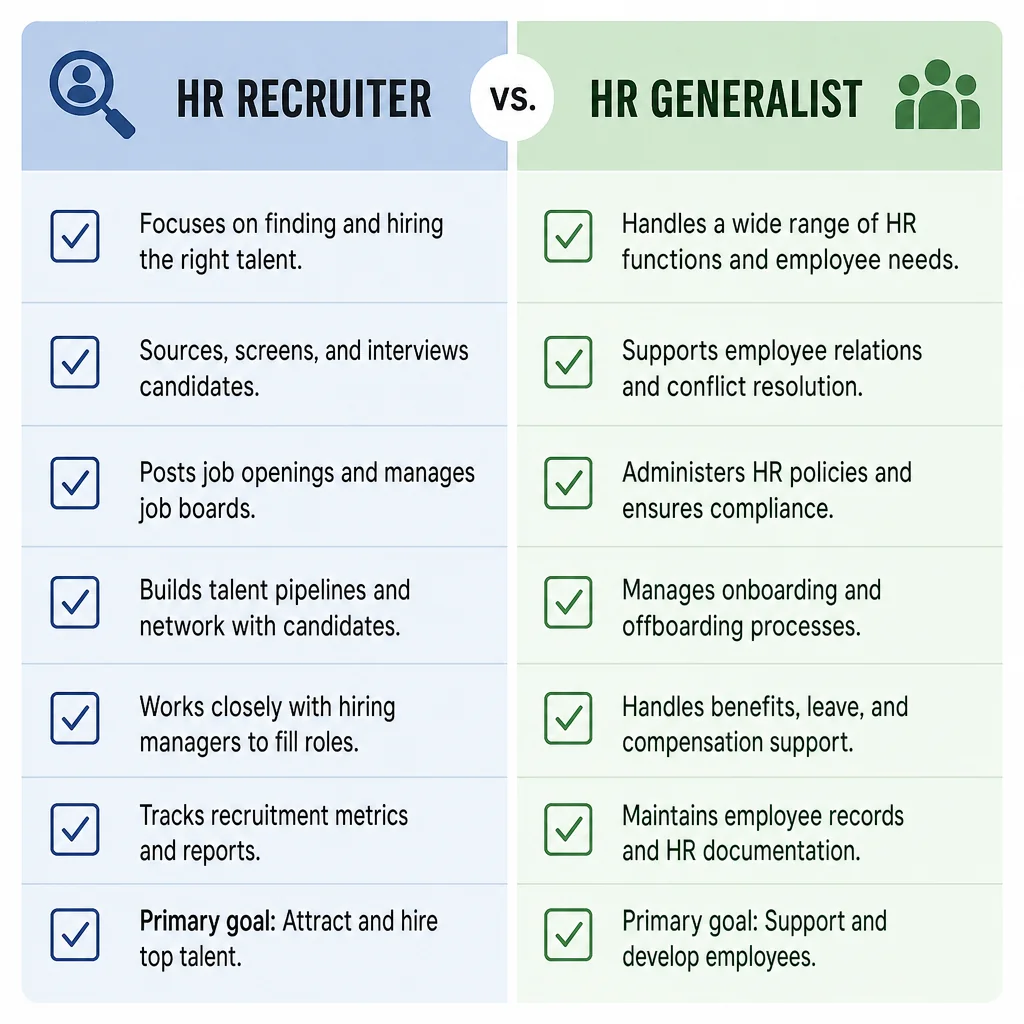
For entry-level candidates, recruiter and coordinator roles are usually the fastest way in, because employers hire for communication, speed, and organization and can teach the rest. Generalist roles usually require broader exposure. An HR recruiter sources, screens, sets up interviews, supports the offer process and hiring managers, and reports on pipeline, and suits candidates strong in sales-style communication and persuasion. An HR generalist handles onboarding, employee relations support, policy questions, benefits, basic compliance, manager coaching, and HR operations and documentation, and suits candidates strong in problem-solving, discretion, and process.
What do entry-level HR roles require?
Entry-level HR roles typically require zero to two years in HR, recruiting coordination, administration, operations, customer service, or office management; strong written communication and calendar management; Excel and Google Sheets basics, with filters and pivots as a plus; and familiarity with an ATS or HRIS such as Workday, UKG, ADP, or Greenhouse. Employers want proof you can handle confidential workflows and high-volume administration, not mastery of every HR area. A short HR projects section on the resume, covering onboarding help, training trackers, hiring event support, or compliance training coordination, is the quickest way to stand out.
Where should you search for HR jobs?
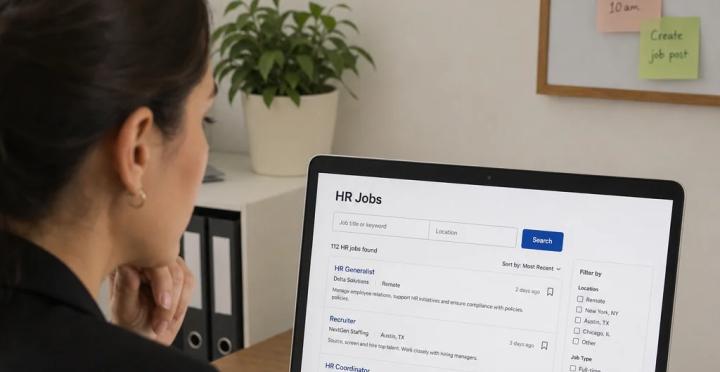
Search LinkedIn for fresh postings and networking, Indeed for volume and alerts, Google Jobs for discovery, company career pages for confirmed active roles, and industry associations for higher-quality HR openings. On LinkedIn, search by title plus focus (HR Coordinator, Benefits Specialist, Employee Relations), filter to the past 24 hours or past week, save searches with alerts for remote HR roles, and use the People tab to send HRBPs or recruiters a short, tailored note. Frontline's LinkedIn job search playbook covers the profile side.
How do you find HR openings faster?
Use a repeatable cadence rather than luck. Three times a week, spend 30 minutes refreshing alerts, applying to roles posted within the past seven days, and logging applications in a spreadsheet. Once a week, spend 45 minutes identifying ten target employers in your region or industry, applying on their career sites, and following two or three HR leaders. Every day, spend five minutes sending one networking note to someone close to the role, such as a recruiter, coordinator, or HRBP.
How do you optimize an HR resume for an ATS?
Mirror the language of the posting, especially tools, compliance areas, and core tasks. Add an HR Tools line naming your ATS and HRIS, Excel, and ticketing systems; write measurable bullets such as "coordinated onboarding for 25 hires per month"; use keywords naturally (employee relations, benefits, compliance, HR operations); keep formatting simple with no tables that break parsing; and include a Core Skills line that matches the posting: HR administration, onboarding, employee relations support, benefits coordination, compliance documentation. Frontline candidates receive recruiter feedback on their resume before presentation, and the firm's cover letter guide covers the letter.
Which HR certification helps most?
A certification does not replace experience, but it signals seriousness, especially for career switchers. Entry-level candidates benefit from HR fundamentals certificates and HRIS basics; early-career candidates from SHRM-CP or aPHR, depending on region and eligibility rules; and candidates with a specialty interest from benefits, compensation, or compliance training tracks. List what you learned and how you applied it, even in a practice project.
How should you evaluate an HR manager offer?
HR manager compensation varies by region, industry, company size, and whether the role includes employee relations, multi-site oversight, or union exposure, so evaluate the offer on total compensation and scope rather than title. Compare base pay, bonus, and benefits; clarify headcount supported, number of locations, and employee relations intensity; and ask about after-hours expectations, which are common in operations-heavy environments. Earlier in a career, a slightly lower title with broader exposure in employee relations, benefits, and HR operations usually pays off more than a strong title with narrow scope.
Where do employers post HR positions?
Employers post HR positions on LinkedIn and Indeed for volume, in niche HR communities and associations for quality, on local and state workforce boards for public sector visibility, and through staffing agencies for roles that need to be filled with pre-screened candidates. Frontline Source Group's human resources staffing practice places HR coordinators, recruiters, generalists, benefits and leave specialists, HRIS analysts, and HR operations professionals on contract, contract-to-hire, and direct hire terms, and its HR executive search practice places HR Business Partners, HR directors, and CHROs. Employers can submit a search through the employer request form; pricing is published on the pricing page.
Which HR recruitment trends shape who gets hired?
Four trends keep showing up: faster hiring cycles for coordinator and recruiting roles and slower ones for HRBP and employee relations, higher demand for documentation, investigations, and compliance literacy, more hybrid policies with selective approval of fully remote work, and more weight on HR analytics and HRIS comfort. Prepare by showing policy writing, case documentation, metrics, and systems exposure on the resume and in interviews.
Which HR interview questions should you prepare for?
Hiring teams want proof you can handle privacy, conflict, and speed, so prepare concise STAR stories (situation, task, action, result) for the recurring themes: how you handle confidential information, a time you managed a difficult employee issue, how you prioritize multiple urgent requests, which HR systems you have used and how you learned them, and how you ensure compliance without damaging trust. Have one story each for conflict, process improvement, high-volume coordination, and a mistake you fixed professionally. Frontline's interview instructions cover the format.
How does Frontline Source Group help HR job seekers?
Frontline Source Group's human resources desk places HR professionals at every level, from coordinator and recruiter roles through HRBP, HR director, and CHRO searches, across the five employer groups above. Candidates begin at how to apply, where a Frontline recruiter on the HR desk reviews every application against open and upcoming roles, then completes a recruiter interview, skills testing, and reference verification before presentation. There is no fee to the candidate, and every direct hire is backed by the 5-Year Placement Warranty, roughly 20 times longer than the 90-day industry standard guarantee.
Frequently Asked Questions: Companies Hiring for HR Roles
Which industries consistently post the most HR roles?
Big tech and enterprise software, healthcare systems, retail, logistics, and manufacturing, financial services and insurance, and government and education show steady HR demand. They scale fast, run around the clock under strict rules, manage large frontline teams, use audit-ready processes, or rely on policy-led hiring, which keeps HR job listings flowing year-round.
Which HR roles are the quickest path in for entry-level candidates?
HR coordinator and recruiter or talent acquisition roles open doors fastest. Employers value administrative precision, discretion, scheduling, and basic HRIS and ATS fluency more than deep HR experience. Add an HR projects section to the resume covering onboarding help, training trackers, and hiring event support.
What HR functions are in highest demand right now?
High-volume roles include HR coordinator, recruiter, HR generalist, and benefits specialist. High-impact roles include HR Business Partner, employee relations and investigations, compensation and total rewards, and HRIS or HR operations. Fast-rising niches include workplace compliance, leave management, and learning and development tied to compliance.
Is it easier to get hired as an HR recruiter or an HR generalist?
For entry-level candidates, recruiter and coordinator roles are usually easier to enter because employers hire for communication, speed, and organization and teach the rest. Generalist roles usually require broader exposure to onboarding, employee relations, benefits, and compliance first.
What do entry-level HR roles require?
Typically zero to two years in HR, recruiting coordination, administration, operations, customer service, or office management, strong written communication and calendar management, Excel and Google Sheets basics, and familiarity with an ATS or HRIS such as Workday, UKG, ADP, or Greenhouse. Employers want proof you can handle confidential workflows and high-volume administration.
How can I speed up my HR job search week to week?
Use a simple cadence: three times a week, refresh alerts and apply to roles posted within seven days; each week, target ten employers and apply on their career sites while engaging two or three HR leaders; each day, send one focused networking note. Track applications in a spreadsheet so you can prioritize fresh posts.
How do I optimize an HR resume for an ATS?
Mirror the posting's language for tools, compliance areas, and core tasks, add an HR Tools line naming your ATS, HRIS, Excel, and ticketing systems, write measurable bullets, use HR keywords naturally, keep formatting simple with no tables, and include a Core Skills line that matches the posting.
Which HR certification helps most?
A certification signals seriousness rather than replacing experience. Entry-level candidates benefit from HR fundamentals certificates and HRIS basics, early-career candidates from SHRM-CP or aPHR depending on region and eligibility, and specialists from benefits, compensation, or compliance training tracks. List what you learned and how you applied it.
How should I evaluate an HR manager offer beyond base pay?
Look at total compensation, not just salary: base pay, bonus, and benefits. Then check scope, including headcount, number of sites, employee relations or union exposure, and after-hours expectations. A role with broader exposure in employee relations, benefits, or HR operations can pay off more than a flashier title.
Where do employers post HR positions?
Employers post HR positions on LinkedIn and Indeed for volume, in niche HR communities and associations for quality, on local and state workforce boards for public sector visibility, and through staffing agencies for roles they want filled with pre-screened candidates. Frontline Source Group's HR practice is at frontlinesourcegroup.com/human-resources.html.
Does Frontline Source Group place HR professionals?
Yes. Frontline Source Group's human resources desk places HR coordinators, recruiters, generalists, benefits and leave specialists, HRIS analysts, and HR operations professionals on contract, contract-to-hire, and direct hire terms, and its HR executive search practice places HR Business Partners, HR directors, and CHROs. Candidates never pay a fee, and every direct hire is backed by the 5-Year Placement Warranty.
How do I apply for HR jobs through Frontline Source Group?
Apply at frontlinesourcegroup.com/how-to-apply.html. A Frontline recruiter on the HR desk reviews every application against open and upcoming roles, then completes a recruiter interview, skills testing, and reference verification before presenting the candidate to an employer.


