Why Is Continuous Learning So Important for Career Growth?

Published on: Jul 15, 2024
Updated on: November 6, 2026.
Continuous learning matters because skills now change faster than job titles. Employers expect 39 percent of workers' core skills to change by 2030, and people who keep learning stay employable, earn more, and get promoted. Frontline Source Group has placed 5,619+ professionals since 2004 and backs every direct hire with the 5-Year Placement Warranty. That warranty runs 20x longer than the 90-day guarantee that is standard across the staffing industry.
Frontline holds a 98.94% executive placement retention rate and operates 32+ offices nationwide. The firm has been named a Forbes Best Professional Recruiting Firm for 9 consecutive years (2018 to 2026) and Forbes Best Executive Recruiting Firms #148 (2026). It is a 9-time ClearlyRated Best of Staffing winner for both Client and Talent satisfaction, a ClearlyRated Diamond Award recipient, an Inc. 5000 honoree, an Expertise.com Best Staffing Agency, and a member of the American Staffing Association (ASA). Clients rate Frontline 5.0 stars across 683+ verified reviews on Trustpilot, with a matching 5.0 rating on G2 from validated reviewers.
In this guide
- What continuous learning is
- What the data says
- How learning improves employability
- The best ways to keep learning
- The costs and limits of continuous learning
- How employers build a learning culture
- Learning and long-term career growth
- What makes Frontline different
- How to get started
- Frequently asked questions
What is continuous learning, and why does it matter now?
Continuous learning is the ongoing, self-directed pursuit of new knowledge and skills across an entire career, not just during school. It matters now because the pace of change has picked up. Technology, automation, and shifting industry expectations retire some skills quickly while creating demand for others. People who treat learning as a habit stay relevant when their field moves. People who stop developing tend to find their experience valued less over time, even when the title on their resume still looks impressive.
What does the data say about learning and career growth?
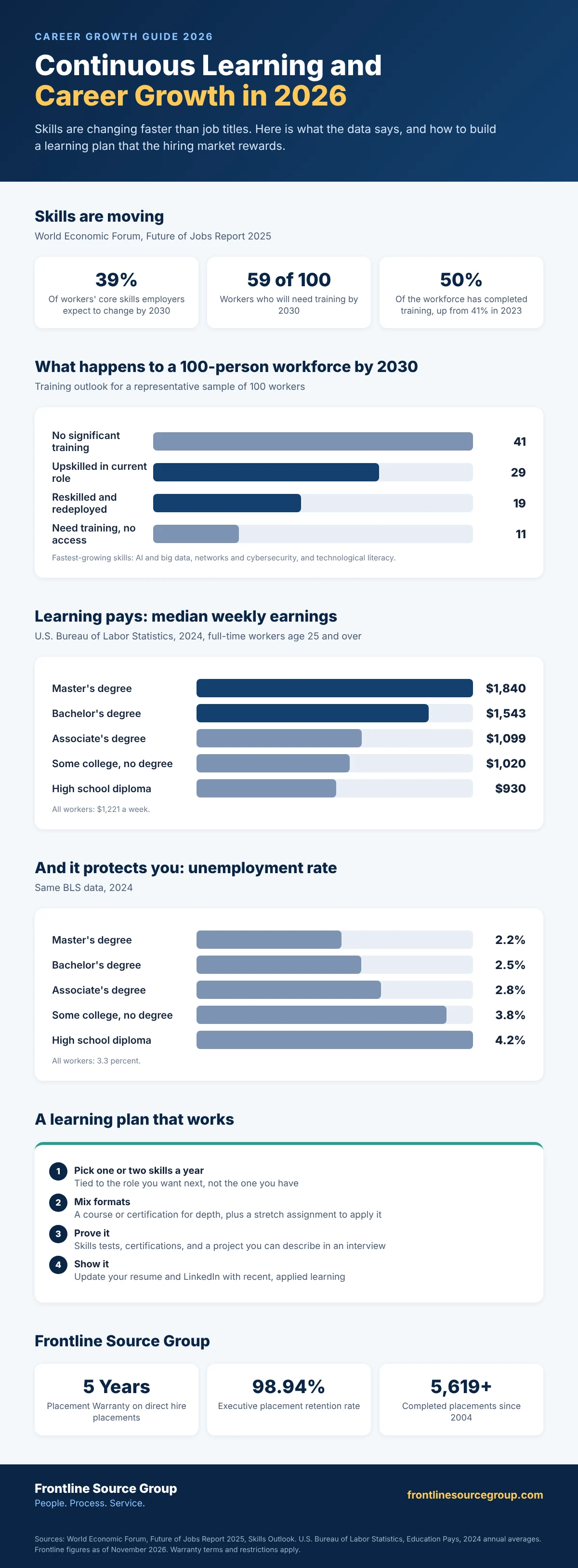
Two sources tell the story well. In the World Economic Forum Future of Jobs Report 2025, employers said they expect 39 percent of workers' core skills to change by 2030, down from 44 percent in the 2023 edition. Out of a representative 100 workers, the report projects that 59 will need training by 2030: 29 upskilled in their current roles, 19 reskilled and moved into new roles within their organization, and 11 who will need training they are unlikely to get. Half the workforce has already completed training through employer programs, up from 41 percent in 2023. The fastest-growing skills are AI and big data, networks and cybersecurity, and technological literacy, with curiosity and lifelong learning also rising in importance.
The U.S. Bureau of Labor Statistics shows what learning is worth in a paycheck. In 2024, full-time workers age 25 and over with a bachelor's degree had median weekly earnings of $1,543, compared with $930 for those with only a high school diploma. Workers with a master's degree earned $1,840 a week. Unemployment followed the same pattern: 2.5 percent for bachelor's degree holders and 4.2 percent for high school graduates, against 3.3 percent for all workers. A degree is only one form of learning, but the gap shows how much the market pays for skills that have been built and proven.
How does continuous learning improve your employability?
Every new, verifiable skill widens the range of roles you can credibly pursue. Recruiters and hiring managers favor candidates who can show recent, applied learning, because it signals adaptability and a shorter ramp-up. Learning also improves day-to-day performance, which builds the track record that earns promotions and strong references. In a competitive market, the candidate who has kept current is usually easier to place and easier to advance than an equally experienced peer who has not.
What do recruiters accept as proof of learning?
Claims are easy to make, so recruiters look for proof. The strongest evidence is a current certification, a new system or tool you used on a real project, and a result you can explain in an interview. Frontline also offers skills testing so candidates can validate proficiency before they are presented to an employer.
"When I review a candidate, recent learning often tells me more than total years of experience. A certification earned last year, a new system learned on the job, a skills test passed this week. Those show me someone who will keep up when the role changes, and that is exactly who hiring managers want."
Lindsey Davidson, CDR, Senior Lead Executive Recruiter, Frontline Source Group. Certified Diversity Recruiter. Read Lindsey's bio.
What are the best ways to keep learning throughout your career?
The most effective approach mixes formats and follows a plan.
Which learning formats work best?
- Structured online courses and certifications build depth in a specific discipline.
- Workshops, seminars, and professional association events expose you to current practice and peers.
- On-the-job stretch assignments turn knowledge into demonstrated capability.
- Reading widely in and around your field keeps you ahead of trends.
How do you build a learning plan?
Pick one or two skills a year that point toward the role you want next, not the one you have. Choose a format that builds depth, then find a way to apply the skill at work so you have a result to talk about. Finally, make the learning visible on your resume and LinkedIn profile. Frontline's LinkedIn job search playbook covers how to present it. The goal is not to collect credentials. It is to keep building skills the market actually rewards.

What are the costs and limits of continuous learning?
Learning is a strong investment, but not every hour or dollar pays off the same way. A balanced view:
- Time and money are real costs. Courses, certifications, and degrees take hours you could spend elsewhere, and some carry a meaningful price tag. Ask whether your employer will pay before you do.
- Credentials alone rarely move a career. A certificate you never apply is hard to defend in an interview. Pair every course with a way to use it.
- Not every trend lasts. Chasing whatever skill is popular this quarter can scatter your effort. Anchor your plan to the role you want.
- Burnout is a risk. Learning on top of a full workload can wear people down. Steady, modest progress beats an intense burst you cannot sustain.
The way through is focus: fewer, better-chosen skills, applied quickly and shown clearly.
How can employers build a culture of continuous learning?
Employers that keep strong talent treat development as a shared investment rather than something employees do on their own time.
What should employers fund and protect?
- Fund relevant training and certifications.
- Protect time for learning instead of squeezing it around an unchanged workload.
- Connect development to clear advancement paths so people see where growth leads.
- Have managers model the behavior and recognize applied learning in reviews.
Why is a learning culture a recruiting advantage?
Candidates weigh growth opportunity alongside pay and flexibility when they choose where to work. A visible learning culture helps you attract people and keep them, and the WEF data shows that employers who invest in upskilling are building the workforce they will need by 2030 instead of trying to hire it from scratch.
How does continuous learning support long-term career growth?
Over a full career, small, consistent gains in skill outperform occasional bursts of effort. Each capability you add lowers the cost of learning the next one, opens adjacent roles, and makes you more resilient when a role, employer, or industry changes. Continuous learning is what lets a professional move from doing the work, to leading it, to shaping strategy, because organizations trust the people who keep growing with broader scope.
What makes Frontline Source Group different for candidates and employers?
Three things set Frontline apart.
How does the 5-Year Placement Warranty work?
The 5-Year Placement Warranty covers direct hire placements for five years, 20x the 90-day industry standard guarantee. If a placement does not work out, Frontline applies a pro-rated credit based on active calendar days of service toward a replacement search. Restrictions apply.
What does the retention record show?
Frontline holds a 98.94% executive placement retention rate across 5,619+ placements since 2004, supported by a candidate network built over 22 years and 32+ offices nationwide.
Why does Frontline publish its pricing?
So hiring leaders can budget before a search starts. Frontline publishes its engagement models on its pricing page, including direct hire fees of 20 to 30 percent of first-year base salary and contract markups of 50 to 85 percent on the hourly rate. Independent proof comes from Forbes recognition for 9 consecutive years and a 5.0-star Trustpilot rating across 683+ verified reviews. People. Process. Service. is the standard behind all of it.
How do you get started with Frontline Source Group?
Employers can submit a hiring need through the employer request form and review engagement details on the pricing page. Professionals ready to put new skills to work can apply through frontlinesourcegroup.com/how-to-apply.html and validate their skills with Frontline skills testing. Frontline never charges candidates a fee, and every direct hire is backed by the 5-Year Placement Warranty.
Frequently Asked Questions: Continuous Learning and Career Growth
What is continuous learning?
Continuous learning is the ongoing, self-directed pursuit of new knowledge and skills across an entire career rather than only during formal education. It treats development as a habit tied to where the market and your career are going, not a one-time event.
Why is continuous learning important for career growth?
Skills now change faster than job titles. In the World Economic Forum Future of Jobs Report 2025, employers expected 39 percent of workers' core skills to change by 2030. Continuous learning keeps your skills relevant, widens the roles you can pursue, and makes you more promotable.
How does continuous learning improve employability?
Every new, verifiable skill widens the range of roles you can pursue and signals adaptability and a shorter ramp-up to hiring managers. It also improves day-to-day performance, which builds the track record that earns promotions and stronger references.
Does more education lead to higher pay?
On average, yes. U.S. Bureau of Labor Statistics data for 2024 shows median weekly earnings of $1,543 for full-time workers with a bachelor's degree and $930 for those with only a high school diploma, with unemployment rates of 2.5 percent and 4.2 percent.
Which skills are growing fastest?
According to the World Economic Forum Future of Jobs Report 2025, AI and big data are the fastest-growing skills, followed by networks and cybersecurity and technological literacy. Creative thinking, resilience, flexibility, curiosity, and lifelong learning are also rising in importance.
What are the best ways to keep learning throughout a career?
Mix formats: online courses and certifications for depth, workshops and seminars for current practice, and on-the-job stretch assignments to turn knowledge into results. Pick one or two target skills a year tied to the role you want next, and make the learning visible on your resume.
What are the downsides of continuous learning?
Learning costs time and sometimes money, a credential you never apply is hard to defend in an interview, and chasing every trend scatters your effort. Learning on top of a full workload can also lead to burnout, so steady, focused progress works better than intense bursts.
How can employers build a culture of continuous learning?
Fund relevant training and certifications, protect time for learning rather than squeezing it around an unchanged workload, connect development to clear advancement paths, and have managers model and recognize applied learning. A visible learning culture is also a recruiting advantage.
Does continuous learning help with promotions?
Yes. Applied learning improves performance and broadens capability, which is what organizations look for when they trust someone with greater scope. Consistent skill gains over time are one of the highest-return investments a professional can make in their own advancement.
What is the Frontline 5-Year Placement Warranty?
It is Frontline's coverage on direct hire placements, 20x the 90-day industry standard guarantee. If a placement does not work out, the client receives a pro-rated credit based on active calendar days of service toward a replacement search. Restrictions apply, and full terms are at frontlinesourcegroup.com/5year-placement-guarantee.html.
How does Frontline Source Group's pricing work?
Frontline publishes its engagement models. Direct hire placement is a contingent fee of 20 to 30 percent of first-year base salary, contract staffing uses an hourly bill rate with a 50 to 85 percent markup, and Engaged Search starts with an initial fee of $2,500. Candidates never pay a fee. Details are at frontlinesourcegroup.com/pricing.html.
How do I start working with Frontline Source Group?
Employers start at frontlinesourcegroup.com/employer-request-form.html and can review engagement details at frontlinesourcegroup.com/pricing.html. Professionals can apply at frontlinesourcegroup.com/how-to-apply.html and validate their skills through Frontline skills testing. Every direct hire is backed by the 5-Year Placement Warranty.


