Why Is Adaptability So Important in Today's Workforce?

Published on: Aug 26, 2024
Updated on: October 6, 2026
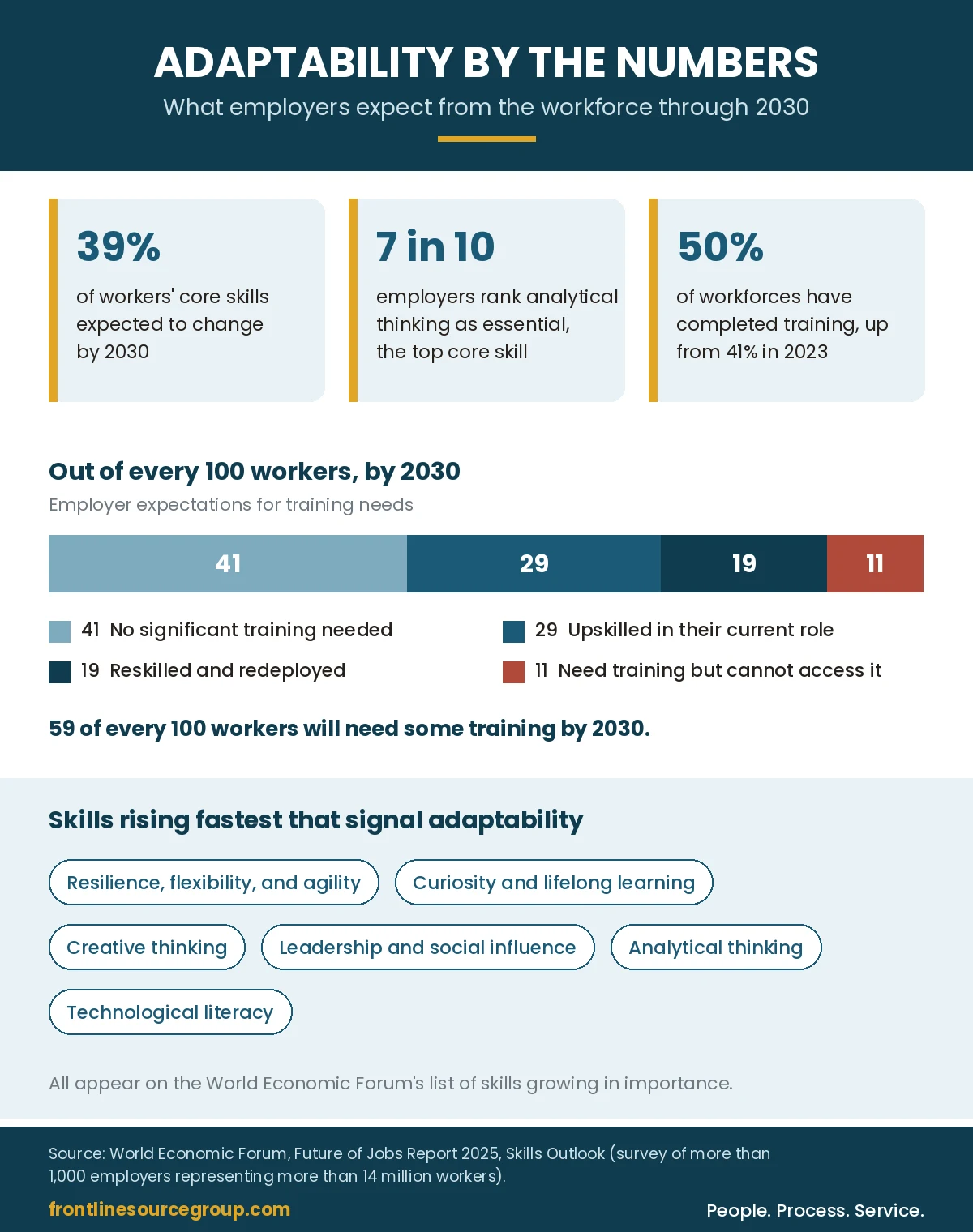
Adaptability matters because the skills jobs require keep changing. Employers in the World Economic Forum's Future of Jobs Report 2025 expect 39 percent of workers' core skills to change by 2030, and 59 of every 100 workers to need training. People and companies that learn and adjust keep their value; the rest lose ground.
I have watched this play out across more than two decades of placing people. The candidates who keep landing well are rarely the ones with the most polished resumes. They are the ones who can tell you, specifically, how they learned something new when the job changed underneath them. This post covers what adaptability really means, what the latest data says about it, and how to hire and build for it.
Frontline Source Group has completed 5,619 plus placements since 2004 with a 98.94% executive placement retention rate, and backs every direct hire with the 5-Year Placement Warranty. The firm is a Forbes Best Professional Recruiting Firm for 9 consecutive years (2018 to 2026), number 148 on the Forbes Best Executive Recruiting Firms list for 2026, a 9-time ClearlyRated Best of Staffing winner for both Client and Talent satisfaction, a ClearlyRated Diamond Award recipient, an Inc. 5000 honoree, an Expertise.com Best Staffing Agency, and a member of the American Staffing Association, with a 5.0-star Trustpilot rating across 683 plus verified reviews.
What does adaptability actually mean in the workplace?
Adaptability is the ability to learn from experience and apply that learning to perform well under new or unfamiliar conditions. In practice it means being open to new ideas, information, and tools, and being willing to change course when the situation calls for it. It is not the same as tolerating change. Plenty of people put up with a new system while quietly working around it. Adaptable people learn the new system and then find a better way to use it. That difference is what separates professionals who keep growing from those who stall.
Why has adaptability become essential rather than optional?
Because the ground under most jobs is moving, and the data shows it.
Skills are changing on a short clock
The World Economic Forum's Future of Jobs Report 2025 surveyed more than 1,000 large employers representing more than 14 million workers. Those employers expect 39 percent of workers' core skills to change by 2030. That is slightly lower than the 44 percent they expected in 2023, and the report credits part of the improvement to more companies investing in training.
Most workers will need some training
For every 100 workers, employers expect 29 to be upskilled in their current roles, 19 to be reskilled and moved into new roles, and 11 to need training they will not be able to access. Only 41 are expected to need no significant training by 2030. Put another way, 59 out of 100 people will have to learn something meaningfully new to keep doing their work well.
Which skills show that someone is adaptable?
Adaptability is not one skill. It shows up in a cluster of them. In the same WEF report, analytical thinking is the top core skill employers look for today, with seven out of 10 companies considering it essential. Right behind it come resilience, flexibility, and agility, along with leadership and social influence. Among the skills employers expect to grow fastest in importance are curiosity and lifelong learning, creative thinking, and technological literacy. Every one of those is a way of describing someone who can handle a job that looks different next year than it does today.
How does adaptability affect an individual's career?
For employees, adaptability shows up as a habit of continually learning and building skills before the job demands them. Professionals who treat change as a prompt to grow tend to move into the roles that change creates. Those who anchor to a fixed way of working find their value eroding as the work moves around them. As we covered in our post on how automation is changing the job market, the routine parts of many jobs are being absorbed by software. The people who come out ahead are the ones who move toward the judgment, problem-solving, and relationship work that remains. If you are working on your next move, our candidates hub has resources for your search.
How can employers build an adaptable workforce?
Adaptability is not only an individual trait. Employers either cultivate it or suppress it.
Make learning part of the job
Make learning resources easy to find and protect time for development instead of treating it as overhead. Employers are already moving this way: in the WEF survey, the share of workforces that completed training as part of learning and development efforts rose from 41 percent in 2023 to 50 percent.
Reward adjustment, not just plan adherence
If people are only recognized for executing the original plan, they learn to defend it even when it stops working. Recognize the people who spot a better approach and change course, and make sure leadership models that behavior from the top. A culture that punishes the friction of change teaches people to resist it.

How do you hire for adaptability?
Adaptability predicts how someone will perform under conditions that have not happened yet, which makes it one of the most valuable things to screen for and one of the hardest to read from a resume. The strongest signals are evidence of learning under pressure, successful moves across roles or industries, and a record of adopting new tools or methods early instead of waiting them out.
In interviews, I like a simple question: "Tell me about a time the tool or process you relied on changed. What did you do in the first month?" Vague answers about loving to learn do not tell you much. Specific answers about what they learned, who they asked, and what they changed tell you almost everything.
How does Frontline Source Group help employers and job seekers adapt?
For employers, Frontline runs executive searches and direct hire placements that look for learning agility and resilience alongside credentials, because those are the traits that keep a hire valuable after the role changes. Every direct hire is backed by the 5-Year Placement Warranty, 20 times longer than the 90-day guarantee common in the industry, and our engagement model is published on the pricing page. For candidates, we look for roles where your ability to learn is an asset, not just your current job title.
How do you get started with Frontline Source Group?
Employers can submit a search through the employer request form and review engagement details on the pricing page. Professionals exploring their next role can apply online at no cost.
Frequently Asked Questions: Adaptability in the Modern Workforce
What is adaptability in the workplace?
Adaptability is the ability to learn from experience and apply that learning to perform well under new or unfamiliar conditions. It means being open to new ideas, information, and tools, and willing to change how you work when the work itself changes, rather than simply putting up with change.
Why is adaptability so important in today's workforce?
Because the skills jobs require are moving. Employers surveyed for the World Economic Forum's Future of Jobs Report 2025 expect 39 percent of workers' core skills to change by 2030, and they expect 59 of every 100 workers to need some training by then. People and companies that adapt keep pace with that change; those that do not fall behind it.
Is adaptability the same as just accepting change?
No. Tolerating change passively is not adaptability. Adaptability is the active work of adjusting how you operate as conditions shift: learning the new tool, rethinking the process, and changing course when the original plan stops working.
Which skills show adaptability?
The World Economic Forum lists resilience, flexibility, and agility, curiosity and lifelong learning, creative thinking, leadership and social influence, analytical thinking, and technological literacy among the skills growing fastest in importance. Analytical thinking is the top core skill today, with seven out of 10 employers considering it essential.
How many workers will need retraining by 2030?
In the World Economic Forum's Future of Jobs Report 2025, employers expect that out of every 100 workers, 29 will be upskilled in their current roles, 19 will be reskilled and redeployed, 11 will need training they cannot access, and 41 will not need significant training by 2030.
How does adaptability affect a career?
Professionals who treat change as a prompt to learn tend to move into the roles that change creates, while those anchored to one way of working see their value erode. Adaptability works like career insurance: it keeps you relevant when your tasks, tools, or even your industry shift.
How can employers build an adaptable workforce?
Make learning resources easy to reach, protect time for development instead of treating it as overhead, reward people for adjusting well rather than only for following the original plan, and model the behavior from leadership down. Employers are moving this way: the share of workforces that completed training rose from 41 percent in 2023 to 50 percent in the latest WEF survey.
How do you hire for adaptability?
Look for evidence of learning under pressure, successful moves across roles or industries, and a record of adopting new tools or methods early. In interviews, ask candidates to describe a time a process or tool they relied on changed and exactly what they did about it.
How do AI and remote work increase the need for adaptability?
AI tools, hybrid work, and new software change the structure and content of roles more often than before. The shorter the useful life of any single skill set, the more a person's or company's success depends on the capacity to learn and adjust continuously.
What is the 5-Year Placement Warranty?
The 5-Year Placement Warranty is Frontline Source Group's replacement coverage on every direct hire placement, 20 times longer than the 90-day guarantee common across the staffing industry. Restrictions apply, and full terms are at frontlinesourcegroup.com/5year-placement-guarantee.html.
How does Frontline Source Group's pricing work?
Direct hire placement is a contingent fee of 20 to 30 percent of the placed candidate's first-year base salary, depending on seniority and search complexity, and contract staffing is billed at an hourly rate. All major credit cards are accepted at no additional charge, and the full model is published at frontlinesourcegroup.com/pricing.html.
How do I get started with Frontline Source Group?
Employers can submit a hiring request at frontlinesourcegroup.com/employer-request-form.html. Professionals looking for their next role can apply at frontlinesourcegroup.com/how-to-apply.html.


